

That beautiful, rolling hill on your Cumming, GA property is one of the things that makes North Georgia so special. But when it's time to mow, that picturesque slope can quickly become your most dreaded—and dangerous—chore. It's a classic Forsyth County dilemma: what looks great from the porch is a whole other beast up close, a challenge many homeowners from Alpharetta to Dawsonville face.
At Barefoot Organics, we've seen it countless times in Cumming neighborhoods. A homeowner underestimates the incline, and what should be a routine lawn task turns into a serious safety risk. This isn't just about getting an even cut; it's about preventing a life-altering accident. That’s why our local experts are here to help.
Struggling with a dangerous slope? Don't risk it. Call Barefoot Organics at (678) 421-4818 for a free lawn evaluation and professional, safe mowing services.
The Unspoken Risks of Mowing Hills in Cumming

From the new builds in Cumming to the established neighborhoods of Alpharetta and Milton, a sloped yard is simply part of the local landscape. As lawn care experts who work on these challenging properties every single day, we can tell you honestly: these hills demand respect. This isn't about scaring you; it's about making sure you're fully aware of the real dangers before you turn the key, especially with our tough Georgia clay soil.
Why This Matters in Cumming: Beyond the Obvious Dangers
The risk everyone knows about is a mower rollover. It’s a very real threat, especially with zero-turn and riding tractors. Their high center of gravity makes them notoriously unstable on inclines, and a split-second loss of traction is all it takes. The Consumer Product Safety Commission sees thousands of mower-related ER visits annually, with a large number involving slopes.
But the dangers don't stop there. Here are the other hazards we see constantly on local lawns:
- Slips and Falls: That heavy morning dew or a quick afternoon shower makes our local Bermuda and fescue grass incredibly slick. All it takes is one slip while wrangling a heavy push mower to end up with a severe sprain, a broken bone, or worse. You lose your footing, the mower keeps going.
- Loss of Control: Ever tried to turn a mower at the bottom of a steep grade? It's a struggle. If that machine gets away from you, it can barrel down into the street, a neighbor's yard, or a sensitive creek bed before you can stop it. This is a common concern in subdivisions with strict HOA rules.
- Uneven Ground: Hillsides across our service area, from Johns Creek to Suwanee, are rarely perfect. They hide unexpected dips, exposed tree roots, and loose rocks. Hitting one of those can jolt the mower, tip the machine, or cause you to lose your balance in an instant.
The truth is, a slope that looks manageable from your back deck feels completely different when you're wrestling a 500-pound machine on it. We’ve learned how to spot the exact point where a hill goes from being a weekend chore to a genuine hazard.
We want you to have the facts so you can make a smart, safe decision for your property and your family. Let our experienced team handle the most dangerous job in your landscape so you don't have to. Request your free lawn evaluation today.
Sizing Up Your Slope in Forsyth County
Before you even think about pulling the start cord on your mower, the single most important job is to get a true sense of the hill you're about to tackle. Here in Cumming, I've seen countless homeowners underestimate the steepness of their own yards. A hill often "looks fine" from the deck, but it's a completely different story once your mower is on it. This isn't a time for guesswork; it's about making a smart, safe call.
Knowing your lawn's grade is simply not optional. The beautiful rolling terrain that gives Forsyth County its charm is also what makes mowing so tricky. A gentle-looking incline can turn dangerous in a hurry, especially when you factor in our slick Georgia red clay or the morning dew that settles on fescue lawns.
How to Get a Real Number on Your Slope
You don't need any high-tech gear to figure out how steep your hill is. There's a tried-and-true method we call "rise over run" that will give you a reliable number.
It’s surprisingly simple. All you need are two stakes, a 10-foot string, and a small string level you can get at any hardware store.
- First, pound one stake in at the very top of the hill.
- Next, walk 10 feet straight down the slope and hammer in the second stake.
- Tie your string to the base of the top stake and run it over to the second one. Pull it taut and use your string level to make sure it's perfectly horizontal.
- Finally, measure the distance from the level string straight down to the ground at the second stake. That vertical drop is your "rise."
Let's say that distance is 2 feet. That means for every 10 feet of horizontal distance, your slope drops 2 feet. You have a 20% grade. If the drop is 3.5 feet, you're looking at a serious 35% slope. This simple test gives you the hard data you need to proceed safely.
Knowing the Danger Zone
Once you have that number, you can see where you stand against established safety limits. These aren't just arbitrary figures; they're based on the physics of mower stability. The UGA Extension—an invaluable resource for us here in Forsyth County—is very clear about the risks.
For a standard riding mower, any hill over 15 degrees (that's a 27% grade) is a definite no-go zone. For a walk-behind, pushing becomes incredibly difficult and unsafe on anything steeper than 20 degrees (a 36% grade). These are the thresholds where rollovers and life-altering falls become a real possibility.
The statistics are sobering. In a single year, lawn mower accidents sent over 91,800 Americans to the emergency room. Lacerations accounted for 46.7% of those injuries, and tragically, 21.5% involved amputations. On the rolling hills around North Atlanta, those numbers are a powerful reminder of what's truly at stake.
For larger, more complex properties in areas like Milton or Johns Creek, sometimes a more detailed assessment is wise. Advanced methods like surveying with drones can map out tricky topography with incredible accuracy. A detailed survey can also pinpoint potential drainage problems, which often go hand-in-hand with steep slopes. If you’re worried about water runoff, our guide on how to improve drainage in your yard is a great place to start.
Mower Type vs Maximum Safe Slope for Cumming Lawns
When it comes to hillsides here in Cumming, not all mowers are built the same. Understanding your machine's limitations is absolutely essential for staying safe. We put together this quick-reference table to help local homeowners see how their equipment stacks up against our terrain.
| Mower Type | Maximum Slope (Degrees) | Maximum Slope (Percentage) | Best Mowing Pattern |
|---|---|---|---|
| Walk-Behind/Push Mower | ~20° | ~36% | Across the slope (horizontally) |
| Standard Riding Mower | ~15° | ~27% | Up and down the slope (vertically) |
| Zero-Turn Mower (Lap Bar) | ~10° | ~18% | Up and down (avoid steep slopes) |
| Steep-Incline Mower | 20°+ | 36%+ | Varies by model (Professional use) |
Keep in mind, these are just general guidelines. Wet grass after a Suwanee thunderstorm, hidden ruts, or other obstacles can instantly make a "safe" slope hazardous. Always, always err on the side of caution. If your property in Dawsonville or Canton is pushing these limits, it’s a clear sign that it's time to call in professionals who have the specialized equipment and training to do the job right.
Application Process: The Right Mowing Technique for North Georgia Hills
You've sized up your slope. Now comes the critical part: how you actually mow it. Taming a hilly lawn in Forsyth County is more than just a chore; it's a specific skill that accounts for the physics of your mower and the sometimes unforgiving nature of our local terrain. The advice we're sharing here isn't from a manual—it comes straight from our team's daily work on some of the most challenging lawns from Cumming to Alpharetta.
There are two fundamental rules for mowing a hill, and they are polar opposites. Getting them mixed up is one of the most common—and dangerous—mistakes a homeowner can make. The right approach depends entirely on your mower.
Push Mower Strategy: Go Across the Slope
If you're using a walk-behind or a push mower, the rule is non-negotiable: always mow across the hill, horizontally. You should never, ever push the mower straight up or pull it straight down.
Mowing sideways keeps your body parallel to the incline, giving you a wider, more stable stance. This lowers your center of gravity and helps you keep your footing, especially if the grass is a little damp or the soil is loose. If you tried to mow vertically, pushing up the hill would exhaust you and risk a fall backwards, while pulling it down could let the mower get away from you in a heartbeat.
Pro Tip: Always keep the uphill side of your body away from the mower deck. If you slip, this simple habit ensures you fall away from the machine, not into its path.
Riding Mower Strategy: Straight Up and Down
For any kind of riding mower—lawn tractors and zero-turns included—the rule is the exact opposite: always mow straight up and down the slope, vertically. Never drive a riding mower sideways across an incline.
Riding mowers have a high center of gravity. When you traverse a hill, all the weight shifts to the downhill wheels. This makes the machine incredibly top-heavy and dramatically increases the risk of a rollover accident. Driving straight up and down keeps the mower's weight balanced over the rear tires, which is where you get your traction and stability.
This simple decision tree is the best way to visualize this critical safety rule.
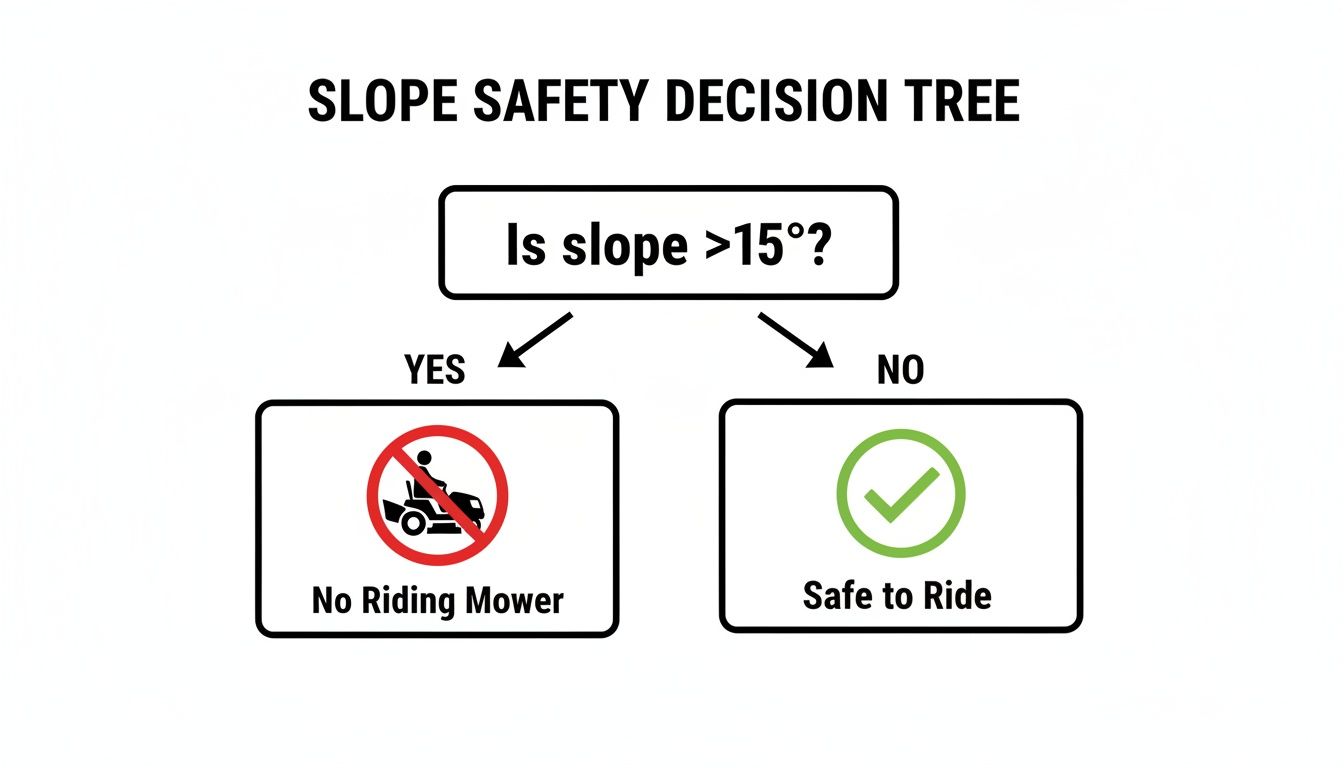
This image isn't just a suggestion; it reinforces the absolute limit for riding mowers, a piece of knowledge every homeowner in our hilly North Georgia communities needs to take seriously.
Pro-Level Tips for Tricky Inclines
Beyond those two main rules, here are a few other practical techniques our crew has picked up over the years mowing some of the toughest lawns in Cumming, Milton, and Johns Creek.
- Turn on Flat Ground Only: Never try to turn a riding mower while you're on the slope. Finish your pass going up or down the hill, and only make your turn once you’re back on level ground. Make it a wide, slow turn before starting your next pass.
- Raise Your Mower Deck: Hills put uneven pressure on the mower deck. Set your cutting height a notch or two higher than you do for the flat parts of your yard. This prevents "scalping," where the blade on the high side digs in and tears up your turf, exposing that red Georgia clay.
- Never Mow Wet Grass: This is a golden rule everywhere, but it’s twice as important on a hill. A recent rainstorm, so common in Suwanee and Buford, leaves grass slick and reduces your traction to almost nothing. It’s a perfect recipe for a slip-and-fall or a mower rollover.
- Manage Your Clippings: When you mow across a slope with a push mower, clippings naturally pile up on the downhill side and can smother the grass. You'll want a plan for them. You can learn more about your options by checking out our guide on side-discharge vs. mulching to see what’s best for your lawn's health.
Knowing the limits is key. Steep slopes turn simple yard work into a high-stakes activity, but data from global leaders like STIHL shows clear boundaries. While a ride-on mower can handle gentle slopes up to 10 degrees when going up and down, they recommend a maximum of 25 degrees for traversing a slope. For anything steeper, a professional-grade brushcutter or a specialized slope mower is the only safe tool for the job. You can discover more insights about slope-mowing safety from STIHL's experts to better understand these global standards.
Treatment Breakdown: Choosing and Maintaining Equipment for Hilly Terrain
When you're staring down a steep hill in Cumming, the mower you use matters. A lot. But even the most advanced machine is a liability if it’s not cared for properly. For the kinds of slopes we see all over Forsyth County, picking the right gear and keeping it in top shape isn't just a suggestion—it’s how you stay safe.
Let's start with the mower itself. If you're using a walk-behind, you'll want to look for a model with high rear wheels. Those larger back wheels give you much better stability and control on uneven ground. It's all about leverage. They help you push and pivot across an incline without feeling like the mower is about to get away from you—a common problem with standard mowers where all four wheels are the same small size.
Mower Maintenance for Maximum Slope Safety
A top-of-the-line mower for hilly terrain can still be incredibly dangerous if it’s not maintained. On a slope, a small mechanical hiccup can turn into a serious accident in a split second. Here’s what I tell everyone to check before they even think about tackling a hill.
Sharpen Your Mower Blades: This isn't just about lawn health. Dull blades tear grass instead of cutting it, leaving your lawn looking ragged and vulnerable to diseases like brown patch fungus. From a safety standpoint, a mower with dull blades has to work much harder. This puts a huge strain on the engine and makes it less responsive when you need precise control.
Check Your Tire Pressure: Proper tire pressure is your best friend when it comes to grip. If your tires are underinflated, the mower can slip. If they’re overinflated, you lose a surprising amount of contact with the ground. Always check the manufacturer’s recommended PSI and make sure every tire is where it needs to be before you start.
Test All Safety Features: Don't just assume they work. Your mower’s safety features, like the blade-brake clutch (which stops the blade without killing the engine) or the "dead man's switch," are critical. Test them on a flat, clear patch of lawn before you get anywhere near an incline.
Think of your mower like a car you’re about to drive down a steep mountain road—you wouldn’t do it with bad brakes or bald tires. The same logic applies to mowing a hill in Suwanee or Buford. Routine maintenance is your most important safety check.
Your Most Important Gear: Sturdy Footwear
The mower isn’t the only piece of gear that matters. Honestly, the most crucial safety tool is probably what you have on your feet. Never, ever attempt to mow a slope in sneakers, sandals, or any kind of open-toed shoe.
The ground on a hillside, especially over our Georgia clay, can be slick and unpredictable. Sturdy, over-the-ankle boots with deep treads are essential. They give you the ankle support needed to prevent a roll and the grip to keep your footing, especially if the ground is damp or loose. A slip-and-fall while wrestling with a walk-behind mower is one of the most common ways people get seriously hurt. The right footwear is your first and best line of defense.
For those managing larger properties or commercial operations in North Atlanta, a big investment in specialized hillside equipment might be on the table. When you’re looking at that level of machinery, researching the best equipment financing companies can help make the investment more manageable for your North Georgia business. For most homeowners here in Cumming, though, you don't need professional-grade tools—just well-maintained ones.
Alternatives to Mowing for Cumming's Steepest Slopes
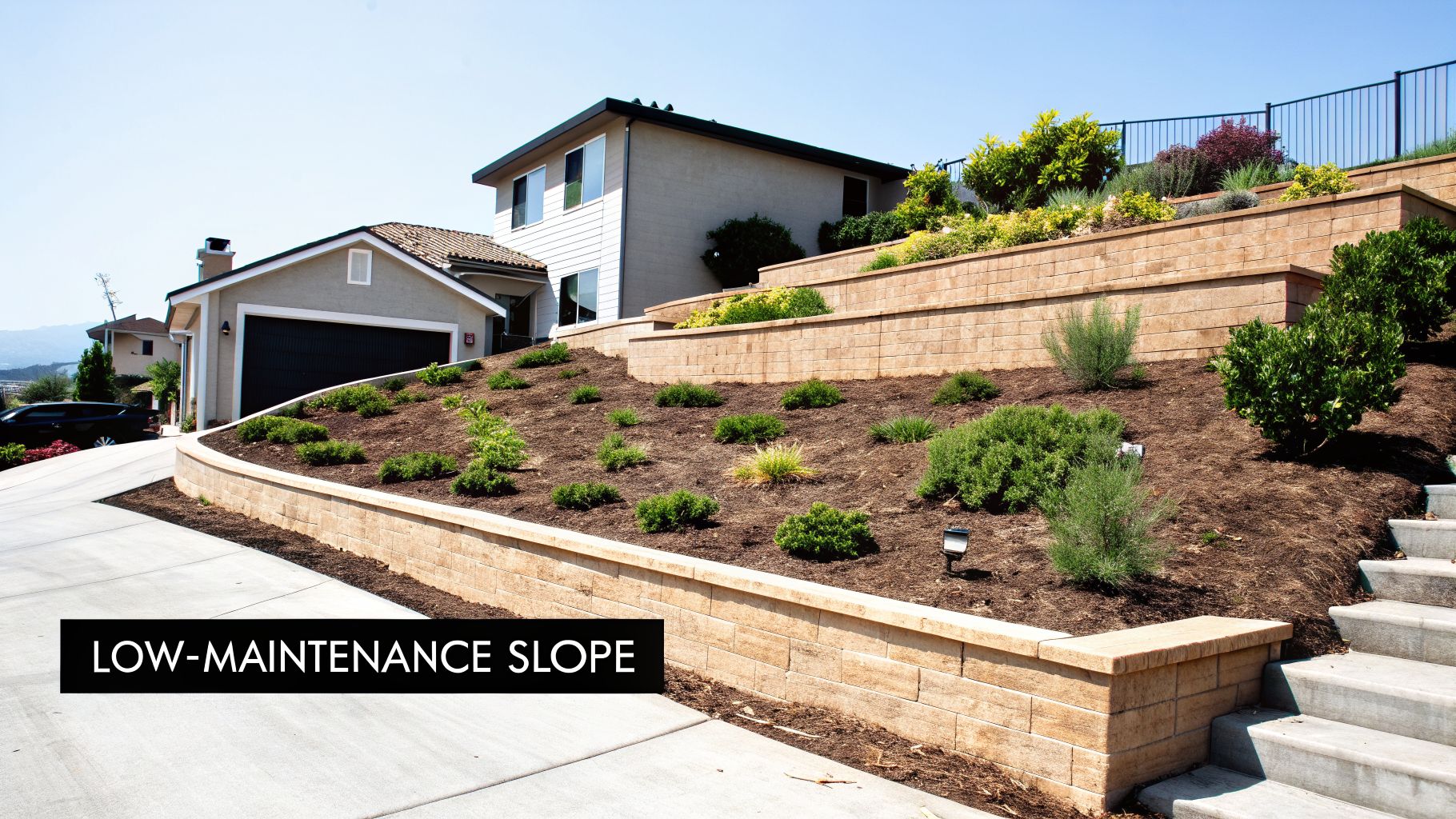
Let's be honest—sometimes the best way to deal with a steep hill is to stop fighting it. For some of the trickiest slopes we see across Forsyth County, wrestling with a mower every week isn't just dangerous; it's often a losing battle for the health of your lawn.
Instead of waging war on a hazardous incline, you can transform it into a beautiful, functional feature that actually enhances your property. This is all about working with the natural topography of your land, a common challenge in neighborhoods from Dawsonville to Canton.
Replace High-Maintenance Grass with Hardy Ground Covers
One of the most effective solutions we recommend is replacing that tricky turfgrass with a robust ground cover. These plants are practically made for our North Georgia climate, and once they're established, they need far less upkeep than a traditional lawn.
Even better, their deep, tangled root systems are champions at preventing soil erosion. This is a huge deal on hillsides, especially with our heavy rains and infamous Georgia red clay.
Here are a few ground covers that we've seen do exceptionally well in the Cumming area:
- Creeping Juniper: This is a sun-loving, evergreen workhorse. It's incredibly drought-tolerant once it gets going and forms a thick, weed-choking mat that you’ll never have to mow.
- Vinca Minor (Periwinkle): Got a shadier slope? Vinca Minor is your answer. It spreads to create a lush carpet of glossy leaves, dotted with lovely blue-purple flowers in the spring. It’s a classic you’ll spot in many established Milton landscapes for good reason.
- Liriope (Monkey Grass): Often used for borders, Liriope is also a fantastic erosion-fighter on slopes. It’s tough as nails and doesn’t mind sun or shade, making it one of the most versatile options out there.
For many homeowners, the right tool isn't a new mower; it's a completely different planting strategy. Trading a dangerous slope for a self-sufficient ground cover saves you time, eliminates the risk, and looks great all year.
Create Stunning Terraced Landscape Beds
If you have a truly dramatic slope or just want to reclaim more usable space, building terraced retaining walls is a game-changing investment. This method breaks up one massive, unusable hill into a series of smaller, level garden beds. It turns a problem area into the star of your landscape.
We see this approach work wonders for new construction homes in places like Johns Creek and Alpharetta, where the grading can leave behind some pretty challenging terrain.
With terracing, you can:
- Completely eliminate mowing on that part of your property for good.
- Design dedicated planting zones for beautiful shrubs, flowers, and even small ornamental trees.
- Massively improve drainage and stop valuable topsoil from washing away in a downpour.
While building retaining walls is a major project, the outcome is a permanent, gorgeous solution that makes your yard safer and more enjoyable. For some great ideas on what to plant in your new beds, check out our guide to low-maintenance landscaping.
If you’re ready to end the weekly battle with your hilly lawn, let's talk about a better way. Call Barefoot Organics today for a free lawn evaluation, and we can walk your property, assess your slope, and explore some safe, beautiful alternatives together.
Why Choose Barefoot Organics in Cumming?
Let's be honest. Some of the rolling hills we see every day here in Forsyth County are just plain dangerous to mow on your own. When you're staring down a steep, slick slope, the risk simply isn't worth it. That's when calling a local professional becomes the smartest—and safest—choice for your property and your peace of mind.
At Barefoot Organics, we're not just another lawn treatment company. We're your neighbors, living and working right here, and we're fully equipped to handle the unique challenges of our North Georgia landscape. Our crews are trained and insured specifically to manage the very slopes that pose a real danger to homeowners using standard equipment. We bring commercial-grade mowers designed for stability and safety where a residential mower would quickly fail.
More Than Just Mowing for Cumming Hillsides
But for us, tackling a hillside is about so much more than just the cut. We view your lawn as a complete ecosystem, and a sloped yard has its own set of rules. Anyone with a property in Cumming, Alpharetta, or Johns Creek knows that a steep grade invites a whole host of problems—problems we've become experts at solving.
- Preventing Nutrient Runoff: Think about it: during a heavy Georgia downpour, fertilizers and soil amendments can easily wash right down a slope. We use specific application methods and products designed to stick, ensuring our treatments feed your turf, not the storm drain.
- Fighting Soil Erosion: That infamous red Georgia clay is especially prone to eroding on an incline, and a thin, patchy lawn only makes the problem worse. Our programs are built around developing thick, healthy turf with deep roots that act like a net, holding your precious topsoil firmly in place.
- Promoting Healthy Growth: Grass on a hillside is constantly stressed. We apply targeted, organic-based treatments to build its resilience, helping it power through the intense summer heat and fend off common issues like brown patch fungus.
Safety and Expertise You Can Count On
Understanding the limits of your equipment is everything. The University of Georgia’s Forsyth County Extension office provides clear data on mower safety, and we follow it to the letter. For example, they warn that riding mowers become dangerously unstable on slopes steeper than 27%. This is a hard and fast rule for safety. Global equipment guides echo this, stressing that mowing across a slope should only be done in dry conditions to prevent a catastrophic slip. You can learn more about these critical safety guidelines from the experts at Einhell to see how seriously professionals take these risks.
We take the guesswork and the danger completely out of the equation. Our team knows these limits because we work with them every single day on properties from Suwanee to Milton.
Choosing Barefoot Organics means putting your trust in a local company that gets it. We understand the specific demands of a Cumming lawn because we care for them every day. Let our professional, insured team handle the most hazardous job in your landscape so you and your family can simply enjoy a beautiful, healthy yard without a moment's worry.
FAQ: Mowing Steep Hills in Cumming, GA
It's smart to ask questions when it comes to mowing steep slopes. We hear a lot of the same concerns from homeowners in Cumming and across North Georgia, so we've gathered the most common ones right here to give you some straightforward answers based on our local experience.
Q: How do I know if my hill in Cumming is too steep to mow?
A: The best way to know for sure is to measure it. As a general rule, a riding mower is unsafe on any slope over 15 degrees, which is a drop of about 2.5 feet over a 10-foot distance. For a push mower, the limit is closer to 20 degrees. If you’re standing at the bottom of the hill and feeling unsure, that’s your best signal to call a professional lawn service near me.
Q: What’s the best time of day to mow a steep hill in Georgia?
A: Always mow when the grass is completely dry. In our Forsyth County climate, that usually means waiting until late morning or afternoon after the sun has burned off all the morning dew. Our local Bermuda and Fescue lawns get extremely slick when wet, making a slip or a mower rollover much more likely, especially after a recent rain.
Q: Can I use a zero-turn mower on a hill?
A: It's generally not recommended. Standard lap-bar zero-turn mowers are very unstable on slopes over 10 degrees because their steering mechanism can cause a loss of control. While some newer models with steering wheels offer better stability, a traditional lawn tractor is almost always a safer choice for the rolling hills we have in Cumming and North Atlanta.
Q: What should I do if my mower starts to slip on a hill?
A: The first step is to stay calm. If you're on a riding mower, immediately and carefully back straight down the slope; do not turn sideways, as this can cause a rollover. If you are using a push mower and you slip, let go of the machine and move away from its path. Your personal safety is far more important than the equipment.
Q: How do you handle weeds on a steep slope in Forsyth County?
A: Weeds on a hill are a specific challenge because liquid treatments can easily run off before they work, especially on our Georgia clay soil. At Barefoot Organics, we use professional-grade weed control products formulated to adhere to the plant and soil. This targeted approach prevents runoff, protects the surrounding environment, and ensures the weeds are eliminated effectively.
Q: What’s the safest way to mow a hill with a riding mower?
A: The number one rule for a riding mower is to always mow straight up and down the slope, never across it. Driving sideways makes the mower top-heavy and dramatically increases the risk of a rollover accident. Finish each pass, turn on level ground, and then begin your next pass up or down the hill.
Don't gamble with your safety on a difficult slope. If you're looking at your lawn in Cumming or the surrounding areas and feel even a little unsure, the smartest move is to call in the experts. Let Barefoot Organics provide a free, no-obligation evaluation to keep your lawn looking great and, most importantly, keep your family safe.