

When it comes to yard drainage, the goal is pretty straightforward: guide water away from your foundation and get back to having a healthy, usable lawn. The best approach usually isn't one single fix but a smart combination of improving how your soil absorbs water, redirecting the water that runs across the surface, and making sure your gutters are actually doing their job. For many of us here in North Georgia, just starting with the basics like aeration and downspout extensions can make a world of difference.
Your Guide to a Drier North Georgia Yard
If you live anywhere from Cumming to Alpharetta, Milton, or Johns Creek, you know the struggle with standing water is real. Our infamous red clay soil, combined with the rolling hills of the region, creates a perfect storm for drainage headaches. One heavy downpour can turn a beautiful backyard into a soupy mess, making it useless and even threatening your home’s foundation.
This guide is designed to cut through the noise and give you practical, no-nonsense solutions that actually work in our local conditions. Taming the water on your property isn't just about getting rid of puddles; it's about protecting your biggest investment and creating an outdoor space you can truly enjoy.

Why Drainage Is a Unique Challenge in Our Area
The number one culprit behind most drainage problems from Cumming to Milton is our soil. Georgia red clay is incredibly dense. It's made of tiny particles that pack together tightly, leaving almost no space for water to soak in. So, when a big storm hits, that rainwater has nowhere to go but sideways, sheeting across your lawn and pooling in the first low spot it finds.
This runoff issue gets magnified by the very landscape we love—the rolling hills and slopes across Forsyth County and surrounding areas. A gentle slope can be your best friend for drainage, but if your property is graded incorrectly, it can funnel every drop of rain straight toward your house.
A poorly drained yard isn't just an inconvenience—it's a liability. Persistent moisture against your foundation can lead to cracks, leaks, and costly structural damage over time. It also creates a perfect breeding ground for mosquitoes and lawn diseases.
Learning how to improve drainage in your yard means you have to work with our local conditions, not fight them. It really boils down to a few key strategies:
- Improving Soil Structure: The first step is to make that dense clay more porous so it can actually absorb more water on its own.
- Managing Surface Runoff: You need to give excess water a clear, safe path to follow away from your house and off your property.
- Capturing and Releasing Water: Sometimes, the best solution is a system that collects runoff and allows it to seep slowly back into the ground.
Whether you're looking for a simple weekend project like adding organic matter to your soil or considering a more permanent fix like a French drain, this guide will walk you through it. You don't have to put up with a soggy, unusable lawn any longer.
Diagnosing Your Yard's Drainage Issues
Before you even think about grabbing a shovel, the first step is to play detective. The real key to fixing a soggy yard isn’t just dealing with the wet spots; it’s figuring out why and where the water is coming from in the first place. A swampy lawn is just a symptom, not the root cause.
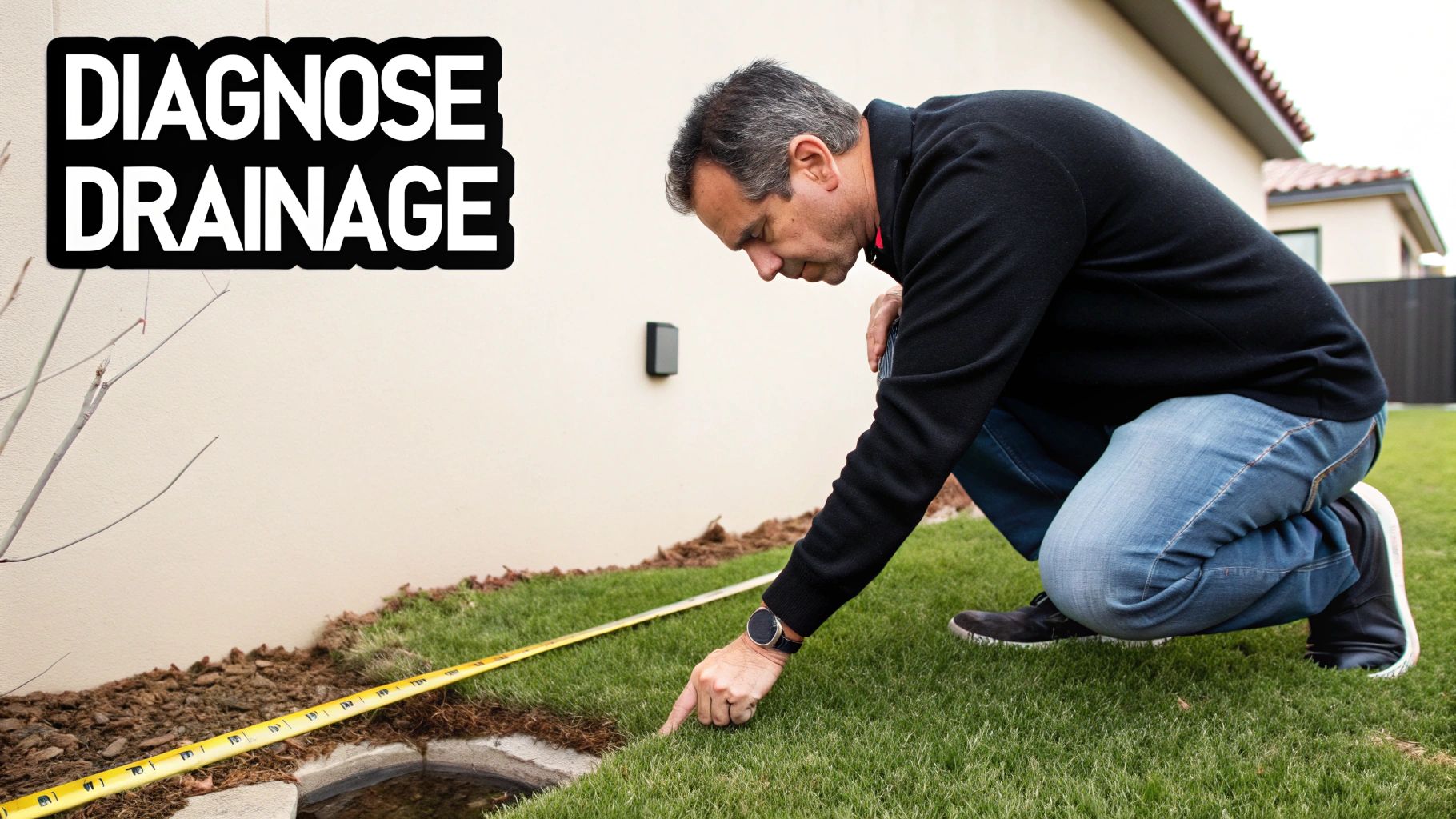
Honestly, the single best thing you can do is put on your rain boots during the next big downpour we get in Cumming or Johns Creek. Go outside and watch. See exactly where the water is flowing, where it’s pooling, and how long it’s taking to soak in. This firsthand look tells you more than any inspection on a dry day ever could.
Your North Georgia Drainage Checklist
Take a methodical walk around your property to start pinpointing the real issues. A simple walkthrough can uncover problems with surprisingly easy fixes, potentially saving you a ton of money on a solution you don't even need.
Keep an eye out for these common culprits:
- Follow the Gutters: Where do your downspouts end? If they're dumping water right next to your foundation, you've found a major problem. This is one of the most common and damaging mistakes, leading to saturated soil and potential foundation trouble.
- Identify the Low Spots: Take note of every puddle. Are they just random dips in the lawn, or do they form long, channel-like pools? This tells you where water is getting trapped on its journey.
- Check the Slope: Get a good vantage point from your driveway or patio and really look at the grade. Your yard should slope gently away from the house. If it looks flat or—even worse—slopes back toward your foundation, you're fighting an uphill battle.
- Examine Your Landscaping: Those beautiful, thick mulch beds or raised garden borders can sometimes act like mini dams. They might be trapping water in your lawn instead of letting it flow freely off your property.
Your goal here is to map out water's entire journey across your yard. Once you've identified the sources and the roadblocks, you can stop guessing and start creating a smart, targeted plan.
Sometimes, the clues are right in front of you. This table breaks down what you might be seeing and what it likely means for your property.
Common Drainage Issues and Symptoms in North Georgia
| Symptom You Observe | Likely Cause | Where to Look First |
|---|---|---|
| Water pooling right next to the house foundation | Short downspouts or incorrect grading | Check where gutters discharge; look at the slope of the soil within 10 feet of the house. |
| Large, squishy patches in the middle of the lawn after rain | Low spots in the yard and/or heavily compacted clay soil | Walk the lawn to find depressions; test soil hardness with a screwdriver. |
| A constantly damp or muddy area that never fully dries | Compacted soil, a high water table, or a persistent source like a leaky pipe | Check for underground utilities; perform a percolation test. |
| Water running across your driveway or sidewalk like a river | Improper slope of hardscapes or runoff from a neighboring property | Observe water flow during a storm; check the elevation of your neighbor's yard. |
By matching what you see to the potential causes, you're well on your way to narrowing down the right solution for your specific problem.
Digging a Little Deeper into the Cause
After you’ve sized up the surface, it’s time to look at what’s happening underground. Here in Forsyth and North Fulton counties, our infamous red clay is often the main villain. It gets packed down so tightly that water has nowhere to go.
You can run a simple "percolation test" to see how bad it is. In a problem area, dig a hole about a foot deep and a foot wide, then fill it with water. Now, time how long it takes to drain away. If you still have standing water in that hole after a few hours, you've definitely got a compaction or heavy clay issue. This tells you that just moving water on the surface won't be enough—you'll also need to improve the soil itself. If you want to get more technical, you can learn how to read soil test results to understand your soil's composition.
This kind of diagnostic work aligns with a bigger shift in how we manage residential water. The North American drainage systems market was valued at around USD 1.86 billion in 2023, and a lot of that growth is driven by a need for smarter stormwater management in urban and suburban areas. For homeowners, that means a move toward more sustainable fixes, like improving soil health, that help your property absorb more rain right where it falls.
Simple Fixes You Can Tackle This Weekend
Not every soggy yard needs a full-on excavation. I've seen countless drainage headaches in places like Cumming and Alpharetta solved with a few smart, simple changes that you can absolutely knock out yourself over a weekend.
These aren't just quick patches. They're about tackling the most common reasons we see standing water here in North Georgia. By getting a handle on where the water is coming from and helping it soak into the ground, you can stop a small puddle from turning into a big, expensive problem.
Start at the Source: Extend Your Downspouts
Honestly, this is the single most important thing you can do, and it's also one of the easiest. Your roof is a massive water collector. During a heavy rain, all that water gets funneled right down to your foundation. If your downspouts just dump it out right there, you’re basically inviting a swamp to form around your house.
Extending those downspouts is non-negotiable. Your mission is to push that roof runoff at least ten feet away from the house. This one move gives all that water room to spread out and soak into the lawn instead of pooling up against your foundation walls.
You’ve got a few straightforward options:
- Flexible Corrugated Pipe: This is your fastest, cheapest fix. These black plastic pipes snap right onto your downspout and can easily be routed around flower beds or walkways.
- PVC Pipe Extensions: If you want something more permanent, you can connect a solid PVC pipe and bury it, leading the water to a pop-up emitter somewhere out in the yard. It's a cleaner look and very durable.
- Splash Blocks & Rain Barrels: While not a solution for heavy volume, a good splash block can at least prevent erosion right at the base of the downspout. Rain barrels are great for capturing some of that water to use in your garden later.
Getting that water away from your foundation is priority one. It immediately relieves pressure on the soil right where it matters most.
Tackle the Infamous Georgia Clay
Okay, you've redirected the big gush of water from the roof. Now, what about the lawn itself? Anyone living in Forsyth County knows the real culprit: our dense, red clay soil. It can get so compacted that water has nowhere to go but sideways.
Core aeration is your best friend here. This isn't just poking holes in the ground with a spike. You need a machine that pulls out small plugs—or "cores"—of soil. This physically removes compaction, creating little channels for water and air to finally get down into the root zone where they belong.
Think of compacted clay like a paved parking lot—water just sheets right off. Core aeration is like breaking up that pavement and turning it back into a sponge.
The best time to aerate is in the spring or fall when your grass is actively growing. You’ll see an immediate difference in how your lawn handles water, and it sets the stage for healthier, deeper grass roots that will improve drainage even more over time.
Build Better Soil with Organic Matter
Aeration is a fantastic first punch, but building better soil is how you win the long game. The absolute best time to improve your soil is right after you've aerated.
Topdress your lawn with a thin layer of organic compost. This is the secret weapon for fighting clay. The compost falls into all those little aeration holes and immediately gets to work, breaking up the dense clay particles. Over time, it creates a richer, loamier soil structure that can actually absorb and hold water correctly.
This isn't a one-and-done deal. Think of it as an ongoing process. A topdressing of compost once or twice a year will steadily transform your soil, making your yard far more resilient to both heavy rain and drought. For a more detailed guide on this, check out this great resource on how to improve clay soil for grass.
Building Effective DIY Drainage Systems
When the quick fixes just aren't cutting it and you're still dealing with standing water, it’s time to roll up your sleeves and build a more dedicated drainage system. This might sound like a major undertaking, but some of the most effective solutions are surprisingly achievable for a determined homeowner. These projects are all about physically capturing and redirecting water, offering a lasting fix for soggy lawns across North Georgia.
From a simple, handsome dry creek bed that channels surface water to underground workhorses like French drains and dry wells, these systems can permanently change your yard for the better. Let's dig into how you can tackle them, keeping in mind the challenging red clay soil we see from Dahlonega all the way to Alpharetta.
For a lot of folks, the journey to a drier yard starts with a few key weekend tasks, as this simple flow shows.
This diagram really nails the fundamentals—extending downspouts, aerating the lawn, and amending the soil—which are often the perfect prelude to building a more complex system.
Creating a Dry Creek Bed for Surface Water
A dry creek bed is hands-down one of the most attractive ways to solve a surface runoff problem. It's especially brilliant for sloped yards in areas like Milton or Dahlonega. Think of it as a shallow, man-made channel lined with stones that mimics a natural creek. When the rain comes, it transforms into a functional waterway, guiding that runoff safely away from your house and toward a better exit point.
Here's the approach I recommend:
- Trace the Flow: First, you need to see where the water wants to go naturally. Head out during a storm and watch its path. Mark this route with spray paint or flags, and don't be afraid to add some gentle, natural-looking curves.
- Dig the Swale: Next, dig a shallow trench—what we call a swale—along the path you marked. It doesn’t need to be a canyon. 12 to 18 inches deep at the center, tapering up to the sides, is usually plenty. The most important part is ensuring a consistent, gentle downward slope for gravity to do its work.
- Line and Fill: Lay down landscape fabric in the trench to stop weeds and keep soil from muddying up your rocks. Then comes the fun part: filling it with a mix of river rocks and boulders to create that authentic creek look.
This project doesn't just solve a drainage headache; it also adds a beautiful, low-maintenance hardscape feature to your yard.
Installing a French Drain for Subsurface Water
What about those spots where the ground itself is just always saturated? For that, the French drain is the undisputed champion. Unlike a dry creek bed that handles water on the surface, a French drain is an underground system built to collect water that’s already soaked into the soil. It’s the perfect fix for drying out those perpetually squishy patches of lawn.
A French drain is essentially a perforated pipe buried in a gravel-filled trench. Water in the saturated soil is drawn into the gravel trench, enters the pipe through its holes, and then flows with gravity to a safe discharge point, like the street or a wooded area on your property's edge.
Pro Tip: When you're digging a trench in our heavy Georgia clay, it's absolutely crucial to line the entire trench (bottom and sides) with a quality, water-permeable landscape fabric before you add any gravel. This simple step is what prevents clay and silt from seeping in and clogging your system down the road.
Constructing a Dry Well to Capture Runoff
But what if you don't have a good place to send all that water? This is where a dry well comes in. It's a fantastic solution for properties that are flat or lack easy access to a street drain. A dry well is a large, underground pit filled with gravel that collects runoff and lets it slowly percolate back into the deeper subsoil.
Often connected to downspouts or a French drain, the well fills up with water during a storm, then allows it to gradually seep out over a day or two. This prevents the water from ever flooding your lawn in the first place. It’s a very effective solution in packed residential areas where you can’t just pipe water off your property.
Choosing the right project can feel overwhelming, so I've put together a quick comparison to help you decide.
DIY Drainage Solution Comparison
This table breaks down the most common DIY drainage projects to help you match a solution to your specific problem, budget, and how much sweat equity you're willing to invest.
| Solution | Best For | Estimated Cost | Effort Level |
|---|---|---|---|
| Downspout Extensions | Redirecting roof runoff away from the foundation. | $20 – $100 | Low |
| Grading/Regrading | Creating a gentle slope to guide water away from the house. | $100 – $1,000+ (DIY vs. Pro) | Medium to High |
| Dry Creek Bed | Channeling surface water on sloped yards; adds aesthetic appeal. | $300 – $1,000 | Medium |
| French Drain | Solving soggy, saturated soil and high water tables. | $500 – $1,500+ | High |
| Dry Well | Capturing excess water on flat lots with no discharge point. | $400 – $1,200 | High |
Each of these systems has its place, and sometimes the best solution is a combination of two or more.
As our communities grow, the need for smart drainage becomes even more critical. In fact, the global drainage system market, valued at around USD 50.3 billion, is projected to nearly double by 2035. This is largely driven by urbanization creating more hard surfaces like driveways and patios, which increases runoff.
For those interested in the bigger picture of water management, the principles behind mastering storm water drainage system design offer some fantastic insights. And don't forget that any drainage project works better when your soil is healthy. Aeration is a key part of that, and you can learn more in our guide on how to aerate your lawn.
Knowing When to Call in the Pros for Your Yard Drainage
I'm all for rolling up your sleeves and tackling a good DIY project. It’s satisfying. But when it comes to the relentless rain and tricky clay soil we have here in North Georgia, some drainage battles are best left to the experts.
While things like adding downspout extenders or aerating your lawn can make a real difference, there's a tipping point where a weekend fix just won't cut it. Knowing when to put down the shovel and pick up the phone is the smartest move you can make to protect your home and, frankly, save yourself a lot of headaches and money down the road.
Sometimes, the sheer scale of the problem is the deciding factor. If you're looking at a yard that needs serious re-sloping to get water moving away from your house, that's professional grading territory. This isn't just about pushing dirt around; it's a science. The landscape contractors we see in Cumming and Alpharetta know how to calculate the precise grade needed. Get it wrong, and you could accidentally send a river toward your foundation or, even worse, flood your neighbor's property. That's a whole different kind of problem.
Red Flags That Demand an Expert Eye
Certain drainage symptoms are more than just a nuisance—they’re your yard’s way of screaming for help. If you spot any of these, it’s time to consult an expert who knows the right way to fix yard drainage with professional-grade solutions.
- Water Threatening Your Foundation: This is the big one. If you see water pooling right up against your foundation for hours after a storm, that's a major red flag. If you've found moisture or standing water in your crawlspace or basement, it's an emergency. The risk of serious, expensive structural damage is just too high to mess around with.
- Persistent, Widespread Soggy Areas: A single squishy spot is one thing. But if huge sections of your lawn in Milton or Johns Creek stay completely saturated long after the sun has come out, you might be dealing with a high water table or a complex underground spring.
- Steep Slopes and Erosion: On the hilly properties common in our area, uncontrolled water flow can quickly wash away your topsoil and destabilize the entire landscape. A pro can design and install the right retaining walls or terracing to manage that flow for good.
- Issues Crossing Property Lines: If the water is flowing in from a neighbor's yard, or your fix would send water toward their property, you need to bring in a professional. They can navigate the technical and legal issues to create a solution that works for everyone.
And if you have soggy spots that just never seem to dry out, don't rule out a plumbing issue. It's worth exploring the different types of sewer line repair services because a hidden pipe problem can sometimes look just like a surface drainage issue.
Finding the Right Contractor in North Georgia
Once you’ve made the call to hire out, how do you find the right person? Look for local contractors in Forsyth County or nearby areas who specialize in drainage solutions, not just general landscaping. There’s a big difference.
My best piece of advice? When you're checking out a contractor, ask for references from recent drainage jobs right here in your area. A good company will be happy to show you their work and let you chat with past clients.
Before you sign anything, make sure you grill them with these questions:
- Are you licensed and fully insured for this specific work in Georgia?
- Based on what you see, what do you think is causing my drainage problem?
- What's your proposed solution, and why do you believe it's the best approach for my yard?
- Can you give me a detailed, itemized quote so I know where every dollar is going?
- What's the project timeline, and what kind of maintenance will be required afterward?
That last point about upkeep is huge. The global market for drainage maintenance services hit USD 22.06 billion for a reason—these systems need care! A professionally installed French drain can still clog with silt and fail if it isn't maintained. Understanding the long-term plan is crucial for protecting your investment.
Local Logistics You Can't Ignore
Before a single shovel hits the ground, there are two non-negotiable local rules to follow.
First, you or your contractor must call 811 before you dig. It's a free service, and it's the law. They'll come out and mark the location of all underground utility lines, which prevents a dangerous and incredibly expensive accident.
Second, check in with your local government. A project in Alpharetta might have totally different permit rules than one in unincorporated Forsyth County. Major work like grading or installing a system that ties into a public storm drain will almost certainly require a land disturbance permit. A good contractor should handle all the permitting for you, but it’s always smart to know what’s required.
Got Questions About Yard Drainage? We've Got Answers.
When you start digging into a yard drainage project, a lot of questions pop up. It’s only natural. We hear the same ones from homeowners all over North Georgia, from Cumming and Alpharetta to Milton and Johns Creek. Let's get them answered so you can move forward with confidence.
What’s This Going to Cost Me? A Realistic Look at Drainage Fixes in North Georgia
This is always the first question, and the honest answer is: it really depends. The price tag is tied directly to the solution you choose and whether you're grabbing a shovel yourself or calling in the pros.
Here’s a practical breakdown of what you can expect to spend in our area:
- Quick DIY Fixes: Simple things like adding downspout extensions or renting a core aerator are your best bang for your buck. You're likely looking at $50 to $150 for materials and rentals.
- DIY Drainage Systems: If you're tackling a French drain or a dry creek bed on your own, the cost is all in the materials. Plan on spending anywhere from $500 to over $1,500 for pipe, gravel, fabric, and decorative stone, depending on how big you go.
- Professional Installations: Hiring a crew in the Johns Creek or Milton area to install a proper French drain or swale usually starts around $2,500. For bigger, more complex systems, that number can easily climb past $10,000.
- Major Re-Grading: This is the big one. Bringing in a professional crew with heavy equipment to reshape your yard is a significant investment, often starting at $5,000 and going up from there.
My best advice? Always get at least three detailed quotes from local, reputable drainage contractors. It’s not just about comparing the final price—it’s about understanding their proposed solution and the quality of materials they plan to use.
Will Aerating My Clay Soil Actually Do Anything?
Yes, absolutely. In fact, if you only do one thing for your yard, this should be it. Aerating the dense, compacted red clay we have all over Forsyth County is a game-changer. It’s not just about "poking holes" in the ground.
When you core aerate, you're physically pulling out small plugs of that rock-hard soil. This creates new channels for water, air, and nutrients to finally get down to the roots instead of sheeting off the surface. You'll see less puddling almost immediately. Over time, it encourages deeper, stronger grass roots, which helps improve the soil structure even more. For the best results, aerate in the spring or fall and follow it up right away by spreading a thin layer of good compost.
Do I Need a Permit to Install a French Drain in Forsyth County?
Probably not. For a standard French drain on your own property, most local jurisdictions like Forsyth County, the City of Johns Creek, or the City of Milton do not require a permit. This assumes you're not moving a mountain of dirt and, crucially, not dumping the water onto your neighbor's property or into a public right-of-way.
But—and this is a big but—the rules change if your project gets more ambitious. You might need to get a land disturbance permit if you're planning on:
- Major excavation that moves a lot of soil.
- Tying your system directly into a city storm drain.
- Significant grading that changes the overall slope of your lot.
The smartest move is to just call. Before you dig, give your local city or county planning and development department a ring. A five-minute phone call can save you a world of headaches and potential fines.
What Are the Best Plants for a Soggy Spot in Georgia?
Putting plants to work to soak up excess water is a brilliant, natural strategy. For those perpetually damp areas or a full-blown rain garden, you want to pick native plants that don't mind having "wet feet" but can also handle our hot, sometimes dry, summers.
Here are a few of my favorite workhorses for North Georgia yards:
- Swamp Milkweed (Asclepias incarnata): A beautiful perennial that's a magnet for monarch butterflies and loves moisture.
- Cardinal Flower (Lobelia cardinalis): Sends up incredible spikes of bright red flowers and thrives in damp soil.
- Ironweed (Vernonia noveboracensis): A tall, tough-as-nails plant with vibrant purple flowers that is fantastic at absorbing water.
- Sedges (Carex species): Many native sedges look like ornamental grasses but are superstars for stabilizing soil in wet zones.
- Buttonbush (Cephalanthus occidentalis): A fantastic native shrub with unique, spiky white flowers that absolutely adores wet conditions.
These plants do more than just solve a drainage problem; they create a beautiful, living habitat for birds and pollinators. Any good local nursery in Cumming or Alpharetta can help you find the perfect options for your yard's specific sun and soil conditions.
Fixing a drainage problem can feel like a huge undertaking, but getting answers to these common questions is a huge step in the right direction. For the ongoing health of your soil—which is the foundation of good drainage—it pays to have a local expert on your side.
At Barefoot Organics, we specialize in building resilient, healthy lawns across North Georgia with treatments that are safe for your family and the environment. Ready to build a stronger lawn from the ground up? Get your free, no-obligation quote online today at https://barefootorganicsllc.com.