

When you're standing in the aisle looking at lawn care products in Cumming, Alpharetta, or Johns Creek, the choice between liquid and granular fertilizer can feel a bit overwhelming. It’s not about finding one single "best" product, but picking the right tool for the job at hand.
Think of it this way: liquid fertilizers offer a rapid boost, like a shot of espresso for your lawn, perfect for a quick green-up. On the other hand, granular fertilizers provide a slow, steady diet, building health over the long haul. The best choice really boils down to your lawn's immediate needs, your long-term goals, and how you want to handle the unique challenges of our Georgia clay soil, from Dahlonega down to Milton.
Choosing the Right Fertilizer for Your North Georgia Lawn
It’s one of the most common questions we hear from homeowners across the Cumming area: "Liquid or granular?" The truth is, there’s no simple, one-size-fits-all answer. It's a strategic decision based on your specific turf, soil conditions, and what you’re trying to accomplish.
This guide will give you a framework for making a smart choice, one that’s actually tailored to our North Georgia environment. We'll get into the real-world differences and explore how each type performs on the grasses we see every day—from the tough Bermuda grass baking in the Alpharetta sun to the cool-season Fescue that loves the shaded yards in Milton.
Understanding the Core Differences
Before we dive into the nitty-gritty, let's start with a high-level look. It helps to think of it as choosing between a quick energy shot for an immediate pick-me-up versus a balanced, slow-cooked meal for sustained performance.
Here’s a quick overview of how these two fertilizer types compare for local homeowners in places like Cumming and Johns Creek:
| Feature | Liquid Fertilizer | Granular Fertilizer |
|---|---|---|
| Nutrient Release | Immediate. Nutrients are ready for the grass blades and roots to absorb almost instantly. | Slow-Release. Pellets break down over weeks or months, offering a steady feeding. |
| Best Use Case | Getting a fast green-up, fixing nutrient deficiencies quickly, and giving new sod a head start. | Building long-term soil health, executing a seasonal feeding plan, and cutting down on labor. |
| Application Method | Applied with a hose-end sprayer, which makes getting even coverage pretty straightforward. | Applied with a broadcast or drop spreader, which requires careful calibration to avoid stripes. |
| Effect on Clay Soil | Can deliver micronutrients and soil amendments that soak into our dense Georgia clay more easily. | Builds up nutrients in the top layer of soil over a longer period. |
This comparison gives us a great starting point for a deeper dive. And remember, feeding your lawn is just one piece of the puzzle. You might want to check out these great tips for reviving a struggling lawn for a more complete picture.
The most effective lawn care strategies often involve using both types of fertilizers at different times. A slow-release granular product can build a strong foundation in the spring, while a liquid application can provide a quick fix for mid-summer yellowing in your Cumming lawn.
Ultimately, the right choice really connects to your personal lawn care style and the specific challenges your property presents. For a more detailed walkthrough of the process, our guide on how to fertilize a lawn offers some practical, step-by-step advice. This introduction should set you up to navigate the next sections, where we’ll explore exactly how each fertilizer works and break down real-world scenarios for your North Georgia landscape.
Understanding How Each Fertilizer Type Works
When you're standing in the aisle looking at lawn fertilizers, it’s easy to get overwhelmed. But the choice between liquid and granular really boils down to how they deliver nutrients to your grass. Think of it less as picking a product and more as choosing a feeding strategy—one that dramatically affects how fast your lawn greens up and how long it stays that way.
The fundamental difference comes down to their form and how quickly the grass can actually use them. One is like a quick energy shot for your lawn, while the other is more like a full, balanced meal that lasts all day.
Liquid Fertilizers: The Fast-Acting Boost
Liquid fertilizers are all about speed. The moment you spray a liquid formula, the nutrients are already dissolved and ready for your lawn to absorb. This happens in two ways: the traditional route through the soil to the roots, and also directly through the blades of grass in a process called foliar feeding.
This two-pronged approach is why you see results so quickly. Let's say you have a barbecue planned for the weekend in Milton and your lawn is looking a bit tired and pale. A liquid application can give it that vibrant green pop in just a couple of days. It’s the perfect tool for fixing visible nutrient deficiencies, like the tell-tale yellowing from low iron, almost overnight.
But that speed has a downside. Because the nutrients are so easy for the plant to access, they get used up just as fast. This means you’ll be out there applying it more often throughout the long North Georgia growing season to keep that color and health consistent.
Liquid fertilizer is your go-to for immediate impact. It’s a tactical tool for fast corrections and providing a quick aesthetic enhancement when you need your Alpharetta lawn to look its best on short notice.
Granular Fertilizers: The Slow and Steady Foundation
On the other hand, granular fertilizers are built for the long haul. These are dry pellets, often coated to control how fast the nutrients inside break down. After you spread them across your lawn and water them in, these little granules dissolve slowly over weeks or even months.
This creates a steady, consistent feeding for your lawn's root system. Instead of one big rush of food, it’s more like a slow-drip IV of everything the grass needs to build deep, foundational health. This approach is fantastic for getting our lawns through the brutal summers in Johns Creek and Cumming, as it builds resilience to heat and drought without forcing a bunch of weak, leggy growth.
It's no surprise that the global fertilizer market is dominated by dry, granular products. In fact, the dry fertilizer segment accounts for an estimated 82.5% of the total market, mostly due to how easy it is to store, ship, and apply on a massive scale. For us homeowners, the real win is the sustained feeding that means fewer applications and a more self-sufficient lawn.
This slow-and-steady method is a cornerstone of smart, sustainable lawn care. If you're curious about the science, understanding how slow-release fertilizer benefits lawns can give you a much better appreciation for what it takes to build a truly healthy turf.
Ultimately, how each fertilizer works defines its best use. Liquid is your quick fix, giving you precise control for immediate problems. Granular provides the long-term, foundational nutrition that builds a tough, healthy lawn ready to handle the Georgia climate. The right choice—or even using a combination of both—really depends on what your lawn is telling you it needs.
A Detailed Comparison for Georgia Lawns
Choosing between liquid and granular fertilizer isn't just a technical decision—it’s about balancing your lawn's immediate needs with its long-term health, not to mention your budget and weekend plans. For homeowners here in Cumming and across the surrounding communities, there’s no single right answer. It really comes down to what you’re trying to achieve.
This simple decision tree can help you map out your choice based on your main goal.
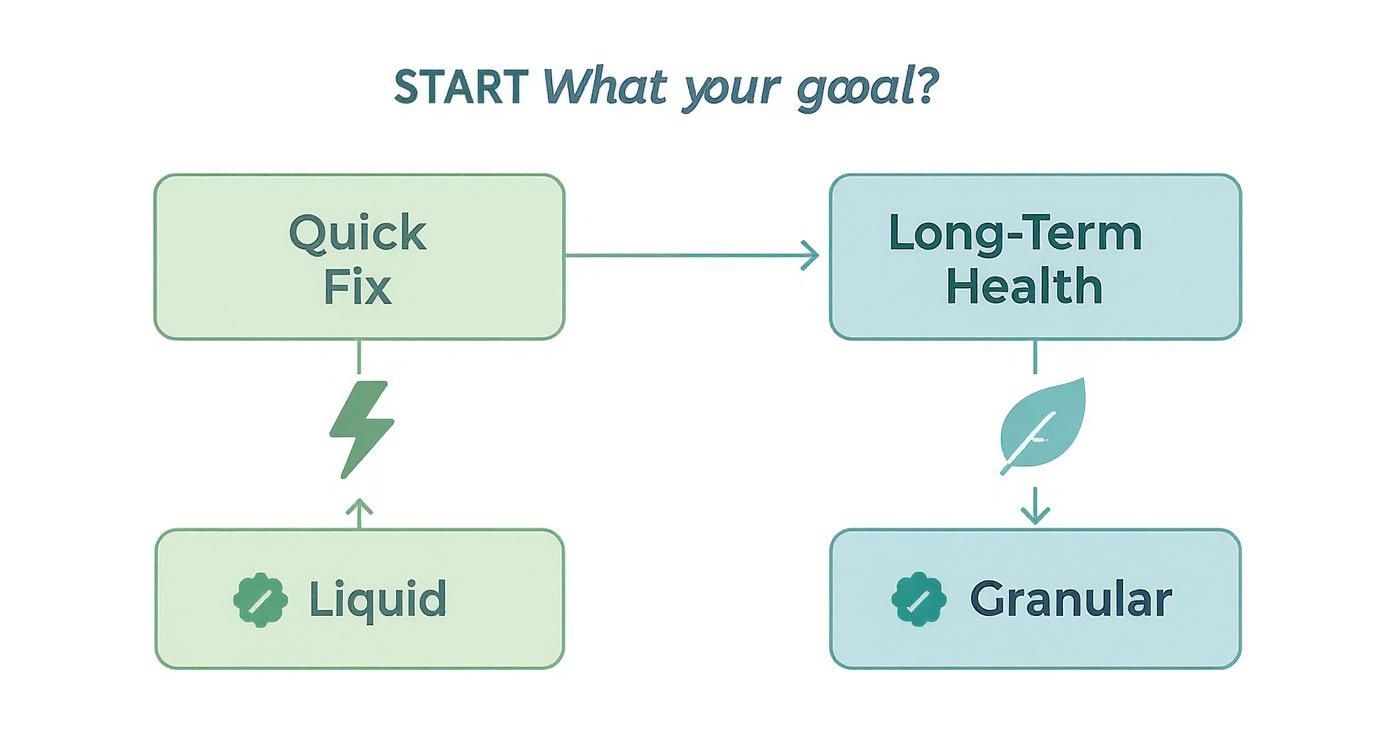
As you can see, if you’re after a quick visual pop, liquid is your most direct route. But if you're playing the long game and focusing on sustainable health from the soil up, granular is the way to go.
Nutrient Delivery and Control
The biggest difference between the two is how they get food to your grass. Liquid fertilizers are like a shot of espresso for your lawn—they deliver an immediate, easy-to-absorb meal. Because the nutrients are already dissolved, they get soaked up fast through both the roots and the leaves (a process called foliar feeding), which is why you see such a quick green-up. This is perfect if you're trying to fix a visible iron deficiency in your Alpharetta lawn or need it looking its best for a party this weekend.
Granular fertilizers, on the other hand, are more like a balanced, slow-cooked meal. They release nutrients steadily over weeks or even months. This consistent feeding schedule is what builds deep, strong root systems and the kind of resilience your lawn needs to laugh off a brutal Georgia summer.
Liquid fertilizers are a tactical tool for quick, visible fixes. Granular fertilizers are a strategic investment in the foundational health and resilience your lawn needs to thrive all season long in Cumming.
So, think of it this way: liquid is for short-term results, while granular is for long-term vitality.
Application Uniformity and Ease
Getting even coverage is the secret to avoiding those dreaded stripes or burn spots. For a beginner, liquid fertilizers often seem easier. When applied with a hose-end sprayer, every drop has the same nutrient mix, so as long as your spray pattern is consistent, the distribution should be too.
Applying granulars requires a bit more finesse and the right tool—usually a broadcast or drop spreader. You have to get the calibration just right to avoid putting down too much or too little, which can definitely lead to a patchy look. But with a properly calibrated spreader and a little practice, a homeowner in Milton can achieve perfectly uniform results.
Effectiveness on Georgia Clay Soil
Let’s be honest, our dense, red Georgia clay is a challenge. Liquid fertilizers have a real advantage here because they can penetrate compacted soil more easily. This allows them to get micronutrients and other soil conditioners right to the root zone, helping improve the soil structure with repeated use.
Granular products are fantastic for building up the nutrient bank in the top layer of soil. As the pellets break down, they enrich the area right around the grassroots, which is exactly what our turf needs. For many lawns in Cumming or Johns Creek sitting on heavy clay, a hybrid approach often yields the best results—using granulars to build the base and liquids for targeted, supplemental feedings.
To help you decide what's best for your lawn, here’s a quick side-by-side look at the key differences that matter most for North Georgia yards.
Liquid vs Granular Fertilizer At-a-Glance for Georgia Lawns
| Attribute | Liquid Fertilizer | Granular Fertilizer |
|---|---|---|
| Nutrient Release | Immediate, fast-acting | Slow-release, provides steady feeding |
| Application Method | Hose-end or tank sprayer | Broadcast or drop spreader |
| Best For | Quick green-up, correcting deficiencies | Building long-term soil and root health |
| Labor | Less physical effort, more frequent application | More physical effort, fewer applications |
| Cost | Higher cost per application | Lower cost per application, better value |
| Runoff Risk | Higher if heavy rain follows application | Lower, but still a risk on sloped lawns |
| Skill Level | Beginner-friendly for even coverage | Requires spreader calibration skills |
This table shows the clear trade-offs: liquids offer speed and convenience at a higher frequency and cost, while granulars provide a more economical, long-term health solution that requires a bit more initial effort.
Cost, Labor, and Storage Considerations
When it comes to your wallet, granular fertilizers usually come out ahead, especially if you buy larger bags. A single application can feed your lawn for months, which cuts down on both product cost and the time you spend working on the lawn. The main things to factor in are the one-time cost of a quality spreader and finding a dry spot in the garage to store the bags.
Liquid fertilizers tend to have a higher cost per application and don't last as long. Your lawn uses them up quickly, so you might find yourself reapplying every few weeks. That means more time spent on lawn care throughout the season. The trade-off is pure convenience—no heavy spreader to push, just a sprayer on the end of your hose. For smaller lawns in Johns Creek, that convenience might be worth the extra cost and effort.
Environmental and Family Safety
For families in Cumming, Milton, and Alpharetta, safety is always the top concern. The biggest environmental risk with any fertilizer is nutrient runoff, which happens when excess product washes into our local streams and rivers. Liquids are more vulnerable to immediate runoff if a big storm hits right after you spray. Slow-release granulars tend to stay put better, but they can still get washed away on steep hills in a downpour.
As for family safety, the ingredients matter more than whether it's liquid or solid. Organic options are available in both forms and are always the safest bet for homes with kids and pets. With granulars, the lawn is usually safe once the pellets have been watered in and have dissolved. With liquids, you just need to wait until the spray has completely dried on the grass. No matter what you use, always read the label and follow the manufacturer's instructions for re-entry times.
Practical Use Cases for North Georgia Turf
Knowing the difference between liquid and granular fertilizer is one thing, but putting that knowledge to work on your lawn in Alpharetta, Milton, or Cumming is what really counts. The best choice always comes down to your grass type, the time of year, and what you’re trying to accomplish right now.
Let's get practical. The way fertilizer is applied is just as critical as the product itself. The market shows a clear preference: broadcasting granular products still makes up about 89% of global fertilizer use because it's a proven, effective method for long-term feeding. At the same time, liquid methods are gaining ground fast, with foliar sprays being a popular choice for quick, targeted nutrient delivery. This divide highlights how each approach has a distinct, valuable role.
It all comes down to picking the right tool for the job, and here in North Georgia, that job changes with the seasons.
Feeding Common Georgia Grasses
Our local turfgrasses—Bermuda, Zoysia, and Fescue—all have unique appetites and schedules. Matching the right fertilizer to their needs at the right time is the secret to a standout lawn.
Scenario 1: Waking Up Bermuda Grass in Spring
As your dormant Bermuda grass lawn in Johns Creek starts to show that first hint of green, it's hungry. It needs a sustained source of food to power its aggressive spring growth. This is a perfect scenario for a slow-release granular fertilizer. An early spring application provides a steady, season-long diet that builds deep roots and thickens the turf, helping it crowd out weeds and brace for the coming summer heat.
Scenario 2: Correcting Mid-Summer Stress in Fescue
Fescue, being a cool-season grass, often gets stressed and pale during a hot Milton summer. Pushing it with a heavy dose of nitrogen right now would only make things worse. Instead, a targeted liquid application of iron and micronutrients can restore that deep green color almost overnight. This approach gives it a cosmetic boost without forcing stressful new growth, helping it hang on until cooler weather returns.
Scenario 3: Establishing New Zoysia Sod
You just laid beautiful new Zoysia sod at your home in Cumming. The last thing you want is to scorch those tender, developing roots. A gentle, starter liquid fertilizer is the way to go here. It delivers an immediate, easily absorbed shot of phosphorus to kickstart root development, all without the risk of burning your new investment.
A common mistake we see is the "one-size-fits-all" approach to fertilizing. The key to a truly thriving lawn is tailoring the product to the situation: liquid for a quick fix, granular for long-term health.
Situational Uses for Every Homeowner
Beyond the regular seasonal schedule, some situations just demand a specific type of fertilizer to get the results you need, when you need them.
Here are a few real-world examples:
- Quick Green-Up for an Event: Selling your home in Alpharetta or hosting a big backyard party? A liquid fertilizer applied a few days beforehand will deliver a fast, vibrant green that makes your lawn pop.
- The Low-Maintenance Season-Long Plan: If you're a busy homeowner who prefers a "set-it-and-forget-it" strategy, a high-quality, slow-release granular fertilizer is your best friend. Applied once or twice a season, it provides consistent nutrition with minimal effort, building great soil health in the process.
- Targeting Stubborn Bare Patches: When you're trying to fill in those thin or bare spots, a liquid fertilizer gives you the precision to deliver nutrients right where they’re needed most. This encourages new growth without over-feeding the healthy grass nearby.
For those with larger properties or even small farms around the Dahlonega area, storing and applying liquid products can be a bigger undertaking. Managing extensive turf areas often means looking into solutions like large plastic storage tanks for farm applications. Choosing organic products can also simplify things, and our guide to the best organic lawn fertilizer is a great place to start finding options that are both effective and safe.
When to Partner with a Lawn Care Professional
Let's be honest: choosing between liquid and granular fertilizers and building a season-long plan can feel like taking on a part-time job. For many homeowners around Cumming and the rest of North Georgia, there's a tipping point where DIY lawn care goes from a rewarding weekend project to a full-blown chore. That's usually the best time to think about calling in a pro.
Great lawn care isn't just about scattering pellets or spraying a hose-end bottle. It's really about figuring out why your grass isn't thriving in the first place. If you're stuck in a cycle of problems you can't seem to solve, bringing in an expert is one of the smartest investments you can make for your property.
Tackling North Georgia's Toughest Lawn Challenges
Some lawn problems are just too complex or time-consuming to tackle on your own. That dense, red clay soil we all know and love—from Dahlonega down to Johns Creek—creates some unique hurdles that big-box store products just aren't designed to handle. A local professional service like Barefoot Organics has seen it all and knows how to manage these tough situations.
Think about these scenarios where a professional can make all the difference:
- Persistent Nutrient Imbalances: Your lawn is still yellowish or thin, even after you've fertilized. A pro can conduct a proper soil test to pinpoint the exact deficiencies and mix a treatment that gives your lawn precisely what it's missing.
- Stubborn Weed Infestations: Professionals have access to targeted, more effective treatments that can knock out invasive weeds without damaging your Fescue or Bermuda grass in your Cumming-area lawn.
- Establishing a New Lawn: Getting new sod or seed to take root in compacted Georgia clay is a real challenge. Experts use specialized equipment and proven techniques, like core aeration and top dressing, to create the right conditions for success.
When you hire a professional, you're not just buying fertilizer. You're investing in diagnostic skill, commercial-grade equipment, and a strategic plan built specifically for your yard's unique ecosystem.
The Advantages of an Expert-Led Program
Working with a professional lawn care service opens the door to resources and knowledge that you just can't get at the local garden center. One of the biggest perks is their access to specialized products, especially when it comes to liquid fertilizers.
Pros often use custom-blended liquid cocktails that mix essential nutrients with powerful soil conditioners and biostimulants. This is where the industry is heading—the liquid fertilizers market is on track to hit USD 31.4 billion by 2034, driven by the precision that professionals demand. You can dig into more of these trends by checking out the expanding liquid fertilizer market analysis on gminsights.com.
A service like Barefoot Organics takes all the guesswork off your plate by creating a hybrid program. They might apply a slow-release granular fertilizer as a strong foundation in the spring, then follow up with targeted liquid treatments during the hot Alpharetta or Milton summers to address pop-up issues. This integrated approach ensures your lawn gets exactly what it needs, right when it needs it, for fantastic health all season long.
Got Questions About Lawn Fertilizers? We've Got Answers.
Even with all the details laid out, you probably still have a few specific questions about how this all works in the real world here in Cumming or Johns Creek. Let's tackle some of the most common things we hear from homeowners. Think of this as the final piece of the puzzle to help you make your decision with total confidence.
Can I Use Both Liquid and Granular Fertilizer on My Lawn?
Absolutely. In fact, for many lawns across North Georgia, using both is the smartest strategy. This kind of integrated approach plays to the strengths of each type, giving you a lawn that's healthier and looks better. It’s like giving your lawn a steady, balanced diet and a quick vitamin boost when it needs it most.
Here’s what a practical hybrid program might look for a lawn in Cumming:
- Early Spring: As your Bermuda or Zoysia grass starts waking up in Milton, put down a high-quality, slow-release granular fertilizer. This is its foundational meal, feeding the roots steadily as the growing season kicks off.
- Mid-Summer: Notice your Fescue in Alpharetta looking a bit stressed and yellowed from the heat? That's the perfect time for a targeted liquid fertilizer with iron. It delivers a quick green-up and fixes the nutrient issue without pushing new growth when the grass is already struggling with high temperatures.
Combining the two gives your lawn the long-term, deep-down nutrition from granules and the fast-acting, problem-solving ability of liquids. It's a professional-level strategy that just works.
Which Fertilizer is Safer for My Kids and Pets?
This is a big one. The truth is, a fertilizer's safety comes down to its ingredients and how you apply it, not whether it’s a liquid or a solid. You can find excellent, family-safe organic options in both forms in Cumming and Alpharetta.
With granular products, the key is watering them in thoroughly right after you spread them. You want to dissolve those pellets so they move down into the soil, away from the surface where curious pets or little feet might find them. Always read the bag for the specific "re-entry time"—that's how long you need to wait before letting everyone back on the lawn.
Organic liquid fertilizers are typically safe as soon as the spray has completely dried on the grass. That drying time is often a lot shorter than the waiting period for granular products.
Ultimately, safety isn't about liquid vs. granular. It’s about choosing a quality organic fertilizer, storing it somewhere safe, and following the label instructions to the letter on application rates, watering, and re-entry times. Working with an organic-focused pro is the surest way to know the safest products are being used with expert precision in your local area.
How Does All This Georgia Rain Affect Fertilizer?
That's a fantastic question, especially here where a pop-up thunderstorm can ruin your weekend plans. Getting the timing right around rainfall is everything—for your lawn's health and for the local environment.
Slow-release granular fertilizers handle rain much better. Their coatings are designed to break down gradually with moisture over time. That said, spreading them on a sloped lawn in Dahlonega right before a gully washer is a bad idea; you’ll still get runoff. The best-case scenario is to apply granulars when you see a day of light, steady rain in the forecast. That helps work the nutrients into the soil perfectly.
Liquid fertilizers, on the other hand, are much more susceptible to being washed away. You need a dry window of at least 4 to 6 hours after spraying for the grass and soil to soak up the nutrients. Spraying a liquid an hour before a classic Georgia thunderstorm is like pouring money straight down the storm drain and sending fertilizer into local waterways like Lake Lanier. Always check the hourly forecast before you even think about spraying.
Ready to stop guessing and get a lush, healthy lawn? The experts at Barefoot Organics build custom, organic-based lawn care programs that put the right products on your lawn at the right time. Get your free online quote today!