

Let's be honest: finding the best organic lawn fertilizer for the notorious clay soil in areas like Cumming and Alpharetta isn't about grabbing a random bag from the home improvement store. The real secret is using a blend that's custom-fit to your lawn's specific needs—usually a slow-release granular mix that’s not only high in nitrogen but also actively improves the soil itself.
The Secret to a Lush Lawn in North Georgia
If you're a homeowner in Cumming, Alpharetta, or Johns Creek, you're probably all too familiar with the struggle against compacted, nutrient-starved clay. This guide cuts through the generic advice to give you a practical, localized plan for building a healthy soil ecosystem right under your feet. We'll show you how to pick the right amendments to turn your yard from a constant headache into a thriving, green space using methods that are both sustainable and safe for your family and pets.
Choosing an organic path puts you in good company. More and more homeowners from Milton to Dahlonega are making the switch, prioritizing a beautiful lawn without compromising the local environment. This isn't just a fad; it's a fundamental shift. The global market for natural lawn fertilizers, including organic options, was valued at $5.5 billion in 2023 and is expected to nearly double to $10.2 billion by 2032. This surge is fueled by a growing demand for eco-friendly solutions, particularly right here in North America.
Why Organic Matters for Georgia Clay
That famous Georgia red clay poses some unique problems, and surprisingly, synthetic chemical fertilizers can often make things worse. Sure, they might give you a quick burst of green, but they do absolutely nothing for the underlying soil structure. Over time, these chemicals can even wipe out the beneficial microbial life that is the foundation of a truly healthy lawn.
Organic fertilizers have a completely different game plan. Instead of just force-feeding the grass, they feed the soil. They are made from natural materials that decompose slowly, releasing a steady stream of nutrients while simultaneously improving the soil's physical condition.
This "soil-first" philosophy is the key to getting lasting results in our region. For anyone battling the clay in places like Milton or Dahlonega, this means you'll see real, tangible benefits:
- Better Soil Structure: Organic matter is fantastic at breaking up compacted clay. This improves drainage and gives your grassroots the space they need to grow deep and strong.
- Greater Nutrient Retention: When your soil is rich in organic material, it acts like a sponge, holding onto water and nutrients far more effectively. This means less runoff and less wasted fertilizer.
- A Healthy Soil Ecosystem: Organic inputs are food for the good guys—the worms, fungi, and bacteria that naturally make nutrients available for your grass to use.
The core idea behind organic lawn care is to build a self-sustaining ecosystem from the ground up. You’re not just spreading fertilizer; you are cultivating a living soil that can support a resilient, beautiful lawn year after year.
If you're aiming for a yard that's the envy of your Cumming neighborhood, it's worth exploring additional tips to revive your lawn and keep it looking its best. By taking this approach, you're creating a safer yard for your kids and pets and doing your part for a healthier local environment.
How to Understand Your North Georgia Soil
Before you even think about buying a bag of fertilizer, you need to get to know the ground you're working with. Here in North Georgia, from the rolling hills of Dahlonega down to the suburbs of Johns Creek, we’re dealing with our famous dense, red clay. Just throwing down a generic fertilizer is a shot in the dark—a complete waste of time and money.
The single most important thing you can do for your lawn is get a real soil test.
It's not as complicated as it sounds. Your best local resource is the University of Georgia (UGA) Extension office in your county. For a small fee, usually around $20, they’ll give you a detailed scientific breakdown of your soil's makeup. This report takes all the guesswork out of the equation and gives you a precise roadmap for feeding your lawn exactly what it’s hungry for.
Getting a Good Soil Sample
To get accurate results, you can't just scoop up dirt from one spot. You need a sample that represents your entire lawn. Grab a trowel or a soil probe and follow these steps:
- Collect soil from 8-10 different areas across your lawn.
- Dig down about 4-6 inches for each mini-sample. That’s where the grassroots live.
- Mix all these samples together in a clean bucket. This creates a composite sample that gives you the big picture.
Once you’ve got your mix, pick out any grass, roots, or rocks. Bag up about a cup's worth of the soil and drop it off at your local extension office. For those of us in Cumming, that’s the Forsyth County office.
The UGA Extension is a fantastic community resource. They do way more than just soil tests, offering gardening advice that’s perfectly tailored to our unique Georgia climate.
This screenshot gives you the contact info for the Forsyth County Extension office—your direct line to expert, localized soil analysis.
Decoding Your Soil Test Results
In a week or two, you’ll get a report back that might look a little intimidating with all its charts and numbers. Don't sweat it. You only need to focus on two main things: the soil pH and the N-P-K levels.
- pH Level: This tells you how acidic or alkaline your soil is. Our North Georgia clay tends to be acidic (meaning a low pH), which can "lock up" nutrients. Even if the nutrients are in the soil, your grass can't access them. The report will likely recommend adding lime to raise the pH to a healthier, more neutral level.
- N-P-K Ratios: This is the holy trinity of lawn care: Nitrogen (N), Phosphorus (P), and Potassium (K). Nitrogen fuels that lush, green growth. Phosphorus builds strong roots. Potassium improves the lawn’s overall toughness against stress like drought and disease.
Think of your soil test as your lawn's personal health report. It tells you exactly which nutrients are missing so you can choose an organic fertilizer that provides what's needed and nothing more. This targeted approach is the smartest way to build a truly healthy lawn.
Understanding these results is the first step in a much bigger journey of restoring your soil's health. For those in Alpharetta and Milton looking to dive deeper, our guide on how to improve soil covers more advanced techniques for breaking up that compacted clay. With this knowledge in hand, you'll be ready to choose the perfect organic blend for your lawn.
Choosing the Right Organic Fertilizer Blend
Armed with your soil test results, you can finally walk into the garden center and know exactly what you’re looking for. Forget getting overwhelmed by aisles of choices. Your report is a personalized roadmap, steering you past the flashy marketing to find what your lawn actually needs.
For those of us in Alpharetta or Milton dealing with that stubborn, acidic clay soil, this step is a game-changer. Your test might reveal low nitrogen and a pH that's out of whack. That means you’re on the hunt for a blend with slow-release nitrogen and ingredients like composted poultry litter. This doesn’t just feed the grass; it fuels the beneficial microbes that break up compacted soil over time.
You’ve officially shifted from a generic, one-size-fits-all strategy to a targeted approach. You're not just feeding the grass anymore—you're healing the soil from the ground up.
Understanding N-P-K in Organic Sources
Every fertilizer bag has three numbers on it: the N-P-K ratio. This stands for Nitrogen (N), Phosphorus (P), and Potassium (K). While synthetic fertilizers often boast high, concentrated numbers, organic sources are different. They offer a more balanced, slow-release dose of nutrients.
This gentle, steady feeding is exactly what your lawn wants. It prevents the chemical burns and thatch buildup that aggressive synthetic products can cause.
The infographic below shows how different organic materials bring their own unique nutrient profiles to the table.
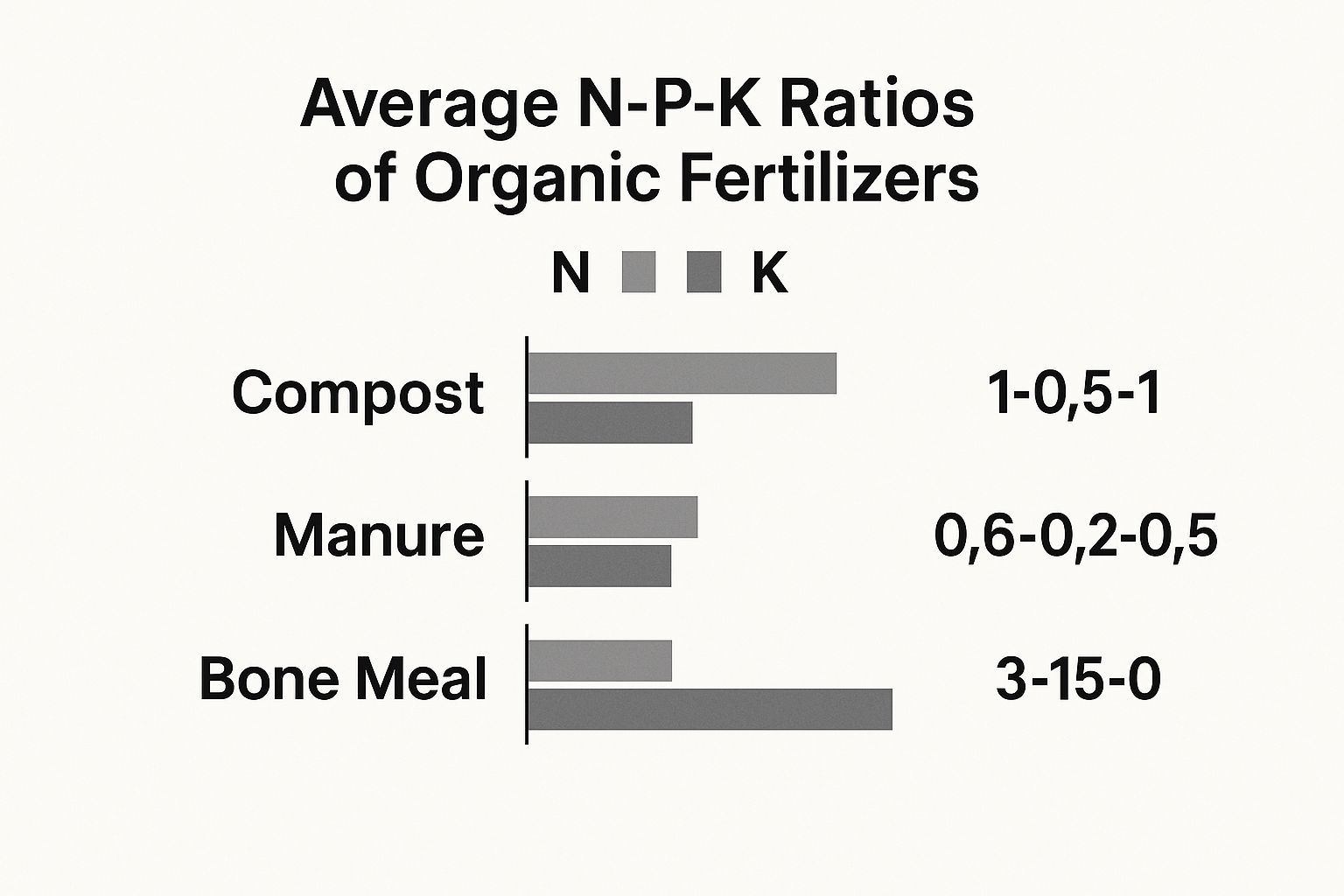
As you can see, there's no single "best" source. The real magic happens when you use a blended product or a custom mix based on what your soil test tells you.
Thankfully, finding these products is getting easier. The U.S. organic fertilizer market, valued at USD 397 million in 2025, is expected to surge to USD 708.4 million by 2030. This boom means better, more effective, and more accessible eco-friendly options for all of us. You can read more about the U.S. organic fertilizers market trends at Mordor Intelligence.
Granular vs. Liquid Formulations
When you're browsing the options, you'll see two main types: granular and liquid. Each plays a distinct role in a healthy lawn care program, especially given our tough North Georgia climate.
To help you decide, let's compare them head-to-head.
Comparing Organic Fertilizer Types for Georgia Lawns
This table breaks down the strengths of each formulation, helping you select the most effective organic fertilizer for your lawn's specific conditions.
| Fertilizer Type | Release Speed | Best For | Application Tips |
|---|---|---|---|
| Granular | Slow (weeks to months) | Building long-term soil health, providing sustained nutrients, and improving soil structure. | Apply with a spreader in spring for a season-long foundation. Water in thoroughly. |
| Liquid | Fast (immediate absorption) | A quick green-up, correcting minor nutrient deficiencies, or helping lawns recover from stress. | Use a hose-end sprayer for even coverage. Great for a mid-summer boost. |
Ultimately, a balanced approach often works best for keeping North Georgia lawns looking their best year-round.
- Granular Fertilizers: Think of these as the foundation of your lawn's diet. They’re the slow-burning fuel. Made from things like feather meal, bone meal, or composted manure, they break down over weeks and months, providing a steady stream of nutrients.
- Liquid Fertilizers: These are the quick-fix energy shots. Products like fish emulsion or liquid kelp are absorbed rapidly by both the grass blades and roots. They’re perfect for a fast green-up or for helping your lawn bounce back from a classic Johns Creek summer dry spell.
For genuine, long-term health, build your program around a high-quality granular fertilizer. That's the main course. Use liquids as a supplement—like a vitamin boost—whenever your lawn needs an extra lift.
For the Bermuda and Zoysia grasses so common in the Cumming area, a slow-release granular fertilizer in the spring provides the sustained energy needed to wake up from dormancy and power through the summer heat. You can learn more about how to use a natural fertilizer for grass and see how these components work together. Combining both granular and liquid methods gives you a robust feeding schedule that supports your lawn all season long.
Your Year-Round Organic Fertilizing Schedule

Here in North Georgia, when you fertilize your lawn is just as critical as what you use. You can have the best organic fertilizer on the market, but if you apply it at the wrong time of year, you’re just throwing money away. A smart organic program works with the seasons, not against them. It’s all about supporting your grass when it’s actively growing and fortifying it for the inevitable stress of summer heat and winter dormancy.
This is a totally different mindset from a chemical-heavy schedule. Instead of just reacting to problems with a quick fix, you're proactively building a healthy soil ecosystem. The focus isn't just on feeding the grass blades; it's about nourishing everything happening down below.
And it’s clear this approach is catching on. The global organic fertilizer industry is expected to jump from USD 13.09 billion in 2025 to over USD 20.08 billion by 2032. That's a huge shift, showing that homeowners everywhere are looking for more responsible ways to care for their lawns. You can dig into the numbers in a detailed market analysis from Coherent Market Insights.
The Crucial First Spring Feeding
For warm-season grasses like Bermuda and Zoysia—the mainstays in Cumming and Alpharetta—that first spring feeding is all about a gentle wakeup call. You have to be patient. Wait until the soil temperature stays consistently above 65°F, which usually happens around late April or early May. If you jump the gun and fertilize while the grass is still dormant, the product will just sit there, wasted.
Grab a slow-release granular organic fertilizer for this job. The goal is to provide a steady, low-and-slow supply of nitrogen to fuel that initial green-up without forcing a ton of weak growth. Set your broadcast spreader to a low or medium setting. A light, even application is always better than a heavy-handed dump.
Surviving the Summer Heat
That brutal Georgia heat from July through August is the ultimate stress test for any lawn, whether you're in Johns Creek or Milton. During this period, your lawn's main goal isn't growing—it's surviving. A second, much lighter application of your organic granular fertilizer in early to mid-June can help give it the reserves it needs.
But honestly, the real secret to summer survival is water.
- Water Deeply, Not Daily: Give your lawn about one inch of water per week, but do it in one or two deep soakings. This forces the roots to grow deeper to find moisture, making the whole plant more resilient to drought.
- Water Early: The best time is between 4 AM and 10 AM. Watering in the morning minimizes evaporation and helps prevent fungal diseases that love to pop up in damp, warm nighttime conditions.
Think of summer care as maintenance, not a push for peak performance. Your job is to support the lawn through the heat with smart watering and a light feeding so it can head into fall strong and healthy.
Building Roots for Winter in the Fall
I'll say it: the fall application is probably the most important feeding of the entire year. As the air cools down in September and October, your grass naturally shifts its energy away from growing new blades and focuses on developing its root system. This is your golden opportunity to build a powerful foundation for next year.
Put down a final round of your slow-release organic fertilizer. The nutrients will get stored in the roots over the winter, essentially banking energy that will give your lawn a massive head start next spring. This one feeding strengthens the turf, helps it withstand dormancy, and all but guarantees a quicker, healthier green-up. Just be sure to water it in well so it can get to work nourishing the soil.
Holistic Lawn Care Beyond Fertilizer
Getting that deep green, envy-of-the-neighborhood lawn here in North Georgia takes more than just spreading the best organic fertilizer. The real secret is a whole-system approach. Think of fertilization as just one piece of the puzzle—things like aeration, how you mow, and smart watering are what build a tough, healthy lawn that can shrug off our region's weather curveballs.
I've seen it a hundred times in Cumming and Alpharetta: someone invests in top-shelf organic fertilizer but applies it to soil that's as hard as a brick. It's a waste of time and money. The nutrients just sit on top, unable to get down to the roots where they're needed. That’s why a few other key tasks are absolutely critical for homeowners everywhere from Cumming to Dahlonega.
Unlocking Your Soil With Core Aeration
If you're battling Georgia's infamous red clay, core aeration isn't just a good idea; it's essential. This is where a machine pulls up small plugs of soil, opening up channels for air, water, and all those good nutrients to finally reach the root zone. It’s the single best thing you can do to fight back against soil compaction.
When you break up that dense clay, you're physically changing the soil's structure for the better. Grassroots can now stretch out and grow deeper, easily finding the organic fertilizer you so carefully applied. Aeration also chews through thatch, that layer of dead grass that can choke your lawn by blocking water and nutrients. Timing is key—aerating in the late spring or early fall really prepares the soil to get the most out of your feeding schedule.
A healthy lawn starts with healthy soil, and in our part of Georgia, healthy soil must be able to breathe. Aeration is the essential first step in creating an environment where organic nutrients can actually do their job effectively.
Smart Mowing And Watering Strategies
You could be using the best products in the world, but if your mowing and watering habits are off, you're undermining your own efforts. These two simple practices can make or break your organic lawn care program.
- Mow High: This is a big one. Set your mower blades to leave the grass tall—aim for 3 to 4 inches for popular turf types like Bermuda and Zoysia. Longer grass blades mean more surface area for photosynthesis, which is the engine that drives deep, robust root growth. As a bonus, taller grass naturally shades the soil, preventing many weed seeds from ever getting a chance to sprout.
- Water Deeply, Infrequently: Forget the daily light sprinkle. You want to give your lawn a good, long drink just once or twice a week. This simple shift encourages the roots to grow down deep in search of moisture, building a lawn that’s incredibly resilient when those hot Alpharetta summers hit.
Going beyond just buying fertilizer, truly nurturing your soil means embracing the entire nutrient cycle. Learning how to compost at home can be a game-changer, turning kitchen scraps into black gold for your lawn and garden. This practice supercharges any organic program. To really dig into how this works, check out the many host compost benefits and see how it builds a far superior soil structure from the ground up.
Answering Your Top Organic Lawn Care Questions
When you're thinking about moving away from synthetic chemicals, a few questions always come up. It's totally normal. We get calls all the time from folks in Cumming, Alpharetta, and Johns Creek who want a great-looking lawn but are worried about the process. Let's walk through the most common ones we hear.
How Long Until I See Results?
This is probably the number one question, and the answer requires a slight shift in thinking. Organic lawn care is a marathon, not a sprint. Synthetic fertilizers give you that quick, almost artificial, pop of green because they're force-feeding the plant. Organic methods work differently—they focus on rebuilding the soil first, creating a healthy foundation that naturally supports a thriving lawn.
You'll start to see subtle changes, like better soil texture and a bit more resilience in your grass, within the first 4-6 weeks. The real magic, however, happens over a full growing season. Think of it as investing in your soil's long-term health, not just painting the grass green for a few weeks.
Can I Switch from Chemical Fertilizers?
Absolutely. You can make the switch anytime. The most important first step is to get a soil test to see what you're working with. Years of chemical treatments can often leave soil life a bit depleted, so your initial organic applications are all about kickstarting that underground ecosystem.
A pro tip for a smoother transition? Combine your first organic feeding with core aeration. This is especially effective in our dense North Georgia clay. Aeration punches holes in that compacted soil, creating channels for the organic nutrients and beneficial microbes to get down deep and start improving things right away.
Is Organic Fertilizer Safe for My Kids and Pets?
Yes, and for many families in Cumming and the surrounding areas, this is the main reason they switch. The best organic lawn fertilizer is made from natural ingredients—things like kelp, bone meal, or composted poultry litter. It's just a fundamentally different product than conventional fertilizers that rely on a cocktail of synthetic chemicals.
Once the fertilizer has been spread and watered in properly, following the directions on the bag, the lawn is ready for your kids and pets to enjoy. That peace of mind is what organic care is all about.
Where Can I Find Good Organic Fertilizer Locally?
You've got some great choices right here in our area. Many local, independent garden centers in Forsyth and North Fulton counties have really stepped up their game and carry excellent organic brands. You'll also find that bigger stores like Pike Nurseries and even Home Depot have dedicated more and more shelf space to their organic sections.
And don't forget about your local landscape supply yards in and around Cumming. For seriously improving that tough Georgia clay, nothing beats top-dressing with high-quality bulk compost. It’s one of the best things you can do for your lawn's foundation.
Ready to transform your lawn with a safe, effective, and environmentally friendly approach? The team at Barefoot Organics specializes in creating lush, healthy lawns tailored to the unique challenges of North Georgia soil. Get your free online quote today!