

Turning your yard into the envy of the neighborhood in Cumming really boils down to a straightforward plan: test your soil, pick the right fertilizer for your specific grass, and put it down at the right time of year. This isn’t about guesswork; it’s about giving your lawn exactly what it needs to handle North Georgia’s unique climate and soil.
Your Guide to a Greener North Georgia Lawn

If you’re dreaming of a lawn that truly stands out in Alpharetta or Johns Creek, you’ve come to the right place. Getting that lush, green carpet isn’t magic. It’s about knowing how to fertilize your lawn the right way, especially given the curveballs our local environment throws at us.
Here in North Georgia, we’re dealing with that infamous dense, red clay soil and specific grass types that have their own timetables and needs. This guide is built to give you a practical, actionable plan that cuts through the generic advice and gets down to what actually works here.
What Makes Georgia Lawns Different
Our lawns face a unique set of challenges you just don’t see in other parts of the country. That heavy clay soil tends to be acidic and compacted, which can make it tough for grass roots to breathe and soak up nutrients. On top of that, our climate favors specific grass varieties that have very different growing seasons.
One of the biggest mistakes I see homeowners make is treating all grass the same. A feeding schedule that gets incredible results for Fescue in Milton could seriously stress, or even kill, a Zoysia lawn in Dahlonega if you apply it at the wrong time.
This guide is your roadmap to working with our local environment, not fighting against it. I’ll walk you through how to:
- Tackle our challenging red clay soil conditions head-on.
- Properly fertilize popular local grasses like Bermuda, Zoysia, and Fescue.
- Apply products safely and effectively for a lawn that’s not just green, but genuinely healthy.
We’ll cover everything from making sense of a soil test to spreading fertilizer like a seasoned pro, all while keeping your kids and pets safe. By the time you’re done, you’ll have the confidence to build a beautiful lawn that’s a credit to your home and your neighborhood.
Getting to Know Your Georgia Soil and Grass
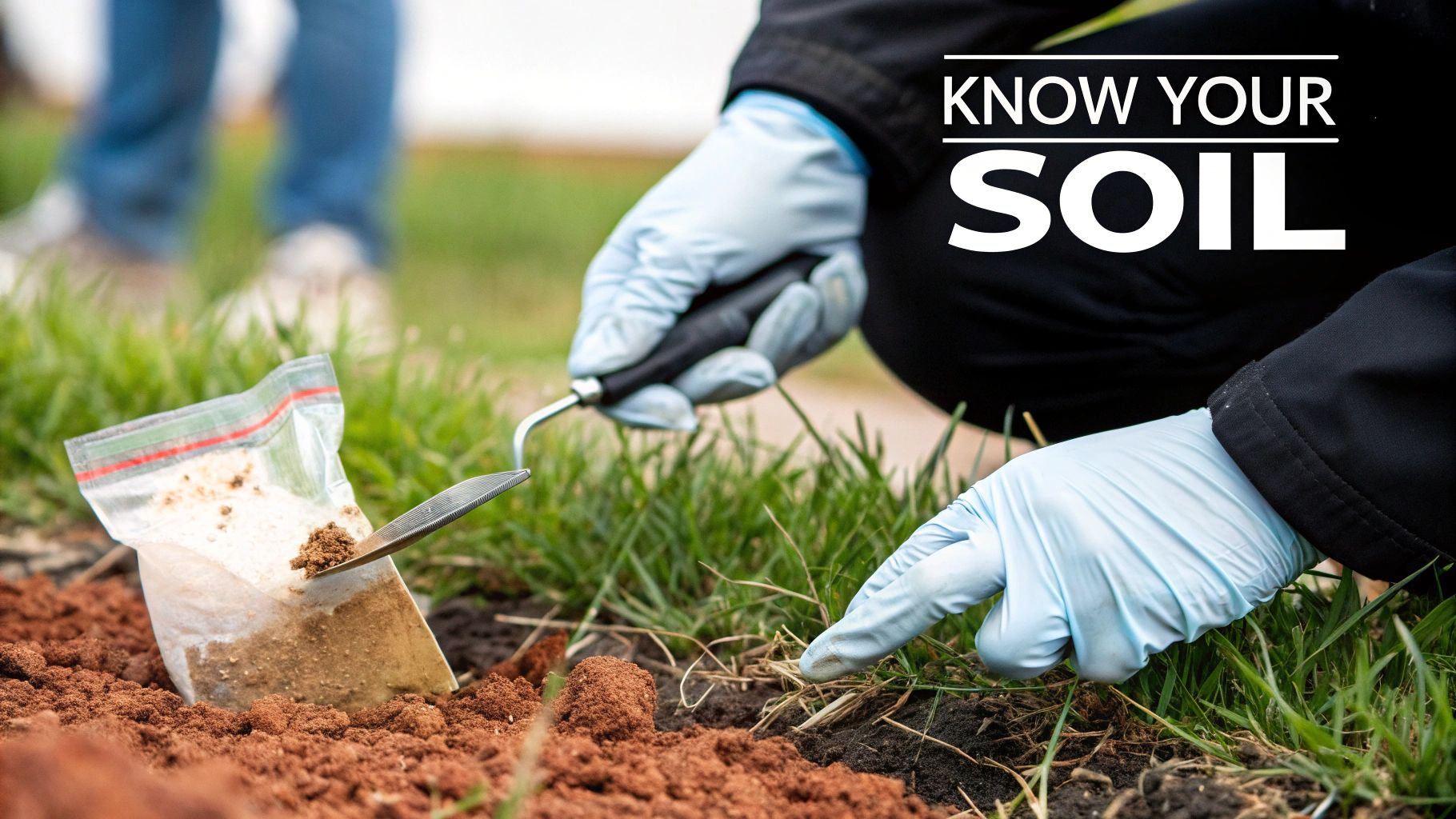
Before you can even think about which fertilizer to buy, you have to get your hands dirty and understand what you’re starting with. Here in North Georgia, from Johns Creek to Milton, our soil is the famous red clay—and it’s notoriously stubborn.
Just tossing a generic fertilizer on your lawn is a shot in the dark. A little bit of prep work transforms that guesswork into a real strategy.
The absolute first thing you should do is get a soil test. This isn’t some complicated, professionals-only task; it’s a simple and powerful tool for any homeowner. Your local UGA Extension office has easy-to-use kits that will give you a full rundown of your soil’s health, including its pH level and what specific nutrients it’s crying out for.
To get a sample, just dig down about 4-6 inches in a few different spots around your yard. Mix all that soil together in a clean bucket, bag it up, and send it off. The report you get back is a customized roadmap for your lawn, telling you exactly what it needs to thrive.
The Truth About Our Red Clay
That classic Georgia red clay poses a few specific challenges. It’s dense and gets compacted easily, which can suffocate your grass’s roots by blocking out water, air, and, you guessed it, nutrients. On top of that, our clay soil is often acidic.
Why does that matter? Acidity “locks up” vital nutrients in the soil, making them unavailable to your grass, no matter how much fertilizer you apply.
A soil test will tell you your exact pH level. If it’s on the low side (too acidic), the report will probably recommend adding lime. This one simple adjustment can be a game-changer, making your fertilizer far more effective because the grass can finally absorb the nutrients. You can learn more by checking out our guide on how to test soil pH.
Are You Team Warm-Season or Cool-Season?
Knowing your soil is half the battle; the other half is knowing your grass. Lawns across Alpharetta and Cumming are usually dominated by one of two types, and their feeding schedules are polar opposites.
- Warm-Season Grasses: These are the summer champions like Bermuda and Zoysia. They do their best growing in the heat from May through September, then go dormant and turn brown once the first frost hits.
- Cool-Season Grasses: Fescue is the main player here, especially in lawns with more shade. It looks its best in the cooler weather of fall and spring, staying green all winter but often struggling through our brutal summer heat.
Fertilizing Bermuda grass in the middle of winter is a waste of time and money—you’ll just be feeding the weeds. By the same token, pushing a heavy nitrogen fertilizer on Fescue in the peak of July can stress it to the breaking point. Timing is everything.
Identifying your grass type sets the entire calendar for your fertilization plan. It tells you exactly when your lawn is actively growing and hungry, which is the secret to getting it right. It’s no wonder people put so much effort into this; the global market for lawn care products was valued at $23.10 billion, with fertilizer leading the way. North America is the biggest market, which just shows how much we all want that perfect, healthy lawn.
Picking the Right Fertilizer for Your Lawn
Staring at a wall of fertilizer bags can make your head spin. With all those numbers and unfamiliar terms, choosing the right one for your lawn in Alpharetta or Dahlonega feels like you need a chemistry degree.
It’s actually much simpler than it looks. You just need to know what you’re looking at on the bag, and it all starts with three little numbers.
What Do Those N-P-K Numbers Mean?
You’ll see three numbers on every fertilizer bag, something like 10-10-10 or 32-0-4. This is the N-P-K ratio, and it’s a shorthand for the percentage of the three main nutrients your grass needs to really pop.
- N is for Nitrogen: This is the big one for getting that deep, lush green color. Nitrogen fuels leaf growth and makes your lawn look vibrant and healthy.
- P is for Phosphorus: Think of phosphorus as the root-builder. It’s essential for establishing a strong, deep root system, which is especially critical for new lawns or turf recovering from a tough season.
- K is for Potassium: Potassium is all about resilience. It’s like a multivitamin for your grass, helping it fight off disease, handle drought, and survive the extreme heat of a Georgia summer.
This is where your soil test results come in handy. An established lawn might just need a nitrogen-heavy formula to green up, while a brand-new lawn in Milton will need more phosphorus to get its roots going.
The Great Debate: Synthetic vs. Organic
After you get a handle on the numbers, the next choice is whether to go with a synthetic or an organic fertilizer. Both will feed your lawn, but they go about it in completely different ways, and the right choice for your family in Cumming really depends on your long-term goals.
Synthetic fertilizers are basically fast food for your grass. They’re made from chemical compounds that give your lawn a quick, powerful jolt of nutrients. You’ll see a fast green-up, but they don’t do much for the soil itself.
On the other hand, organic fertilizers are more like a slow-cooked, healthy meal. They come from natural sources like compost, bone meal, or manure. Instead of just feeding the plant, they feed the tiny microorganisms in your soil, which then break down the nutrients and make them available to your grass.
This approach builds a healthier, more resilient soil structure over time. The results might not be as immediate, but the long-term payoff for your lawn’s ecosystem is huge. To learn more, check out our guide on the best organic lawn fertilizer to see what we recommend for Georgia turf.
Slow-Release or Quick-Release?
This decision usually ties directly into whether you choose synthetic or organic. Most synthetic formulas are quick-release, and almost all organics are naturally slow-release.
- Quick-Release: You get an immediate burst of nutrients. This is great if you need a fast fix for a pale-looking lawn, but you run a much higher risk of burning the grass if you’re not careful.
- Slow-Release: Nutrients are delivered gradually over weeks or even months. This means more consistent feeding for your lawn, almost no risk of fertilizer burn, and fewer times you have to drag the spreader out of the garage.
We’re seeing a big shift toward more sustainable lawn care, which has made slow-release and organic products a top choice for homeowners. In fact, the market for these products is expected to jump from $12.5 billion to $19.32 billion by 2030. People are prioritizing options that are better for the environment and safer for their families. You can read more about these industry trends in lawn care chemicals.
For most families here in North Georgia, a slow-release organic fertilizer is hands-down the better option. It builds healthy soil from the ground up and provides a steady diet for your lawn, all while giving you peace of mind when your kids and pets are playing outside.
Proper Fertilizer Application Techniques
You’ve picked out the perfect fertilizer for your North Georgia lawn, and now it’s time to get it down. The truth is, how you apply the product is just as critical as what you’re applying. A little prep work and a steady hand are all that stand between a patchy, striped mess and a uniformly lush, green lawn in your Cumming or Alpharetta neighborhood.
Before you even think about tearing open that bag, a couple of simple steps will make all the difference. I always recommend mowing your lawn a day or two before you fertilize. This lets the granules get right down to the soil instead of getting hung up on tall grass blades.
It also really helps to have slightly moist soil—not a swamp, but definitely not bone-dry either. If you haven’t had rain recently in Johns Creek, giving the lawn a light watering the day before you fertilize will prime the soil to start soaking up those nutrients right away.
This visual guide breaks down the different approaches for various fertilizer types.
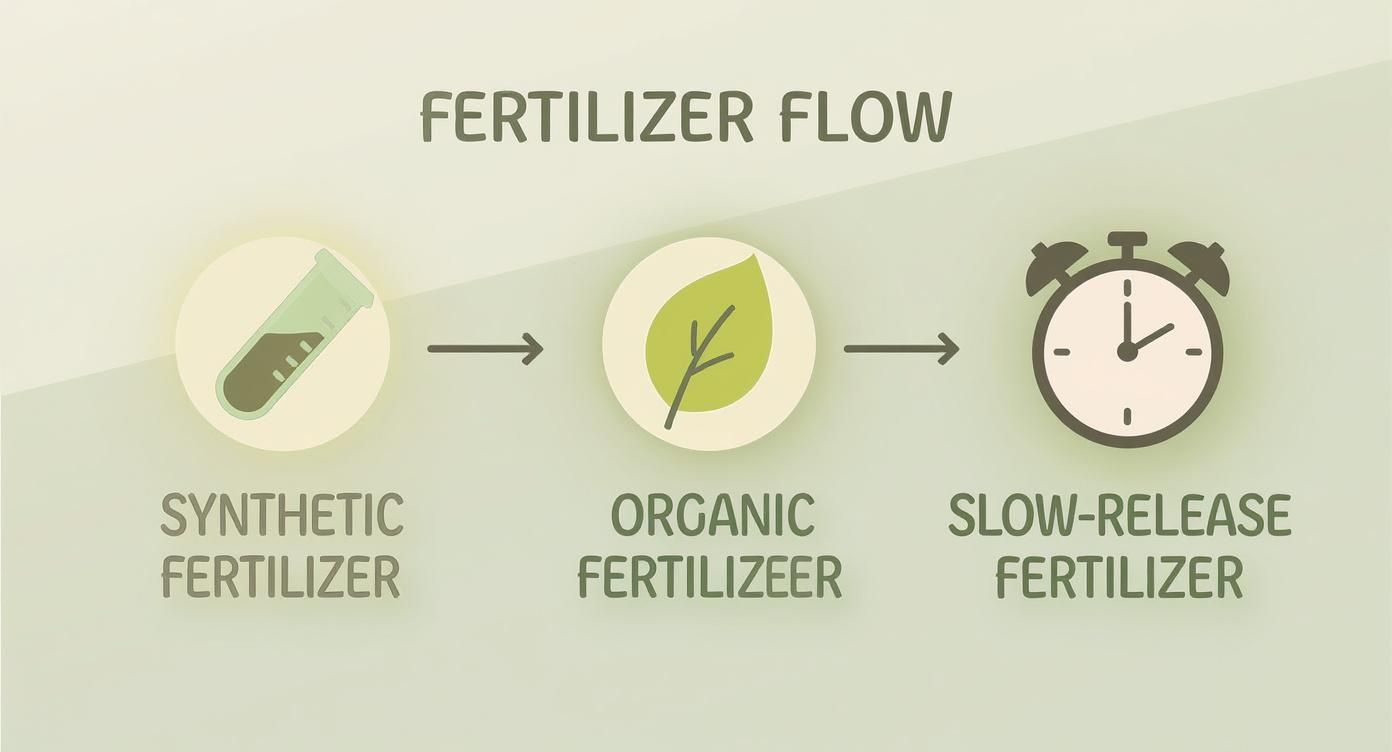
As you can see, synthetic fertilizers give you that quick green-up, but organic and slow-release options are playing the long game, focusing on building healthy soil and providing a steady diet for your turf.
Choosing and Calibrating Your Spreader
Your spreader is your most important tool for this job, and you’ll generally run into two types: broadcast and drop.
- Broadcast (or Rotary) Spreaders: These are what most homeowners use. They fling granules in a wide, fan-like pattern, which makes covering a lot of ground fast and easy. They’re perfect for most lawns around Milton and Dahlonega.
- Drop Spreaders: These do exactly what the name implies—they drop the fertilizer straight down in a line between the wheels. This gives you incredible precision, which is great for smaller yards or when you need to carefully work around flower beds and walkways without tossing fertilizer where it doesn’t belong.
No matter which type you own, calibration is non-negotiable. Every fertilizer bag comes with recommended settings. I can’t tell you how many scorched lawns I’ve seen because someone skipped this step. Always, always follow the specific instructions for your product and spreader model.
The Art of the Application
Once your spreader is dialed in, the actual application process feels a lot like mowing. The goal is the same: even, slightly overlapping passes for complete coverage.
Here’s a technique the pros use: start by applying a “header strip” around the entire perimeter of your lawn. This creates a buffer zone where you can turn around at the end of each row without accidentally dumping a double dose of fertilizer on the grass.
With your header strip in place, just walk back and forth across the lawn in straight lines. Overlap each pass just enough—usually by about the width of your spreader’s wheel—to prevent any striping. Maintaining a steady, consistent walking speed is the real secret to an even application.
After the last pass, you’re almost done. Grab a broom or leaf blower and sweep any stray granules off your driveway, sidewalks, and patio back onto the lawn. This isn’t just about being neat; it prevents that fertilizer from washing down the storm drains and into our local waterways.
Finally, the most important last step is to water it all in. A solid 15-20 minutes of watering will activate the fertilizer, helping the granules dissolve and moving those nutrients down into the root zone where they’re needed most. This is also a perfect time to think about soil compaction. Learning more about how to aerate your lawn can be a game-changer for improving how well your grass absorbs both water and these vital nutrients.
Keeping Your Lawn Safe and Thriving After You Fertilize
Alright, you’ve spread the fertilizer—but the job isn’t quite done yet. What you do next is just as important as the application itself, especially when it comes to keeping your family, pets, and the local Cumming environment safe. Proper aftercare is the key to protecting your loved ones and making sure all that hard work actually pays off.
One of the first questions I always hear from homeowners in Alpharetta is, “So, how long do we have to stay off the grass?” The honest answer is: it depends entirely on what you just put down.
- Organic Stuff: If you went with a truly natural, organic product, you’re in luck. Once you’ve watered it in, the lawn is pretty much good to go for kids and pets. This is a huge reason why so many people are making the switch.
- Synthetic Granules: For the more traditional synthetic products, the golden rule is to wait at least 24 hours after giving the lawn a good soak. This gives those little granules time to dissolve and work their way into the soil, away from curious hands and paws.
No matter what, always check the product label. The manufacturer’s instructions are your best friend here—follow them to the letter to keep everyone safe.
The Simple Secrets to Post-Fertilizer Success
Your routine after fertilizing is straightforward but makes all the difference in getting that deep, lush green you’re after. It all starts with water.
As soon as you finish spreading a granular fertilizer, give your lawn a solid drink for about 15-20 minutes. This does two critical things: it rinses any fertilizer dust off the grass blades to prevent burning and starts pushing the nutrients down into the soil where the roots can find them.
After that first watering, just go back to your normal schedule. Remember, it’s better to water deeply and less often. This encourages the roots to dig down deep, which is your lawn’s best defense against the hot, dry spells we often get here in Forsyth County.
Storing Leftovers and Timing Your Next Mow
The final details—storing what’s left and knowing when to fire up the mower—are the last pieces of the puzzle.
When you’re all finished, seal the fertilizer bag up tight. Find a cool, dry spot for it in your garage or shed, and make sure it’s well out of reach of children and pets. This keeps the product fresh and prevents any accidental spills.
As for mowing, hold off for at least 24-48 hours after you’ve watered the fertilizer in. If you mow too soon, the mower bag will just suck up a good portion of the granules you just spread, wasting your time and money. Giving it a day or two ensures the fertilizer is settled right where it needs to be.
A great-looking lawn is a big deal to people, and it shows—the professional fertilizer market in the U.S. is on track to hit $2.1 billion. You can dive deeper into these lawn and garden fertilizer trends if you’re curious. By following these simple aftercare steps, you’re making sure your lawn is part of that beautiful, healthy standard.
Answering Your Top Lawn Fertilization Questions
Even with the best game plan, questions always come up. From Cumming to Alpharetta, homeowners often bump into the same tricky situations, especially with North Georgia’s unpredictable climate. Let’s tackle some of the most common questions I hear from folks.
Should I Fertilize My Lawn During a Georgia Drought?
This is a big one, and the short answer is no. It’s almost always best to hold off on fertilizing a lawn that’s dormant or stressed from lack of water.
Think of it this way: when your Johns Creek lawn is struggling through a drought, it’s just trying to survive. Pushing fertilizer on it is like trying to force-feed someone who’s already sick—it can actually burn the grass because the plant can’t process the nutrients without enough water.
The best move is to wait for consistent, reliable rain to return. If you feel you absolutely have to fertilize during a dry spell, go with a very light hand, use a slow-release organic product, and water it in deeply, first thing in the morning, to cut down on evaporation.
What Are the Signs of Over-Fertilizing?
It happens! Going a little too heavy with the fertilizer is a common mistake, but thankfully, the lawn usually tells you pretty clearly. You’ll want to look for a few key signs.
The most obvious is scorched-looking patches that are yellow or brown. You might also see weird streaks of discolored grass where the spreader overlapped, or even a crust of leftover fertilizer granules sitting on the soil.
If you spot this, the fix is to flush the area with water. I mean a lot of water. Soak it deeply for several days in a row to help wash the excess salts down and away from the grass roots. Don’t even think about adding more fertilizer until you see that Milton lawn start to bounce back with healthy new growth.
Is Liquid or Granular Fertilizer Better for My Bermuda Lawn?
Great question. Both have their place for Bermuda and Zoysia lawns around here, and the best choice really boils down to your goals and how you prefer to work.
- Granular Fertilizers: These are the workhorses. They’re easy to apply and provide a steady, long-term food source for your lawn. A good slow-release granular is perfect for giving your grass a consistent supply of nutrients for months.
- Liquid Fertilizers: Think of liquids as a quick fix. They’re fantastic for a fast green-up or if your soil test shows a specific nutrient is missing. The downside is they have to be applied more often, and you have to be more careful to get even coverage.
For most North Georgia homeowners, a high-quality granular fertilizer is the more practical and forgiving option for routine feeding. It delivers the reliable, steady nutrition our warm-season grasses need to power through those hot summers.
How Long Should I Wait to Mow After Fertilizing?
Give it at least 24 hours after you’ve watered the fertilizer in. That waiting period is crucial because it allows the granules time to dissolve and start working their way into the soil.
If you jump the gun and mow too soon, the suction from your mower can literally vacuum up a good chunk of the fertilizer you just spread. That’s a waste of your time and money. The best routine is always mow first, then apply your fertilizer, and finish by watering everything in.
Ready to skip the guesswork and get a lawn that’s the envy of your Forsyth County neighborhood? At Barefoot Organics, we specialize in natural, effective lawn care solutions designed specifically for North Georgia’s unique soil and climate. We build healthy, resilient lawns that are safe for your kids and pets. Get your free, no-obligation quote today and see the difference a professional, organic approach can make. Visit us at https://barefootorganicsllc.com to get started.