

When you live in North Georgia, you know our winters can be a bit of a mixed bag. One week it's mild, the next we're getting a hard frost. Nailing the timing for your winter fertilizer application is crucial, and it’s a question I get all the time from folks in Cumming, Alpharetta, and all over Forsyth County.
The sweet spot for getting that winterizer down is between late October and early December. You're aiming for that perfect window after your last mow of the season but before the ground freezes solid. The real key is the soil temperature—you want it to be consistently above 50°F so the grassroots are still active enough to soak up all that goodness.
Your North Georgia Winter Fertilizer Timeline
Let's get one thing straight: winterizing your lawn isn't about chasing one last burst of green growth before everything goes dormant. It's a strategic play for next spring. This single application is all about feeding the roots, protecting your lawn from cold stress, and setting the stage for a strong, healthy return when the weather warms up.
Think of it this way: summer fertilizers push top growth for that lush, green look. A winterizer works underground, strengthening the foundation of your lawn. For the cool-season grasses we love here in North Georgia, like Fescue and Ryegrass, this late-fall feeding is non-negotiable. As the air cools and the blades stop growing, the roots are still working hard, storing up nutrients for the long haul.
It’s like stocking the pantry for the winter. By giving your grass a meal low in nitrogen but high in potassium, you're helping it build stronger cell walls, fight off winter diseases, and store energy.
This timeline gives you a simple visual for how it all fits together.
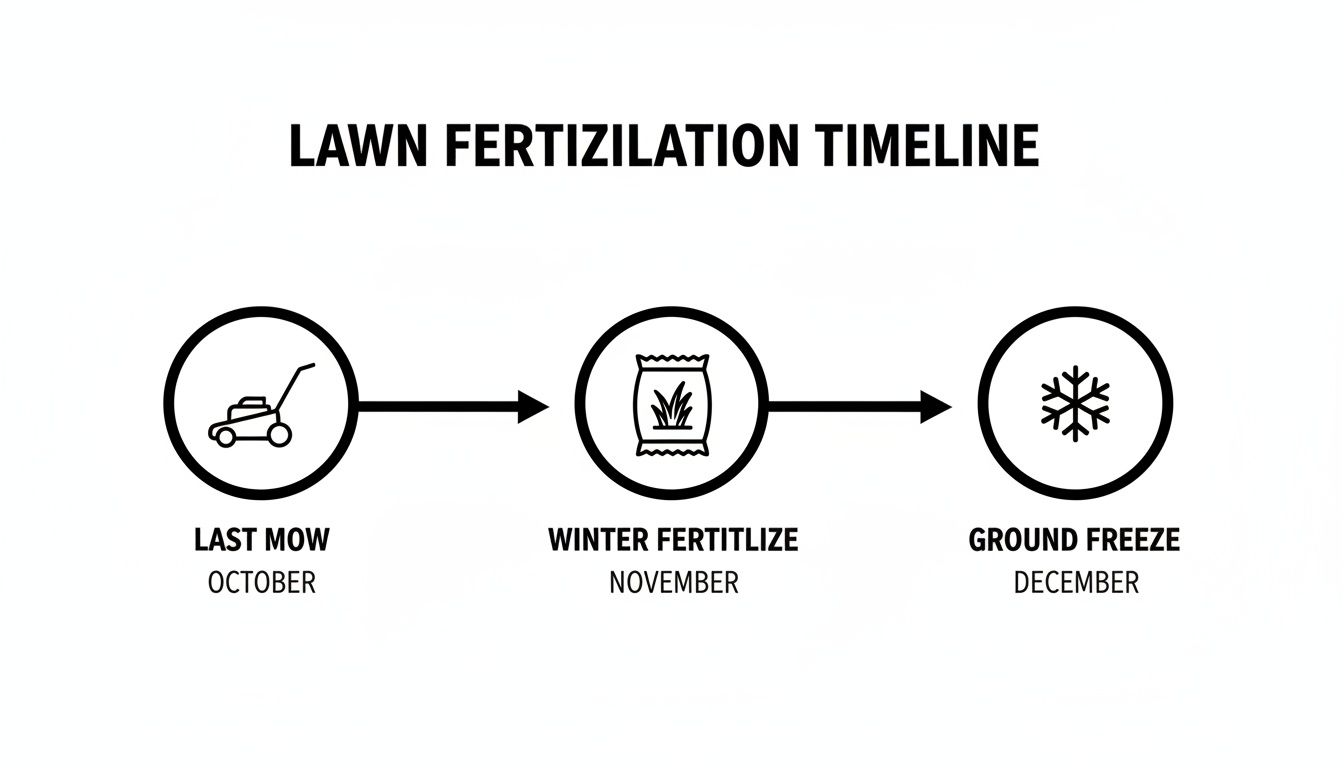
As you can see, it’s a pretty straightforward sequence. That application window falls right between your final mow and the first real ground freeze, ensuring the soil is ready to accept the nutrients.
The Science Behind the Schedule
So, why is this late October to early December window so critical for our lawns from Milton to Johns Creek? It’s all about the interplay between soil temperature and what your grass is trying to do to survive the winter.
-
Soil Temperature is Everything: Grass roots will keep absorbing nutrients as long as the soil is above 40-45°F. But the optimal window is when those temps are holding steady in the 50s. This allows for maximum absorption without tricking the blades into putting on new growth that will just get zapped by the first hard frost.
-
Banking Energy for Spring: During the fall, the grass plant naturally shifts its focus from growing leaves to developing roots and storing carbohydrates. The potassium in a good winterizer directly fuels this process. It's building up an energy reserve that will power a vigorous green-up next spring, often weeks ahead of lawns that were neglected.
This isn't just old-school lawn wisdom; the science backs it up. For our specific climate in North Georgia, a well-timed winter fertilizer application can boost root growth by as much as 8-9%. Research on cool-season grasses has shown time and again that late-fall applications significantly increase the root mass that emerges in the spring.
A Quick Guide for Local Grass Types
To make it even easier, here’s a quick-reference table for homeowners around Cumming and Alpharetta. This will help you pinpoint the best time to act based on the type of grass you have.
North Georgia Winter Fertilizer Application Windows
| Grass Type | Optimal Timing Window | Key Indicator |
|---|---|---|
| Tall Fescue | Late Oct – Mid-Nov | Soil temps consistently 50-55°F. Your mowing has slowed to every 2-3 weeks. |
| Kentucky Bluegrass | Early Nov – Late Nov | After the first light frost, but 2-3 weeks before a hard ground freeze is expected. |
| Perennial Ryegrass | Late Oct – Mid-Nov | Similar to Fescue. The grass has stopped its vigorous vertical growth for the season. |
| Zoysia & Bermuda | (Do not apply) | These warm-season grasses are dormant. Fertilizing now can cause damage. |
This table helps translate the general "late fall" advice into actionable cues you can see right in your own yard.
Watch the Weather, Not Just the Calendar
Every year in North Georgia is a little different. A warm, extended autumn might push your ideal application date into the first week of December. An early cold snap could have you reaching for the spreader in late October. The best tool you have is observation.
My Pro Tip: Don't guess. Grab a simple soil thermometer and check the temperature a few inches down. Once it’s holding steady between 50°F and 55°F, that’s your green light.
Your goal is to get that fertilizer down and watered in before the ground gets too hard for the nutrients to penetrate. By following this local-first approach, you’re giving your lawn its best shot to not just survive a North Georgia winter, but to come back in the spring stronger and healthier than ever.
To see how this single application fits into a full year of care, check out our comprehensive lawn care schedule template. It puts everything into context.
Why Bother Fertilizing Before a Georgia Winter?
If you live anywhere from Cumming to Dahlonega, you've probably wondered if winter fertilizing is really necessary. It's a fair question. After all, the grass is about to go dormant, right? But here in North Georgia, with our wild temperature swings and stubborn red clay soil, that final fall application is more than just another chore—it’s the single most important thing you can do for your lawn's long-term health.
Unlike the fertilizers we use in spring and summer to get that deep green, leafy growth, a winterizer has a completely different job. Its focus is entirely underground, building a powerful, resilient root system that can store energy and nutrients all winter long.
Stocking the Pantry for the Cold Months
Think of your lawn’s root system like a pantry for the winter. All season, your grass has been burning energy to grow. As the days get shorter and cooler in places like Alpharetta and Johns Creek, your Fescue or Ryegrass gets the signal that it's time to stop focusing on top growth and start hoarding resources down below.
This is where a good winterizer steps in. By giving your lawn a meal loaded with potassium, you’re helping it stock that pantry. The grass pulls those nutrients down into the roots, converting them into carbohydrate reserves. It’s the fuel it needs to survive freezing temperatures and power its comeback in the spring.
Honestly, this one feeding is probably the most crucial application your lawn will get all year. It’s what separates the lawns that merely survive winter from the ones that are ready to explode with growth next season.
Without this critical late-season meal, your lawn goes into winter hungry. It’s weaker and far more susceptible to cold-weather stress and diseases. Come spring, it will struggle to green up, often looking thin, patchy, and exhausted.
The Payoff Lasts All Year Long
The benefits of a well-timed winter fertilizer application go way beyond just getting through the cold. We see it every year with our clients across Forsyth and Cherokee Counties—the positive effects are tangible and last through the following spring and summer.
Here’s what that well-stocked "pantry" really does for your lawn:
-
A Faster, Greener Spring: Properly winterized lawns are always the first ones on the block to turn a vibrant green in the spring. Because they have a full tank of energy reserves, they don't hesitate. As soon as the soil warms up, they burst to life, looking healthier weeks before unfed lawns even start to wake up.
-
Better Drought Tolerance: A deep, robust root system is your best insurance policy against our brutal Georgia summers. The root growth encouraged by winter feeding builds a stronger, more expansive network that can find water deep in the soil when things get hot and dry.
-
Natural Disease Resistance: A strong, well-fed lawn is much better at fending for itself. Potassium, a key ingredient in winterizers, actually strengthens the cell walls of the grass, making it physically tougher and more resistant to common fungal diseases like brown patch. It's a proactive step that means fewer problems down the road.
Ultimately, this one application sets off a positive chain reaction. A stronger spring lawn becomes a more resilient summer lawn, which then heads into the next fall in even better shape. It’s how you break the cycle of a struggling, needy yard and build a genuinely healthy lawn from the ground up.
Choosing the Right Fertilizer for a Pet-Safe Lawn
If you have kids and pets tearing around your yard in Milton or Cumming, the safety of what you put on your lawn is a top priority. Staring at the fertilizer aisle can feel like a pop quiz in chemistry, but picking the right winter formula is actually pretty straightforward. It's all about finding something that works for your North Georgia lawn and is safe for your whole family.
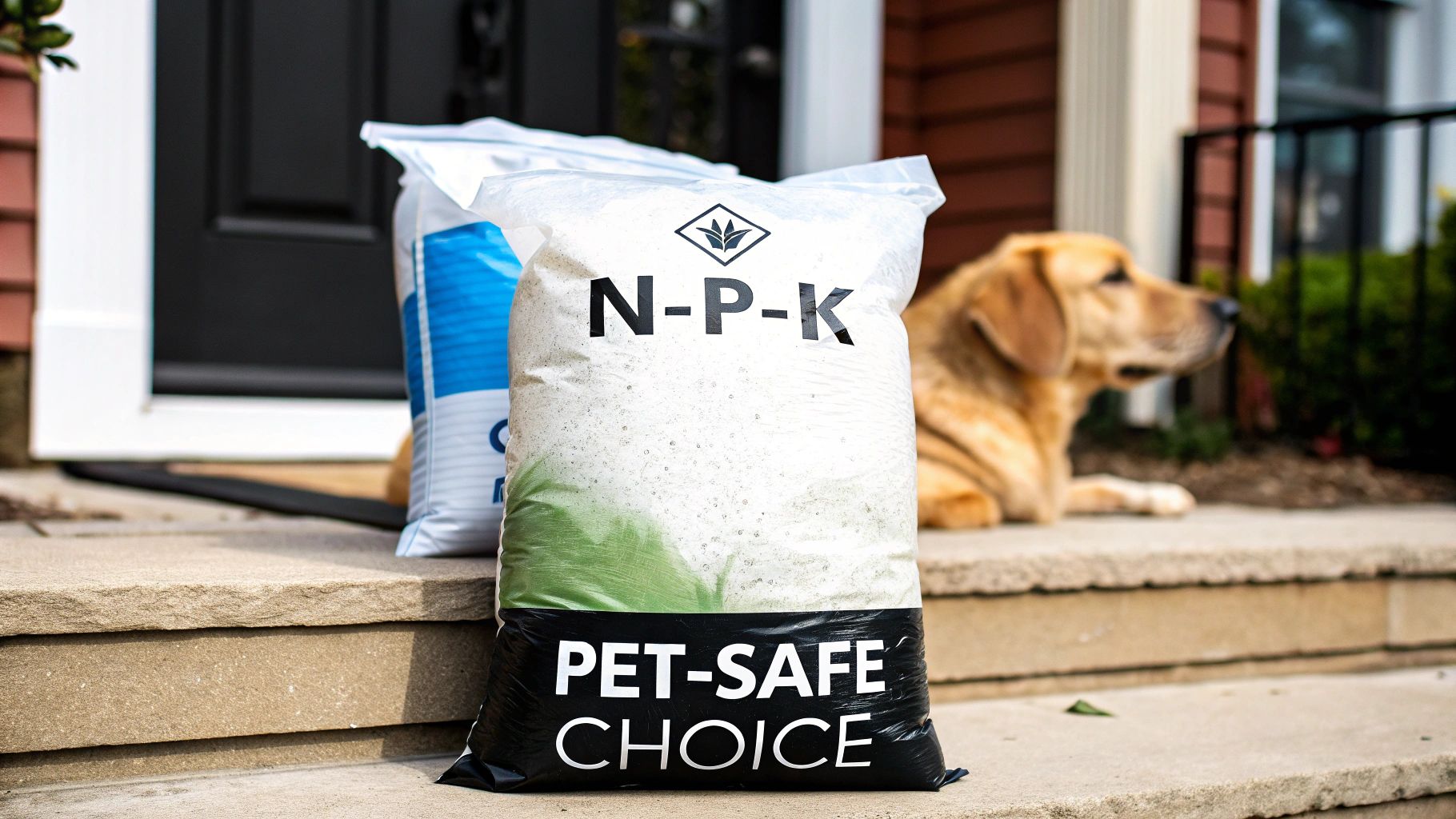
The most important thing to get a handle on is the N-P-K ratio—those three big numbers on every bag. They stand for Nitrogen (N), Phosphorus (P), and Potassium (K), the main nutrients your grass craves. For a winter application, you’re looking for a bag where the first number (Nitrogen) is low and the third number (Potassium) is high.
Why Potassium is the Winter MVP
Dumping a high-nitrogen fertilizer on your lawn in late fall would be a huge mistake. It just forces a bunch of weak, leafy growth that the first hard frost will immediately zap.
Instead, potassium (K) is the real star of the show. Think of it as a winter coat for your grass. It strengthens the plant's cell walls, helping it tough out cold temperatures and fight off common winter fungal diseases. A high-potassium formula is your best bet for building that deep-down resilience.
Slow-Release Organics vs. Fast-Release Synthetics
Your next decision is between organic and synthetic formulas. They both provide nutrients, but they work in completely different ways, especially when you factor in pet safety and the local environment.
-
Synthetic Fertilizers: These are basically an energy drink for your lawn. They’re chemical salts that dissolve fast, giving your grass an immediate jolt of nutrients. While they green things up quickly, they can be harsh on the soil’s microbial life and are more likely to wash into local waterways around Cherokee and Forsyth counties.
-
Organic Fertilizers: Think of these as a slow, nourishing meal. They come from natural sources like bone meal or compost and work by feeding the soil first. The tiny organisms in the soil break down the material, releasing nutrients slowly over time. This builds a healthier soil ecosystem and is a much safer bet for lawns where kids and pets play.
For homeowners around here, I always recommend going with a natural, slow-release product. It’s simply the most family-friendly approach and supports the long-term health of your soil, not just a temporary pop of green. You can dig deeper into the benefits in our guide to pet-safe lawn care.
Reading the Label Confidently
Don’t get overwhelmed by the long list of ingredients. When you’re hunting for a pet-safe product, look for words like "organic," "natural," or "slow-release." Steer clear of combination products that contain harsh chemical herbicides or pesticides, which are often sold as "weed and feed."
There's solid research to back this up. We know that winter fertilizer applied when the soil is between 45-55°F can boost root mass by 8-12% heading into summer—a huge deal for lawns stressed by the humidity we get in Forsyth County. On top of that, homeowners in Milton who choose organic, slow-release formulas can cut nutrient pollution by 30% compared to those using synthetics.
Choosing an organic winterizer isn't just a safety precaution; it's a strategic investment in the health of your soil's entire ecosystem. A healthy soil biome means a more resilient and naturally beautiful lawn year-round.
While the right fertilizer is key, you can also protect your lawn by creating dedicated dog potty areas to prevent those infamous spots. By pairing a safe product with smart lawn management, you create a beautiful outdoor space that you, your family, and your pets can all enjoy without a second thought.
Getting the Application Just Right: A Practical Guide
You’ve picked out the perfect winterizer for your North Georgia lawn. Now comes the part where the rubber meets the road—or in this case, where the spreader wheels meet the turf. A precise application is what separates a good result from a great one. For homeowners from Johns Creek to Dahlonega, this is a pretty straightforward process once you know the key steps.
Let's walk through how to get it done right, making sure every one of those nutrient-packed granules goes exactly where it needs to.

First Things First: Prep Your Lawn for Success
Before you even think about tearing open that fertilizer bag, a little prep work will make a world of difference. The whole point is to get the granules in direct contact with the soil. If there's a thick blanket of fall leaves or debris in the way, those vital nutrients will never reach the grassroots.
Take the time to rake or blow all the leaves, sticks, and anything else off your lawn. I can't stress this enough; it's a non-negotiable step for an effective feeding. It ensures that when you water everything in later, the fertilizer washes down into the soil instead of getting stuck to a bunch of wet leaves.
Calibrating Your Spreader and Doing the Math
Guesswork is the enemy of a beautiful lawn. Spreading too little means you won't see the full benefits, but spreading too much is a waste of money and can seriously burn your grass. The secret is knowing your lawn's size and dialing in your spreader settings.
- Measure Your Lawn: Figure out the approximate square footage of your turf. A quick way to do this for rectangular areas is just to multiply the length by the width.
- Read the Bag: Your fertilizer bag will tell you how many pounds of product to apply per 1,000 square feet. For instance, it might recommend 3 pounds per 1,000 sq. ft.
- Adjust Your Spreader: The bag should also have a list of recommended settings for common spreader models (like Scotts or Earthway). Use that number as your starting point. My advice? It's always better to start on a slightly lower setting. You can always make a second pass if you need to, but you can't take back fertilizer once it's down.
This is the one step I see people skip all the time, and it's so important. For a more detailed breakdown, our complete guide on how to fertilize a lawn goes even deeper into the specifics.
A common mistake I see in Cumming and Alpharetta is homeowners just pouring the bag into the spreader and walking without measuring. Taking ten minutes to calculate your lawn’s square footage and calibrate your spreader is the difference between a pro-level application and a streaky, uneven mess.
Mastering Your Spreader Pattern
With your spreader calibrated and loaded, it's time to get moving. The goal here is consistent, even coverage—that's how you avoid those ugly stripes of dark green and pale yellow. Always, always apply winterizer to a dry lawn. The granules just bounce off wet grass blades, leading to a splotchy application.
Here’s the simple pattern the pros use for perfect coverage:
- Make a "Header Strip": Start by making two passes around the entire perimeter of your lawn. This creates a border that gives you a safe space to turn around in without accidentally dumping piles of fertilizer.
- Walk at a Steady Pace: Now, walk back and forth across the main lawn area in straight lines. A normal, steady walking speed is all you need. Don't rush it.
- Overlap Your Wheel Tracks: As you make each pass, aim to have the fertilizer from your spreader slightly overlap the wheel track from the previous pass. About six inches of overlap is perfect for preventing gaps.
- Close the Hopper: Remember to shut off the spreader flow whenever you stop walking or as you make your turns on that header strip. This prevents those concentrated green burn spots.
Following this pattern ensures every square foot of your turf gets its fair share of nutrients.
According to Georgia Extension guidelines for our North Georgia climate, the sweet spot for this application is when soil temperatures hit 55°F, which often happens in mid-to-late November in areas like Milton. Getting the timing right can lead to a 20-25% boost in winter hardiness for the fescue lawns so common in Forsyth County. On the other hand, you should hold off if the soil temp drops below 40°F, as nutrient uptake plummets by 40-50%, which only increases the risk of root burn.
The Final, Crucial Step: Water It In
Once the last granule is spread, you have one final job. Give the lawn a light watering for about 10-15 minutes. This accomplishes two critical things: it washes any fertilizer off the grass blades and down to the soil, and it activates the slow-release nutrients, kick-starting the feeding process for the roots.
Now you can step back, knowing you’ve given your lawn the strategic meal it needs to power through winter and come back swinging next spring.
Lawn Care That Goes Beyond Fertilizer
Applying a good winter fertilizer is one of the smartest things you can do for your North Georgia lawn. But if you’re aiming for a lawn that doesn't just survive winter but truly thrives and explodes with growth in the spring, a single feeding isn't the whole story. To get the absolute most out of that winterizer, we need to look at the bigger picture.
For those of us with lawns in Cumming, Alpharetta, and across Forsyth County, two key practices work in perfect harmony with a winter fertilizer application: fall core aeration and getting that final mow just right. Think of these not as extra chores, but as force multipliers that guarantee your winterizer does its best work.
Unlocking Your Soil with Core Aeration
If you’ve ever tried to dig into your yard, you know all about our dense, compacted red clay soil. It’s a hallmark of North Georgia. Over a long, hot summer, foot traffic and rain can make this soil nearly as hard as concrete, which chokes off the grassroots from everything they need to survive.
This is where fall core aeration becomes an absolute game-changer.
By pulling small plugs of soil out of the lawn, we’re essentially opening up thousands of tiny windows. For your grass, it’s a breath of fresh air. These new channels allow fertilizer, water, and oxygen to bypass the compacted surface and get straight down into the root zone.
- Better Nutrient Uptake: After aerating, your winter fertilizer granules fall directly into these holes. This places those vital nutrients right where the roots can grab them, instead of just sitting on the surface.
- Improved Water Absorption: Aeration shatters that hardpan layer, so rainwater soaks deep into the soil profile instead of just sheeting off into the street.
- Enhanced Oxygen Flow: Grass roots need to breathe! Aeration delivers critical oxygen to the root system, fostering a much healthier underground environment.
Timing this service in the fall, right before your winterizer application, is the perfect one-two punch for lawns in Forsyth and Cherokee counties.
The Importance of the Final Mow
Your last mow of the season is more than just a final trim—it’s a critical step in tucking your lawn in for its long winter nap. How you cut your grass in late fall can either set it up for success or leave it vulnerable.
The goal here is balance. Mowing too short scalps the lawn and exposes the crown of the plant to harsh winter winds and frost. But if you leave it too long, the blades will mat down under the winter moisture. This creates a damp, tangled mess that’s a perfect breeding ground for fungal diseases like snow mold.
For the beautiful Fescue lawns so common in Milton and Johns Creek, a final cutting height of around 2.5 to 3 inches is the sweet spot. This is just long enough to insulate the plant but short enough to promote good air circulation and discourage disease.
This simple adjustment helps your lawn enter dormancy strong and resilient. And while fertilizer builds a vibrant lawn, a truly comprehensive approach also means protecting your turf from pests that can ruin all your hard work. Dealing with issues like moles and voles removal is another crucial piece of the puzzle, preventing underground damage that can undermine everything you’ve done on the surface.
Fall & Winter Lawn Care Synergy
Viewing these tasks as interconnected parts of a whole system is the key to a standout lawn. This table shows how combining these efforts creates a result far greater than the sum of its parts.
| Lawn Care Action | Benefit of Action Alone | Combined Benefit with Winter Fertilizer |
|---|---|---|
| Fall Core Aeration | Relieves soil compaction and improves air/water flow to roots. | Nutrients from winterizer penetrate directly into the root zone for maximum absorption and minimal runoff. |
| Proper Final Mow | Reduces the risk of winter fungal diseases and protects the plant's crown. | A healthy, disease-free lawn is better able to store and use the fertilizer's nutrients throughout winter. |
By synergizing these treatments, you're not just feeding your lawn; you're creating the perfect environment for it to use those nutrients effectively. This holistic approach ensures your lawn has the deep root structure, disease resistance, and stored energy it needs to bounce back stronger than ever next spring.
Got Questions About Winterizing Your Georgia Lawn? We’ve Got Answers.
Even with the best plan, lawn care in North Georgia always brings up a few questions. From Cumming to Milton, we get calls from homeowners who want to make sure they're doing the right thing for their specific yard. Let's tackle some of the most common questions we hear.
Can I Put Winter Fertilizer on My Bermuda or Zoysia Lawn?
This is a big one, and the answer is a hard no. Applying any kind of winter fertilizer to warm-season grasses like Bermuda, Zoysia, or Centipede is one of the most frequent mistakes we see people make around here. Once the weather turns cold, these grasses go completely dormant. Their root systems basically shut down for a long winter nap.
Throwing fertilizer on them during this time is worse than just wasting money; it can actually hurt your lawn. The nutrients won't get absorbed and can damage the dormant turf. Even worse, a late shot of nitrogen can trick the grass into a weak spurt of growth just in time for the first hard frost to kill it right off, leaving your lawn stressed and vulnerable. For these grass types, it's all about fall prep, not winter feeding.
What If I Get the Timing Wrong and Fertilize Too Early or Too Late?
With winterizer, timing really is everything. Whether you're in Forsyth or Cherokee County, missing that ideal window can either undo all your hard work or create brand-new headaches.
- Applying Too Early (September/Early October): If you jump the gun while the soil is still warm, you’re just encouraging a flush of flimsy top growth. That tender new grass is a magnet for fungal diseases and will be the first thing to die back when a surprise frost hits.
- Applying Too Late (After the Ground Freezes): Once the ground is frozen solid, the fertilizer has nowhere to go. The granules will just sit on the surface, ready to be washed away by the first winter rain. This not only wastes your money but also contributes to nutrient runoff in our local streams.
Does the Type of Spreader I Use Really Matter?
It does! For most homeowners, there are two choices: broadcast (or rotary) and drop spreaders. For the typical suburban lawn in Alpharetta or Johns Creek, a broadcast spreader is almost always the better option. It slings the granules in a wide, overlapping arc, making it much easier and faster to get even coverage. You're far less likely to get those ugly stripes you sometimes see.
Drop spreaders, on the other hand, drop the fertilizer straight down. While they're precise—which is handy for tight spots next to flower beds—they demand a perfect, overlapping walking pattern. One small mistake and you'll see green and yellow stripes in your lawn for months.
Should I Bag the Clippings After My Final Mow?
Excellent question. It shows you're thinking about your lawn as a complete ecosystem. For that last mow of the season, yes, bagging the clippings is a smart move. During the growing season, letting clippings fall back on the lawn (a practice called "grasscycling") is great for returning nutrients to the soil.
But heading into a long, damp winter, a thick layer of clippings can mat down and suffocate the turf. This creates a soggy, trapped layer of moisture right against the grass blades—the perfect breeding ground for winter fungal diseases like snow mold. Bagging them for the last cut keeps things clean and lets air circulate, helping your lawn stay healthy through its dormancy.
A common misconception is that all fertilizer is the same. The truth is, the product you use in May for lush growth is fundamentally different from the one your lawn needs in November for root strength. Using the wrong formula at the wrong time is often worse than using nothing at all.
When you get right down to it, understanding the "why" behind your lawn care routine is what separates a decent yard from a great one. Every step, from picking the right product to nailing the timing, is about working with your lawn's natural rhythm. You're not just feeding the grass; you're building a resilient, healthy foundation for the entire year to come.
Ready to give your lawn the professional, organic care it deserves without all the guesswork? The team at Barefoot Organics is here to create a customized plan for your property, ensuring it stays healthy and beautiful all year round. Get your free online quote today!