

Ever walked down the fertilizer aisle and felt a bit lost staring at those three numbers on the bag? That's the NPK ratio, and it's the single most important piece of information for understanding what you're about to feed your lawn.
Think of it like the nutrition label on food. Those numbers stand for Nitrogen (N), Phosphorus (P), and Potassium (K)—the three core macronutrients your grass needs to thrive. Each one plays a unique and vital role in creating a healthy, beautiful lawn.
Cracking the Code for a Greener Lawn
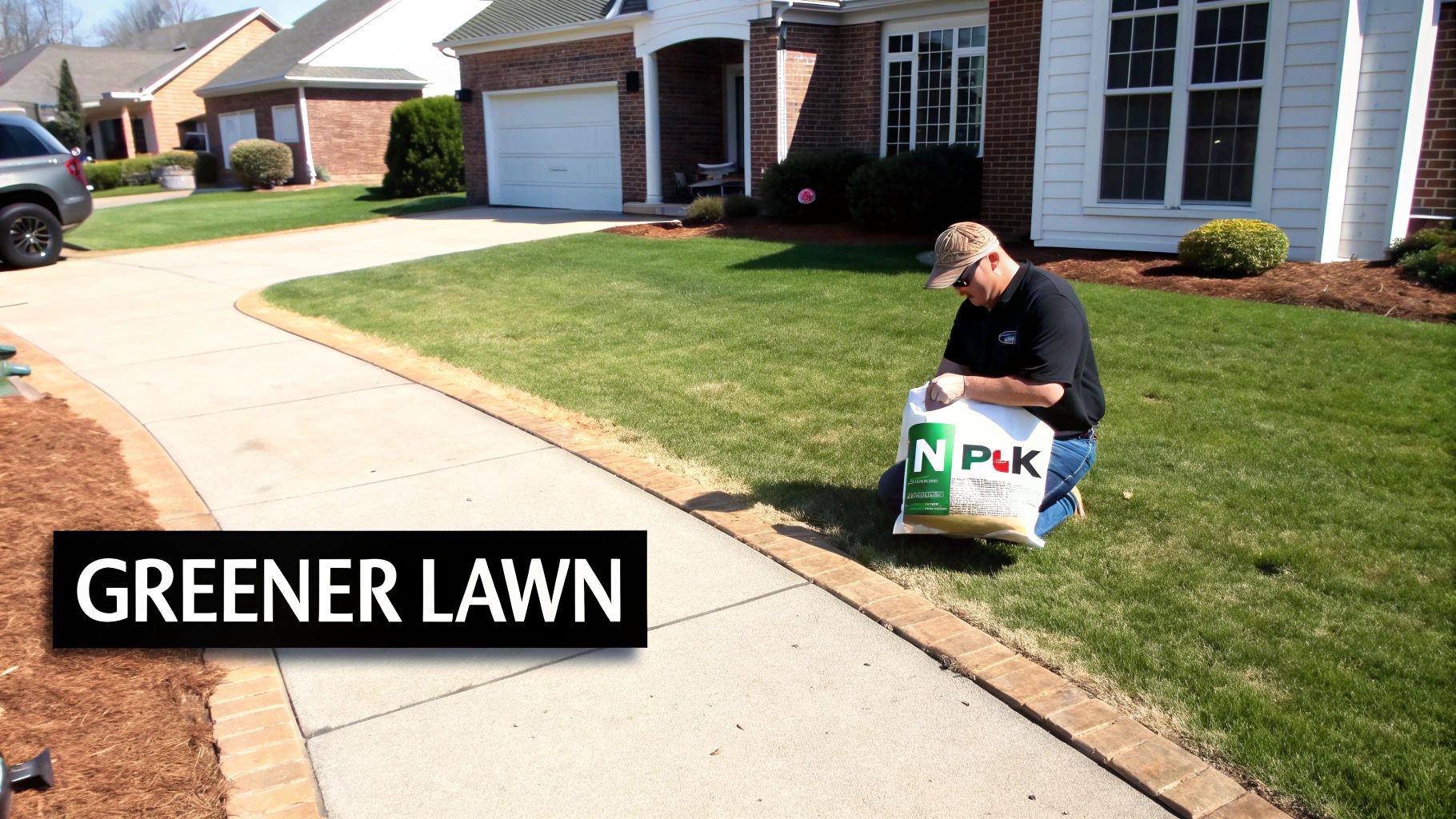
For homeowners across North Georgia, from Cumming to Alpharetta, getting this NPK recipe right is the secret to a lawn that’s not just green, but truly healthy from the roots up. But what exactly is NPK, and why should you care? It’s the very foundation of plant nutrition.
This guide will break it all down. We'll look at what NPK is, how each nutrient works its magic, and how you can use this knowledge to create a vibrant yard in communities like Johns Creek and Milton that’s also safe for your kids and pets to play on.
Understanding this trio is about moving beyond guesswork. It’s about making smart, informed choices for your property based on what it actually needs to flourish in our unique Georgia climate.
The Three Essential Macronutrients
Each letter in NPK stands for one of the three primary nutrients that plants need in large amounts to grow. Without the right balance, your lawn will struggle, looking thin, discolored, and becoming an easy target for pests and diseases.
Let's look at the role each one plays:
- N for Nitrogen: This is all about growth and green. Nitrogen is the engine that drives lush, dense turf and gives your lawn that vibrant, deep green color.
- P for Phosphorus: Think of this as the foundation builder. Phosphorus is crucial for developing a strong, deep root system and helps the plant manage and transfer energy effectively.
- K for Potassium: This is your lawn's bodyguard. Potassium strengthens the grass from the inside out, helping it withstand stress from drought, heat, cold, and disease.
The NPK concept isn’t just some local gardener’s trick; it’s a global agricultural standard. The worldwide demand for NPK fertilizers has exploded to meet the needs of a growing population. In recent years, global sales climbed at a compound annual growth rate (CAGR) of 5.5%, a clear sign of how vital these nutrients are for boosting crop yields everywhere. You can dive deeper into the data on the NPK fertilizer market to see the bigger picture.
The Building Blocks of a Healthy Lawn
To really get a handle on NPK, it helps to think of each nutrient as a specialist with a very specific job. Imagine your lawn is a high-performance vehicle. For it to run perfectly, it needs the right fuel, a powerful engine, and a sturdy frame to handle the road. The three main nutrients in NPK work together in a similar way, each playing a vital, non-negotiable role in your lawn's health.
When these elements are in balance, your lawn has what it needs to stand up to the stresses of a hot Georgia summer—from the intense sun in Milton to the heavy foot traffic from backyard barbecues in Cumming. Let’s break down exactly what each of these building blocks does for your grass.
Nitrogen (N): The Growth Engine
Nitrogen is the most visible player of the trio. It's the "gas in the tank" that fuels rapid growth and gives your lawn that deep, emerald green color everyone wants. Nitrogen is a core component of chlorophyll, the pigment that lets grass turn sunlight into food through photosynthesis.
When your lawn has enough nitrogen, you'll see:
- Vigorous blade growth, which creates a thick, dense turf that naturally crowds out weeds.
- A rich, vibrant green hue—the most obvious sign of a well-fed lawn.
- Quick recovery from mowing and general wear and tear.
Without enough nitrogen, a lawn just looks pale, thin, and tired. It’s the driving force behind that lush, beautiful look every homeowner in Alpharetta and Johns Creek is aiming for.
Phosphorus (P): The Root Developer
While Nitrogen is busy working above ground, Phosphorus is the powerhouse working beneath the soil. Think of it as the engine and transmission—it’s responsible for transferring energy and building a strong foundation. Phosphorus is absolutely critical for establishing the deep, healthy root systems that anchor your lawn.
A lawn with enough Phosphorus develops strong roots that can reach deeper into the soil for water and nutrients. This is especially important for surviving the summer heat and drought conditions we often see in North Georgia, from Dahlonega down to Alpharetta. It's the key to resilience, ensuring your lawn doesn't just survive, but actually thrives.
Analogy in Action: Just like a car's engine provides the power to move forward, Phosphorus provides the energy for roots to grow and expand. A weak engine means the car struggles; weak roots mean the lawn struggles.
Potassium (K): The Lawn's Bodyguard
Finally, we have Potassium, which acts as both a protective frame and a sophisticated internal regulator. It's your lawn's "bodyguard," toughening up the grass from the inside out to make it resilient against all kinds of stress.
Potassium helps regulate water movement within the plant, improves its tolerance to drought and extreme temperatures, and strengthens cell walls to help it fight off disease. For a family in Cumming or Milton who loves to play in the yard, a lawn rich in potassium will better withstand constant foot traffic. It’s the nutrient that hardens your lawn, preparing it to face just about any challenge.
NPK Functions At A Glance
Here's a simple way to remember what each macronutrient brings to the table for your lawn.
| Nutrient | Symbol | Primary Function | Visible Result in Lawn |
|---|---|---|---|
| Nitrogen | N | Fuels leaf & stem growth | Deep green color, thick blades |
| Phosphorus | P | Drives root development & energy | Strong roots, new seedling growth |
| Potassium | K | Boosts overall plant health & defense | Stress tolerance, disease resistance |
Think of it this way: Nitrogen is for up, Phosphorus is for down, and Potassium is for all around. Getting this trio in the right balance is the secret to a lawn that looks great and is genuinely healthy from the roots up.
How to Read a Fertilizer Bag Like a Pro
Have you ever stood in the lawn care aisle, completely overwhelmed by the different bags? You see numbers like 10-10-10 or 16-4-8 and wonder what they actually mean. Don't worry, it's simpler than it looks.
Those three numbers are the NPK ratio, and they’re the most important piece of information on the entire bag. They represent the percentage, by weight, of the three essential macronutrients your lawn craves: Nitrogen (N), Phosphorus (P), and Potassium (K).
Let's break it down with a real-world example. Imagine you have a 50-pound bag of 16-4-8 fertilizer. Here’s what’s actually inside:
- Nitrogen (N): 16% of 50 lbs equals 8 pounds of pure nitrogen.
- Phosphorus (P): 4% of 50 lbs equals 2 pounds of pure phosphorus.
- Potassium (K): 8% of 50 lbs equals 4 pounds of pure potassium.
Knowing how to do this simple math is a game-changer for homeowners in Cumming and Forsyth County. It empowers you to give your lawn exactly what it needs, preventing the kind of over-fertilization that wastes money and can harm the environment. You’re no longer just guessing; you’re in complete control of your lawn’s diet.
If you want to get even more comfortable with these calculations, we walk through it step-by-step in our guide to understanding fertilizer numbers.
Fast Release vs. Slow Release Fertilizers
Beyond the NPK ratio, you'll also notice fertilizers are labeled as either "fast-release" or "slow-release." This tells you how the nutrients are delivered, and it's a critical distinction for the long-term health of your lawn and our local environment here in Milton and Johns Creek.
A fast-release synthetic fertilizer is like giving your lawn a shot of espresso. It delivers a huge, immediate dose of nutrients that often results in a dramatic, almost overnight, green-up. The problem? That growth is often weak and unsustainable. Worse, much of the fertilizer can wash away into local waterways before the grass roots even have a chance to grab it.
On the other hand, slow-release organic fertilizers act more like a healthy, balanced meal. They release nutrients gradually over an extended period, feeding the soil's ecosystem of beneficial microbes. This patient approach builds a truly healthy soil foundation, promotes deep, resilient root growth, and drastically reduces the risk of nutrient runoff polluting our streams and lakes.
This constant, steady feeding is what drives the cycle of a truly healthy lawn—fueling growth, building roots, and guarding against stress.
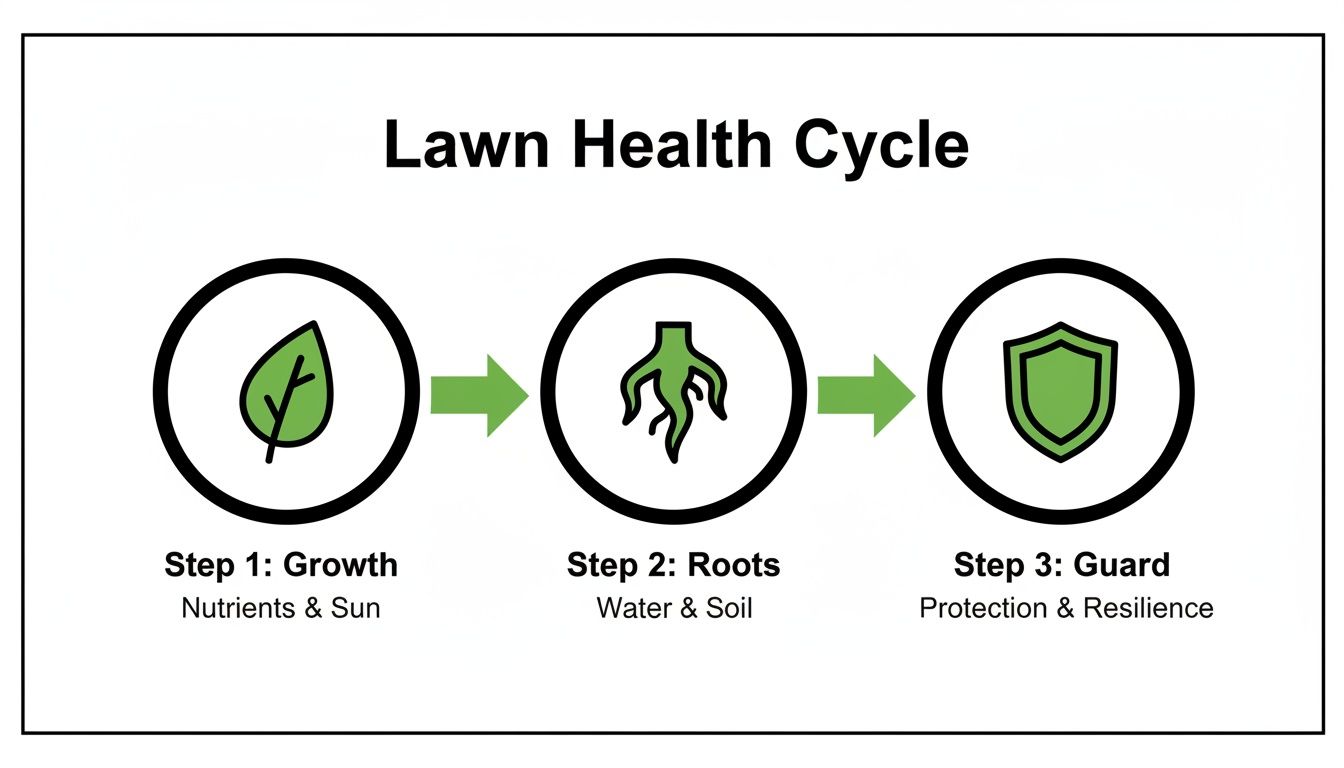
By providing the right nutrients at the right pace, you create a lawn that can practically sustain itself.
Making a Safe and Smart Choice
For parents and pet owners in Alpharetta and Milton, understanding NPK is about more than just a green lawn—it's about creating a safe outdoor space. Once you know that nitrogen is for leaf growth, phosphorus is for roots, and potassium is for overall resilience, you can be incredibly precise. This targeted approach is not only more effective for your turf but is also far kinder to the environment. In fact, using efficient, water-soluble nutrients can reduce environmental impact by 20-30%.
Finding the Right NPK Balance for Georgia Soil
If you've ever tried to grow a lawn here, you know Georgia's notorious red clay and humid climate present a unique challenge. From Cumming to Dahlonega, a one-size-fits-all approach to fertilizer just won't cut it. The secret isn't just dumping a generic bag on your yard; it's about listening to what your soil is actually telling you it needs.
So, where do you start? The single most important first step is a professional soil test. Think of it as a check-up for your yard. It gives you a precise report card, showing which nutrients you have in abundance and which ones are barely there. Without that data, you're just guessing—a strategy that can waste money and do more harm than good. You can get the full rundown on this in our guide on how to read soil test results and finally unlock the secrets buried in your yard.
Tailoring Nutrients for Common Georgia Grasses
Our region is home to a few popular types of grass, and each has its own appetite that changes throughout the year. A lawn in Alpharetta might have completely different needs than one just a few miles away in Milton, all depending on the type of grass planted there.
Here’s a quick look at what we typically see:
- Bermuda and Zoysia: These are warm-season powerhouses. During the summer, they grow like crazy and crave higher nitrogen to fuel that vibrant green color and aggressive spreading. We focus on feeding them heavily in the spring and early summer.
- Fescue: As a cool-season grass, Fescue does most of its heavy lifting in the spring and fall. A balanced fertilizer works best during these active periods. We ease up on the nitrogen during the summer heat to prevent stressing it out.
Adjusting NPK for Seasonal Stress
Understanding NPK isn't just about what to apply, but when to apply it. The needs of a lawn in Forsyth County shift dramatically from a cool, wet spring to a scorching Cumming summer.
For example, as we head into a hot, dry summer, it’s a smart move to apply a fertilizer with higher potassium (K). This nutrient is like a bodyguard for your grass, strengthening its cells to better withstand drought and heat. On the flip side, a spring application is all about nitrogen (N) to give the lawn a powerful jumpstart after a long winter nap.
For environmentally conscious families in Milton and Johns Creek, NPK fertilizers are a cornerstone of soil fertility. Phosphorus-based NPK, in particular, commands a significant market share due to its critical function in root development and energy transfer—vital for Georgia lawns battling clay soils and humidity. As property managers in Cumming or Alpharetta shift toward precision lawn care, this targeted approach minimizes runoff and protects our local waterways.
Ultimately, the goal is to create a healthy, self-sustaining lawn. When we give your turf the right nutrients at the right time, we’re building its resilience. It grows stronger, denser, and becomes much better at naturally fighting off weeds and disease, which means fewer chemical inputs are needed down the road.
Why Healthy Soil Is Your Lawn's True Foundation
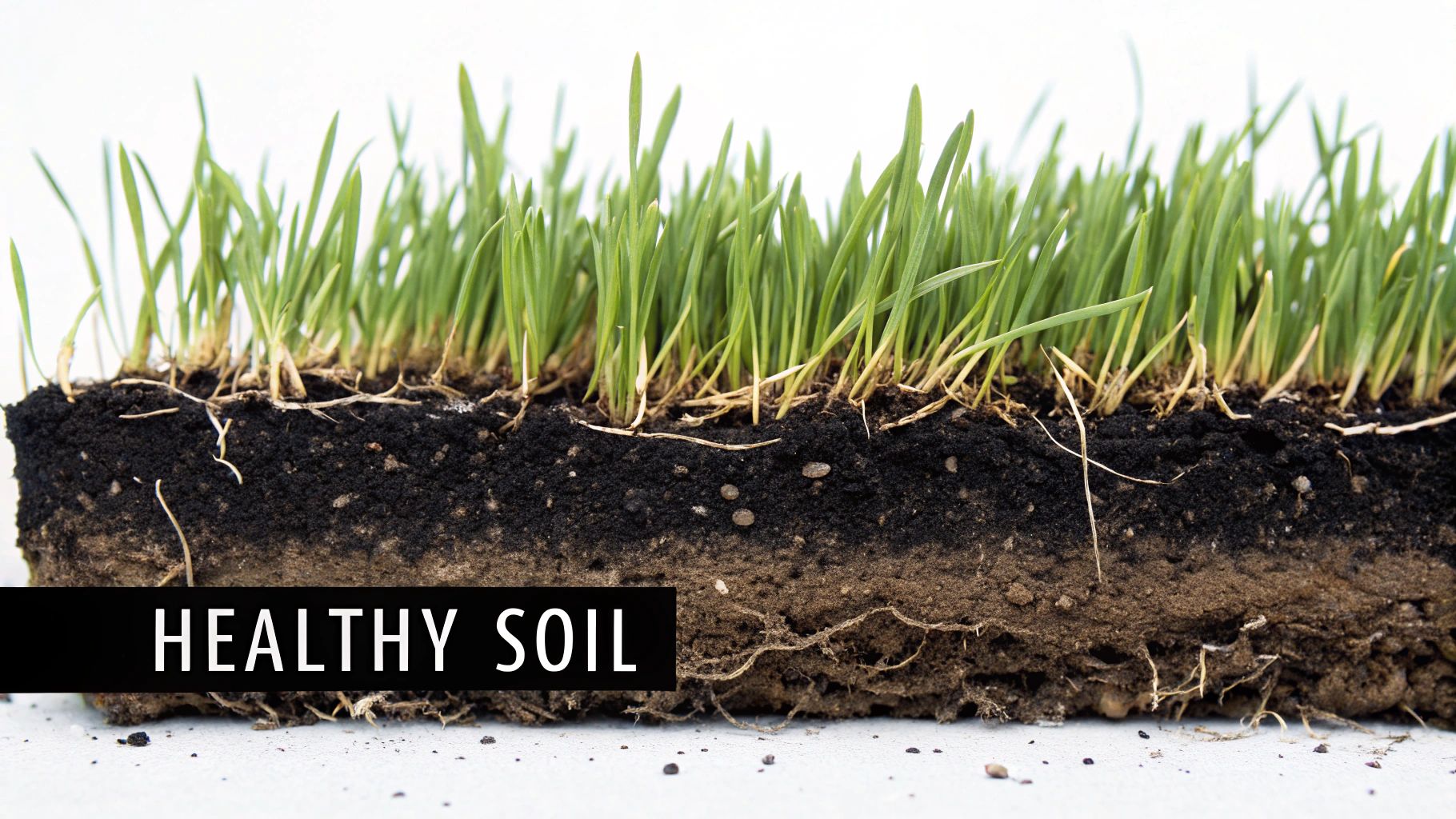
Knowing what NPK is puts you in the driver's seat when it comes to your lawn's diet, but those numbers on the fertilizer bag don't tell the whole story. Here’s a mental shift that’s crucial for homeowners in Cumming, Alpharetta, and across North Georgia: fertilizer feeds the plant, but healthy soil builds the lawn.
It’s easy to get a quick green-up with synthetic chemicals, but that often leads to a weak lawn that depends on its next chemical fix. A truly sustainable, gorgeous lawn is built from the ground up, starting with a living, breathing soil ecosystem that does most of the heavy lifting for you.
The Living World Beneath Your Grass
Healthy soil is absolutely teeming with life. We’re talking billions of beneficial microorganisms—bacteria, fungi, and other microscopic critters. This invisible workforce is your lawn's best ally. Their main job is to break down organic matter and unlock the nutrients from fertilizers, converting them into a form your grass roots can actually use.
When your soil is vibrant and healthy, it naturally cycles and releases nutrients for your grass. This creates a resilient, self-sufficient system that needs fewer inputs over time. It’s the difference between a lawn that’s just propped up and one that is genuinely strong from the roots to the blades.
Breaking Through Georgia's Clay Soil
Anyone living in areas like Milton and Johns Creek knows our infamous red clay. It’s dense, it’s compact, and it makes life tough for grass roots trying to grow deep, find oxygen, and access water. Piling on more fertilizer won't fix this core structural issue.
This is where practices like core aeration and top dressing with organic compost are game-changers.
- Core Aeration: Think of this as a deep-tissue massage for your yard. We pull out small plugs of soil, which instantly relieves compaction. This allows vital air, water, and nutrients to finally reach deep into the root zone where they’re needed most.
- Top Dressing: Spreading a thin layer of high-quality organic compost over the lawn is like feeding the soil itself. It adds valuable organic matter and provides fuel for that all-important microbial life.
The heart of a natural, organic-based lawn care program is simple: build the soil first. While synthetic fertilizers offer a fast, temporary green, they do very little for the long-term health of your soil. An organic approach, on the other hand, builds a robust foundation. The result is a lawn that is naturally more resilient and, most importantly, safer for your pets and children to enjoy.
This soil-first mindset is everything. If you're ready to dig deeper, you can learn more about how to create healthy soil in our detailed guide. By improving your soil’s structure and biology, you’re creating an environment where grass can thrive, leading to a stronger, more drought-tolerant lawn that looks great all season.
Common Questions About NPK and Georgia Lawns
Even when you've got a good handle on what NPK means, figuring out how to apply it to your own yard here in North Georgia can bring up a lot of questions. From Cumming to Alpharetta, our lawns deal with some unique challenges, like heavy clay soil and blistering summer heat. Let's walk through some of the most common questions we get from homeowners.
What Happens If I Use the Wrong NPK Ratio on My Lawn?
Putting down the wrong NPK ratio can, unfortunately, do a lot more harm than good. Think of it like putting the wrong fuel in your car—it’s not going to run well, and you might cause some serious damage.
For instance, dumping too much nitrogen on your lawn can trigger a surge of weak, spindly growth, which basically rolls out the welcome mat for pests and diseases. It can also chemically "burn" the grass, leaving you with those ugly, dead-looking brown patches. On the flip side, skimping on phosphorus means your grassroots will be shallow and weak, leaving your lawn totally defenseless against the summer heat and drought we see in places like Milton and Johns Creek.
An incorrect balance doesn't just hurt your lawn; it impacts our local environment, too. Any extra nutrients the grass can't soak up will just get washed away with the next rain, ending up in our local streams and rivers as pollution. This is exactly why getting a professional soil test is the smartest first step—it tells you precisely what your lawn needs so you're only applying what's necessary for it to thrive.
Is Organic NPK Fertilizer as Effective as Synthetic?
Absolutely. In fact, for the long-term health of your lawn, it’s often the far better choice. Synthetic fertilizers are like a shot of caffeine for your grass—they deliver a fast, powerful jolt of nutrients for a quick green-up. Organic sources, however, are more like a balanced meal, releasing their nutrients slowly and steadily over time.
This slow-and-steady approach has some major advantages:
- It feeds the soil, not just the plant: Organic fertilizers nourish the tiny, beneficial microbes living in your soil. This creates a healthier ecosystem that naturally makes nutrients available to your grass.
- It prevents lawn burn: The gradual release of nutrients means there's no risk of overwhelming your grass with a sudden chemical overload.
- It builds resilience from the ground up: By strengthening the soil and encouraging deep root growth, organic fertilizers help create a lawn that is naturally tougher against pests, drought, and other stressors.
For families in Alpharetta and Milton with kids and pets playing in the yard, an organic-based program is simply a safer, more sustainable way to go.
How Often Should I Apply Fertilizer to My Lawn in Georgia?
How often you need to fertilize really depends on your specific type of grass, the time of year, and the product you’re using. A common mistake we see is homeowners grabbing a generic, one-size-fits-all schedule off the internet.
Warm-season grasses like Bermuda and Zoysia, which are all over Forsyth County and surrounding areas like Johns Creek, have completely different appetites and feeding schedules than cool-season Fescue. The best approach is always to tailor applications to what your lawn actually needs, guided by the results of a soil test. A customized program delivers the right nutrients at exactly the right time, which encourages steady, healthy growth instead of those weak, sudden growth spurts. This ensures your lawn has what it needs to handle Georgia's tough climate year-round, from a cool, wet spring all the way to a hot Dahlonega summer.
Understanding NPK is the first step toward a beautiful, healthy lawn. But actually putting that knowledge into practice can be a lot of work. If you'd rather have experts handle it, delivering the right nutrients at the right time, Barefoot Organics is here to help. Our Natural Lawn Care Program is designed specifically for North Georgia soils and is safe for your family and pets.
Ready for a lawn you can love? Get your free online quote today!