

For homeowners in places like Cumming and Dahlonega, a thick, green lawn is more than just grass—it's a point of pride. The secret to winning the weed war without torching your turf is using a selective herbicide. This is simply a weed killer that’s smart enough to target biological processes found only in weeds, leaving your prized Bermuda or Zoysia unharmed.
How to Protect Your North Georgia Lawn While Fighting Weeds
It can feel like a never-ending battle, can't it? You put in the time mowing, watering, and feeding your lawn, and then suddenly, unwelcome guests like crabgrass, clover, and dandelions crash the party. For so many folks I talk to in Johns Creek and Milton, the biggest fear is accidentally killing the grass they've worked so hard to cultivate. This is exactly why getting a handle on selective treatments is so important.
These products are designed to know the difference between the makeup of a broadleaf weed (like a dandelion) and your turfgrass. They work by zeroing in on specific growth hormones or metabolic functions in the weed, causing it to wither away while your lawn keeps on growing. It’s like sending in a special-ops team instead of dropping a bomb.
Why Selective Herbicides Are the Go-To Solution
Let's be honest, there's a reason these products are the standard for lawn care. They give you a real, effective way to get rid of invasive plants without the back-breaking work of pulling everything by hand or having to re-seed your entire yard.
This approach is so common that North America has become a leading consumer of herbicides, especially in lawn-obsessed suburban areas like ours in Forsyth County. Selective herbicides own this market because they let you knock out the ugly stuff while keeping the good stuff. If you're curious about the bigger picture, you can find plenty of global herbicide trends and market insights online.
The real goal isn't just killing weeds. It's about creating a lawn so healthy and dense that weeds can't find the space, sunlight, or nutrients they need to get started in the first place.
Choosing the right product is your first move in taking back your yard. It’s all about working smarter, not harder, to get that vibrant, uniform look you’re after. But before you can pick out the perfect weed killer that kills weeds but not grass, you have to know what you’re up against. Let’s figure out what’s actually growing out there.
Getting to Know Your Lawn: Weeds vs. Grass in North Georgia
Before you even think about grabbing a bottle of weed killer, you’ve got to play detective. The biggest mistake I see homeowners make in places like Alpharetta and Milton is spraying first and asking questions later. You need to know exactly what you’re up against in your lawn. A misidentified weed or grass type can lead to a treatment that does more harm than good, damaging the very turf you're trying to protect.
First things first, let’s separate the good guys from the bad guys. Here in North Georgia, our lawns are dominated by beautiful warm-season grasses like Bermuda and Zoysia, though you’ll find Fescue holding its own in the shadier spots around Cumming. These are the grasses that create that lush, uniform look we all want. Weeds are the gate-crashers, the opportunists looking to take over.
This little decision tree gives you a great starting point for figuring out what's going on with your lawn.
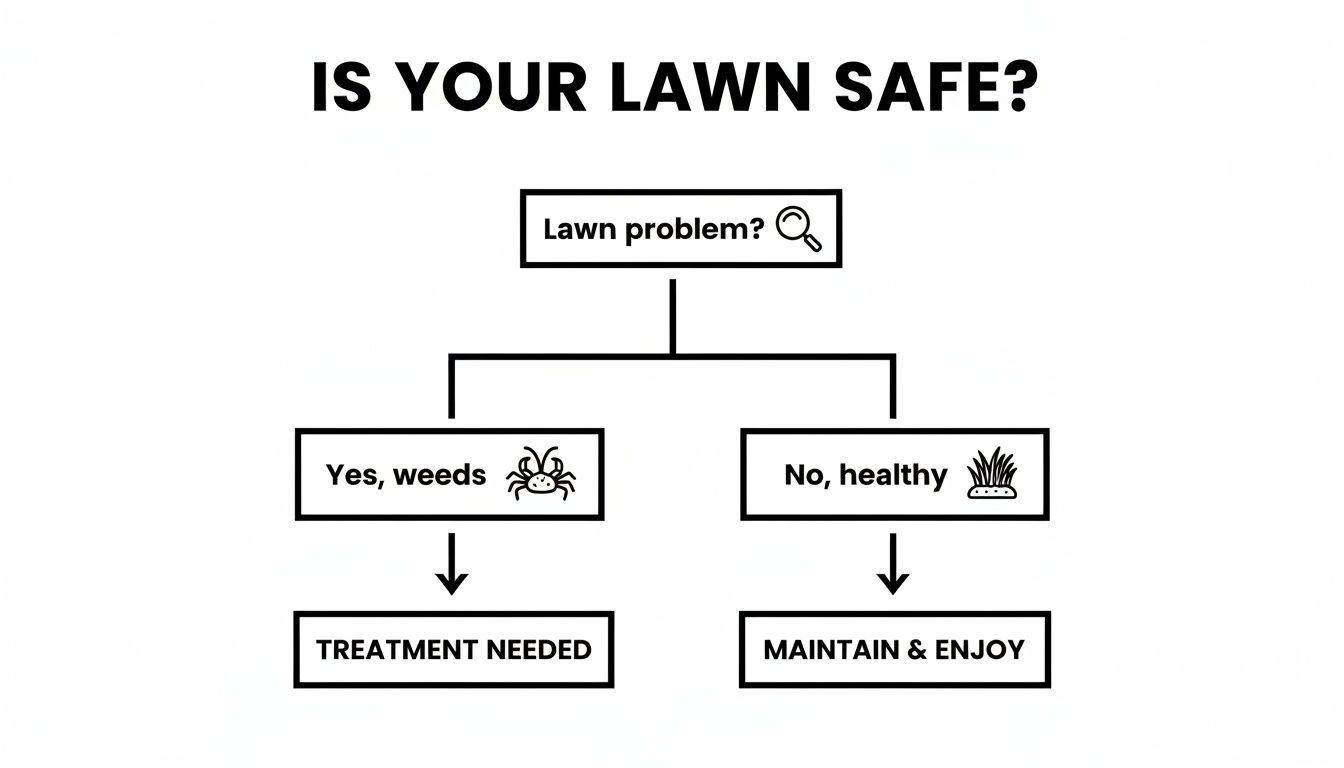
It helps you quickly sort out whether you're dealing with a true weed invasion or if your lawn just needs a little TLC to stay healthy and resilient.
The Usual Suspects: Common Invaders in Georgia Lawns
Weeds really break down into two main families: broadleaf and grassy. Understanding this difference is half the battle, since most selective herbicides are designed to go after one type while leaving your grass alone.
- Broadleaf Weeds: These are the ones that stick out like a sore thumb. Their leaves are wide, with veins that branch out like a little road map. Think of the classics: dandelions, clover, chickweed, and plantain. They look nothing like your fine-bladed turfgrass, making them pretty easy to spot in any Johns Creek yard.
- Grassy Weeds: Now, these are the sneaky ones. Grassy weeds like crabgrass, nutsedge, and goosegrass are masters of camouflage. Their long, thin blades can blend right into your lawn, and you might not even notice them until they've started to take over a whole section.
If you want to get really familiar with the specific troublemakers in our area, check out our guide on common weeds in Georgia. It’s a fantastic resource for becoming a local weed-spotting pro.
What to Look For: Telltale Signs for Identification
When you're walking your yard in Alpharetta or Dahlonega, get down and look closely. Don't just see a "weed"—examine its features.
Leaf Shape and Texture
What do the leaves feel and look like? Is it a single, broad leaf like plantain, or is it made up of tiny leaflets like clover? Some weeds, like spurge, have a slightly hairy texture. Nutsedge, one of the most stubborn weeds we face in North Georgia, has a dead giveaway: its stem is triangular. Just roll it between your fingers, and you’ll feel three distinct edges.
Growth Patterns
Pay attention to how the weed is spreading. Is it creeping low to the ground and forming a mat, the way crabgrass does? Or is it growing straight up from a deep, central root like a dandelion? This clue tells you a lot about how it spreads and the best way to tackle it.
A critical mistake homeowners make is assuming all green plants in their lawn are grass. Zoysia grass, for instance, forms an incredibly dense canopy that naturally chokes out many weeds, but invaders like nutsedge can still push through.
Flowers and Seed Heads
If a weed has matured, it will show you its flowers or seed heads. Those bright yellow dandelion flowers, the little white puffballs on clover, or the unmistakable finger-like seed heads of crabgrass are all definitive clues. Catching and identifying a weed before it goes to seed is crucial for preventing an even bigger headache next year.
Why Your Grass Type Is a Huge Deal
Knowing your turf is just as critical as knowing your enemy. A weed killer that a tough Bermuda lawn can shrug off might seriously injure or even kill a more sensitive Fescue lawn.
- Bermuda Grass: This stuff loves the sun and is incredibly resilient, which is why you see it all over Cumming and Milton. It stands up well to most selective herbicides meant for broadleaf weeds.
- Zoysia Grass: Famous for its thick, dense growth that naturally crowds out weeds. When an invader does pop up, you have to be careful to choose a product that won't thin out that beautiful, carpet-like turf.
- Fescue Grass: This is our go-to for shadier spots in areas like Dahlonega. As a cool-season grass, it can be more sensitive to chemicals, especially when it's stressed by our hot summers.
By correctly identifying both your grass and the specific weeds giving you trouble, you’re giving yourself the power to choose a treatment that actually works without collateral damage. This thoughtful approach is the key to winning the war on weeds while keeping your North Georgia lawn healthy and vibrant.
How to Choose the Right Weed Killer for Your Lawn
Alright, so you’ve scouted the enemy and identified the weeds crashing your lawn party here in Cumming. Now it’s time to choose your weapon. Walking into a garden center can be pretty overwhelming with walls of different bottles and bags, but the choice really boils down to a few key ideas. Finding the right weed killer that kills weeds but not grass is all about matching the product to what your lawn actually needs.
The biggest concept to get your head around is the difference between pre-emergent and post-emergent herbicides. Just think of it as defense versus offense. A pre-emergent is your defensive line, put down before weed seeds even think about sprouting. It creates a barrier in the soil that stops germination cold.
A post-emergent, on the other hand, is your star quarterback. It’s what you grab when the weeds are already up and visible, actively tackling the invaders that have broken through. For a truly solid game plan in Forsyth or Lumpkin County, you almost always need both at different times of the year.
Pre-Emergent vs. Post-Emergent Herbicides
Choosing between these two is all about timing and your current situation. Are you trying to head off a future crabgrass invasion, or are you fighting the dandelions that are already flowering?
- Pre-Emergent Herbicides: This is your proactive move. Applied in late winter or early spring in North Georgia, they target annual grassy weeds like crabgrass before they even get a chance to start.
- Post-Emergent Herbicides: This is your reactive solution for weeds you can see right now. These are best used when weeds are young and actively growing in the spring and fall.
A classic rookie mistake is using a post-emergent and expecting it to stop new weeds from popping up a month later. It won't. Likewise, spraying a pre-emergent on a lawn already full of mature weeds will do absolutely nothing to them.
Decoding the Product Label
That product label is your best friend. It’s not just a bunch of warnings; it’s your instruction manual for getting this right without wrecking your lawn. Before you buy anything, turn the bottle around and hunt for a few critical pieces of information.
First, see which specific weeds the product is designed to kill. Something formulated for clover might not even faze nutsedge. Next—and this is the most important part—confirm it's safe for your grass type, whether it’s Bermuda, Zoysia, or Fescue. Using a product not rated for your turf is one of the fastest ways to cause serious, widespread damage.
The label will also list the active ingredients, which are the chemicals doing the heavy lifting. Knowing these helps you understand how the product works. For lawns battling stubborn broadleaf weeds without harming the grass, targeted solutions containing ingredients such as selective herbicides like Triclopyr can be incredibly effective. Understanding what you're buying puts you in control.
A crucial takeaway for any Milton or Alpharetta homeowner: Always read and follow the label's application rates. More is not better. Over-applying can stress or kill your grass and harm our local environment.
Chemical vs. Natural Options
The world of selective weed control isn’t just about powerful chemicals anymore. There's a growing market of natural and organic-based options that are a great fit for families with kids and pets in communities like Johns Creek and Cumming.
Traditional Chemical Herbicides
These products are often highly effective and work fast. They usually contain active ingredients like 2,4-D, MCPP, and Dicamba, which are engineered to attack the growth systems in broadleaf weeds while leaving your turfgrass alone. For widespread infestations, they are a reliable go-to. Homeowners with Bermuda lawns, in particular, have many powerful options, which we dive into in our dedicated guide on finding the right weed killer for Bermuda grass.
Natural and Organic Alternatives
For folks in our area who lean toward an eco-friendlier approach, there are some fantastic alternatives. These products use ingredients from natural sources.
- Chelated Iron: This is a game-changer for broadleaf weeds. The iron is absorbed quickly by weeds like dandelions and clover, causing them to turn black and die within hours. The best part? Your grass just gets a nutrient boost and turns a deeper green.
- Vinegar-Based Sprays: Horticultural vinegar (which is much stronger than what's in your pantry) can be used to burn down weeds. A word of caution: it is non-selective and will damage your grass, so it's only for careful spot-treating on driveways or patios, never on the lawn itself.
The right choice comes down to balancing effectiveness with your personal priorities for safety and environmental impact. Once you understand the types of herbicides and get in the habit of reading the label, you can confidently pick a product that takes out the weeds but leaves your beautiful North Georgia lawn to thrive.
Getting Your Application Just Right: Timing, Technique, and Safety
You've done the hard part—you’ve identified your weeds and picked a product designed to knock them out without hurting your grass. But even the best weed killer on the shelf is only as good as its application. Getting this step right is what separates a lush, weed-free lawn from a patchy, disappointing mess.
For those of us here in North Georgia, from Cumming to Dahlonega, how and when you apply that product makes all the difference. It's about working with our unique climate, not against it, to get maximum effect while keeping your family and pets safe.

This isn’t just a "spray and pray" situation. Real success comes down to the details: mastering the timing, knowing whether to spot-treat or cover the whole yard, and, most importantly, putting safety first.
Mastering the Art of Timing
In our corner of Georgia, timing is everything. Our weather can be notoriously unpredictable, and things like rain, intense heat, or a sudden breeze can completely neutralize your efforts.
First thing’s first: check the forecast. Spraying a liquid herbicide an hour before one of those classic Cumming afternoon thunderstorms rolls through is a complete waste of time and money. You really need a solid 24-hour window of dry weather after you spray to let the product soak in and do its job.
You also want to avoid spraying in the blistering heat of a summer afternoon. When the thermometer climbs past 85°F, your grass is already stressed out. Hitting it with chemicals, even selective ones, can be the tipping point that causes burn spots. The sweet spots are in the morning after the dew has dried or in the early evening as things start to cool down.
And don't forget the wind. A windy day can send that fine mist drifting right into your prize-winning roses or your vegetable garden. Worse, it could end up in your neighbor's yard in Alpharetta. Always choose a calm day to make sure the weed killer only hits its intended targets.
Spot Treatment vs. Broadcast Spraying
How you apply the product should match the scale of your weed problem. You don't bring a fire hose to put out a candle, right? The same logic applies here.
-
Spot-Treating: This is your best friend when you're dealing with a few scattered weeds here and there. A small handheld or backpack sprayer lets you target each weed individually. It’s precise, saves product, and drastically reduces the amount of chemical you’re introducing to your yard. This is the perfect move for those stubborn dandelions that pop up in an otherwise beautiful Zoysia lawn in Johns Creek.
-
Broadcast Spraying: Now, if it looks like the weeds are staging a full-scale invasion, broadcast spraying is the more practical approach. Using a hose-end sprayer or a larger push sprayer, you can apply the herbicide evenly across the entire lawn. This method is great for catching widespread weeds you might not even see. The absolute key here is to calibrate your sprayer perfectly to deliver the exact rate recommended on the product label.
A common mistake I see is homeowners using a broadcast sprayer for just a handful of weeds. That's a classic case of over-application. It's wasteful and unnecessarily exposes your entire lawn, family, and the local ecosystem to chemicals. Always start with the most targeted method possible.
Your Safety Checklist Before You Spray
Let's be clear: these products are chemicals. A proper application is a safe application, and protecting yourself and your loved ones is non-negotiable. Before you even think about mixing a batch, make these safety steps a non-negotiable habit.
Gear Up with Personal Protective Equipment (PPE):
- Long sleeves and pants: You want a barrier between the product and your skin.
- Waterproof gloves: Your hands are ground zero for contact.
- Closed-toe shoes: No flip-flops. Protect your feet from spills.
- Safety glasses: It only takes one stray splash or gust of wind to cause serious eye irritation.
Once you're done, the job isn't over. You need to know how long to keep kids and pets off the treated area. Your guide here is always the product label. Generally, the rule is to wait until the spray has completely dried, which can take a few hours depending on the weather. This is the bare minimum wait time. Following these simple precautions ensures that the only things you're harming are the weeds.
Building a Naturally Weed-Resistant Lawn
Sure, a good selective herbicide is a handy tool, but the real victory over weeds doesn't come from a spray bottle. For those of us in Cumming and Johns Creek, the secret is cultivating a lawn so thick and healthy that weeds simply can't find a foothold. It’s all about creating an ecosystem where your grass is the undisputed champion.
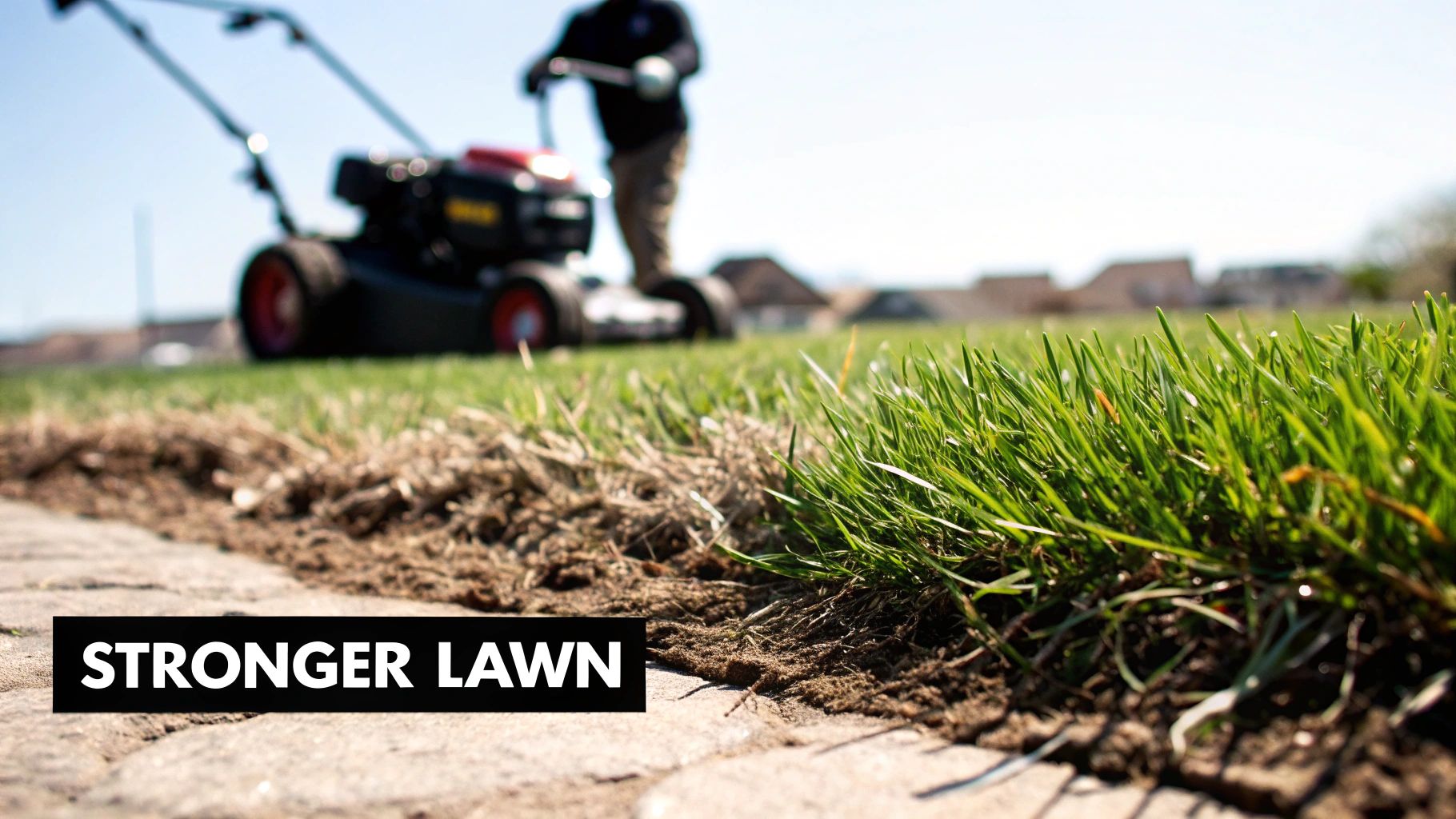
Think of your lawn as a living, green shield. Every blade of healthy Bermuda or Zoysia is fighting for sunlight, water, and nutrients. A dense, thriving lawn creates a nearly solid canopy that starves weed seeds of the sunlight they need to even start growing. This is the heart of a long-term strategy that minimizes your need for any weed killer that kills weeds but not grass.
Smart Cultural Practices for a Stronger Turf
Your day-to-day lawn care habits are actually your best weed prevention tools. Making a few small tweaks to how you mow and water can make a world of difference in your lawn's natural resilience.
Mow High, Not Low
It’s so tempting to scalp the lawn for that super-tight, manicured look we see around Alpharetta, but it’s one of the worst things you can do for weed control. Keeping your Bermuda or Zoysia at a higher setting—I usually recommend 2 to 2.5 inches—lets the grass blades grow taller and wider. This not only gives them more surface area for photosynthesis but, more importantly, it shades the soil. Shady, cool soil is terrible for weed germination.
Water Deeply and Infrequently
Watering your lawn a little bit every day is a recipe for shallow roots and a welcome mat for weeds. It keeps the soil surface perfectly damp for them. The better approach is to water deeply just once or twice a week. This forces your grass to grow deep, tough roots to find that moisture, making it far more drought-tolerant and a much better competitor against shallow-rooted weeds.
The goal is to train your lawn to be a fierce competitor. By encouraging deep roots and a thick canopy, you are fundamentally changing the battlefield to favor your grass, not the weeds.
Transforming Georgia’s Clay Soil
Anyone who's ever tried to dig a hole in Forsyth or Cherokee County knows what we're up against: heavy, compacted clay. This dense soil chokes out grass roots, making it hard for them to breathe and find nutrients. Those weak spots are exactly where weeds take over.
Two practices are absolutely essential for turning that clay into a foundation for a great lawn:
-
Core Aeration: This is the process of pulling small plugs of soil out of the ground. It’s a game-changer for breaking up compaction, allowing precious air, water, and nutrients to finally reach the root zone. For our local soil, I consider this a non-negotiable step.
-
Organic Topdressing: Right after aerating is the perfect time to spread a thin layer of rich, organic compost. This material falls into the aeration holes and gets to work, slowly improving the soil structure, adding vital nutrients, and boosting the microbial life. Over time, it helps transform that stubborn clay into something your grass will actually love.
Beyond the lawn itself, think about the whole picture. Using various types of mulch in your garden beds is another great way to smother weeds and improve the soil health of your entire landscape.
These cultural practices all work together to build a lawn that is its own best defense. By focusing on the soil first and adopting smarter mowing and watering habits, you create a dense, vigorous turf that crowds out weeds before they even have a chance. If you want to dive deeper, there are plenty of other natural weed control methods that can help build a healthier, more self-sufficient lawn.
When to Call in a Pro for Weed Control
Let's be honest, sometimes a weed problem is more than just a weekend project. It’s a full-blown war. You’ve done your homework, you’ve tried the store-bought stuff, but that stubborn patch of nutsedge or dallisgrass just laughs and comes back stronger.
If you feel like you're fighting a losing battle, or if you're just not comfortable mixing and spraying chemicals around your home, that’s the perfect time to bring in a professional. It’s not about giving up; it’s about making a smart, strategic decision to get your lawn back.
For homeowners here in Cumming, Alpharetta, and the surrounding areas, a serious infestation can quickly overwhelm a beautiful Bermuda or Zoysia lawn. A professional crew has access to products and equipment that are simply a step above what you can buy at a big-box store. This means they can target weeds much more effectively without collateral damage to your grass.
The Barefoot Organics Approach
When you call a service like ours, you’re getting more than just a temporary weed-killing spray. For the families we work with in Johns Creek and Milton, our whole philosophy is built on long-term lawn health. After all, the best weed killer that kills weeds but not grass is a lawn so thick and healthy that weeds can't find a place to sprout.
We tackle the problem from multiple angles:
- Expert Diagnosis: We don't just look at the weed; we look at why it's there. We'll identify every last weed and figure out the underlying soil issues that are giving them an advantage.
- Targeted Treatments: We use professional-grade, selective products applied with precision timing to knock out tough weeds without stressing your turf.
- Building a Healthy Foundation: Our main goal is to improve your soil. Through services like aeration and organic soil amendments, we help your lawn build the natural strength to choke out weeds on its own.
Bringing in a professional is an investment in a complete solution. It tackles the weeds you see now and the root causes, so you end up with a beautiful lawn that's genuinely safe for your kids and pets to play on.
A Few Common Questions We Get About Selective Weed Killers
Even with the best game plan, it's natural to have a few questions before you start spraying. Let's tackle some of the things we hear most often from homeowners around North Georgia.
How Long Before I Actually See Results?
This is probably the first thing people ask us, whether they're in Cumming or Milton. Honestly, it varies quite a bit depending on what you're using and what you're trying to kill.
With a good liquid post-emergent, you'll often see broadleaf weeds like clover or dandelions start to look sad and wilted within 24 to 48 hours. They should be completely gone in about a week or two. Grassy weeds and those really stubborn ones, like nutsedge, can take a little more patience to fully disappear.
Some of the natural options out there, especially the ones that use chelated iron, can be surprisingly fast. It’s not uncommon to see broadleaf weeds turn black and start shriveling up in just a few hours. Talk about satisfying! But no matter what you use, the product label is your best friend for a realistic timeline.
Are These Products Actually Safe for My Kids and Pets?
For any homeowner in Alpharetta or Johns Creek with children or four-legged family members, this is the most important question. The real answer comes down to two things: the product's active ingredients and how closely you follow the instructions on the label.
The golden rule for any lawn application, whether it's a synthetic chemical or a natural product, is to stick to the manufacturer's re-entry guidelines. Never guess or assume it's safe for everyone to run around on the grass right away unless the label says so.
Many conventional weed killers require the lawn to dry completely before it's safe for people or pets to walk on it. That simple step is usually all it takes to prevent direct contact. Some of the newer, natural options might have shorter waiting periods, but taking a few minutes to read the instructions is an absolute must for your family's safety.
When Is the Best Time of Year to Apply Weed Killer in Georgia?
Timing is everything, especially with our wild Georgia weather. You can't just go out and spray on any random weekend.
For the most part, post-emergent products work best when weeds are actively and happily growing. Here, that's usually in the spring and again in the fall. Trying to apply them during the peak of a Georgia summer can really stress out your turf, leaving it open to other problems.
On the other hand, pre-emergent herbicides are all about prevention. You have to get them down before the weed seeds even think about sprouting, which typically means late winter or the very beginning of spring in the Cumming area.
Ready to take the guesswork out of weed control and ensure your lawn is safe for the whole family? The team at Barefoot Organics provides expert, tailored lawn care solutions for homeowners throughout North Georgia. Get your free quote and learn more about our natural approach.