

Picking the right grass for your North Georgia home really starts with one simple question: do you want a lawn that loves our hot summers, or one that stays green through the cooler months? This is the classic warm-season versus cool-season grass debate, and it's the single most important decision you'll make for your yard in Cumming, Johns Creek, or anywhere else around here. It sets the stage for everything that follows—how your lawn looks, how much work it needs, and how well it holds up to our wild weather swings.
Choosing Your Perfect North Georgia Lawn
Ever stand on your lawn in Alpharetta or Milton and just feel stumped about what to plant? You’re definitely not alone. Here in North Georgia, from Cumming to Dahlonega, we have a unique challenge. Our area is what lawn care pros call the "transition zone." We get the sweltering, humid summers that warm-season grasses crave, but we also get cold enough for cool-season grasses to do their thing.
This means there's no single "best" grass for everyone. It's all about finding the right grass for your specific yard, your lifestyle, and how much effort you want to put in.
This guide is designed to cut through that confusion. The first big choice comes down to two main teams:
- Warm-Season Grasses: These are the sun-bathers of the grass world. They grow like crazy in the summer heat, but the moment we get a good frost, they go dormant and turn a tan or brown color to protect themselves for winter.
- Cool-Season Grasses: These are the exact opposite. They hit their stride in the milder weather of spring and fall. The big plus? They stay green through most of the winter, but they can really struggle and get stressed out by our brutal July and August heat.
This simple decision tree can help you picture that initial choice.
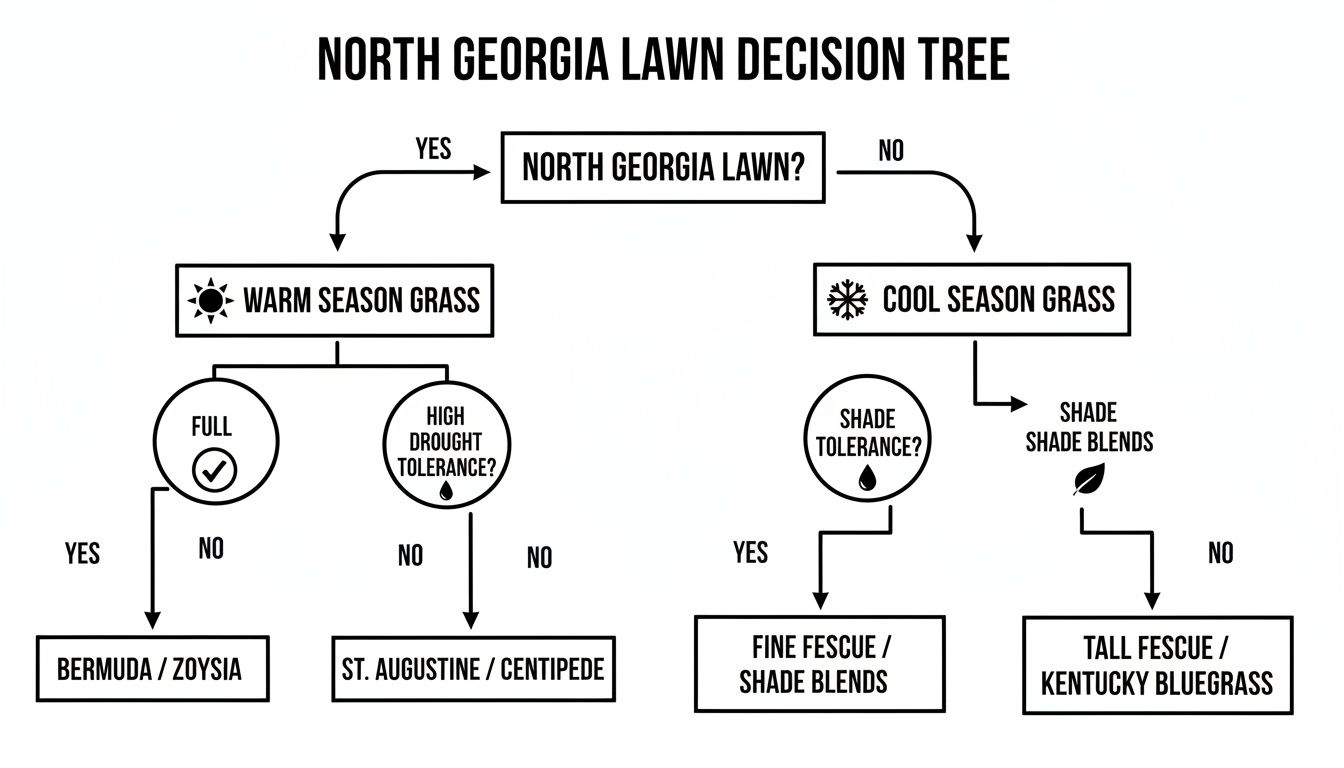
As you can see, how much sun your yard gets and when you want it to be green are the first big forks in the road.
Matching Grass to Your Lifestyle
Beyond the seasons, think about how you actually use your yard. A family in Johns Creek with kids and a dog tearing around the backyard needs something tough that can handle the traffic, like a hearty Bermuda. On the other hand, if your property in Milton is covered in beautiful, mature oak trees, a shade-tolerant Fescue might be your only real shot at a lush, green lawn.
The goal is to create a resilient lawn that complements your life, not one that constantly battles its environment. Understanding the strengths and weaknesses of each grass type is the key to long-term success and enjoyment.
To make this even easier, here’s a quick-glance table to help you compare the top contenders for our area.
Quick Guide to North Georgia Grass Types
| Grass Type | Primary Growing Season | Sunlight Needs | Drought Tolerance | Best For |
|---|---|---|---|---|
| Bermuda | Warm-Season | Full Sun (8+ hours) | Excellent | High-traffic areas, full-sun yards, athletic look |
| Zoysia | Warm-Season | Full Sun to Light Shade | Very Good | Manicured lawns, decent foot traffic, some shade |
| Fescue | Cool-Season | Partial Shade to Full Shade | Fair to Good | Shady yards, year-round green color, low traffic |
| Centipede | Warm-Season | Full Sun to Light Shade | Fair | Low-maintenance, acidic soils, slow-growing needs |
This table gives you a starting point, but we'll dive deeper into what makes each of these grasses tick.
Ultimately, this guide is your roadmap to a beautiful, tough lawn that’s also safe for your family and pets. As you weigh your options, think about how things like water needs will affect your monthly bills and weekend chores. To get a head start, you can check out our guide on the most resilient drought-resistant grass for Georgia. We'll explore all these options in more detail so you can make a choice you'll be happy with for years to come.
Warm-Season Grasses: Built for the Georgia Heat
When the Georgia sun is blazing and the humidity is so thick you can practically swim through it, some grasses don't just hang on—they hit their stride. These are the warm-season grasses, the undisputed champions of summer for homeowners everywhere from Cumming to Alpharetta.
Think of them as sun-worshippers. They soak up our intense summer heat and channel that energy into growing a thick, vibrant green lawn.
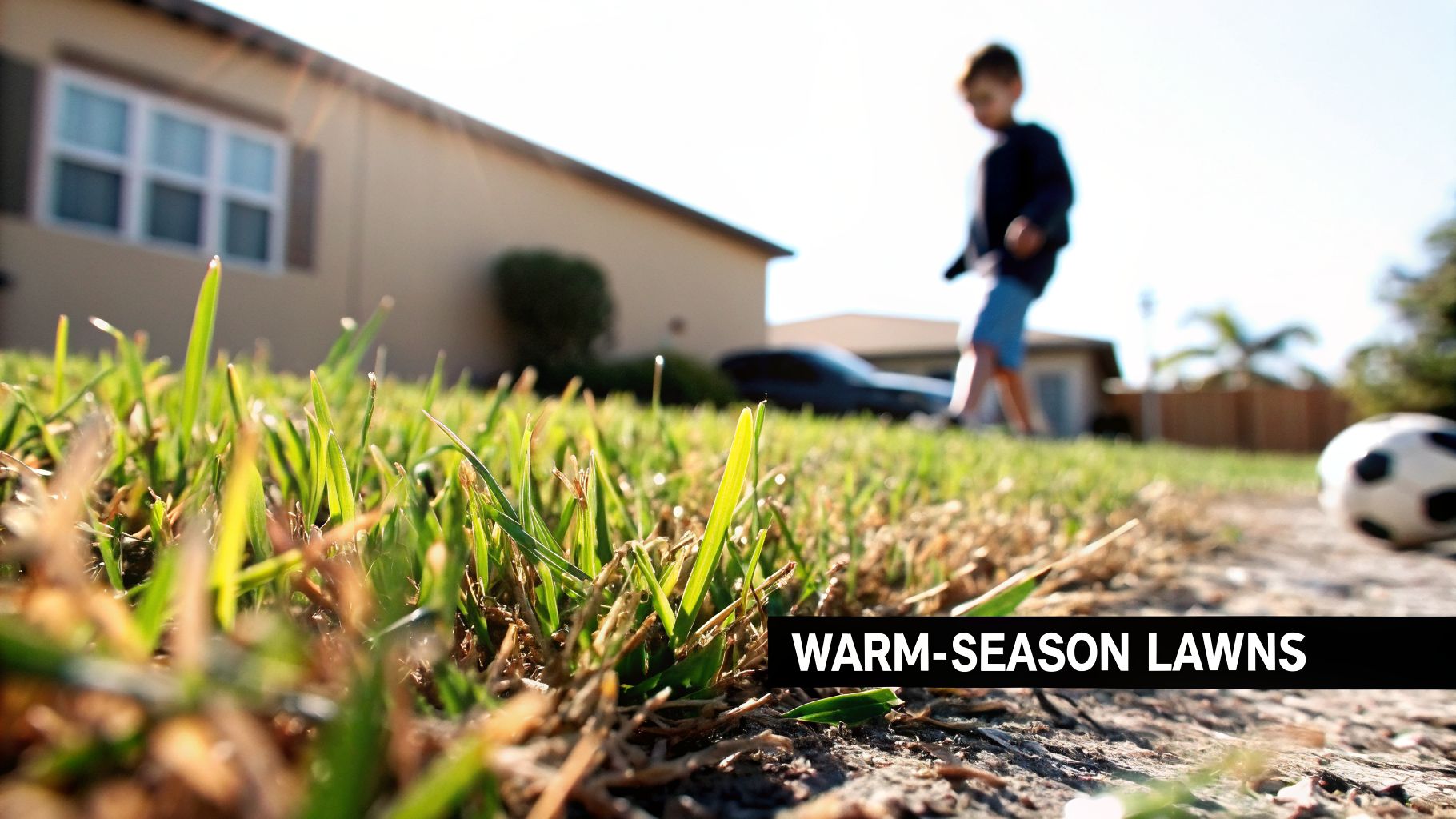
Unlike their cool-season cousins, these grasses are in their prime from late spring all the way through summer. But once the first real frost hits in places like Dahlonega or Milton, they go into a natural dormancy. This is just a survival tactic. The grass turns a tan or brownish color to save its energy for the spring, when it will roar back to life as the soil warms up.
The Heavy Hitters: Bermuda, Zoysia, and St. Augustine
Here in North Georgia, a few key players dominate the warm-season lineup, and each one has its own personality. Figuring out their strengths and weaknesses is the key to picking the right one for your yard, whether you're in Forsyth, Dawson, or Cherokee County.
Bermuda Grass
This is the athlete of the grass world—it’s tough, it spreads aggressively, and it’s incredibly resilient. Bermuda creates a dense, deep green carpet that stands up to heavy foot traffic, which is perfect if you have active kids and pets. Its one big demand? Full, direct sunlight. Bermuda will get thin and patchy in a hurry if it's in the shade.
Zoysia Grass
If you're after a more refined, almost golf-course-perfect look, Zoysia is a fantastic choice. It’s famous for its dense growth pattern that naturally chokes out weeds. While it still loves the sun, many Zoysia varieties handle shade much better than Bermuda, making it a more versatile pick for typical suburban yards in Cumming and Alpharetta.
St. Augustine Grass
With its wider, coarser blades, St. Augustine is another popular option, mainly because it has the best shade tolerance of the common warm-season grasses. The trade-off is that it can be more vulnerable to pests and diseases, and it needs a consistent supply of water to stay looking good during dry spells.
Real-World Pros and Cons for Georgia Homeowners
Choosing a grass isn't just about looks; it's about finding one that fits your lifestyle and your property's specific conditions. It's a practical decision. Warm-season grasses are surging in popularity because they can handle the heat, with varieties like Bermuda and Zoysia thriving in temperatures of 80-95°F. They go dormant in winter but come back strong every spring, a cycle perfectly suited to North Georgia's climate.
Here are a few things to consider:
- Wear-and-Tear: For high-traffic areas where kids are playing or dogs are running, Bermuda is the undisputed champ because it repairs itself so quickly. Zoysia is a solid runner-up, offering good durability as well.
- Drought Tolerance: Summer water restrictions are a reality here, so drought tolerance is a massive benefit. Both Bermuda and Zoysia are stars when it comes to surviving dry periods, which means less time and money spent watering.
- Shade Intolerance: This is the Achilles' heel for most warm-season grasses. If you have large, mature trees casting a lot of shade in your Johns Creek yard, a sun-loving Bermuda lawn is going to struggle and thin out.
A common mistake we see is people trying to force a sun-loving grass to grow in a shady yard. It almost always results in a weak, patchy lawn that becomes a constant source of frustration. Matching the grass to your available sunlight is the number one rule for a successful lawn.
Building Resilience with Natural Care
No matter which warm-season grass you land on, its long-term health is all about the soil it's growing in. This is where a natural approach truly shines. Instead of hitting your lawn with a constant barrage of synthetic chemicals, the Barefoot Organics program focuses on building a healthy, living soil ecosystem.
Our treatments are specifically designed to work with the natural growth cycle of grasses like Bermuda and Zoysia. By improving soil structure and providing balanced, natural nutrients, we help these grasses grow deeper roots. A deeper root system means the grass can find more water and nutrients on its own, which directly translates to a lawn that is more resilient against drought, disease, and pests. That foundational strength is the secret to a beautiful yard, year after year.
For a deeper comparison of top contenders, read our article on the best lawn grasses for Georgia's climate.
Cool-Season Grasses: The Secret to Year-Round Green
While warm-season grasses own the summer here in North Georgia, there's another player in the game that offers something truly special: a vibrant green lawn in the middle of winter. This is the world of cool-season grasses, like Tall Fescue, which operate on a completely different clock. They do their best growing in the mild temperatures of spring and fall, a perfect choice if the sight of a dormant, brown lawn just isn't for you.
For many homeowners, especially in areas like Johns Creek and Milton, the biggest draw is that beautiful, consistent color that lasts right through the winter. It’s a huge visual payoff during the otherwise gray and dreary months.

Of course, this perk comes with a well-known catch. These grasses simply aren't built for the intense, humid heat of a Georgia summer. Come July and August, a cool-season lawn can get stressed, thin out, and really start to struggle if you’re not giving it the right kind of attention.
The Trade-Off for Winter Color
Choosing a cool-season grass like Tall Fescue isn't a casual decision; it's a commitment. The care it needs is fundamentally different from a Zoysia or Bermuda lawn. It’s less of a "set it and forget it" grass and more of a partnership that demands consistent care to help it push through that summer stress.
Globally, cool-season grasses are hugely popular, making up about 45% of the total natural lawn market simply because they’re perfect for temperate climates. These grasses are happiest when temperatures hover between 60-75°F. For families in Forsyth and North Fulton Counties who prioritize a pet-safe yard, this aligns perfectly with natural, soil-focused care that builds a resilient lawn without relying on harsh chemicals. You can see more on these market trends for natural grass and how they're shifting.
So, while Fescue delivers an incredible look, it’s a higher-maintenance choice that truly shines with a dedicated, natural care plan.
Keeping Fescue Healthy Through the Seasons
Because these lawns are more vulnerable to our climate, being proactive is everything. The whole game is about building a strong, resilient turf that can withstand the summer heat and bounce back with vigor in the fall.
Here are a few key strategies for a thriving cool-season lawn:
- Mow High: Keep your Fescue on the taller side during the summer, around 3-4 inches. This helps shade the soil, keeping it cooler and holding onto precious moisture.
- Water Deeply, Not Daily: Give the lawn a good, long soak once or twice a week instead of light daily sprinklings. This encourages roots to dig deep, making them tougher during dry spells.
- Fall is Everything: Autumn is, without a doubt, the most important season for a Fescue lawn. It's prime time for recovery and for setting the stage for the entire year ahead.
The health of a Fescue lawn next spring is a direct reflection of the work you put in the previous fall. A strong recovery after summer stress is what gives you that lush, green turf that can power through the next heat cycle.
For this very reason, two services are non-negotiable for maintaining a dense, healthy Fescue lawn in our region.
The Power Duo: Aeration and Overseeding
Think of summer as a tough battle for your cool-season lawn. By the time fall rolls around, the grass is often tired, worn out, and patchy. This is where core aeration and overseeding step in as the ultimate one-two punch for recovery.
- Core Aeration: This is the process of pulling up small plugs of soil from the lawn. It’s a simple concept with a massive impact. It breaks up compacted soil and allows air, water, and nutrients to finally reach the grassroots. For a stressed Fescue lawn, it’s like throwing open the windows to let in a breath of fresh air.
- Overseeding: Right after aerating, we spread a fresh layer of high-quality grass seed across the lawn. Those holes from the aerator are the perfect little pockets for seeds to settle into, giving them direct contact with the soil. This ensures you get great germination, filling in all those thin and bare spots that cropped up over the summer.
This annual fall ritual is the secret to keeping a Fescue lawn thick and vibrant year after year in places like Cumming and Alpharetta. It’s how you directly counteract the summer damage and ensure your lawn stays a beautiful, green asset all year long.
Establishing Your Lawn: Sod vs. Seed
Once you've picked the perfect grass for your North Georgia yard, you’ve got another big decision to make. How are you going to get it started? You can either plant seed and wait for it to grow, or you can lay down instant turf with sod. This choice really comes down to a trade-off between your budget, your timeline, and how much work you want to put in yourself.
Think of it this way: seeding is like building a house from the ground up, piece by piece. Sod is like buying a move-in-ready home. One takes patience and nurtures growth from the very beginning, while the other gives you that "wow" factor right away.

The Patient Path: Seeding Your Lawn
For homeowners in places like Cumming or Dahlonega who actually enjoy the process of watching something grow, seeding is a fantastic option. It’s by far the most budget-friendly route, especially if you have a lot of ground to cover. You can get a beautiful, established lawn for a fraction of what you'd pay for sod.
The real secret to success with seeding, though, is all in the prep work. You can’t just toss seeds onto our hard-packed Georgia clay and hope for the best. Proper soil preparation is absolutely critical. This is where services like core aeration become so important, as they create little pockets for the seeds, water, and nutrients to settle into, giving that new grass a fighting chance.
Seeding is a classic for a reason. Germination usually takes anywhere from 7-30 days, and you have a huge variety of grass types to choose from. It's a popular approach across North America, which accounts for 36% of the global market for natural grass. For large properties, it's a no-brainer—you can cover up to 80% more ground for the same price as sod, which can easily cost two to three times more per square foot. If you're interested, you can dig into more of these lawn and turf grass market trends.
The Instant Solution: Laying Sod
Let’s be honest—for many busy families in Forsyth County or Alpharetta, waiting weeks for a patchy lawn to fill in just isn't practical. This is where sod shines. It delivers a mature, dense, and fully usable lawn the very same day it’s installed. It's like rolling out a lush green carpet that instantly transforms your home's curb appeal.
Sod is also a fantastic problem-solver, especially for yards with slopes or hills. A heavy Georgia downpour can easily wash away fresh seed and topsoil, but sod stays put. It provides immediate erosion control and creates a stable surface from the get-go. While the upfront investment is definitely higher, you simply can't beat the immediate results.
The best choice often comes down to your primary goal. If budget and the satisfaction of cultivation are your priorities, seeding is a perfect fit. If time is of the essence and you need an immediate, stable lawn, sod is the clear winner.
Comparing Your Options Head-to-Head
To help you decide what’s right for your property, whether you're in Milton or Johns Creek, let's break down the key differences.
| Feature | Seeding | Sodding |
|---|---|---|
| Upfront Cost | Low | High |
| Labor Intensity | High initially (prep), lower install | Lower prep, very high install |
| Time to Usable Lawn | 6-12 weeks | 2-3 weeks |
| Best Time in GA | Fall (cool-season), Spring (warm-season) | Spring, Early Summer, or Fall |
| Watering Needs | Frequent, light watering at first | Heavy, deep watering initially |
At the end of the day, both paths can lead to a gorgeous North Georgia lawn. Your decision really hinges on what you value most: the quick, stunning impact of sod or the patient, rewarding journey of growing a lawn from seed. If you're looking for another popular middle-ground, you might want to check out our guide comparing hydroseeding vs sodding methods to see if it's a better fit for your project.
The Barefoot Organics Approach to a Healthy Lawn
We’ve covered the different types of grasses and how to get them started, which is a great foundation. Now, let’s shift from the “what” to the “how.” Specifically, how do you care for a North Georgia lawn in a way that’s not only effective but also sustainable and genuinely safe for your family? This is where the Barefoot Organics philosophy really shines.
Our approach isn’t about just blasting your yard with a generic cocktail of chemicals and calling it a day. It’s a thoughtful strategy, built around the unique character of your property. We know firsthand that a Bermuda lawn baking in the Cumming sun has entirely different needs than a Fescue lawn tucked away in the shady corners of Milton. Our promise is simple: to deliver a beautiful lawn that you can feel good about letting your kids and pets play on.
A Program Built for Your Specific Lawn
A one-size-fits-all program just doesn't cut it in the varied microclimates of North Georgia. The dense clay soil in Forsyth County, the wide-open, sunny yards in Milton, and the mature, tree-lined properties of Alpharetta all present their own challenges. That's why our signature Natural Lawn Care Program always begins with a thorough assessment.
We dig into every factor that makes your lawn unique:
- Your Grass Type: Are we working with a warm-season Zoysia that needs a push to get going in the spring, or a cool-season Fescue that needs serious support to survive our summer heat?
- Your Soil Condition: We look at the very foundation of your lawn’s health. Is the soil compacted, starving the roots of oxygen, or is it alive and rich with microbial activity?
- Your Property's Microclimate: We take note of sun exposure, drainage patterns, slopes, and any other site-specific conditions that affect how your grass grows.
Only after we understand your lawn’s story do we develop a treatment plan. This ensures we’re giving your turf exactly what it needs, right when it needs it, without wasting a drop on unnecessary products.
The Science Behind Our Natural Methods
Our entire goal is to foster a lawn that is naturally tough and resilient, and that starts with the soil. When the soil is thriving, the grass has the strength to fight off pests, diseases, and drought all on its own. It’s a simple idea, but the results are powerful.
Think of it like this: harsh chemical treatments are like giving your lawn a shot of adrenaline. You might see a quick green-up, but it does absolutely nothing to build real, long-term health. Our organic-based methods, on the other hand, are like providing a balanced, nutritious diet that builds strong bones—or in this case, deep, healthy roots.
A healthy, biologically active soil is the immune system of your lawn. Our program is designed to feed and strengthen that system, creating a turf that is self-sustaining and naturally beautiful.
This focus on soil biology is what allows us to keep synthetic inputs to a minimum. A strong lawn can naturally outcompete most weeds and shrug off fungus, dramatically reducing the need for constant chemical intervention.
Core Services for a Thriving Georgia Lawn
Our Natural Lawn Care Program is built on a few key services that work together to create this healthy ecosystem. Each one plays a critical part in unlocking your lawn’s true potential.
How Aeration Helps Your Lawn Breathe
Over time, the soil in our yards gets packed down and hard, especially our native Georgia clay. This compaction is like trying to grow a plant in a brick. Roots can't push through the dense soil, and essential water, air, and nutrients can't reach them.
Core aeration is the single best solution for this problem. Our machines pull up small plugs of soil, creating thousands of small channels that let everything flow freely again. It’s the most important thing you can do to relieve compaction and give your grassroots the oxygen they’re gasping for.
Building Soil with Organic Topdressing
Following up an aeration with a layer of organic topdressing is like giving your soil a supercharged health smoothie. This special blend of high-quality compost and other organic matter gets to work right away:
- It introduces billions of beneficial microbes that break down thatch and improve soil structure.
- It slowly releases vital nutrients back into the soil, feeding the turf naturally.
- It helps the soil hold on to moisture, making your lawn much more resilient during dry spells.
This service is fundamental to our philosophy of building a healthy foundation from the ground up, whether your home is in Alpharetta, Johns Creek, or Cumming.
Targeted, Safe Fertilization
Our fertilization strategy is both precise and responsible. We use premium, organic-based fertilizers that provide a slow, steady release of nutrients. This feeds the grass consistently for weeks, promoting strong, steady growth instead of the weak, rapid surge that often attracts pests and diseases.
By focusing on feeding the soil first, we make sure your turf gets exactly what it needs for robust health and deep color. And just as importantly, we’re protecting the local ecosystem in Forsyth and Cherokee counties from the harmful chemical runoff that plagues so many conventional lawn programs. It's simply a smarter, safer way to get that lush, green lawn you’ve always wanted.
Got Questions About Your Georgia Lawn? We've Got Answers.
We get it—keeping a lawn looking its best in North Georgia can feel like a puzzle. One minute you're dealing with a summer drought, the next you're wondering what "organic" even means for your backyard. It's easy to get overwhelmed.
We hear these questions all the time from homeowners in Cumming, Johns Creek, and all over the area. So, let's clear things up with some straightforward, practical answers.
What's the Easiest Grass to Grow in Cumming, GA?
If you're in Cumming or anywhere in Forsyth County and dream of a great-looking lawn without giving up all your weekends, Zoysia grass is probably your best bet. Now, let's be real: no grass is zero-maintenance. But Zoysia gets pretty close.
It's a slow-growing, dense turf, which is fantastic news for two reasons: less time spent mowing and fewer opportunities for weeds to pop through. Its root system runs deep, making it tough enough to handle our hot, dry summers once it's established. Zoysia also holds up well to foot traffic and handles a bit of shade better than its main competitor, Bermuda. For a lawn that balances beauty with less back-breaking work, Zoysia is a fantastic choice.
Can I Really Have a Green Lawn All Year in Alpharetta?
Absolutely. Keeping a lush, green lawn year-round in Alpharetta is totally achievable, but it takes the right strategy. The trick lies in understanding that our popular warm-season grasses, like Bermuda and Zoysia, naturally go dormant and turn a straw-brown color in the winter.
To get that year-round green, you need a cool-season grass. Turf-type Tall Fescue is the top choice for this. It looks incredible during the fall, winter, and spring when everything else is sleeping. The trade-off? It needs a little extra love and water to survive the peak heat of a Georgia July and August.
Another popular method is to overseed a dormant Bermuda lawn with annual Ryegrass in the fall. This gives you a temporary green carpet for the winter months, and it conveniently dies back just as the Bermuda starts to wake up and turn green in the spring.
How Do I Know if My Soil is Any Good?
You don't need a lab coat to get a good sense of your soil's health. Healthy, living soil gives off some pretty clear clues.
Here’s what to look for in your Johns Creek or Milton yard:
- Earthworms Are Your Friends: If you dig a small hole and see plenty of earthworms, that's a fantastic sign. They're nature's little plows, constantly aerating and enriching the soil.
- It Drinks, It Doesn't Puddle: After a good rain, watch what the water does. Does it soak in pretty quickly, or does it pool on the surface for hours? Healthy soil absorbs water like a sponge.
- The "Crumble" Test: Grab a handful of moist soil. If it feels loose and crumbly, you're in good shape. If it's sticky like dense clay or super gritty like sand, it needs some help.
- That Fresh, Earthy Smell: Good soil has a distinct smell—rich, fresh, and a little sweet. If it smells sour or has no scent at all, it's likely missing the good stuff, like organic matter and microbes.
If your soil feels more like concrete, don't worry. Services like core aeration and topdressing with organic compost can bring it back to life.
Think of your soil as the foundation of your house. If the foundation is weak, everything you build on it is going to struggle. Investing in your soil health is the single most powerful thing you can do for a resilient lawn that doesn't need constant chemical fixes.
Is Organic Lawn Care Actually as Good as Chemicals?
This is the big one. The answer really depends on what you're trying to achieve. If your only goal is to nuke every weed in sight, fast-acting chemicals will get you there. But if your goal is to build a thick, healthy, and resilient lawn that lasts, an organic-based approach isn't just as good—it's far better in the long run.
Think of it this way: traditional chemical treatments are often just a band-aid. They can create a sterile environment, killing off the beneficial microbes that your soil needs to thrive. This makes your grass dependent on the next chemical hit, leading to a frustrating cycle of problems like thatch buildup and weak roots.
Organic lawn care works from the ground up. It’s all about feeding the soil to create an environment where healthy grass naturally flourishes. By building rich, living soil, we help your lawn develop deep roots, fight off pests on its own, and crowd out weeds before they can even start. It’s a proactive strategy for long-term health, not just a reactive fix for today's problems—and it's a much safer choice for families in Cumming, Johns Creek, and beyond.
Ready to build a lawn that's not just green, but genuinely healthy? The team at Barefoot Organics is here to help. We design natural lawn care programs that are specifically tailored to your grass and our unique North Georgia climate. Get your free online quote today and discover a safer, more sustainable way to get a lawn you'll love.