

Getting a jump on spring lawn care is the secret to a healthy, green lawn that can stand up to a scorching North Georgia summer. For those of us in places like Cumming, Johns Creek, and Alpharetta, it's all about being proactive. The goal is to build fantastic soil, which in turn grows strong, resilient grass without needing a ton of chemicals. It’s about making your yard a beautiful, safe place for your family to live and play.
Your North Georgia Spring Lawn Care Game Plan

As the last traces of winter disappear across Forsyth County and up toward Dahlonega, your lawn is starting to wake up. This is the perfect—and most critical—time to put a smart spring lawn care plan into action, one that’s built for our specific climate. Forget those generic checklists. Great lawn care here means understanding our red clay soil, our common cool-season grasses like Fescue, and the unique challenges we deal with every year.
This guide is your roadmap for the season. We’re going to look past just zapping weeds and focus on creating a tough, self-sustaining lawn. The principle is simple: healthy soil grows healthy grass. By concentrating on organic feeding, proper aeration, and smart, natural weed control, you’ll build a lawn that not only looks incredible but is also safer for your kids and pets.
Laying the Groundwork for a Lush Lawn
The shift from winter to spring is a flurry of activity for your turf. The ground is finally thawing out, grass roots are getting ready for a growth spurt, and all those early-season weeds are just waiting to pop up. What you do in the next few months will make or break your lawn's performance through the summer heat and into the fall.
Here’s what a solid spring plan should really focus on:
- Waking Up the Soil: Bringing the soil's ecosystem back to life with organic matter after a long, cold winter.
- Strengthening Roots: Pushing for deep root growth now to build drought tolerance before the summer heat hits.
- Preventing Weeds Naturally: Using pre-emergent treatments and encouraging a thick turf that naturally crowds out weeds.
- Proper Nutrition: Giving your lawn the right food at the right time to fuel strong, green growth.
A huge mistake I see homeowners in Johns Creek and Milton make is waiting to react to lawn problems after they've already started. A truly effective spring plan is all about prevention. You're setting the stage now so your lawn can naturally fight off weeds, disease, and drought on its own.
To help you stay on track, here’s a simple timeline for our area.
North Georgia Spring Lawn Care Kickoff Calendar
This calendar gives you a quick overview of when to tackle the most important spring tasks in counties like Forsyth, Lumpkin, and Gwinnett. Timing is everything, so use this as your guide to get things done when they’ll have the most impact.
| Task | Late February – Early March | Late March – April | May |
|---|---|---|---|
| Soil Testing | Ideal Time. Get a baseline before adding any products. | Still a good window. | Do it now if you haven't already. |
| Weed Pre-Emergent | Crucial Window. Apply when soil temps hit 55°F. | Too late for most spring weeds like crabgrass. | Focus on post-emergent spot treatments. |
| Fertilization | Light feeding for cool-season grasses as they wake up. | Prime Time. Apply a balanced, natural fertilizer. | Apply a second round of slow-release fertilizer. |
| Aeration/Overseeding | Hold off. Too early for Fescue seed to germinate well. | Good for spot repairs, but fall is better for full lawn. | Do not seed now. Wait for fall. |
| Mowing Kickoff | First mow of the season. Don't cut too short. | Begin weekly mowing. Mow high (3.5-4 inches). | Continue weekly mowing, maintaining a high cut. |
Remember, this is a general guide. A sudden warm spell in February or a cold snap in April might shift these dates a bit, so always keep an eye on the weather and your soil temperatures.
Investing in Your Property
Taking a thoughtful, proactive approach to your yard isn't just another weekend chore; it's a real investment in your home's value and curb appeal. The lawn care industry has exploded, with the U.S. market now estimated at a staggering $110 billion. For us here in the Cumming area, these numbers show just how much homeowners value professional-looking results, with the average household spending around $616 annually on lawn maintenance. The residential sector is the main engine behind this growth, proving that a well-kept lawn is a top priority. You can dig deeper into these lawn care industry trends and statistics on siterecon.ai.
This guide will give you the expert knowledge to make that investment pay off, whether you’re a DIYer or you bring in a professional service. From testing your soil to aerating, you’ll learn exactly what your lawn needs and when it needs it.
Building Great Soil: The Foundation of a Healthy Lawn
A stunning, resilient lawn—the kind you see in the neighborhoods of Cumming or Milton—doesn’t happen by accident. It all starts with what’s happening underneath the surface. We tend to focus on the green blades we can see, but the real secret to a yard that thrives lies in the soil.
Think of your soil as the engine for your entire lawn. If that engine isn’t running right, nothing else will matter. For those of us in Alpharetta and Dahlonega dealing with that infamous Georgia red clay, this is even more critical. Clay soil can get incredibly dense, making it tough for grass roots to breathe and pull in nutrients.
So, the single most important thing you can do this spring is to get a clear picture of what you’re actually working with.
Why a Soil Test Is Your Best Friend
Before you even think about buying a bag of fertilizer or lime, get your soil tested. Seriously. Guessing what your lawn needs is just a recipe for wasted money and a whole lot of frustration. A simple soil test is like getting a report card for your yard; it gives you the hard data you need to make smart, effective decisions.
This isn’t some complicated, scientific process. You can grab a test kit from your local UGA Extension office, whether you're in Forsyth County or surrounding areas. The results will tell you two crucial things:
- Soil pH: This is a measure of how acidic or alkaline your soil is. Most of the turf grasses we have here, especially Fescue, really prefer a slightly acidic to neutral pH range of 6.0 to 7.0. Our Georgia clay is often very acidic, which essentially "locks up" available nutrients. That means even if you fertilize, the grass can't actually use the food you're giving it.
- Nutrient Levels: The test will also show you the levels of key players like phosphorus (P) and potassium (K), along with other important micronutrients. It's a precise roadmap showing you exactly what your soil is missing.
Once you have this information, you can stop the guesswork and start giving your soil precisely what it needs to support a thick, healthy lawn.
Feed the Soil, Not Just the Grass
The old-school way of thinking about lawn care often involves dumping high-nitrogen synthetic fertilizers on the grass for a quick, green pop. That’s like giving your lawn a sugary energy drink—you get a temporary rush, but you’re doing nothing to build its long-term health. A natural, organic approach flips that script and focuses on feeding the incredibly complex ecosystem within the soil.
Organic fertilizers and soil amendments work very differently. They’re made from natural materials that break down slowly, releasing nutrients over time while also feeding the beneficial microbes in the soil. These microbes are the real workhorses of your lawn, breaking down organic matter and making nutrients available for the grass roots to absorb. This entire process builds a rich, living soil structure that encourages strong, deep roots.
By focusing on building up the biology in your soil, you create a foundation where grass can thrive on its own. This approach drastically cuts down on the need for chemical weed and disease controls later on, making your yard a much safer place for kids and pets to play.
Choosing the Right Natural Products
Once your test results are in and you’re ready to get to work, you’ll want to look for the right natural and organic products. This is a cornerstone of any good spring lawn care program.
- To Adjust pH: If your soil is too acidic (a very common issue around Johns Creek and Cumming), the test will likely recommend adding lime. Pelletized dolomitic lime is generally easy to spread and works to raise the pH gradually and safely.
- To Add Nutrients: Look for slow-release organic fertilizers. These products feed the soil microbiology and prevent that rapid, weak blade growth that tends to attract pests and diseases. Ingredients like feather meal, bone meal, and quality compost are all signs of a great natural product.
- To Improve Structure: For compacted clay, adding organic matter is an absolute game-changer. Top dressing with a thin layer of high-quality compost can do wonders for drainage, aeration, and your soil's ability to hold water.
Building great soil is a marathon, not a sprint. Every time you add organic matter, you’re investing in a healthier foundation for the future. This steady, natural approach is hands-down the most effective way to create that lush, self-sufficient lawn that becomes the envy of the neighborhood.
Your Essential Month-By-Month Spring Lawn Tasks
Timing is everything when it comes to spring lawn care, especially with North Georgia’s famously unpredictable weather. If you want to stay ahead of the curve, it helps to break the season down into a manageable, month-by-month game plan. This timeline ensures you’re doing the right things at just the right time for a healthy, vibrant lawn, whether you're in Cumming or over in Milton.
Early Spring (March): The Wake-Up Call
As March rolls in, your lawn is just beginning to stir from its winter nap. The first thing on your to-do list should be a good, thorough cleanup. Gently rake away all the fallen leaves, twigs, and other junk that’s piled up over the winter. This one simple act lets that crucial early spring sunlight and air reach the soil, which goes a long way in preventing mold and disease from taking hold in the damp, matted-down grass.
This is also the perfect time for the first mow of the season. Don't worry about getting a perfect cut; the goal is just to tidy things up and give the grass a little nudge to start growing. Set your mower blades high—I'm talking around 3.5 to 4 inches for Fescue. If you cut it too short right now, you’ll just stress the grass before it has a chance to build up any strength.
But the most critical job for early spring is getting down a pre-emergent herbicide. Think of it as creating a barrier that stops weed seeds, especially the notorious crabgrass, from ever getting started. If you prefer a natural approach, corn gluten meal is a fantastic organic option. The real key here is timing: you need to apply it when the soil temperature consistently hits 55°F. A great natural indicator is when you see the forsythia bushes start to bloom all over Alpharetta and Dahlonega.
Mid-Spring (April): Time to Breathe
By April, your lawn is actively growing, which makes it the ideal time to tackle one of the biggest headaches for Cumming-area homeowners: compacted red clay soil. The single best thing you can do to fix this is core aeration. This process pulls small plugs of soil out of the lawn, opening up channels so air, water, and nutrients can finally get down deep into the root zone where they're needed most.
For those of us with cool-season grasses like Fescue, mid-spring also presents a great window for overseeding. Spreading new seed right after you aerate helps fill in any thin or bare patches that showed up over the winter. The seeds fall right into the aeration holes, giving them excellent seed-to-soil contact and a bit of protection while they germinate. Trust me, your success rate will be much higher this way.
Aeration isn't just about punching holes in the ground; it's about giving your lawn's root system the space it needs to breathe and expand. A strong, deep root system is your best defense against the brutal summer heat and drought that we all know is coming.
Combining aeration and overseeding in April really sets the stage for a thicker, tougher turf that can naturally choke out weeds and handle whatever summer throws at it.
Late Spring (May): Fine-Tuning and Fortifying
When May arrives, the focus shifts to keeping up the momentum and getting your lawn ready for summer. Keep mowing regularly, but always stick to that "mow high" rule. Taller grass blades provide shade for the soil, which helps it hold onto moisture and keeps weed seeds from getting the sunlight they need to sprout.
Your watering habits also need to get more strategic. It's time to stop the frequent, shallow watering and switch to watering deeply but infrequently. This encourages the grass roots to grow deeper in search of moisture, which is exactly what builds drought tolerance. A good rule of thumb is to give your lawn about one inch of water per week, ideally all in one session. And always, always water in the early morning to cut down on evaporation and reduce the risk of fungal diseases.
This is also a great time to spot-treat any stubborn weeds that managed to break through your pre-emergent barrier. Using a targeted, pet-safe post-emergent herbicide is far more effective and better for the environment than just blanket-spraying the entire lawn. For a more detailed guide, you can grab our customizable lawn care schedule template to keep you on track all year long.
This visual timeline breaks down the key steps to improving your soil's foundation, from initial testing to adding vital organic matter.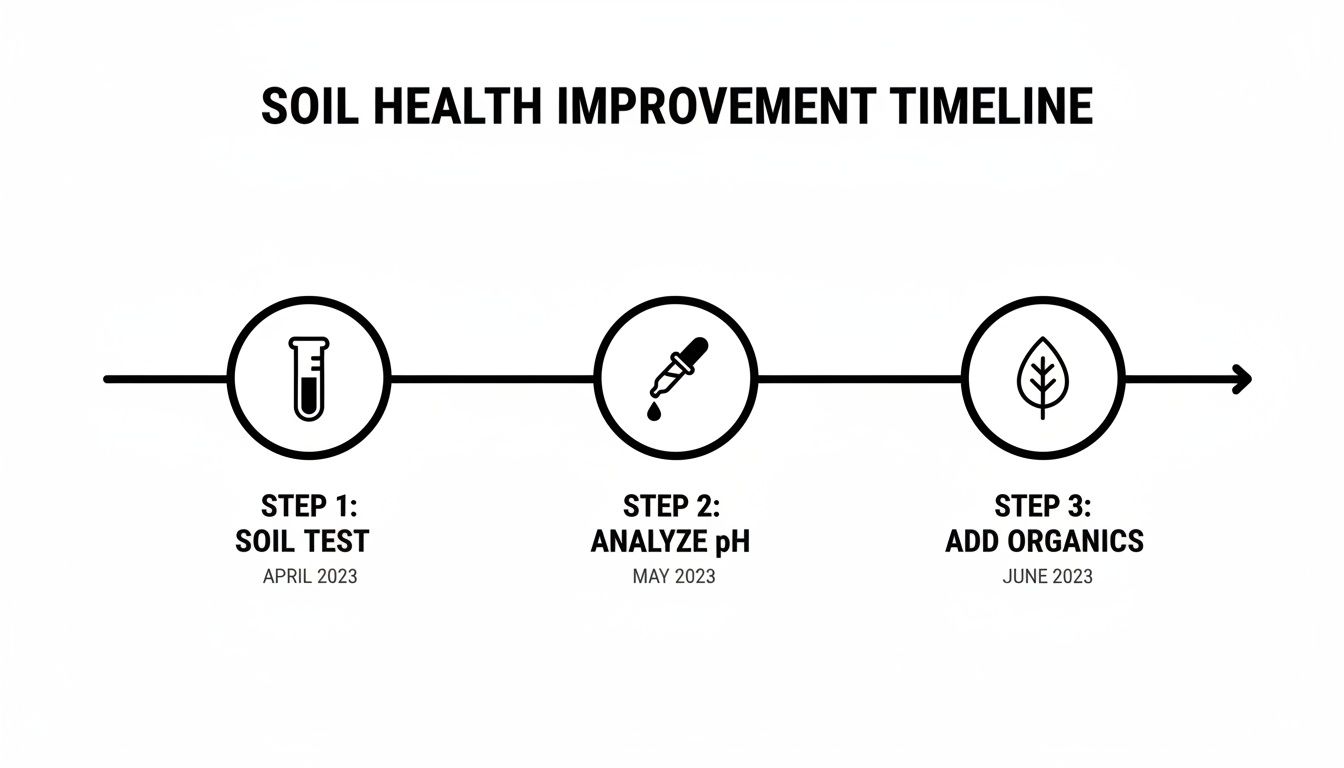
Following this sequence ensures you're amending your soil based on its actual needs, making every application more effective.
Mowing and Watering: The Finishing Touches for a Resilient Lawn
You've done the heavy lifting—testing the soil, aerating, and feeding your lawn. It’s easy to think the job is done, but how you mow and water each week is what truly separates a decent lawn from a spectacular one. These simple habits are make-or-break for building the resilience your grass needs to survive the brutal summer heat we get here in Cumming and Johns Creek.
I’ve seen it time and time again: homeowners unknowingly stress their lawns with a few common mistakes, especially with the mower. The biggest offender is cutting the grass way too short. "Scalping" the lawn might feel like you're saving time, but it actually weakens the turf, rolls out the welcome mat for weeds, and exposes the soil to the sun, causing it to dry out in a flash.
How to Mow Like a Pro
Think of your mower as a training tool. You’re not just cutting grass; you’re encouraging it to grow thick, strong, and healthy.
The golden rule here is the one-third rule. It’s simple: never, ever cut more than one-third of the grass blade’s total height in one go. Hacking off more than that sends the plant into shock. It’s forced to burn through its energy reserves to regrow leaves instead of what really matters—developing deep, resilient roots.
For the turf types common across North Georgia from Alpharetta to Dahlonega, that means setting your mower deck high.
- Fescue: Keep it at a lush 3.5 to 4 inches. This taller height gives the blades more surface area for photosynthesis and, just as importantly, shades the soil to keep it cool and retain moisture.
- Zoysia & Bermuda: These warm-season grasses can go a bit shorter, but in the spring, a height of 2 to 2.5 inches is perfect for helping them green up and spread as they come out of dormancy.
Here’s another critical detail that often gets missed: your mower blade. A dull blade doesn’t slice the grass; it tears and shreds it. Those jagged, torn ends are open wounds, creating the perfect entry point for pests and fungal diseases. Get those blades sharpened at the start of the season. It’s non-negotiable.
And when you can, leave the clippings on the lawn. This practice, often called "grasscycling," is basically a free, natural fertilizer. It returns valuable nitrogen and moisture right back into the soil where your lawn needs it.
Smart Watering to Beat the Summer Heat
Just like mowing, how you water your lawn in Alpharetta or Milton this spring sets the tone for its summer survival. The goal isn't just about keeping it green now. It's about training the roots to dig deep and become drought-resistant before the hot, dry months arrive.
The key is to water deeply and infrequently. Watering for a few minutes every day is one of the worst things you can do. It creates a lazy, shallow root system that becomes totally dependent on that daily sip of water. Instead, give your lawn a long, deep soak once or twice a week. This forces the roots to grow further down into the soil to find moisture, building a much more resilient and self-sufficient lawn.
Your lawn will tell you when it’s thirsty. Look for a slight bluish-gray tint to the color, or if you can still see your footprints on the grass long after you've walked across it. Watering only when it truly needs it is the best way to build its natural strength.
The absolute best time to water is in the early morning, between 4 AM and 10 AM. Watering midday means a huge amount of water is lost to evaporation before it ever reaches the roots. Watering at night leaves the blades wet for hours, creating a perfect breeding ground for fungus and disease. Your target should be about one inch of water per week, factoring in any rainfall we get.
While we're talking about smart watering for your turf, it's worth thinking about your entire landscape. Automated solutions can be a huge help for container gardens and other plants. If you're curious, there's a helpful guide on outdoor automatic watering systems that can point you in the right direction.
Knowing When to Call in a Pro
Taking on your spring lawn care can be a fantastic way to connect with your yard and get some fresh air. I get it. There's a real sense of accomplishment in it. But for those of us with lawns from Cumming to Alpharetta and Milton, there are times when calling in a professional is less about convenience and more about getting the job done right. Think of it as a smart partnership—you handle the routine stuff, and they tackle the heavy lifting for truly superior results.
It's a common dilemma: DIY or hire it out? The numbers show it's a pretty even split. In fact, about 54% of homeowners prefer to manage their own lawn care. With over 650,000 lawn care businesses in the U.S., there's clearly a demand for both approaches. You can dig into some of these lawn care industry trends and insights on accio.com if you're curious.
While DIY is a great option for many tasks, some jobs really benefit from professional-grade equipment and expertise. Let's talk about a few of them.
For Core Aeration That Actually Works
Core aeration is probably the single most important thing you can do for our notoriously compacted Georgia clay soil. You can definitely rent an aerator from a big box store in Cumming or Alpharetta, but I've got to be honest—there's a night-and-day difference between that equipment and what a professional crew brings to your property.
The aerators professionals use are heavy-duty machines. Their weight and power allow them to pull deep, consistent plugs from the soil, which is exactly what you need to break up that dense clay. This allows air, water, and all those good nutrients to finally reach the grassroots. The lighter rental machines often just skim the surface or poke shallow holes, which doesn't do much to relieve serious compaction.
A professional core aeration is one of the best investments you'll ever make for your lawn. Those deep plugs create the foundation for a robust root system that's nearly impossible to achieve with consumer rental equipment.
Labor-Intensive Jobs Like Top Dressing
Top dressing, which is spreading a thin layer of organic compost over your lawn, is a total game-changer for your soil's health. But let's be real: it's an incredibly physical, time-consuming job. First, you have to find and haul bags or a truckload of high-quality compost, then spend hours painstakingly spreading it evenly across your entire yard.
For a homeowner in Johns Creek or Milton, that's your whole weekend gone, and your back will be screaming. A professional service has the right equipment, like motorized spreaders, to get it done efficiently and evenly, giving you all the benefits without the back-breaking labor.
Specialized Tree and Shrub Care
A stunning landscape is about more than just green grass. The health of your trees and shrubs is crucial for your property's overall look and ecosystem. This kind of specialized care requires a different set of skills and knowledge than lawn maintenance.
Here’s what that often involves:
- Proper Pruning: Experts know precisely when and how to prune different species common to North Georgia to promote healthy growth and beautiful blooms.
- Disease and Pest Management: They can spot and treat issues like bagworms on your evergreens or fungus on your crepe myrtles long before they become a major, costly problem.
- Deep Root Fertilization: Using special tools, they can inject essential nutrients directly into the root zone of your established trees and shrubs, something a simple lawn spreader can't do.
By bringing in a professional for these high-impact tasks, you free yourself up to handle the weekly mowing and watering. This kind of balanced approach almost always delivers the best results. If you think this hybrid strategy is right for you, an organic lawn service near you can be a great partner in creating a beautiful, healthy yard.
Your Top North Georgia Spring Lawn Care Questions, Answered
Even with the best plan, spring lawn care around here can throw you a few curveballs. After years of working with homeowners from Cumming to Dahlonega, we've heard just about every question in the book. Let's tackle some of the most common ones that pop up this time of year.
Did I Miss the Window for Crabgrass Pre-Emergent?
This is probably the number one question we get every single spring. The answer has less to do with the date on the calendar and everything to do with the temperature of your soil.
For pre-emergent to work its magic, it needs to be down before crabgrass seeds start to germinate. That magic number for soil temperature is a consistent 55°F. Here in the Cumming area, that window usually opens in late February or early March.
So, what if you missed it? Don't sweat it. Your game plan just needs a little adjustment. A late application won't do much good, so pivot your focus to building up your lawn's natural defenses. Encouraging thick, dense turf through proper high-mowing and natural fertilization is your best bet now—a healthy lawn will choke out a lot of weeds on its own. Just be prepared to spot-treat any crabgrass that does manage to break through.
A Pro Tip for Next Year: Nature gives us a great signal. When you see the local forsythia bushes burst into those vibrant yellow blooms, that's your cue. It means the soil is warm enough and it's time to get your pre-emergent down.
Can I Aerate and Overseed My Bermuda Lawn in the Spring?
This is a really important one for folks with warm-season grasses. While your neighbors in Milton with Fescue are busy overseeding, you absolutely should not aerate or seed your Bermuda or Zoysia lawn in early spring.
Think of it this way: these lawns are just starting to wake up from their winter nap. They aren't growing actively yet. If you punch a bunch of holes in the lawn now, you're basically rolling out the welcome mat for weeds to move in before your grass is strong enough to recover and fill in those gaps.
The prime time to aerate and seed Bermuda or Zoysia is when they hit their peak growing season in late spring and early summer. Wait until May or June when temperatures are consistently in the 80s and 90s. That’s when they’ll bounce back quickly and thrive.
For now, your spring focus for these warm-season lawns should be on weed control and that first dose of fertilizer to help them green up nicely.
What’s the Deal with All These Mushrooms in My Yard?
A classic rainy Georgia spring often brings an unwelcome crop of mushrooms. From Johns Creek to Cumming, they seem to pop up overnight. The good news? They're usually harmless.
Mushrooms are just the fruiting body of fungi that are actually doing a good thing—breaking down organic material like old tree roots or buried wood chips in your soil. You can just knock them over with a rake or mower.
However, their presence is a giant flashing sign that points to one thing: too much moisture.
To get to the bottom of it, here’s what you can do:
- Rethink Your Watering: Are you watering too often? Lawns do best with deep, infrequent watering sessions, not a light sprinkle every day.
- Boost Your Drainage: If you have areas that stay consistently soggy, core aeration is a game-changer. It helps air and water move more freely through the soil, making it a less inviting place for fungi to flourish.
- Look for Lawn Disease: If you're seeing more than just random mushrooms—things like distinct brown patches or strange-colored rings—you might be dealing with a lawn disease. When that happens, it's smart to get a professional diagnosis to make sure you use a targeted treatment that’s safe for your kids, pets, and the environment.
Ready to take the guesswork out of your spring lawn care and achieve a beautiful, healthy lawn without harsh chemicals? The experts at Barefoot Organics specialize in natural solutions tailored for our unique North Georgia climate, serving Cumming, Alpharetta, Johns Creek, Milton, and beyond. Get your free online quote today!