

That first spring feeding is your lawn's wake-up call. Here in North Georgia, especially around Cumming and Forsyth County, it’s the single most important thing you can do to set the stage for a thick, green, and tough lawn that can handle our summer heat. For warm-season grasses like the Bermuda and Zoysia you see all over our area, a well-timed meal provides the kickstart needed for deep roots and that vibrant color we all want.
Your Cumming, GA Spring Lawn Care Playbook

As the days get longer and that winter chill finally backs off in Cumming, Alpharetta, and Johns Creek, your lawn starts stirring. It's been dormant for months, and now it's hungry. But it doesn't just need any food; it needs the right kind of nourishment to really take off in our unique climate. This is about more than just tossing fertilizer out—it's a strategy that builds a healthy lawn from the soil up.
Think of that first spring application as the most important meal of the year for your grass. It's the fuel that powers the big transition from brown and sleepy to lush and green. Getting this right is critical for strengthening the root system, which is what helps your lawn survive the inevitable heat and dry spells of a Georgia summer.
Building a Family-Friendly Outdoor Space
For so many of us in Johns Creek, Milton, and Cumming, a great lawn isn't just about curb appeal. It’s the playground for our kids and the backyard for our pets. The goal is a gorgeous outdoor space where your family can actually live and play without you worrying about what they’re being exposed to. This is where an organic, soil-focused approach to spring fertilizing really makes a difference.
Instead of the quick, almost artificial green-up you get from many synthetic products, organic fertilizers work on a deeper level:
- They feed the soil, not just the plant: A healthy lawn starts with healthy soil. Organic matter nourishes the tiny microbes that create a robust ecosystem underground, leading to stronger, more self-sufficient grass.
- They offer slow-release nutrition: Nutrients are released gradually over time, giving your lawn a steady diet instead of one big jolt. This prevents weak, spindly growth and cuts down on the risk of fertilizer washing away into our local waterways.
- They improve soil structure: This is a huge deal in our heavy Georgia clay. Organic materials help loosen the soil, improving drainage and aeration so roots can breathe and grow deeper.
By putting soil health first, you’re not just feeding the grass for a few weeks—you're building a more resilient, lower-maintenance lawn for the entire year. A lawn managed this way naturally chokes out weeds and requires fewer chemical fixes down the road.
Ultimately, a smart spring fertilization plan is your first and best step toward that stunning, barefoot-worthy lawn. It's about working with nature to create a safe, beautiful, and enjoyable space from the very first warm days of the season.
To get started, here's a quick look at the game plan for the next few weeks.
North Georgia Spring Fertilizer Quick Guide
This table gives you a snapshot of the key actions for fertilizing your lawn this spring in Forsyth County and the surrounding areas.
| Key Action | Best Timing for North Georgia | Primary Goal |
|---|---|---|
| Soil Testing | Early spring (March) | Get a baseline of your soil's pH and nutrient levels before you apply anything. |
| First Fertilizer Application | Late April to early May | Provide essential nutrients as the grass actively starts growing again. |
| Weed Pre-emergent | When soil temps hit 55°F | Stop weeds like crabgrass before they have a chance to germinate. |
| Core Aeration | Late spring (May/June) | Relieve soil compaction and improve air, water, and nutrient flow to the roots. |
Following this timeline helps ensure you’re giving your lawn exactly what it needs, right when it needs it, for a successful growing season.
Getting to Know Your Lawn & Nailing the Timing
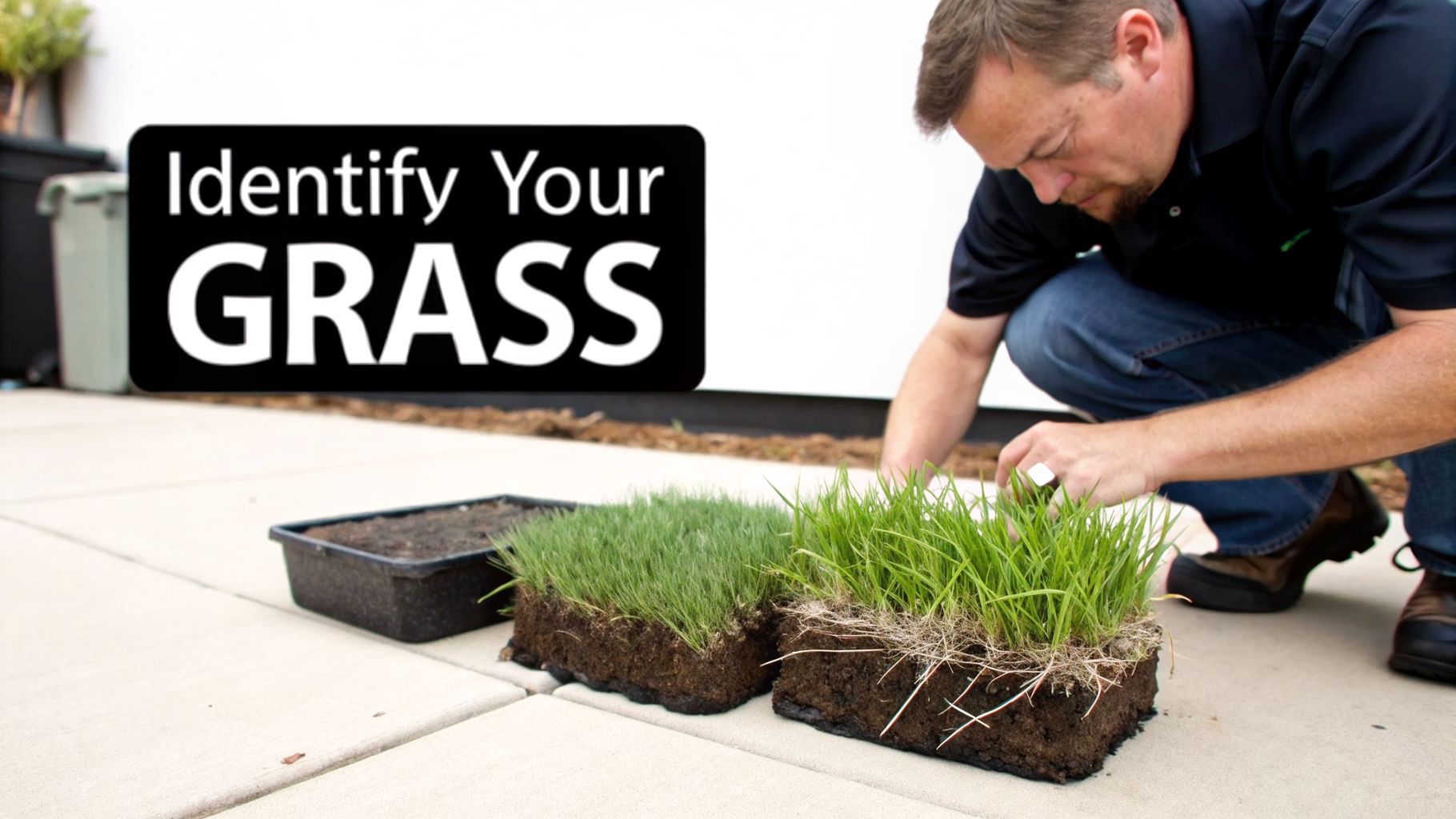
Before you even think about picking up a bag of fertilizer, you've got to know what you’re working with. Out here in the Cumming area, treating a Bermuda lawn the same way you’d treat a Fescue lawn up in Dahlonega is a surefire way to have a frustrating season. The first, most important rule of spring fertilizing grass is simple: know what's growing in your yard.
The vast majority of lawns around here, from Alpharetta all the way up to the foothills, are warm-season grasses. These are the types that absolutely love our summer heat but go dormant and turn brown once winter sets in. Getting this ID right is the key that unlocks your entire spring and summer lawn care strategy.
North Georgia’s Most Common Grasses
Chances are, your lawn is one of two popular warm-season powerhouses, or maybe the common cool-season alternative. A quick look at the blades of grass can tell you almost everything you need to know.
- Bermuda Grass: This is the ultimate sun-worshipper. Its blades are fine and pointed, and it spreads like crazy with both above-ground runners (stolons) and below-ground roots (rhizomes). That aggressive growth makes it incredibly durable, perfect for yards in Cumming with kids and pets.
- Zoysia Grass: People often call this the "barefoot grass" for a reason—it has a famously dense, carpet-like feel. The blades are a bit stiffer and more pointed than Bermuda's, and it tends to be one of the last to green up in the spring.
- Tall Fescue: As a cool-season grass, Fescue is the one that stays greener longer into the fall and sometimes through the winter. It grows in clumps, has wider, darker green blades, and you'll often find it in the shadier parts of yards across Forsyth and Cherokee counties.
Knowing which one you have is everything. For instance, throwing fertilizer on a dormant Bermuda lawn does nothing for the grass itself—it just feeds the winter weeds. This is exactly why timing that first spring application is so critical.
The Perfect Window for Your First Spring Feed
I see it every year: that first warm weekend in March hits, and everyone rushes to fertilize. This is one of the biggest mistakes you can make in our area. Pushing nutrients on a lawn that isn't fully awake and ready to use them is not just wasteful, it’s counterproductive.
An early application can jolt your grass out of dormancy too soon, leaving it vulnerable to a late-season frost. Worse, it’s like rolling out a banquet for winter weeds like poa annua (annual bluegrass) and henbit. You’re giving them the fuel they need to take over before your turf even has a chance to get going.
The Golden Rule for Warm-Season Grass: Wait until your lawn is 100% green and you’ve already had to mow it at least once or twice. This is the non-negotiable signal from your lawn that the roots are active and ready to eat.
For most of us in the Cumming, Milton, and Alpharetta corridor, this visual cue usually happens sometime between late April and mid-May. Don't go by the calendar. Go by what your lawn is telling you. A little patience ensures the fertilizer you apply actually feeds your grass, not its competition.
Local Fertilizing Timelines
While that "100% green-up" rule is your best guide, our local climate gives us a pretty reliable timeline for planning. Here’s what you can generally expect in our neck of the woods:
| Location Area | Typical "100% Green-Up" Window | Key Indicator You're Ready |
|---|---|---|
| Johns Creek, Milton, Alpharetta | Late April – Mid-May | Nights are staying consistently warm (above 60°F) and you can see active growth. |
| Cumming, Forsyth County | Early to Mid-May | You've already done your second mow of the season at the proper height. |
| Dahlonega & Foothills | Mid to Late May | The lawn has a uniform green color with no brown, dormant spots left. |
Waiting for these signs means your investment in spring fertilizing grass will pay off. You’ll encourage deep root growth and build a thick turf that can naturally choke out summer weeds, setting you up for a great-looking lawn all season long.
Why Soil Testing Is Your Secret Weapon
Fertilizing your lawn without knowing what's in the soil is like a doctor prescribing medicine without a diagnosis. You could be dumping on nutrients your lawn already has plenty of while completely ignoring what it's truly starving for. This kind of guesswork isn't just a bad strategy for spring fertilizing grass; it's a waste of money and can damage our local environment right here in North Georgia.
A simple soil test is, without a doubt, the single most powerful tool you have for creating a genuinely healthy lawn. It takes all the speculation out of the equation and gives you a precise roadmap of your lawn's nutritional needs. It's the secret weapon the pros use to get those consistent, head-turning results.
Moving Beyond the N-P-K Guessing Game
You’ve seen the three numbers on every bag of fertilizer: N-P-K, for Nitrogen, Phosphorus, and Potassium. A lot of homeowners just grab a "balanced" bag like a 10-10-10, spread it, and hope for the best. Here's the problem: our Georgia red clay is often naturally high in phosphorus. Adding more just leads to runoff that pollutes our local waterways, including Lake Lanier.
A soil test tells you exactly where you're starting from. For instance, your lawn in Alpharetta might be critically low on potassium, which is absolutely vital for helping your grass stand up to drought and disease. Or maybe the soil in your Johns Creek yard is perfect on nutrients, but the pH is so out of whack that the grass can't absorb them. You’d never know without a test.
You can't build a strong house on a shaky foundation. Think of a soil test as the blueprint for fixing your lawn's foundation—the soil itself. It transforms random fertilizing into a targeted, highly effective strategy.
How to Take an Accurate Soil Sample
Getting a good soil sample is easy, but doing it the right way is what ensures you get accurate results. The goal is to get a composite sample that represents your entire lawn, not just one random patch.
Here’s a simple, reliable way to do it:
- Grab your tools: You'll need a clean bucket, a garden trowel or a soil probe, and a small bag to put your sample in.
- Walk a "W" pattern: Zig-zag across your lawn and take 6-8 small samples from different spots. For each one, make sure you dig down about 4-6 inches to get into the root zone.
- Mix it all up: Toss all those small cores into your bucket and mix them together thoroughly. This is how you create a single, representative sample of your lawn's soil profile.
- Prep it for the lab: Sift through the mixed soil and remove any rocks, grass blades, or big roots. Let it air dry for a day or so, then put about a cup's worth into a sample bag.
For those of us in Cumming and Forsyth County, the easiest and most trusted place to send your sample is the local UGA Extension office. They offer affordable, detailed analysis that's specifically tailored to our region's unique soil types. You can usually just stop by their office to pick up a soil test kit.
Making Sense of Your Soil Test Results
When the report comes back, don't let the charts and numbers intimidate you. You really only need to focus on two key pieces of information: the pH level and the nutrient levels (P and K).
Soil pH: This number tells you how acidic or alkaline your soil is on a scale of 0 to 14. For our warm-season grasses like Bermuda and Zoysia, the sweet spot is slightly acidic, somewhere between 6.0 and 6.5. If your pH is off, your grass simply can't absorb the nutrients you're feeding it, no matter how much fertilizer you use. It's like a locked pantry door.
Nutrient Levels: The report will classify your levels of Phosphorus (P) and Potassium (K) as low, medium, or high. This tells you exactly what kind of fertilizer blend to buy. For example, if your report shows high phosphorus, you'll want to find a fertilizer with a "0" as the middle number.
Understanding these two things empowers you to make smart, effective choices. For a deeper look, check out our guide on how to test soil pH and make the right adjustments. Better yet, your report from the UGA Extension will spell out specific recommendations on what to apply, taking all the guesswork out of spring fertilizing for good.
Choosing and Applying the Right Organic Fertilizer
With your soil test results in hand, you can finally stop guessing. You know exactly what your lawn is hungry for, and you can pick a fertilizer that delivers precisely what's needed. For those of us in Cumming and Alpharetta aiming for a truly healthy lawn, an organic, slow-release fertilizer is the only way to go for long-term success.
Unlike synthetic fertilizers that act like a shot of caffeine—giving you a quick, unsustainable burst of green—organic products play the long game. They work by feeding the soil itself, nourishing the billions of beneficial microbes that create a living, breathing ecosystem under your feet. This healthy soil then slowly and steadily feeds your grass, encouraging deep, strong roots that can handle our Georgia weather.
This approach is a game-changer for our infamous red clay. The organic matter actually improves the soil's structure, helping it hold on to moisture during those dry summer stretches and drain properly during the heavy spring downpours we often see in Forsyth County.
How Much Fertilizer Do You Actually Need?
One of the easiest mistakes to make when spring fertilizing grass is putting down too much or too little product. Your soil test provides the target rate, but you have to match that with the actual size of your lawn to nail the application.
First things first, you need to know your lawn's square footage. It doesn’t have to be down to the inch, but a good estimate is crucial.
- For simple, rectangular lawns: This is easy. Just multiply the length by the width. If your yard is 50 feet long and 100 feet wide, you have 5,000 square feet.
- For odd-shaped lawns: Don't get overwhelmed. Break your yard up into smaller, manageable squares or rectangles. Calculate the area of each section and then just add them all together for your total.
Once you have that number, you can confidently follow the application rates on the fertilizer bag or your soil test. This bit of simple math is the key to feeding your lawn correctly without wasting money or contributing to runoff. If you want to dive deeper into product types, you can explore some of the best organic lawn fertilizer options for our area.
This visual guide breaks down the essential soil testing process, your first step before application.
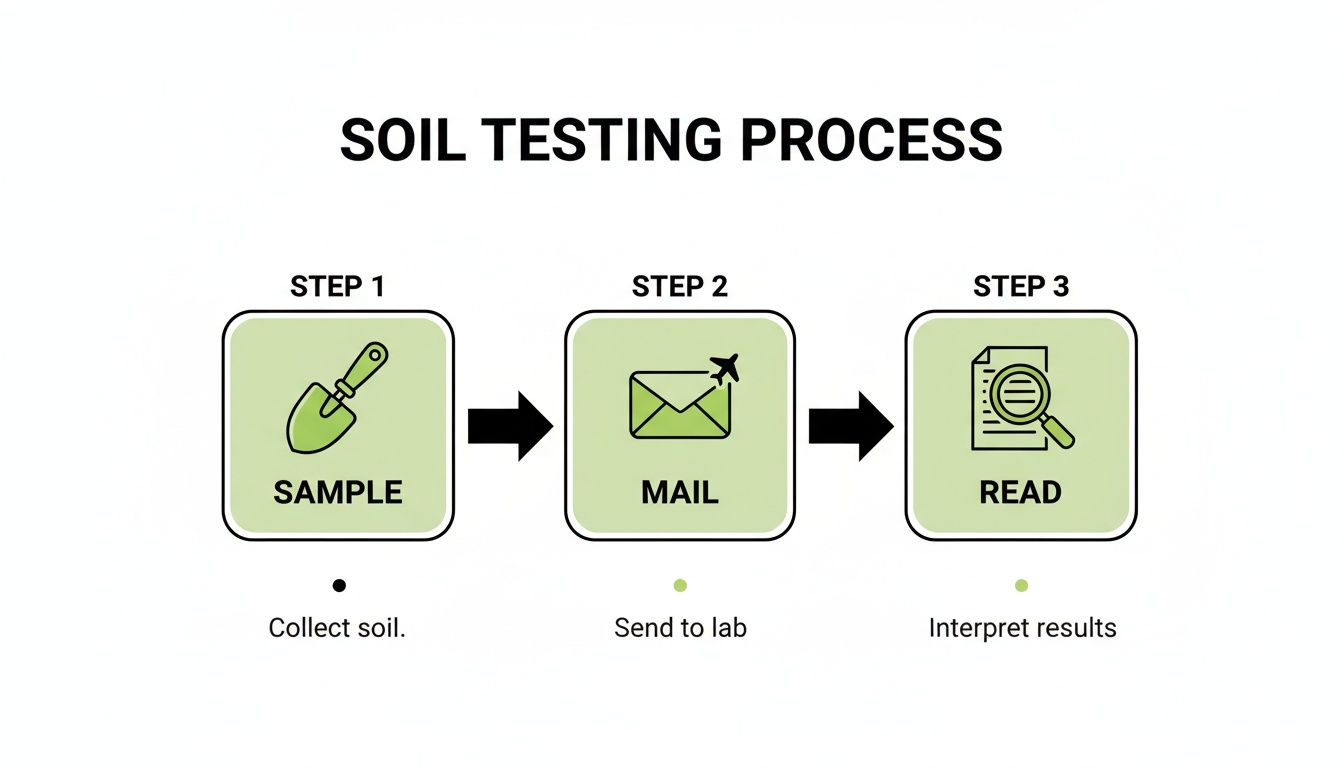
This process—sampling, mailing, and interpreting—is the foundation for making an informed fertilizer choice.
Flawless Application with a Broadcast Spreader
For that even, consistent green that everyone wants, a broadcast (or rotary) spreader is your best friend. It throws the granules out in a wide, fanned-out pattern, which is exactly what you need to avoid the weird stripes and burn spots that drop spreaders can sometimes cause.
Getting a professional-looking result is all about technique.
Make Your "Header Strips" First: Before you start walking back and forth, make a pass around the entire perimeter of your lawn. This creates a buffer zone that gives you a clean place to turn around without accidentally slinging fertilizer into your flower beds or onto the driveway.
Walk at a Steady Pace: Your walking speed directly controls how much product is being spread. Find a comfortable, consistent pace and maintain it across the whole lawn. No speeding up or slowing down.
Overlap Each Pass: As you walk your lines, make sure each pass slightly overlaps the last one. A good rule of thumb is to have the fertilizer from your current pass just reach the wheel tracks from your previous pass. This is the secret to getting that seamless, uniform coverage.
Pro Tip: Get in the habit of closing the hopper on your spreader every single time you stop walking or make a turn. It’s a simple move that prevents piles of fertilizer from dumping out and burning your grass.
After you're done, be sure to sweep any stray granules off your driveway, sidewalk, or patio and back onto the grass. This keeps fertilizer out of our local waterways and ensures every bit of it goes to work right where it’s supposed to—in your soil.
Think Beyond Fertilizer: Why Aeration and Top Dressing are a North Georgia Necessity
A good fertilizer plan is the starting point, but if you're aiming for that truly standout lawn, the kind that makes neighbors in Cumming stop and ask what you're doing, you need to tackle our region's biggest challenge: compacted clay soil.
Anyone with a lawn from Cumming to Alpharetta knows what I'm talking about. That dense, red clay can literally suffocate your grass roots, forming a barrier that blocks water and nutrients. This is precisely where aeration and top dressing come in, transforming a decent lawn into a spectacular one.
Think of core aeration as hitting the reset button for your soil. A machine pulls up small plugs of soil, physically removing the compaction. This isn't just about poking holes; it's about creating channels. These new pathways allow air, water, and the fertilizer you just carefully applied to get down deep where the roots are.
For a lawn in Johns Creek or Milton that's struggling with thatch or turns into a swamp after a heavy spring rain, aeration is a game-changer. It gives the root system room to breathe and spread out, building the resilience it'll need to face a brutal Georgia summer.
The One-Two Punch: Aeration and Top Dressing
Following up aeration with a layer of top dressing is how you lock in those benefits for the long haul. Top dressing is simply spreading a thin layer of high-quality organic compost over the turf. The material settles into the aeration holes, gradually improving your soil from the inside out.
The results are powerful and they last.
- Breaks Up Clay: The organic matter in the compost goes to work on that heavy clay, making the soil looser and easier for roots to penetrate.
- Holds More Water: Compost is like a sponge. It helps your soil retain moisture far more effectively, which can mean less time spent watering.
- Adds Good Biology: Quality compost is alive with beneficial microbes. These tiny helpers break down thatch and make nutrients more available to your grass.
When you combine these two services, you're unlocking the full power of your fertilizer. Aeration opens the door, and top dressing provides the long-term, foundational support for a truly healthy lawn. You can see more about how we integrate these services by checking out our approach to lawn aeration and overseeding.
Getting the Timing Right for Maximum Impact
Just like with fertilizer, timing is everything. For our warm-season grasses like Bermuda and Zoysia, the best time to aerate is when they're growing most aggressively. That sweet spot is typically late spring into early summer—think May and June—when the grass is strong enough to recover quickly and fill in the holes.
This window lines up perfectly with a key fertilization period. Research has shown that concentrating nitrogen applications in late spring leads to much better results. One study found that a fertilizer schedule with the highest nitrogen inputs in May and June grew deeper roots and produced higher-quality turf than other timing strategies. You can dig into the specifics and learn more about seasonal fertilizer distribution's impact on turf.
Aerating in late spring right before you fertilize is a pro-level move. You're guaranteeing those critical nutrients are delivered straight to a root system that's primed and ready to grow. It’s a strategic play that sets your lawn up for success through the hottest, toughest months of the year.
Answering Your Cumming, GA Spring Lawn Care Questions
Even with the best game plan, questions always pop up. It makes sense—every lawn has its own personality, from the stubborn red clay in Cumming to the sun-drenched Bermuda stretches in Alpharetta. Here are some of the most common questions we get from homeowners trying to nail their spring lawn care.
When Is the Right Time to Fertilize My Bermuda Lawn in Alpharetta?
This is, without a doubt, the question I hear most often. The simple answer? Wait. When it comes to waking up warm-season grasses like Bermuda or Zoysia, patience is your best friend.
You absolutely want to hold off on that first feeding until your lawn is 100% green and you’ve already had to mow it at least twice. For most of us in the Alpharetta, Johns Creek, and Milton areas, this sweet spot usually lands somewhere between late April and mid-May.
Fertilizing a dormant or half-awake lawn is a classic mistake. The turf just isn't ready to use those nutrients. All you're really doing is feeding opportunistic winter weeds and pushing the grass to grow before it’s naturally ready, which can stress it out.
Are Organic Fertilizers Actually Safe for My Dog After You Apply Them?
Absolutely. In fact, this is one of the main reasons so many families in Forsyth County are shifting to an organic-first lawn program. A truly healthy lawn is one that's thick enough to crowd out weeds on its own, and that kind of health starts with safe, soil-building products. Organic fertilizers work by feeding the life in the soil, which in turn grows stronger, more resilient grass.
While our products are chosen with family safety as the top priority, the best practice is always to water the fertilizer in and let the lawn dry completely before letting the kids and pets back out to play. This quick step ensures the granules wash off the grass blades and get down into the soil where they need to be. The product gets to work on the soil, and your yard stays a safe playground for everyone.
Should I Kill Weeds Before I Fertilize?
It's easy to think this way, but it gets the order of operations a bit backward. The best defense against weeds isn't a bottle of weed killer; it's a thick, healthy lawn that literally chokes them out. The goal should be to grow turf so dense that weed seeds never find the sunlight or bare soil they need to sprout.
Your real first move should be applying a pre-emergent herbicide in late winter, long before soil temperatures consistently hit 55°F. That’s your critical window to stop crabgrass and other summer annuals from ever getting a foothold. Your spring fertilizer application then becomes fuel for your desired grass—your Bermuda or Zoysia—helping it outcompete anything that might have slipped through. You can always spot-treat a few broadleaf weeds later, but your main strategy should always be promoting turf density.
A dense lawn is the best weed control there is. By focusing your spring efforts on feeding the turf and building soil health, you are actively creating an environment where weeds struggle to survive.
How Soon Should I Water After Fertilizing, and How Much?
Great question. You'll want to water your lawn shortly after putting down a granular organic fertilizer. The idea is to wash the product off the grass blades and get it down into the soil. This is where the magic happens—moisture activates the soil microbes, which then go to work breaking down the organic matter into nutrients your grass can actually use.
A light watering of about 1/4 inch is all you need. There's no need to drench the lawn or run your irrigation system for hours. You just want to get the product to the soil level so it can start doing its job. After that initial rinse, you can go right back to your normal deep-and-infrequent watering schedule.
Can I Fertilize and Overseed My Fescue Lawn at the Same Time?
This comes up a lot, especially for folks with shadier lawns in areas like Alpharetta or Milton where Tall Fescue is popular. For a spring application, however, the answer is almost always no. Spring is simply not the right time to overseed Fescue in North Georgia.
The ideal window for seeding Fescue is in the fall. If you seed in the spring, those fragile new grass seedlings are forced to compete with aggressive summer weeds and then try to establish roots just as our brutal summer heat and humidity arrive. Frankly, it's a recipe for failure.
Here’s your spring game plan for Fescue:
- Apply a pre-emergent to head off summer weeds.
- Fertilize to strengthen the existing turf for the coming summer stress.
- Make a note on your calendar to aerate and overseed this fall for the best results.
What if I See Yellow Spots in My Lawn After Fertilizing?
Seeing yellow patches after you've fed the lawn can be jarring, but the cause is usually pretty simple to diagnose. More often than not, it points to an uneven application. This can happen if a spreader gets clogged, if you miss a few passes, or if the spreader was left open while standing still, which can "burn" the grass with too much product in one spot.
Another common culprit in our area is the soil's pH. If your soil is too acidic or alkaline, the grass can't properly absorb key nutrients like iron. This leads to a condition called chlorosis, which shows up as yellowing blades. This is another reason why starting your season with a soil test is so valuable—it can pinpoint a pH imbalance before you even buy a bag of fertilizer. A simple pH adjustment, usually with lime, can unlock the existing nutrients and fix the problem for good.
Ready to stop guessing and start building a lawn your family can truly enjoy? At Barefoot Organics, we use a soil-first approach to create thick, healthy, and safe lawns all across Cumming, Alpharetta, and Johns Creek. Let us handle the science so you can handle the fun. Get your free, no-obligation quote online today and see the difference a natural approach can make. https://barefootorganicsllc.com