

From Cumming to Johns Creek, Alpharetta, Milton, Dahlonega, and nearby areas like Dawsonville and Suwanee, the secret to a vibrant, resilient lawn is simple: dial your soil’s pH into the sweet spot of 6.0 to 7.0. That window keeps turf feeding on nutrients, not harsh chemicals.
A quick soil test in early spring and another in late fall reveals any swings before your grass really takes off. And, by aligning treatments with family time, you make sure kids and pets stay safe.
Ideal PH Range For Grass In North Georgia

Spring and fall tests give you a clear picture of seasonal pH trends. From there, you can plan:
- Organic Lime eases pH upward over months, so changes happen gradually and safely.
- Elemental Sulfur brings pH down without leaving behind harmful residues—perfect for play areas.
- Timing treatments around dry spells or storms maximizes soil contact and minimizes runoff.
Ideal PH Ranges For Common Georgia Turfgrasses
Below is a quick reference for North Georgia’s favorite turf varieties. Use it to match your grass type to its optimal pH and schedule amendments more precisely.
| Grass Type | Ideal PH Range |
|---|---|
| Bermudagrass | 6.0–7.0 |
| Tall Fescue | 6.0–6.5 |
| Zoysiagrass | 6.0–6.5 |
| Centipedegrass | 5.5–6.5 |
| St. Augustinegrass | 6.0–7.0 |
Adjusting lime or sulfur in line with these targets makes every application count.
For example, a Forsyth County homeowner applied lime to a tall fescue lawn in October—and by spring, the grass was noticeably denser.
Keeping pH in check around play areas protects little feet and paws.
Next Steps For PH Care
- Break your yard into zones, test each separately, and jot down readings in a simple chart.
- Make amendments slowly, then retest every 3–6 months to avoid shocking the soil.
- Keep an eye on weather forecasts—apply before heavy rains or extended dry periods.
A balanced pH unlocks better nutrient uptake, stronger roots, and a deeper, richer green.
Contact Barefoot Organics in Forsyth, Gwinnett, Suwanee, and Dawsonville for a free soil test quote and a kid-and-pet-safe pH plan tailored to your yard.
In Johns Creek, one family lifted their lawn’s pH from 5.8 to 6.5 with two lime treatments six months apart—and enjoyed a 35% jump in green coverage.
Planning those tweaks around fallen leaves simplifies cleanup and boosts soil contact. Keep records of your tests alongside weather notes, and you’ll fine-tune your schedule year after year.
Your lawn’s health starts with the right pH baseline. Start testing this spring, and watch your grass flourish.
Ready to transform your lawn? Schedule a soil test with Barefoot Organics today.
With the right pH foundation, your turf in Roswell or Marietta will be the envy of the neighborhood. Enjoy greener grass through every season.
Why Soil PH Matters For Georgia Lawns
In North Georgia, soil pH really dictates how your turfgrass takes up nutrients and builds strong roots. Clay‐rich soils combined with spring rains often push pH below 6.0, where calcium and phosphorus get tied up and aluminum can become toxic. On the flip side, when pH drifts past 7.5, iron and manganese lock out, leading to those stubborn yellow patches in your lawn.
Homeowners around Cumming and Alpharetta frequently spot 5.8 readings on their spring soil tests. Left unchecked, those acidic spots invite weeds and leave turf thin. I once helped a family in Johns Creek whose centipedegrass under oak trees languished until we raised the pH to 6.3 with a gentle dose of organic lime. Within weeks, blade density improved, and microbes sprang back to life.
Key Consequences Of Extreme PH Levels
- Nutrient lock‐up that starves grass for essential elements
- Shifts in microbial activity that slow breakdown of organic matter
- Open invitations to weeds and patchy turf cover
Signs Of PH Imbalance
Yellow leaf margins on bermudagrass? That often points to high pH stress. Conversely, slow or stunted growth in fescue or zoysia signals acidity. After a heavy rain, kids’ play areas near patios tend to compact and show the first brown spots.
“Adjusting even half a pH point can produce noticeable green up within weeks,” says a local lawn care expert.
Real‐World Examples
- Bare patches appearing after winter in Sandy Springs
- Uneven turf texture across Milton properties
- Fast‐spreading weeds in new Alpharetta lawns
Regional PH Patterns
Research covering 19,299 soil horizons finds that grassland topsoil averages about 6.3 globally. In the eastern and southeastern U.S., you’ll typically see a pH between 5.5 and 6.5. Out West, grasslands often drift toward 6.5–8.0, edging into neutral or slightly alkaline territory. Read the full findings on soil pH distributions in this soil pH distributions report.
| Region | Typical PH Range |
|---|---|
| Eastern and Southeastern US | 5.5–6.5 |
| Western Grasslands | 6.5–8.0 |
| Global Grasslands (Median) | ~6.3 |
Check out our guide on creating healthy soil in North Georgia: Learn more about healthy soil techniques in our guide
Impact On Turfgrass Health
For most Georgia turfgrasses, a pH between 6.0 and 7.0 is the sweet spot. Around 6.5, calcium and magnesium become readily available. Iron and manganese dissolve best just below 6.5, helping prevent that telltale chlorosis.
What Balanced PH Delivers
- Reduced stress on root systems
- Improved efficiency of every fertilizer application
- Reliable readings that guide timely amendments
Key Takeaway: PH swings hamper nutrient cycling and encourage weeds.
Tackling pH in small, gradual steps—timed around seasonal lawn care cycles—keeps you from overcorrecting and ensures safety for kids and pets. That steady approach pays off with stronger roots and a vibrant, uniform lawn across Forsyth, Cobb, and Gwinnett counties.
Microbial Balance And PH
Think of soil microbes as the backstage crew that makes nutrients available on cue. They thrive in a pH band of roughly 6.0–7.0. Dip below 6.0, and fungi start to dominate, slowing organic matter decomposition.
In many ways, it’s like a kitchen: when pH is balanced, every microbial “chef” follows the recipe for a healthy lawn. If pH drifts, those chefs can’t do their job, and nutrients bottleneck.
- Microbial diversity peaks at ideal pH ranges
- Enzyme activity drops sharply below 6.0
- Organic amendments often take months to restore balance
This sets the stage for our next section on precise soil testing methods tailored to North Georgia conditions. Proper pH management builds the foundation for a thriving ecosystem beneath your grass.
Testing Lawn Soil In Cumming And Johns Creek
Accurate soil sampling is the foundation for a pH management plan that actually works in Cumming, Johns Creek, Suwanee, and Milton. Splitting your yard into distinct zones makes sure each patch of grass gets the right treatment.
Think about areas like the full-sun front lawn, shady corners under oaks, high-traffic play spots, and slopes where runoff or erosion can skew results.
- Front lawns bake in sun and reveal nutrient deficiencies first.
- Tree-shaded sections hold moisture longer, throwing off readings.
- Play zones pack soil tightly, which affects pH tests.
- Sloped spots often lose topsoil and key nutrients after a rain.
When you gather 8–10 subsamples per zone with a clean trowel and mix them in a bucket, you blend local quirks into a single, representative sample. This approach avoids chasing misleading “hot spots.”
DIY color-chart kits store easily and give you a solid starting point if lab results are delayed. Handheld meters run $30–$50, need occasional calibration, but they deliver instant feedback. Chart kits cost under $15 and fit neatly in your toolbox.
Capturing Your Samples
Timing and technique matter—aim for soil that’s slightly damp but not drenched or bone dry. Avoid sampling right after heavy rains or long droughts.
• Dig down 2–3 inches at each spot to hit the turf root zone.
• Follow a zigzag or grid pattern to randomize your digs.
• Scoop 8–10 soil bits into a clean bucket and stir until uniform.
Label each bucket mix with zone name, date, and any recent weather or watering notes. This context is crucial for interpreting lab feedback accurately.

This image shows clean tools, clear labeling, and well-mixed subsamples ready for testing—key steps that boost pH accuracy.
Submitting Samples To Labs
Local labs and private services each have perks:
• UGA Extension in Dahlonega returns results in about 10 business days.
• Certified labs near Milton can cut that to five–seven days.
Keep mailing costs under $10 per sample with these tips:
- Air-dry crumbs on paper to prevent mold.
- Place one cup of each mixed sample into labeled zip-top bags.
- Include the submission form and ship via your nearest post office.
A brief note on recent fertilizer use or heavy rainfall helps lab technicians fine-tune their analysis.
Interpreting Preliminary Readings
Handheld meters often show pH values between 5.5 and 7.5. Use these guidelines:
- Readings below 6.0 suggest you’ll likely need lime.
- Values above 7.2 point toward alkalinity; elemental sulfur can help.
Keep a simple log with zone names, meter readings, weather conditions, and any fertilizer or mowing notes.
Key Takeaway: Quick in-field readings guide smarter lab submissions and save you money.
Real Stories From Alpharetta
An Alpharetta family divided their backyard into six zones before a summer cookout. A shady corner under pines tested 5.8 on their meter; the UGA lab confirmed 5.9. They spread organic lime over that 400-sq-ft section two weeks before guests arrived. By fall, their Zoysia grass was noticeably denser and deeper green.
In the U.S., grassland soils vary widely:
| Region | Typical pH Range |
|---|---|
| Eastern & Southeastern | 5.5–6.5 |
| Western Grasslands | 6.5–8.0 |
Read the full regional breakdown on soil pH patterns in our expert overview from EarthScienceGrowing.
For a detailed step-by-step on sample collection, check out our how-to test soil pH guide:
Learn Precise Sampling Methods
Best Practices For Reliable Sampling
Consistency is everything—aim to test in early spring and again in late fall, before major growth spurts. Remember to:
- Rinse or wipe tools between zones to avoid cross-contamination.
- Keep subsample bags sealed and clearly labeled.
- Skip sampling for at least a week after adding fertilizers or amendments.
- Store samples in a cool, shaded spot until mailing to lock in moisture.
Local extension workshops in Forsyth County often include free, drop-in sampling demos.
“Proper sampling technique reduces costly amendments and leads to greener turf,” notes a Dahlonega extension agent.
Armed with the right tools, timing, and organization, North Georgia homeowners can dial in their soil pH with confidence. Contact Barefoot Organics for a professional sampling kit or a free consultation in Alpharetta, Roswell, Marietta, Suwanee, and Dawsonville.
Don’t let pH guessing games waste time and money. A simple, structured approach delivers consistent, greener results—safe for kids and pets on fresh turf immediately. Repeat sampling every 3–5 years or after major soil disturbance to protect your investment and keep your lawn thriving year-round.
Interpreting Your Soil PH Results
When your soil lab report arrives, those pH figures suddenly explain what’s happening beneath your turf. A pH 5.8 reading often shows up as patchy brown spots, while a 7.3 tends to coincide with straw-colored grass. Understanding these numbers is the first step toward targeted fixes.
Matching each zone to the ideal 6.0–7.0 range reveals where you need lime or sulfur. Front lawns around Cumming behave differently than shady corners in Alpharetta, so mapping results by area is crucial.
- Below 6.0 means your soil is acidic—add lime to nudge it upward.
- Above 7.2 signals alkalinity—apply sulfur to bring it down gently.
- Between 6.0 and 7.0 is just right for nutrient uptake and lush growth.
For example, a 5,000 sq ft lawn reading pH 5.8 typically needs about 20 lbs of agricultural lime split into multiple applications. Spreading out the doses avoids root stress and potential disease.
Interpreting PH Zones
In one Cumming yard, the front lawn hit 5.8, while the shaded area under oak trees dropped to 5.5. Focusing first on those acidic spots let the homeowner prioritize lime where it mattered most. Over in Milton, compacted clay areas often drift acid, so they’re front-of-mind when planning treatments.
Key Insight
Slow, deliberate pH shifts lower the risk of root stress and disease.
Johns Creek homeowners who saw 7.3 on their meter applied sulfur in spring and watched their turf rebound to a richer green within weeks.
A glance at research from Germany underlines why incremental adjustments pay off. Across 812 grassland sites, pH values peaked at 5.0 and 7.1, yet only 23.9% sat in the optimum 6.0–7.0 window. Read the full study on Wiley Online Library: Grassland pH Distribution.
| Zone Location | Measured pH | Recommended Action |
|---|---|---|
| Front Lawn Cumming | 5.8 | Apply 10 lbs lime |
| Shady Side Milton | 7.3 | Spread 5 lbs sulfur |
| Play Area Roswell | 6.5 | No amendment needed |
Planning PH Shifts
Safe pH changes happen at a pace of 0.2–0.3 points per season. Breaking the total into two or three applications over several months keeps soil life happy.
- Calculate amendment weights based on zone size, soil texture, and current pH
- Split the total into timed applications across the season
- Lightly water each treated area to activate the amendment
Timing varies by county. In Forsyth and Cobb, fall lime applications in October set you up for winter rest. In Gwinnett and Cherokee, spring sulfur treatments ahead of peak growth deliver the best bounce-back. Keeping a simple log of dates, pH readings, and materials used makes your next retest—six to eight months later—a breeze.
Actionable Timeline
Test in early spring
Apply lime in fall
Add sulfur in spring
Retest after six months
For a hands-off experience, reach out to Barefoot Organics in Johns Creek, Alpharetta, Roswell, Marietta, Suwanee, or Dawsonville. Their organic-friendly programs keep kids and pets safe while building resilient, green lawns.
Monitoring PH Over Time
Even after treatments, soil pH can shift with heavy rains or fertilizer choices. A basic logbook or spreadsheet tracking zone name, sample date, pH value, amendments, and weather notes helps you spot trends early.
Dahlonega gardeners tell us that once they chart seasonal ups and downs, their East Cobb and Cobb County lawns require only minor tweaks year to year.
- Record the test date and conditions to identify shifts sooner
- Note watering and feeding alongside pH changes
- Observe turf color and density after each treatment
Checking in each autumn and spring aligns perfectly with North Georgia’s growth cycles. That rhythm captures extremes and points the way to your next adjustment.
Sustained monitoring ensures your grass stays within the sweet spot for years.
Next Steps For Consistent Success
With clear pH targets and a monitoring plan in place, you’re turning raw data into healthier turf. Local resources like the UGA Extension lab in Dahlonega or private testing services in Milton can confirm your readings and refine amendment schedules.
Homeowners across Roswell, Marietta, Forsyth County, Cherokee County, Gwinnett County, and Dawsonville who maintain detailed logs consistently report thicker, greener lawns. Make soil pH checks part of your lawn-care ritual—North Georgia lawns have never looked better.
Adjusting Soil PH With Organic Amendments
Getting your lawn’s pH into the 6.0–7.0 sweet spot in North Georgia can mean the difference between a patchy yard and a lush one. Homeowners from Cumming to Alpharetta often notice the grass deepening in color once acidity or alkalinity swings back into balance.
With a soil test report in hand, you can choose the right material—lime to raise pH or sulfur to lower it—and time applications to North Georgia’s seasons. This approach minimizes runoff and gives turf the best chance to respond.
For a clear, step-by-step look at how lime, sulfur, and compost work together, take a peek at this visual guide:
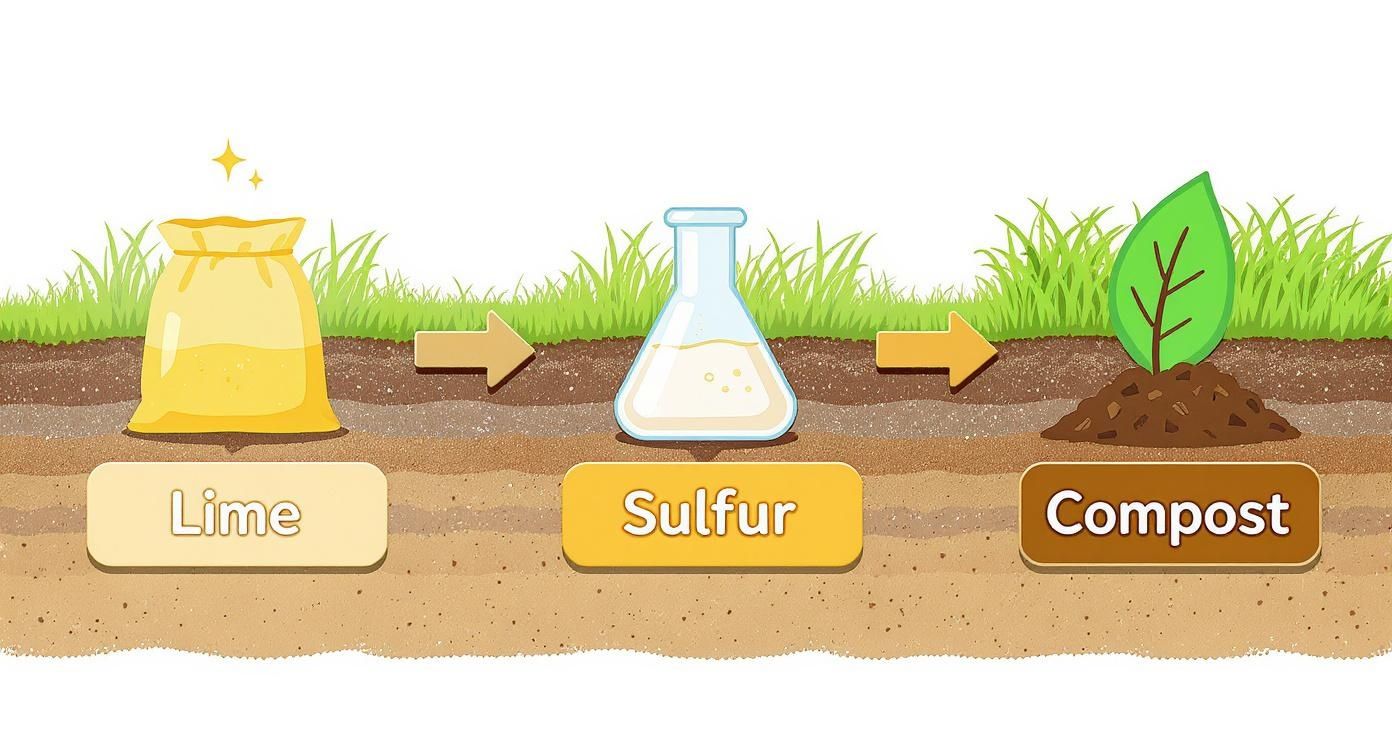
This diagram shows how agricultural lime lifts pH, elemental sulfur tames it, and compost smooths out any bumps—all in one cycle.
Choosing The Right Amendment
Clay soils around Milton and Dahlonega thrive after a lime boost. On Clay Loam, aim for 15–20 lbs per 1,000 sq ft to nudge pH up by 0.2.
In wetter spots like Johns Creek, elemental sulfur helps counteract spring rain leaching. A dose of 5–10 lbs per 1,000 sq ft will typically knock pH down by about 0.3.
For a long-term buffer, Roswell and Marietta estates swear by compost or biochar. Spread 1–2 inches of compost or mix in 5% biochar by volume to keep soil life thriving.
• Agricultural Lime: 15–20 lbs per 1,000 sq ft
• Elemental Sulfur: 5–10 lbs per 1,000 sq ft
• Compost Layer: 1–2 inches spread
• Biochar Blend: 5% of soil volume
“Applying lime in October lifted our pH from 5.8 to 6.1 by spring,” shares an Alpharetta gardener.
Mixing Compost Tea And Minerals
A liquid blend of compost tea plus minerals is perfect for high-traffic zones in Forsyth County. It seeps through dense turf and delivers amendments right to the roots.
Start by gathering 2 gallons of fully broken-down compost. Fill a container with 10 gallons of non-chlorinated water and add the compost. Stir or aerate for 24 hours to wake up beneficial microbes. Once it’s steeped, blend in 1 lb of powdered lime or sulfur per gallon of tea.
• Gather mature compost from your pile or trusted supplier
• Mix with non-chlorinated water and aerate for 24 hours
• Add 1 lb of amendment per gallon of finished tea
• Spray or drench turf evenly with a pump sprayer
This method gives busy families in Cobb County a quick, kid-safe way to treat lawn trouble spots without waiting weeks for granular products.
Monthly PH Monitoring
Keeping a monthly eye on soil pH is the best defense against surprise turf stress. A handheld meter or color-chart kit takes minutes and gives instant feedback.
• Test early in the morning to avoid hot-soil readings
• Jot down results in a notebook or spreadsheet
• Compare to the 6.0–7.0 target range
• Note rainfall, mowing height, and any fertilizer you’ve used
| Month | Sample Zone | Measured PH | Last Amendment |
|---|---|---|---|
| October | Front Lawn – Cumming | 5.8 | 20 lbs lime |
| March | Side Yard – Milton | 6.2 | 1 inch compost |
| June | Back Play Area | 6.8 | Compost tea with sulfur |
| November | Shady Corner – Johns Creek | 6.0 | 5 lbs sulfur |
This running log reveals seasonal trends in East Cobb, Suwanee, and Gwinnett yards—and makes planning your next move a breeze.
Safety Tips For Play Areas
Most organic amendments settle quickly, so kids and pets can return to the grass soon after application. Follow these simple guidelines:
• Spread lime or sulfur between dusk and dawn to cut down on airborne dust
• Lightly water treated areas to lock nutrients into the soil
• Store leftovers in sealed, labeled containers out of reach
• No need to cordon off your lawn once dust settles
• Skip applications when rain is on the way to avoid wash-off
• Pelletized or wet blends help reduce fine particles in the air
Find detailed rates and timing in our step-by-step guide: Read our lime application guide
Seasonal Application Timeline
Georgia’s shifting weather calls for a rhythm in your pH routine. In Dahlonega’s acidic microclimate, a fall lime top-dress after leaf drop sets you up for a steady winter. Come spring in Cherokee County, sulfur ahead of new growth stops hard-water alkalinity in its tracks.
• September–November: Lime on Fescue lawns
• March–May: Sulfur for warm-season grasses
• June–July: Compost or biochar top-dressing
• Monthly: pH checks and compost tea tweaks
One Milton homeowner reports that treating a 3,000 sq ft yard with lime in October and sulfur in April prevented any summer pH rebound. The payoff? A 0.4 pH gain and a 30% thicker carpet of green by midsummer.
| Season | Amendment | Target Turf |
|---|---|---|
| Fall | Lime | Tall Fescue, Zoysia |
| Spring | Sulfur | Bermudagrass, Centipedegrass |
| Summer | Compost & Biochar | All varieties |
| Year-Round | Compost Tea Blends | High-traffic zones |
Ready to see your lawn thrive? Start your pH adjustments now for a vibrant, family-friendly turf.
Soil PH FAQs For Grass
In my years working with lawns around Cumming, the most common question is: “How often should I test my soil pH?” Spotting swings early can keep your turf from hitting a growth snag.
A twice-a-year check—once in early spring, then again after fall cleanup—works for most yards. In wetter pockets like Johns Creek and Suwanee, I recommend a quick mid-summer look to see if heavy rains have washed away alkalinity.
Keep a simple log for each zone. Note the pH reading, recent weather conditions, mowing height, and your last fertilizer application.
“Testing every six months prevented a pH swing in our Milton backyard,” recalls a Dahlonega homeowner.
Choosing Pet Friendly Lime Products
Kids and pets want to dash back onto the lawn right after treatment. Pelletized lime is a smart choice—its larger granules help minimize dusty clouds.
If you prefer an organic-friendly option, granular lime breaks down gradually over weeks. A light watering once it’s down locks it in place, and most families can let kids and pets back on in just a few hours.
Correcting Over Adjusted PH Safely
When pH creeps above 7.2, elemental sulfur gently nudges it back. I always split applications over a couple of months to avoid shocking grassroots.
• Spread 2–4 lbs of sulfur per 1,000 sq ft
• Water lightly—just enough to settle, not run off
• Retest in 6–8 weeks
This slow-and-steady method protects turf health without causing stress.
Troubleshooting DIY Meter Inconsistencies
Consumer pH meters often vary by 0.3–0.5 pH due to soil moisture and calibration drift. If readings jump around, try this:
• Rinse the electrode in distilled water between samples
• Calibrate with a buffer solution at least once a month
• Verify against a lab or reliable chart kit
Also, dig a bit deeper and let excess moisture drain off before testing. A drier, sieved soil sample will deliver more consistent results.
Key Insight
Consistency in sampling technique leads to reliable data—and smarter soil-amendment decisions.
Ready for a personalized plan? Reach out to Barefoot Organics for a free soil test and a kid-safe pH correction schedule in Forsyth, Cobb, Gwinnett, Cherokee, Suwanee, and Dawsonville.