

If you're in Cumming, GA, and dreaming of a lush, green lawn next spring, the work actually starts now. The real secret to a thick, beautiful yard isn't a spring-time push, but a fall reseeding strategy that perfectly aligns with our North Georgia climate. It gives new grass the head start it needs to thrive.
Why Fall is Prime Time for Lawn Reseeding in North Georgia
Homeowners from Milton to Dahlonega know the struggle. After a long, brutal Georgia summer, our lawns often look tired, thin, and patchy. The combination of intense heat and our notoriously dense clay soil is tough on grass.
You might think spring is the obvious time for planting, but for establishing a resilient lawn here, autumn is a far superior window of opportunity.
Think of it as giving your grass a massive head start. Fall in our area serves up the ideal conditions: the soil is still warm from the summer, but the air is getting cooler. It’s the perfect “just right” environment for new grass seed.
- Warm Soil: The ground in places like Alpharetta and Cumming holds its warmth well into September and October. This warmth is exactly what grass seeds need to germinate quickly.
- Cooler Air: Milder days and cooler nights mean less stress for tiny new seedlings. They can put all their energy into growing deep, strong roots instead of just fighting to survive the heat.
- Fewer Weeds: Most of the aggressive annual weeds that drove you crazy all summer are dying off. This gives your new grass a clear field with less competition for sunlight, water, and nutrients.
Laying the Groundwork for a Tougher Lawn
By getting seed down in the fall, you’re giving your lawn a multi-month head start before the next summer's heatwave hits. The new seedlings have all autumn and our relatively mild Georgia winter to grow and mature.
This extended runway lets them establish the deep, robust root systems they’ll need to survive the heat and potential drought we often see in Forsyth County and the surrounding areas.
A lawn seeded in the fall spends the cool months developing a powerful root system. It will be dramatically more resilient to next summer's heat and drought compared to a lawn seeded in the spring.
This timing is especially critical for cool-season grasses like Tall Fescue, which is the go-to choice for a year-round green lawn in North Georgia. These grasses absolutely flourish in fall conditions.
Plus, this approach fits perfectly with an organic, family-safe lawn care plan. A thick, healthy carpet of turf is its own best defense against weeds and disease, which means you'll need fewer chemical treatments down the road. The result is a gorgeous yard that’s also a safer place for your kids and pets to play.
Nailing the Timeline and Prepping Your Soil
Getting that picture-perfect, deep green lawn you see in magazines isn't about luck—it's about strategy, especially here in North Georgia. Timing is absolutely everything when it comes to fall reseeding. For those of us in Cumming, Alpharetta, and the surrounding areas, that perfect window usually opens in mid-September and closes by late October.
Why so specific? It all comes down to soil temperature. The goal is to get your seed down when the ground is consistently between 50-65°F. At this point, the soil is still holding onto enough summer warmth to get seeds to pop, but the cooler air means your new grass sprouts won't be scorched to death. It’s the ideal balance.
This is the magic combination that makes fall the undisputed best time for seeding in our area.
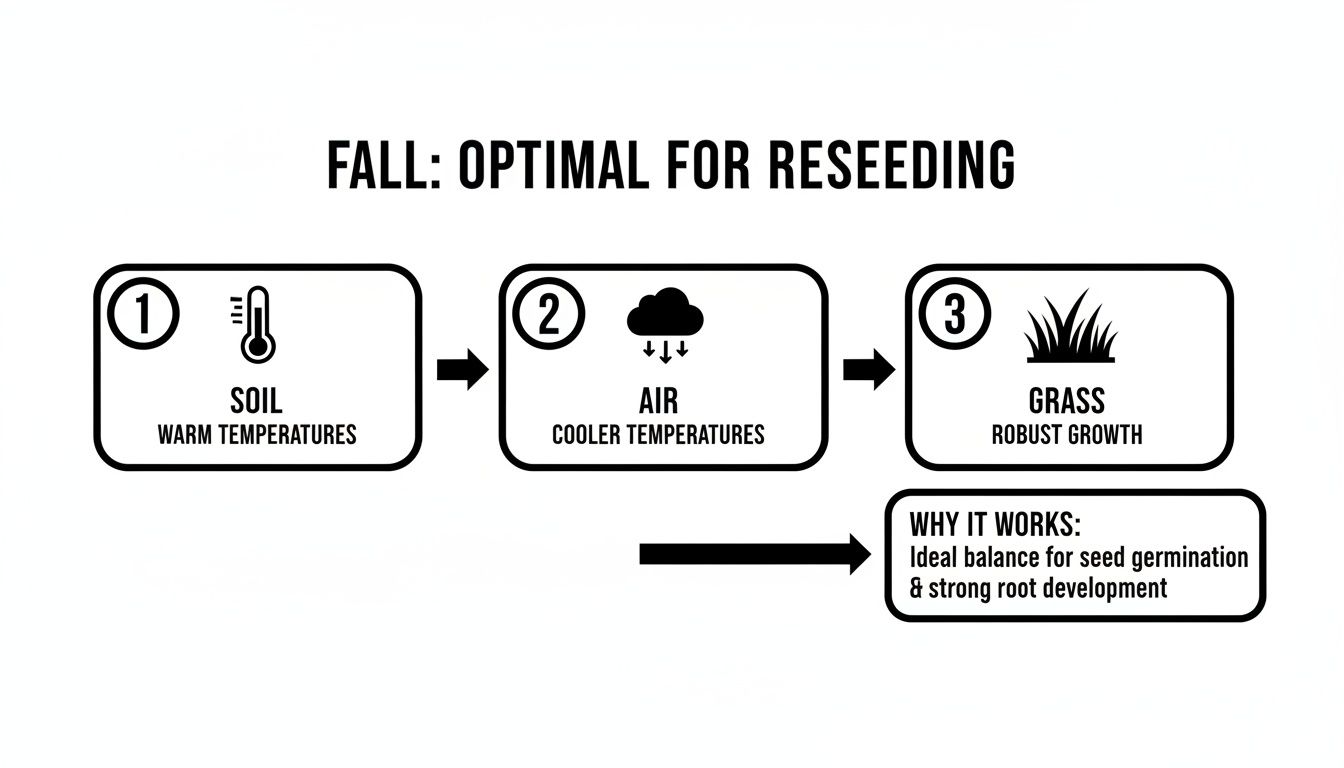
As you can see, warm soil gives the seeds a cozy bed to germinate in, while the cooler air lets the young grass put all its energy into developing strong roots instead of just fighting to survive the heat.
Your Soil Prep Game Plan
Before you even look at a bag of grass seed, we have to talk about the ground it's going into. Think of your lawn as a canvas; you can't create a masterpiece on a dirty, lumpy surface. A well-prepped seedbed is the most critical factor for success. Honestly, skipping these next steps is just throwing your money and time away, because seed needs good, direct contact with soil to even have a chance.
Your first move should always be a soil test. It's a simple step that tells you everything you need to know about your soil's pH and nutrient levels. I can’t tell you how many lawns in the Cumming and Dahlonega area are too acidic. A test will tell you if you need a lime application to get things balanced for new growth.
Once you know what you’re working with, the real work begins.
Breaking Up That Georgia Clay
Ah, our famous Georgia red clay. After a long, hot summer, it can get compacted into something resembling a brick. This suffocates the roots of your existing grass and blocks water and nutrients from getting down where they're needed. The answer? Core aeration.
This isn't just poking holes in the ground. A core aerator pulls up small plugs of soil, and doing this accomplishes a few key things all at once:
- It immediately breaks up that tight, compacted soil.
- It creates little channels for air, water, and nutrients to penetrate the root zone.
- It leaves behind perfect little pockets for the new grass seed to fall into, guaranteeing that crucial seed-to-soil contact.
After you've opened up the soil, it's time to deal with thatch. That's the spongy layer of dead grass and debris that builds up on top of the soil. A little bit is fine, but when it gets thicker than a half-inch, it becomes a barrier that blocks everything—seed, water, fertilizer—from reaching the dirt. A good dethatching (sometimes called power raking) clears out all that junk.
Expert Tip: Don't think of soil prep as a chore. It's an investment. Every bit of effort you put into aerating and dethatching will directly pay you back with a higher germination rate and a healthier lawn for years to come.
And this isn’t just a local secret. A huge study of grassland farmers found that a whopping 66% prefer to reseed between August and October. They’re banking on the same conditions we are: warm soil and cool air creating that perfect storm for seed success.
The Final Touch for a Perfect Seedbed
The last step before you open the seed bag is to spread a thin layer of organic compost or a quality topdressing. Just a quarter-inch of good compost spread over the newly aerated lawn gives a massive boost of organic matter and food right where the new seeds will land.
This topdressing works wonders:
- It improves the structure of our heavy clay, making it less dense.
- It acts like a sponge, helping hold moisture right next to the seeds.
- It provides a slow, gentle release of nutrients to feed the new seedlings as they sprout.
This is really the cornerstone of a good organic lawn care program. By building up your soil health first, you’re creating a lawn that is naturally more resilient and less needy down the road. For a deeper dive, check out our guide on how to improve soil. With your ground perfectly prepped, you're now ready for the fun part: choosing the right seed for a thick, beautiful lawn.
Choosing the Right Grass Seed for Georgia's Climate
Walk into any garden center in Cumming or Alpharetta, and the wall of grass seed bags can be pretty overwhelming. They all promise a perfect, lush lawn. But for us here in North Georgia, the choice is actually simpler than it seems. Our main goal is to get a tough, cool-season lawn established that can handle our hot summers.
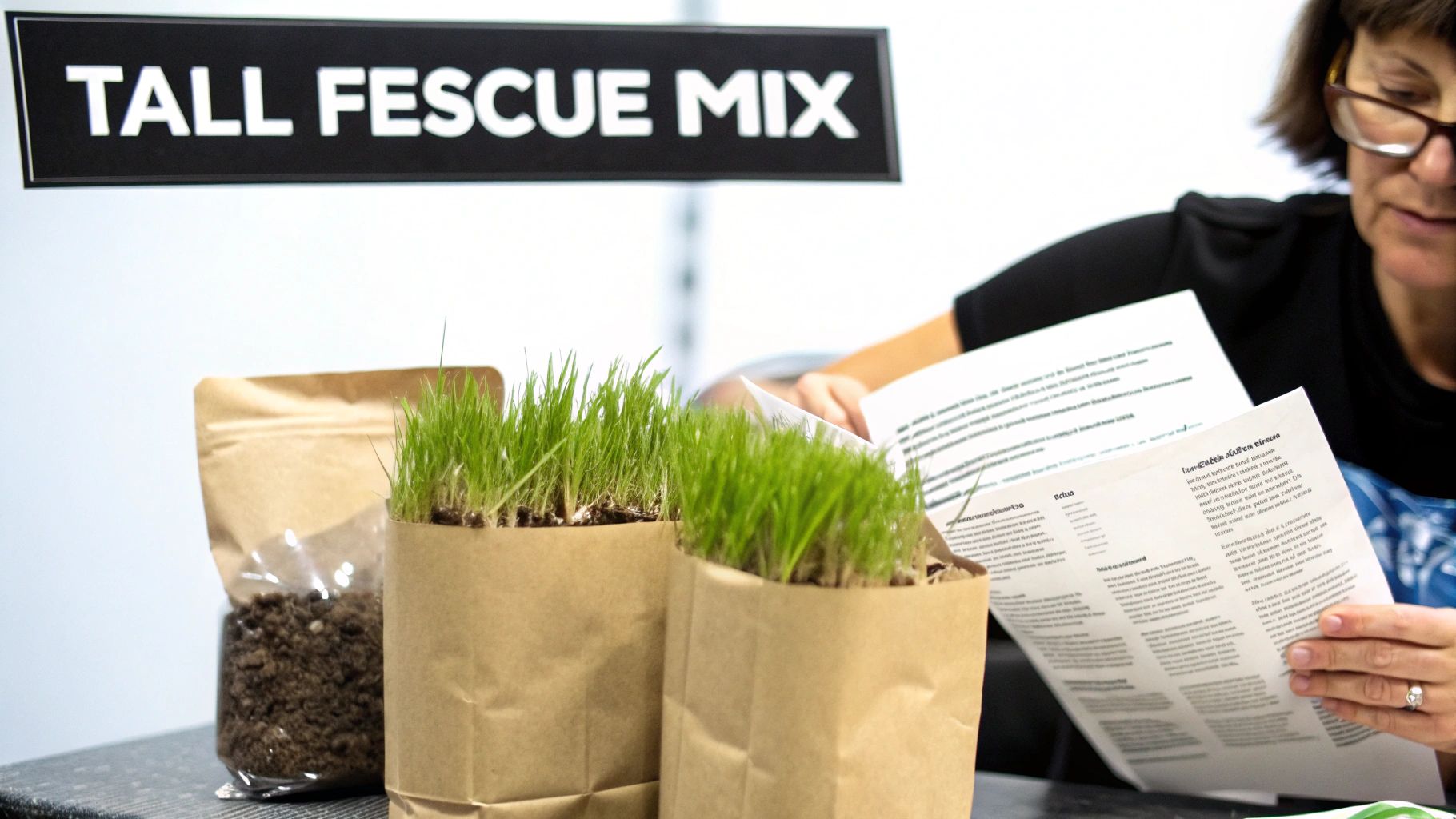
Without a doubt, the champion for our region is Tall Fescue. Unlike warm-season grasses like Bermuda that go dormant and turn brown all winter, modern Tall Fescue varieties are bred to stay green year-round. We value them for their impressive heat tolerance and their ability to grow well in the partially shaded yards you see all over Milton, Johns Creek, and the surrounding wooded neighborhoods.
When you’re reseeding your lawn in fall, a high-quality Tall Fescue blend is your best bet. These bags usually contain several different fescue cultivars, which is a huge plus—it creates a lawn that’s naturally more resilient to disease and stress. Some blends even mix in a little Perennial Ryegrass, which pops up quickly to give you some green ground cover while the fescue takes its time getting established. For a more detailed breakdown, you can check out our complete guide on the best grass seed for Georgia.
Decoding the Grass Seed Label
That little tag on every bag of seed? It's your secret weapon. It’s full of information that tells you exactly what you're paying for. Getting familiar with a few key terms will help you pick a winner every time.
Be sure to find these three critical numbers:
- Purity: This tells you how much of the bag's weight is actually the seed you want. Higher is always better—you're paying for seed, not filler.
- Germination Rate: This is the percentage of seeds expected to sprout under perfect conditions. Look for a rate of 85% or higher.
- Weed Seed: This number needs to be as close to 0% as you can find. Otherwise, you’re literally paying to plant weeds in your freshly prepped soil.
These numbers aren't just for show. They help you figure out the single most important metric: Pure Live Seed (PLS). This tells you the real percentage of the bag that can grow into healthy grass.
To calculate PLS, just multiply the purity percentage by the germination percentage. A bag with 98% purity and 85% germination actually contains 83.3% Pure Live Seed (0.98 x 0.85 = 0.833). This is the number that really counts when you spread your seed.
Knowing your PLS ensures you’re putting down enough viable seed to get that thick, dense lawn you want without wasting money on seed that will never sprout.
North Georgia Grass Seed Selection Guide
To make the choice even easier, here's a quick look at the top contenders for fall reseeding in areas like Cumming and Dahlonega.
| Grass Type | Best For | Sunlight Needs | Seeding Rate (per 1,000 sq ft) |
|---|---|---|---|
| Tall Fescue Blend | Overall resilience; stays green year-round | Full sun to partial shade | 5-8 lbs |
| Perennial Ryegrass | Quick germination and temporary winter color | Full sun | 7-9 lbs |
| Kentucky Bluegrass | Premium feel; self-repairing qualities | Full sun | 2-3 lbs |
| Fine Fescue | Excellent for shady, low-traffic areas | Heavy shade | 4-5 lbs |
While Tall Fescue is the workhorse for most lawns, a blend that includes some of these other types can add specific benefits like faster green-up or improved shade tolerance.
Getting Your Application Rates Right
Once you've picked out a top-tier seed blend, the final piece of the puzzle is putting it down at the correct rate. The amount you need, measured in pounds per 1,000 square feet, depends entirely on your situation.
Are you starting from bare dirt or just thickening up what you already have?
- Overseeding an Existing Lawn: If you're filling in some patchy spots and want to boost overall density, the standard rate for Tall Fescue is 5-6 pounds per 1,000 square feet.
- Establishing a New Lawn: For seeding a completely bare area, you need to be more aggressive. Go with a heavier application of 8-10 pounds per 1,000 square feet to get full coverage.
Timing and rates are everything. The experts at the University of Georgia recommend seeding when soil temperatures at a 4-inch depth are around 75°F, which for us in the Cumming area usually happens in early to mid-September. Hitting that perfect window with the right amount of seed allows cool-season grasses to reach 85-95% establishment before winter sets in.
Watering and Nurturing Your New Grass Seedlings
You've put in the hard work of prepping the soil and getting your seed down. That's a huge step, but the next four to six weeks are absolutely critical. This is where your new lawn is either made or broken, and the care you provide now will directly shape your results.
Think of it this way: you're not just growing grass, you're nurturing thousands of tiny, delicate plants. They need consistent attention to thrive.
The most important job you have right now is managing moisture. The goal is to keep the top inch of soil consistently moist but never a soggy mess. If those new seeds dry out, even for a little while, they’re done. They won’t germinate.
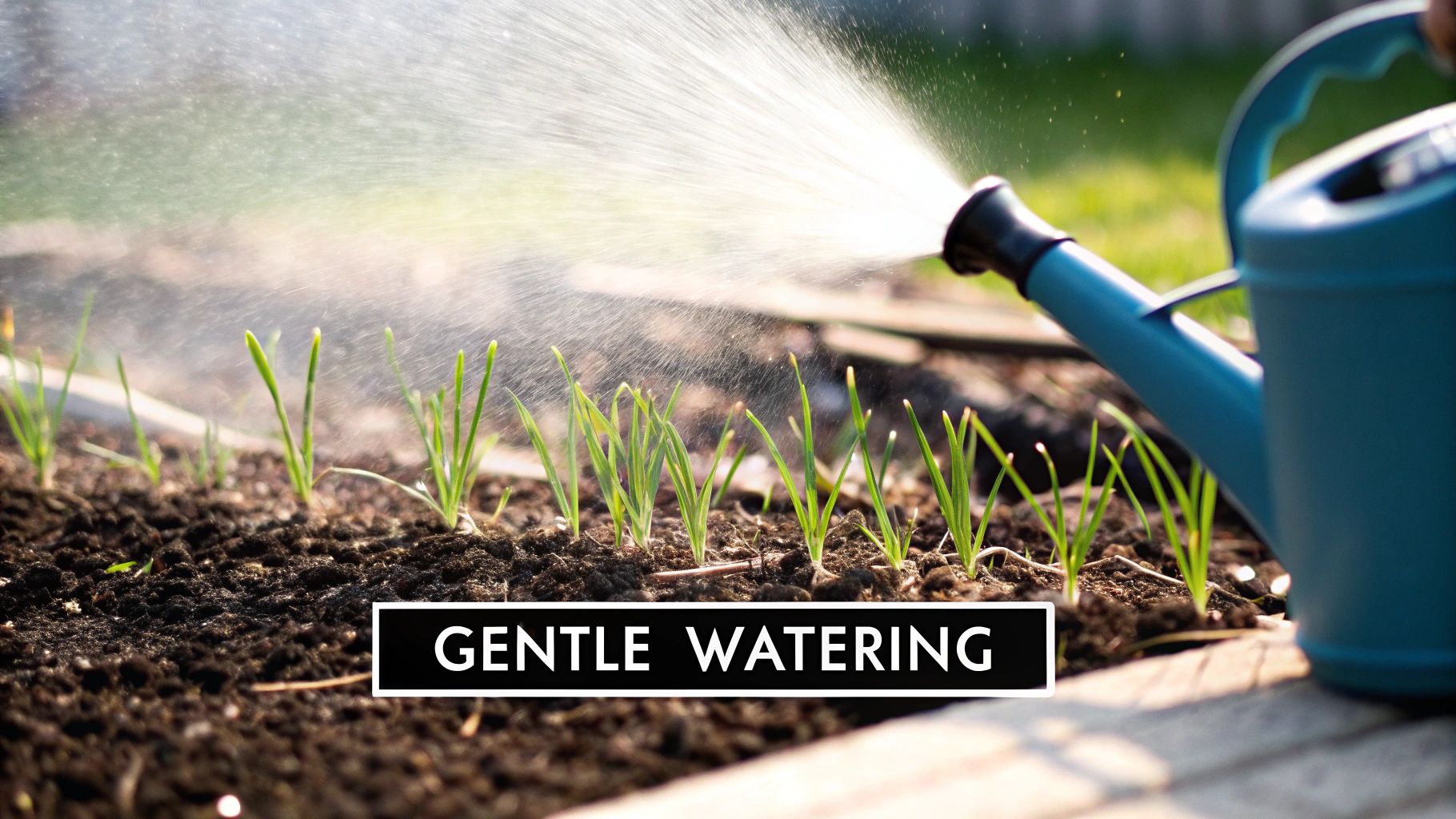
This doesn't mean drowning the lawn for an hour straight. Quite the opposite. You need light, frequent mistings. For the first 7 to 10 days, I tell my clients in Cumming to water two or three times a day for just a few minutes each time. This keeps that crucial top layer damp without creating puddles or washing away your expensive seed.
Adjusting Your Watering as Seedlings Emerge
Once you see that beautiful green fuzz starting to appear across your lawn, it’s time to change up your watering routine. The roots are just beginning to establish, so your focus shifts from keeping the surface damp to encouraging those roots to dig deeper.
This is where you start to water less often but for longer periods. Instead of those quick daily mistings, you’ll transition to a deeper soak every other day or so. This simple change encourages the new roots to stretch down into the soil in search of water, which is the secret to building a lawn that can actually handle a hot Georgia summer.
By the time your new grass is a few weeks old, watering deeply once or twice a week is usually all it needs, depending on the rain. This trains the roots to grow deep, giving you a much more resilient and healthy lawn long-term.
Giving Your New Grass the Right Fuel
New grass seedlings are hungry, but they have a very specific diet. This is the perfect time for a high-quality starter fertilizer.
Don't just grab any bag of lawn food. Most are high in nitrogen, which is great for greening up mature grass. But new seedlings desperately need phosphorus. Phosphorus is the powerhouse nutrient that drives vigorous root development. Applying a starter fertilizer right before or just after you spread your seed gives your new lawn an essential head start, helping it build a strong foundation fast.
Going with an organic-based product takes this a step further. You’re not just feeding the new grass; you're feeding the soil life. This creates a much healthier underground ecosystem that supports the lawn naturally, making it stronger and less needy down the road.
The First Mow and Keeping Off the Grass
I know how tempting it is to get the mower out as soon as things start looking green, but patience is key here. Mowing too soon will literally pull the fragile seedlings right out of the ground.
As a rule of thumb, wait until most of the new grass blades are 3 to 4 inches tall.
For that all-important first cut, make sure your mower blade is razor-sharp. A dull blade rips and tears at the tender grass, causing a ton of stress. Set your deck to its highest setting and only trim off the top third of the grass blade.
Just as important is keeping everyone—kids, pets, even yourself—off the newly seeded areas. Those tiny sprouts are incredibly fragile and can be easily crushed. Try to limit foot traffic as much as humanly possible for at least 3 to 4 weeks to give your new lawn a real chance to get established. If you have any questions about that first cut, you can learn more about when to mow after overseeding in our detailed guide.
What to Do When Things Don't Go to Plan
Even with the best prep work, nature can throw you a curveball. If your fall reseeding project isn't looking quite right, don't worry. Most common issues are surprisingly easy to fix, especially if you spot them early.
Let's say you did everything by the book—you aerated, dethatched, and put down your seed. A week later, you’re staring at more bald spots than green fuzz. This is a classic case of patchy germination, a frequent headache for homeowners from Cumming to Dahlonega. It's almost always caused by inconsistent watering or spots where the seed never made good contact with the soil. Check your sprinkler coverage for evenness, then go back and gently rough up the bare areas with a rake before scattering a little more seed.
When Mother Nature Gets Moody
What if an unexpected Indian summer rolls into Alpharetta right after you’ve seeded? Those sudden heat spells can bake the top layer of soil, stopping germination dead in its tracks.
On those surprisingly hot days, you’ll need to step up your watering game. Instead of misting the lawn twice a day, you might need to do three or four very short cycles. The idea is just to keep that seedbed consistently damp to counteract the evaporation, not to create puddles. This little adjustment can protect your investment until cooler temperatures return.
Another thing that drives people crazy is seeing weeds pop up right alongside the new grass. This is completely normal; aerating the soil brings dormant weed seeds to the surface. Whatever you do, do not apply any weed killer right now. It will absolutely kill your brand-new grass seedlings. For now, patience is your best tool. As your new turf thickens up, it will naturally choke out most of those weeds.
Keeping Critters from Feasting on Your Seed
It’s incredibly frustrating to lay down expensive seed only to watch the local bird population treat it like an all-you-can-eat buffet. Thankfully, there are a few simple and safe ways to keep them away.
- Reflective Tape: You can find shiny "bird-scare tape" at most garden centers. Tie a few strips to stakes around the yard. The flashing light and rustling sound are usually enough to make them think twice.
- A Light Mulch Covering: Spreading a very thin layer of clean straw or peat moss can hide the seeds from view. This also has the added benefit of helping the soil retain moisture, but be careful not to lay it on too thick.
A healthy, dense lawn is its own best defense. Fall overseeding is what transforms a tired, beat-up lawn into a green oasis. While we usually suggest it every 2-3 years, an annual overseeding might be what your lawn needs, especially after a brutal Georgia summer where heat waves can top 95°F+ in places like Milton and Johns Creek. You can find more great insights about when to overseed on TomsGuide.com.
Sometimes, you'll have a stubborn bare patch that just refuses to cooperate, signaling a deeper issue than just bad luck. If a specific spot in your Johns Creek or Milton yard fails to grow grass time and time again, something else is going on under the surface.
These problem areas could point to:
- Severe Soil Compaction: An area that gets a ton of foot traffic might need a second pass with the aerator.
- Underlying Soil Disease: Fungal problems like brown patch can prevent any new growth from taking hold.
- Hidden Grub Damage: Grubs chew on grassroots, killing the turf from below before you even see a problem up top.
If you’ve tried reseeding a spot more than once without any luck, it’s probably time to get a professional diagnosis. Figuring out the root cause is the only way to finally solve those nagging lawn problems and get the thick, beautiful turf you've been working so hard for.
Got Questions About Fall Reseeding in North Georgia?
Even with the best plan, you're bound to have a few questions when it comes to reseeding your lawn. It’s a big project! Homeowners from Cumming to Alpharetta often run into the same challenges, so let's walk through the most common ones we hear from our clients.
Can I Reseed if I Have a Dog or Young Kids?
Absolutely. This is probably the most important question for families, and it’s why an organic-first approach makes so much sense. We're focused on building a healthy lawn without leaving behind harsh chemical residues where your kids and pets play.
The main challenge isn't the products themselves—it's protecting the fragile new grass. After you seed, the goal is to keep all foot and paw traffic off the area for at least 3 to 4 weeks. This is a critical window that allows those delicate new seedlings to sprout and establish roots without getting crushed.
A few practical tips to manage this:
- Temporarily rope off the area with simple garden stakes and string.
- Guide your dog to a designated mulch or pine straw spot for potty breaks.
- For older kids, make it a fun learning moment! You can teach them about how plants grow and why they need a little space to get started.
A little management upfront pays off big time with a durable, beautiful, and truly safe space for your family to enjoy.
What’s the Best Way to Handle Weeds Before I Seed?
Dealing with weeds before you put down seed is a make-or-break step. The most important thing to remember is that most chemical pre-emergent herbicides—the products that stop weed seeds from sprouting—will also stop your new grass seed from growing. You have to steer clear of these for at least 6 to 8 weeks before you plan to seed.
So, what's the game plan? Focus on the visible weeds you have now, a few weeks before you aerate. For smaller patches, good old-fashioned hand-pulling is often the quickest and most effective method. If you're dealing with a bigger problem, a targeted, safe post-emergent spray can work, but you have to read the label carefully to see how long you need to wait before seeding.
Don't forget that the soil prep process itself is a fantastic weed-fighting tool. Mowing the lawn a bit lower than usual and then dethatching will physically rip out a ton of existing weed cover, clearing the deck for your new seed. Once your new turf gets thick and dense, it will become its own best defense, naturally choking out weeds before they can ever get a foothold.
How Soon Will I Actually See New Grass?
I know you’re anxious to see results, but a little patience goes a long way here. Assuming you’ve done your prep work and are watering consistently, you can expect to see the first delicate blades of Tall Fescue pop up in about 7 to 14 days.
You might notice some grass sprouting even sooner. Many of the high-quality seed blends we use in the Johns Creek and Milton area include a small amount of perennial ryegrass. There's a good reason for this: ryegrass can germinate in as little as 5 to 7 days. It provides a quick green cover that helps protect the soil and holds moisture while the slower, more robust fescue gets established.
At first, your lawn will look pretty thin and have a bright, almost lime-green color. This is totally normal. It usually takes a solid 4 to 6 weeks before the new grass is dense and strong enough for its very first mowing.
That deep, rich green color will continue to develop through the fall and our mild Georgia winter. You're not just fixing a few bare spots; you're setting the stage for a spectacular lawn next spring.
Should I DIY This or Hire a Pro?
This is the big question, isn't it? Tackling a reseeding project yourself can be really rewarding, but it’s a serious commitment of time, energy, and money—especially once you start looking at renting equipment like a core aerator.
For many homeowners in the Cumming area, the biggest challenge is getting the diagnosis and the product selection right. It’s tough to:
- Accurately figure out what your soil test is telling you.
- Choose the perfect seed blend for the shady spots versus the sunny areas of your yard.
- Select the right organic amendments to fix our heavy clay soil.
- Apply everything at the correct rate to get the job done right.
Hiring a professional service like Barefoot Organics takes all that guesswork off your plate. We use commercial-grade equipment and have years of hands-on experience with North Georgia’s unique soil and climate, particularly in Cumming and its neighboring communities like Alpharetta, Johns Creek, and Milton. Our expertise ensures the right products are applied at the right time and in the right amounts, giving your lawn the absolute best shot at becoming a thick, healthy, beautiful turf.
Ready to skip the guesswork and get a lush, family-safe lawn you can be proud of? The team at Barefoot Organics has a proven process for getting incredible results for homeowners all over North Georgia. Get your free online quote today!