

Think of pre-emergent weed control as setting up a velvet rope for your lawn—it stops pesky weeds from ever getting past the gate. Instead of waiting for invaders like crabgrass and poa annua to crash the party, this proactive strategy creates an invisible barrier in the soil that keeps their seeds from sprouting in the first place.
It’s the real secret to keeping your Cumming, GA lawn looking its best all year long.
The Foundation of a Weed-Free Lawn
Here’s the core idea: rather than chasing down weeds after they’ve already muscled their way into your yard, pre-emergents stop them at the source—the seed. For anyone with a lawn in Cumming, Johns Creek, or Alpharetta, adopting this preventative mindset is a game-changer, especially with North Georgia's unique climate challenges.
This approach is completely different from the reactive treatments most people are used to. Spraying a visible weed with a post-emergent herbicide is like playing defense after the other team has already scored. A pre-emergent application ensures those weeds never even make it onto the field.
Proactive vs. Reactive Weed Management
The difference is simple but powerful. A proactive plan is all about creating an environment where weeds just can't get a foothold.
- It Prevents Germination: A pre-emergent creates a thin layer at the soil's surface that stops weed seedlings from developing roots. No roots, no weed. Simple as that.
- It Reduces Future Weeds: When you stop weeds from sprouting, you also stop them from maturing and dropping a new batch of seeds. Over time, this seriously depletes the "weed seed bank" lurking in your soil.
- It Promotes a Healthier Lawn: Your grass isn’t fighting for sunlight, water, and nutrients against aggressive weeds. That means it can grow thicker and stronger, naturally choking out any intruders that try to pop up later.
The shift toward preventative care is a big deal. The global market for pre-emergent herbicides was valued at around $2.5 billion in 2023 and is expected to hit $4.0 billion by 2032. This isn't just a global trend; it's a critical local reality for homeowners in areas like Cumming and Milton. Weeds like crabgrass can drain local lawns of up to 40% of their vigor if you don't get ahead of them. If you're interested, you can explore more data on this growing market trend to see why so many are making the switch.
Pre-Emergent vs. Post-Emergent at a Glance
To really get why a proactive strategy is so effective, it helps to see a direct comparison. This is especially true for homeowners in places like Dahlonega, where different types of grass face unique weed pressures throughout the seasons.
Here’s a quick breakdown to make the distinction crystal clear:
| Attribute | Pre-Emergent Control | Post-Emergent Control |
|---|---|---|
| Application Timing | Applied before weeds sprout (Early Spring & Fall) | Applied after weeds are visible and growing |
| Primary Goal | Prevention | Elimination |
| Mode of Action | Creates a soil barrier to stop seed germination | Absorbed by leaves to kill the existing plant |
| Best For | Annual grassy weeds like crabgrass and poa annua | Broadleaf weeds you can see, like dandelions and clover |
| Outcome | Far fewer weeds appear, promoting healthier turf | Kills visible weeds but doesn't stop new ones |
This table shows it's not about one being "better," but about using the right tool for the job at the right time. A comprehensive lawn care plan for the Cumming area needs both a strong defense (pre-emergents) and a reliable offense (post-emergents) for when a few troublemakers sneak through.
At Barefoot Organics, our entire philosophy is built on this proactive foundation. We combine smart pre-emergent applications with our core focus on building rich, healthy soil. This one-two punch creates a lawn in Cumming, GA that doesn't just look good—it becomes a robust ecosystem that naturally resists weeds, giving you a beautiful, safe space for your family and pets to enjoy.
When to Apply Pre-Emergent in North Georgia
If there's one thing I've learned from years of dealing with lawns in Cumming and the surrounding areas, it's this: timing your pre-emergent application is everything. And I don't mean circling a date on your calendar. Forget about "the first week of spring." Your real cue comes directly from the soil.
For those of us in Alpharetta, Cumming, Johns Creek, and the surrounding areas, the entire game hinges on getting that pre-emergent down just before the soil warms up to a consistent 55°F. Why that specific number? Because that's the magic temperature that wakes up crabgrass seeds and tells them it's time to sprout. Your whole goal is to create a protective barrier before that happens.
Here in our unique North Georgia climate, this critical window usually opens up sometime between late February and mid-March.
Reading Nature’s Signals for Perfect Timing
You don't have to run out and buy a soil thermometer (though it helps!). Nature gives us some pretty clear signs if you know what to look for. One of the best and most reliable indicators is the forsythia bush.
When you start seeing those vibrant, almost neon-yellow flowers blooming on forsythia bushes in your Milton or Cumming neighborhood, that's your alarm clock. It’s nature’s way of telling you soil temperatures are creeping into the low 50s. That's your signal to get moving, and fast.
Putting it down too early, say in January, might feel like you're getting ahead, but it's a common mistake in our area. The barrier from the pre-emergent will simply break down before the main flush of summer weeds even thinks about showing up. On the flip side, if you wait until late March or April, you’ve already missed your chance. The crabgrass has germinated, and a pre-emergent is useless against weeds that are already growing.
This visual shows exactly what we're aiming for: the application creates a barrier that stops weed seeds in their tracks, leading to a healthier, cleaner lawn down the road.

The takeaway is simple: the application has to happen before germination. There's just no negotiating with Mother Nature on this one.
The Two Critical Windows for North Georgia Lawns
While everyone focuses on spring to stop crabgrass, there's a second, equally important window for pre-emergent that tons of local homeowners miss. For a truly year-round defense, you need to think about both.
Early Spring (Late February to Mid-March): This is your main event against summer annual weeds. Crabgrass is the top enemy, but this application also shuts down other invaders like goosegrass and foxtail before they can get a foothold in your Cumming lawn during the summer heat.
Early Fall (September to Early October): This round is all about targeting the winter annuals. The biggest nuisance around here is Poa annua, or Annual Bluegrass. It’s those ugly, light-green clumps that pop up and ruin the look of your dormant turf. A fall pre-emergent stops those seeds from ever sprouting.
Here in North Georgia, especially in places like Cumming and Dahlonega where fescue and zoysia are king, this two-step strategy is non-negotiable. When done right and guided by soil temps, these two applications can block up to 90% of summer weeds.
Expert Insight: I always tell my clients in Johns Creek and Alpharetta to think of it like this: the spring application is for the party crashers who show up in summer, and the fall application is for the uninvited guests who try to sneak in over the winter. By locking the door twice a year, you keep your lawn peaceful and healthy all year long.
This disciplined, two-season approach is the foundation of any great weed management plan in our area. It keeps your lawn protected through the entire life cycle of the weeds we fight, from the peak heat of a Johns Creek summer to the chill of a Milton winter. For a deeper dive, check out our detailed article about when to apply pre-emergent in North Georgia.
How to Apply Pre-Emergent for the Best Results
Getting flawless results from a pre-emergent weed control application isn't about luck; it's about following a proven process. Whether you're a DIY enthusiast in Cumming or relying on a professional service in Johns Creek, the fundamental steps are the same. A precise, thoughtful application creates that uniform, unbroken barrier that gives weeds absolutely no room to sprout.
Skipping a step or getting lazy with the details can lead to weak spots in your defense. That's how stubborn weeds like crabgrass slip through. Let's walk through the exact method the pros use to get it right every single time.
Prepare Your Lawn for Application
Before you even think about opening a bag of granules, you need to set the stage. The whole point is to get the pre-emergent down to the soil surface, and anything in its way will compromise its effectiveness.
First, mow the lawn to its recommended height. For the fescue lawns we see all over Dahlonega, this might be a bit higher than the zoysia you'll find in Alpharetta, but the key is just to get a neat, even surface.
Next, and this is crucial, clear away all the debris. Rake or blow off any fallen leaves, twigs, or lingering grass clippings. Think of it this way: every single leaf left on the lawn is like a tiny umbrella, shielding the soil underneath from your application and creating a perfect little hideout for a weed to pop up.
Calibrate Your Spreader Correctly
One of the most common—and most visible—DIY mistakes is botching the spreader calibration. This is what leads to those ugly, tell-tale stripes of green and yellow you sometimes see on lawns around Cumming. It's a dead giveaway of an uneven application.
Whether you’re using a broadcast (rotary) spreader or a drop spreader, taking a few minutes to calibrate it is non-negotiable.
The product bag will have recommended settings for different spreader models. Find your model and set the dial to that specific rate. If you're ever unsure, it’s always smarter to start with a lower setting and make a second pass than to dump too much at once. Over-applying can seriously stress, or even damage, your turf.
The Professional Application Pattern
To guarantee even, wall-to-wall coverage, professionals rely on a specific walking pattern. Instead of trying to apply the full amount in a single, heavy-handed pass, we cut the product in half and apply it in two different directions.
This technique creates a grid, ensuring total coverage and virtually eliminating the risk of missed spots or stripes. Here’s how you do it:
- First Pass: Cut your spreader's application rate in half. Walk in straight lines back and forth across the lawn, making sure to slightly overlap each pass to avoid gaps. For example, walk north to south.
- Second Pass: Take the other half of the product and walk at a right angle to your first set of lines. So, if your first pass was north to south, this pass will be east to west.
This cross-hatching method is the single best way to achieve a uniform barrier across your entire property, from the main yard to those tricky edges along flower beds and driveways in your Cumming-area home.
A Pro Tip from the Field: When you're doing the perimeter of your lawn, use your spreader's edge guard feature if it has one. This little tool prevents you from accidentally slinging granules into your flower beds or all over your sidewalk, which is both wasteful and not great for the environment.
Water It In to Activate the Barrier
You've done everything right up to this point, but don't quit yet. There's one final, crucial step: activation. The pre-emergent product just sitting on top of the soil and grass blades isn't doing anything. It needs to be "watered in" to move it down into the top layer of soil, where it can finally form that chemical barrier that stops germination in its tracks.
The magic number here is about a half-inch of water. This can come from a timely rainfall or your own irrigation system, but you need to get it done within 24-48 hours of the application. If you wait too long, the product can start to break down from sunlight or simply blow away.
This is exactly why our technicians in Milton and Cumming are constantly checking the weather. We aim to apply pre-emergent just before a gentle, steady rain is in the forecast. It’s the perfect way to use nature to our advantage and ensure a perfect activation for maximum weed control.
Natural Pre-Emergent Options vs. Synthetic Products
When it comes to pre-emergent weed control, homeowners in Cumming and the surrounding areas have a real choice to make. This isn't just about getting rid of weeds; it's about your philosophy for lawn care. The decision usually boils down to a trade-off between immediate, powerful results and the long-term, sustainable health of your soil.
Both conventional synthetic products and natural alternatives can stop weeds before they start, but they take very different paths to get there. Understanding the distinction is the first step toward building a lawn care plan that truly fits your family and your property.
The Power and Pitfalls of Synthetic Pre-Emergents
Let's be honest: conventional pre-emergents are popular for a reason. They work, and they work well. These products use specialized chemical compounds to lay down a long-lasting barrier in the soil, giving you a high degree of control over a whole host of weeds, especially stubborn ones like crabgrass.
For a homeowner in Alpharetta who wants a flawless, uniform lawn with minimal fuss, synthetics can seem like the perfect answer. They deliver reliable, season-long protection. But that power comes with a cost. These chemicals aren't picky; they can impact the entire soil ecosystem, harming the beneficial microbes and organisms that are the foundation of your soil's natural fertility.
Over-relying on synthetic controls can lead to sterile soil. Your turf becomes dependent on a cycle of chemical treatments for its food and defense, rather than developing the natural strength to sustain itself.
A Natural Approach with Corn Gluten Meal
If you're looking for a more eco-friendly path, natural pre-emergents are a fantastic alternative. The most common and effective natural option by far is Corn Gluten Meal (CGM). It’s a simple by-product of the corn milling process, but it works in a really clever way.
Instead of creating a chemical shield, CGM releases organic proteins (dipeptides) into the soil. These proteins stop tiny feeder roots from forming on newly germinating seeds. In short, it stops weeds right as they're trying to sprout.
What makes CGM so popular with families in Milton and Johns Creek is that it pulls double duty:
- Weed Prevention: It naturally stops many common annual weeds in their tracks.
- Natural Fertilizer: It's packed with slow-release nitrogen—about 10% nitrogen by weight. So, while it's protecting your lawn from weeds, it's also feeding it. This helps your turf grow thick and dense, which is the best natural defense against weeds in the first place.
Make no mistake, weeds are a serious threat. Globally, they're responsible for crop losses estimated at a staggering 20-40% each year. Here in our tough North Georgia red clay, an unchecked weed problem can easily reduce turf density by 30% or more. That’s why our approach centers on applying natural solutions like CGM at just the right time for lawns in Cumming and Dahlonega.
Comparing Lawn Pre Emergent Treatments
Choosing the right pre-emergent comes down to weighing the pros and cons based on your goals for your lawn. This table breaks down the key differences between the two main approaches.
| Feature | Conventional Pre-Emergents | Natural Pre-Emergents (e.g., Corn Gluten Meal) |
|---|---|---|
| Primary Action | Creates a chemical barrier in the soil to kill germinating seeds. | Releases proteins that inhibit root formation on new seedlings. |
| Effectiveness | Highly effective; provides quick and broad-spectrum control. | Builds effectiveness over several seasons; more targeted action. |
| Soil Impact | Can harm beneficial microbes, leading to sterile, dependent soil. | Improves soil health by adding organic matter and nutrients. |
| Fertilizer Benefit | None. Requires separate fertilizer applications. | Acts as a slow-release nitrogen fertilizer (10% N by weight). |
| Safety | Requires caution; restrictions on re-entry for pets and children. | Safe for children and pets immediately after application. |
| Long-Term Goal | Weed elimination through chemical control. | Building a healthy, dense turf that naturally outcompetes weeds. |
Ultimately, synthetics offer a quick fix, while natural options are part of a long-term strategy to build a self-sustaining, healthy lawn from the soil up.
Setting Realistic Expectations
It’s important to be upfront about the differences in performance, especially at the beginning. Synthetic pre-emergents will almost always give you more complete control in the very first season. Natural options like CGM ask for a bit more patience.
The effectiveness of corn gluten meal is cumulative. It's a process. It usually takes a few seasons of consistent, correctly timed applications to achieve the same level of weed suppression you'd see from a synthetic product. Why? Because you're not just fighting weeds—you're fundamentally improving your soil.
This approach is the heart of our philosophy at Barefoot Organics. We are convinced that the long-term reward of a vibrant, living soil ecosystem is well worth the initial investment of time. To dive deeper into this powerful tool, you can check out our guide on using corn gluten for weed control. It’s about committing to a lawn that isn’t just green on the surface, but truly healthy from the ground up.
Balancing Pre-Emergents with Aeration and Seeding
This is where so many well-intentioned lawn care plans go sideways. For homeowners from Cumming to Alpharetta, figuring out how pre-emergent weed control, aeration, and overseeding all fit together can feel like trying to solve a puzzle with missing pieces.
The central conflict is simple but non-negotiable: a pre-emergent barrier doesn't know the difference between a weed seed and a grass seed. It's designed to stop all seeds from germinating, and it does its job well.
This means you absolutely cannot lay down a pre-emergent and then try to seed your lawn. The new grass just won't sprout. This reality makes smart scheduling critical. You need these essential services to work with each other, not against each other. For a thick, healthy lawn in Cumming or Dahlonega, building a strategic year-round calendar is the only way to succeed.
Crafting the Perfect Annual Lawn Calendar
The trick to juggling these services is to think in seasons, timing each treatment to match your grass type’s natural rhythm. This is especially true for the fescue lawns we see all over North Georgia, which have completely different needs than warm-season grasses like Bermuda or Zoysia.
For fescue lawns in places like Alpharetta and Milton, the winning formula is a clean split between spring and fall.
Spring Focus: Your entire spring should be about prevention. This is when you apply pre-emergent to get ahead of crabgrass and other summer annuals. The protective barrier you establish in March will hold strong for months, keeping your lawn clean through the summer stress.
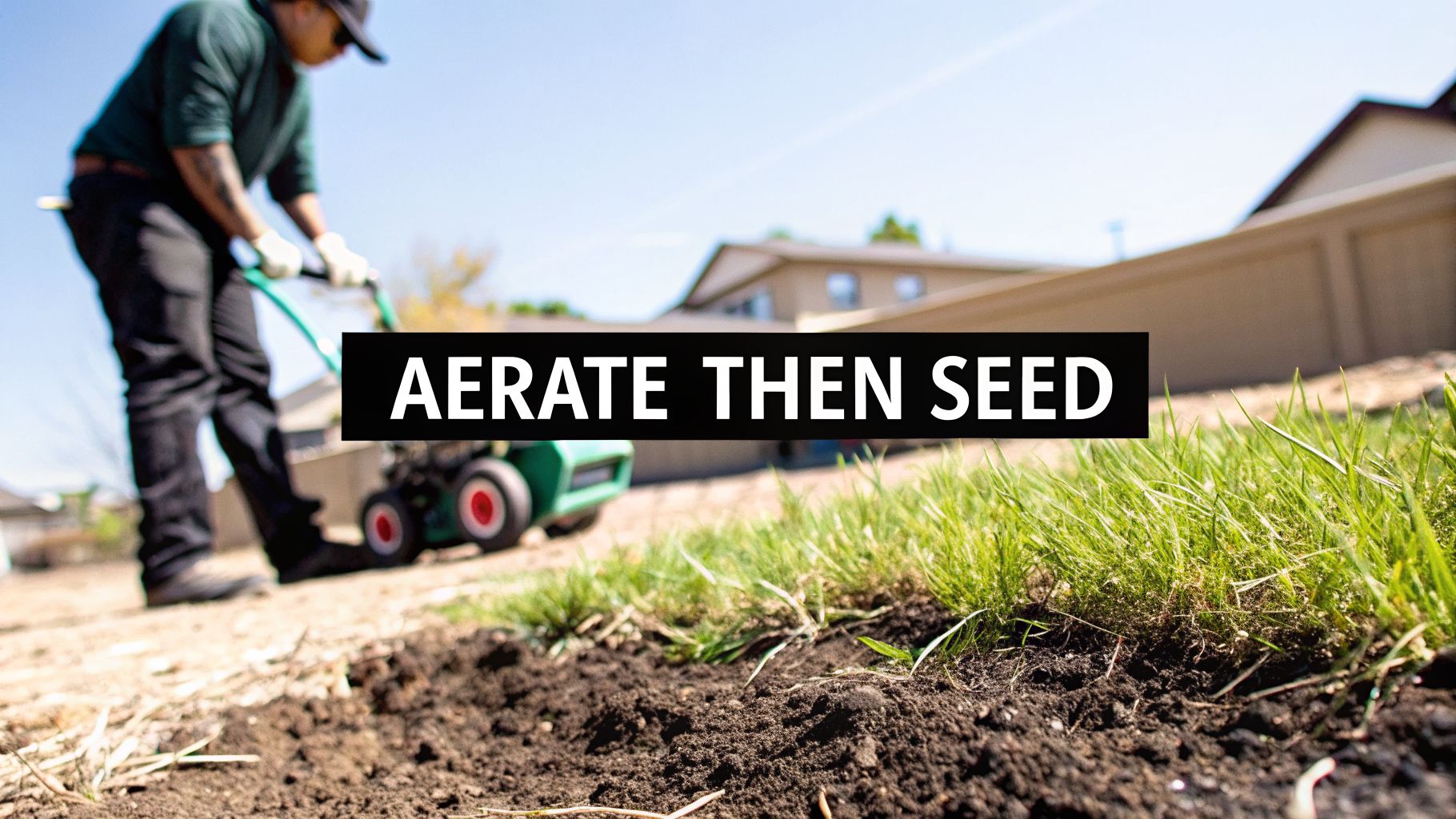
Fall Focus: Autumn is all about renovation. This is the absolute best time for core aeration and overseeding. By September, the pre-emergent you applied back in the spring has broken down, opening up the perfect window to get new seed into the soil. Aerating first pulls plugs of soil, creating channels for that new seed to get great seed-to-soil contact, which is crucial for germination.
Following this seasonal rhythm ensures you get the maximum benefit from every treatment. You knock out weeds in the spring, then build up turf density in the fall without one service sabotaging the other.
Think of it like this: your lawn has two distinct missions each year. In the spring, its job is to defend against invaders. In the fall, its job is to grow stronger and thicker for the year ahead. Trying to do both at once usually means failing at both.
Special Considerations for North Georgia Lawns
While the spring/fall split is the gold standard for fescue, warm-season grasses like Zoysia and Bermuda have a slightly different game plan. These turf types don't typically get overseeded every year. Instead, we aerate them in late spring or early summer, right when they're growing most aggressively.
Even then, the same principle applies. If you're planning on seeding or sprigging to patch some bare spots in your Zoysia lawn in Johns Creek, you have to be certain that any pre-emergent you put down earlier has had time to dissipate.
Ultimately, a successful lawn strategy is all about synergy—making sure each treatment sets the stage for the next. A solid spring pre-emergent application keeps the lawn from being overrun with weeds, which in turn makes your fall aeration and seeding that much more effective.
For homeowners wanting to nail this timing, you can read more about how we handle the critical process of fall aeration and overseeding in North Georgia to build a truly resilient, beautiful lawn.
Your Top Pre-Emergent Questions, Answered
Even with the best game plan, questions about pre-emergent weed control always pop up. It’s a cornerstone of good lawn care, but some of the details can feel a little tricky. We hear many of the same questions from homeowners all over North Georgia, from Cumming to Milton, so let’s clear up a few of the most common ones right now.
Getting these details right can honestly be the difference between a lush, green lawn and one that’s in a constant battle with stubborn weeds.
Will a Heavy Rain Wash Away My Pre-Emergent?
This is a great question, especially with our notoriously unpredictable Georgia weather. The short answer is: it depends on the rain. A nice, gentle shower is actually exactly what you want after an application—it's the key to getting the product to work. Most pre-emergents need about a half-inch of water to dissolve and settle into the top layer of soil, where they form that crucial protective barrier.
The real enemy is a sudden, torrential downpour right after we leave. A powerful storm can definitely wash some of the product away before it has a chance to activate, particularly on lawns with a bit of a slope. This is precisely why our technicians in places like Alpharetta and Cumming are obsessive about checking the forecast. We always aim to apply pre-emergents just before ideal weather rolls in, ensuring it activates perfectly for maximum effect.
How Long Does the Protective Barrier Actually Last?
A single pre-emergent application, unfortunately, isn't a one-and-done solution for the entire year. Typically, the protective barrier it creates lasts for about 6 to 12 weeks. The exact lifespan depends on the specific product we use, your soil type, and, of course, our local weather conditions.
Here in North Georgia, our long and brutally hot growing season means a single spring treatment just won't cut it. By the time July and August hit, that early spring barrier has started to break down, leaving your turf wide open for a second wave of opportunistic weeds like crabgrass.
This is exactly why we, and most lawn care pros in the Cumming area, champion a "split application" strategy. We put down the first round in early spring to stop the initial weed surge. Then, about 6-8 weeks later, we come back for a second, booster application. This re-establishes the barrier and extends that protection right through the hottest months of the year, giving lawns in Cumming and Johns Creek true season-long control.
Are Pre-Emergents Safe for My Kids and Pets?
This is the most important question for many families, and one we take very seriously. When applied by a trained professional according to the manufacturer’s exact instructions, conventional pre-emergents are considered safe for use on home lawns.
The standard industry practice is straightforward and effective: keep children and pets off the treated area until it has been watered in and the grass is completely dry. Once the product is in the soil and the grass blades are dry, the lawn is ready for regular activity again.
For families in Cumming and Alpharetta looking for that extra layer of peace of mind, natural alternatives are a fantastic choice.
- Corn Gluten Meal: This is a completely non-toxic option that’s safe for kids and pets immediately after it’s spread.
- Our Natural Lawn Care Program: We built this program from the ground up with family safety in mind, focusing on building a thick, resilient lawn that naturally crowds out weeds, minimizing the need for chemicals.
Ultimately, the right choice depends on your family’s comfort level, but there are definitely safe and effective options for every home.
Help! What if I Missed the Spring Pre-Emergent Window?
First off, don't panic! It happens to the best of us in the Cumming area. If you’ve missed that critical late February to mid-March window, applying a pre-emergent now won't help much against the weeds that have already sprouted. At this point, you have to pivot from prevention to control.
You'll need to shift your focus to spot-treating the visible weeds with a post-emergent herbicide. It’s a reactive approach, but it’s the only way to tackle weeds that are already up and growing.
The most important step you can take now is to get your lawn on a proper schedule. A lawn care expert can help you manage the existing weeds through the summer and, crucially, make sure you are perfectly timed for the fall pre-emergent application. That fall treatment is absolutely essential for stopping winter weeds like poa annua and setting your lawn up for a much cleaner, healthier start next spring.
Ready to stop weeds before they start and get a beautiful lawn without all the guesswork? Barefoot Organics provides expert, natural-based lawn care designed for the unique challenges of North Georgia's soil and climate, including Cumming, Alpharetta, Johns Creek, Milton, and Dahlonega. Let us build a plan that's safe for your family and perfect for your yard.