

It always starts with the best of intentions. You're chasing that deep, lush green lawn—the kind that makes the neighbors in your Cumming subdivision jealous and keeps the HOA happy. You put down some fertilizer, expecting great results.
But then you see it. Yellow streaks. Brown, scorched-looking patches.
If this sounds familiar, you’re not alone. Many homeowners right here in Cumming, GA, accidentally cause fertilizer burn, especially with our common Bermuda and Fescue grasses. It's an easy mistake to make, but it can be fixed. If your lawn is looking worse for wear after a DIY treatment, don’t panic. Call Barefoot Organics today for a free lawn evaluation to get a professional recovery plan.
Recognizing an Over-Fertilized Lawn in Cumming
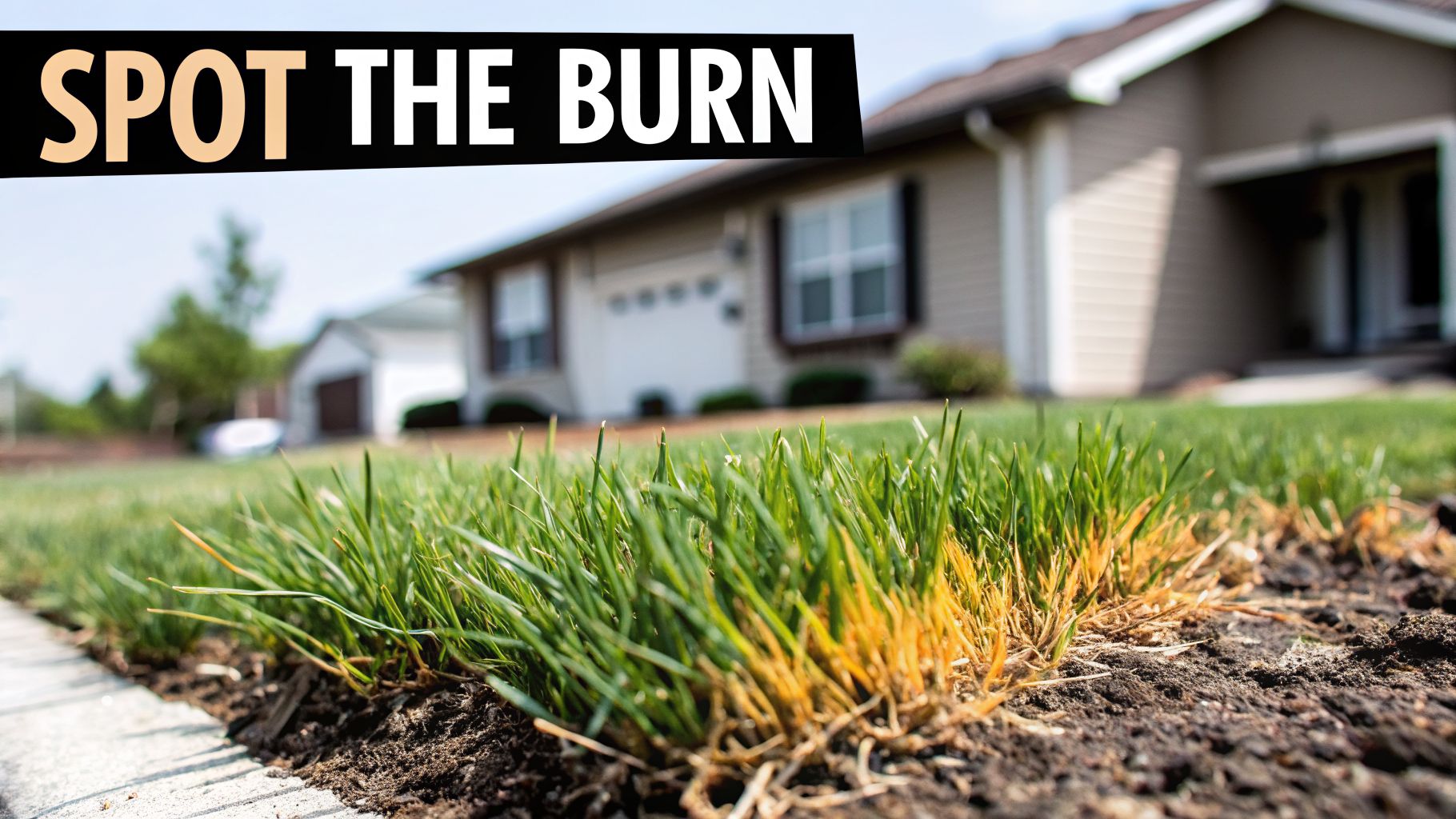
When you've over-fertilized, the signs show up fast—often within a day or two. The damage isn't subtle, and frankly, it can look a lot like drought stress or even a lawn disease like brown patch fungus. The real giveaway? Its sudden appearance right after you treated the yard.
So what's actually happening? The problem is an excess of nitrogen salts. Think of it like salting your dinner: a little bit brings out the flavor, but a heavy hand ruins the whole dish. For your lawn, these extra salts literally pull the moisture right out of the grass blades. This causes them to dry out, turn yellow or brown, and eventually die, even if the soil itself is damp. This is what we call fertilizer burn.
Telltale Signs on North Georgia Lawns
From subdivisions in Alpharetta to properties in Dawsonville, the signs of over-fertilizing are pretty consistent. You might see distinct stripes where your spreader passes overlapped. Or maybe you'll notice broadcast patterns where the fertilizer granules landed too heavily in one spot, a common issue for homeowners looking for lawn treatment near me.
Here in Forsyth County, our dense red Georgia clay can make the problem worse. The salts can sit right on the surface, sometimes forming a visible crust and intensifying the damage.
These visual cues are your lawn's cry for help:
- Color Change: Look for bright yellow to straw-brown patches that feel dry and crunchy to the touch.
- Growth Stoppage: The lawn just seems to stall out. Even the healthy-looking sections stop growing.
- Root Damage: You can't see it, but the roots below are likely scorched and struggling to absorb any water at all.
Recognizing these symptoms is the first step toward fixing the problem. While some issues can cause similar damage, if the brown spots show up right after you fertilize, you're almost certainly looking at fertilizer burn. You can learn more about what causes brown spots in grass in our detailed guide.
Signs of an Over-Fertilized Lawn in North Georgia
To make it even easier, here’s a quick table to help you self-diagnose what’s happening on your lawn. Whether you have a Fescue lawn in Milton or Bermuda in Johns Creek, these symptoms are a universal signal of nutrient overload.
| Symptom | What It Looks Like | Why It Happens in Georgia |
|---|---|---|
| Yellow or Brown Patches | Streaks or patches of dead, straw-like grass. | Excess nitrogen salts pull moisture from grass blades, causing 'burn' in the hot Cumming sun. |
| Slow or No Growth | Grass seems to stop growing, even after watering. | Root systems are damaged by high salt levels and cannot absorb water or nutrients effectively. |
| Crusty Soil Surface | A visible white or yellowish crust on the soil. | Undissolved fertilizer salts accumulating on the surface of our dense red Georgia clay soil. |
| Limp, Weak Grass Blades | Grass blades look wilted and weak, even with moisture. | The plant's internal water balance is disrupted, leading to wilting despite damp soil. |
Pinpointing the issue quickly gives you the best chance to save your turf. If you've spotted these signs on your property near Suwanee, Buford, or anywhere else in the North Atlanta area, it’s time to act fast.
Why This Matters: How Over-Fertilizing Damages Forsyth County Lawns
That yellow, scorched look of fertilizer burn is more than just an ugly patch in your yard; it’s a sign of deeper trouble happening right beneath the surface. For those of us in Cumming and across Forsyth County, seeing this is all too common. It's an easy mistake to make, but it causes significant harm, especially with our local conditions.
The drive for a perfect, lush lawn is understandable. But piling on too much fertilizer—or simply using the wrong kind—kicks off a chain reaction of damage that goes far beyond just scorching the grass blades. It creates an unhealthy environment from the soil up.
The Problem Starts with Our Red Georgia Clay Soil
Here in North Georgia, we’re all intimately familiar with our dense, red Georgia clay soil. While it’s fantastic for a house foundation, it creates some real headaches for growing a healthy lawn. When a heavy dose of synthetic fertilizer hits the ground, our clay soil simply can’t drain the excess salts and nutrients away.
Instead, these chemicals just sit at the surface. They create a highly concentrated zone that essentially pickles the grass roots, making it impossible for them to absorb water. The result? Your grass starts dying of thirst, even if the ground feels damp.
Key Takeaway for Cumming Homeowners: Over-fertilizing on our dense clay soil is like pouring salt on a slug. It pulls moisture right out of the grass blades and roots, leading to that rapid yellowing and browning we call fertilizer burn.
Promoting Disease and Weakening Your Lawn
The damage doesn't stop at dehydration, either. A sudden glut of nitrogen creates the perfect storm for fungal diseases like brown patch to explode. Our hot, humid summers in Cumming, Alpharetta, and Johns Creek already give these fungi a head start—adding excess nitrogen is like throwing gasoline on the fire.
This forced, weak growth also makes your lawn much more vulnerable to other stresses:
- Summer Heat Stress: The shallow, weak root system can't possibly stand up to our 90+ degree days.
- Drought Damage: Weak turf has zero resilience when the heavy rain stops and drought sets in.
- Pest Infestations: A stressed-out lawn is basically an open invitation for pests like armyworms.
Getting a handle on the numbers on a fertilizer bag is one of the best ways to prevent this. To dive deeper, check out our guide on how to read fertilizer numbers.
The Environmental Impact Beyond Your Yard in Cumming
What happens in your yard doesn't stay in your yard. The issue of over-fertilization carries a steep environmental price tag that impacts communities from Canton to Buford. Any excess fertilizer your lawn can't use gets washed away by the next rainstorm, flowing into storm drains and eventually into local streams and even Lake Lanier.
This nutrient runoff has serious consequences. It's shocking, but homeowners in the U.S. often apply ten times more fertilizer per acre than farmers do on their crops. Much of this excess converts to nitrous oxide, a potent greenhouse gas, while the nitrates contaminate our local waterways. This can trigger algal blooms that choke out fish populations and degrade the beautiful recreational areas we all enjoy across North Georgia. You can discover more insights about the ecological impact of lawns on onlynaturalenergy.com.
This is exactly why the one-size-fits-all approach from the big national chains so often fails our local environment. A responsible, localized plan has to consider more than just short-term greenness; it has to protect the health of our shared North Georgia ecosystem.
Your Immediate Recovery Plan for a Burnt Cumming Lawn
That sinking feeling when you see yellow, scorched patches on your lawn after fertilizing is something we see all too often in Forsyth County. Your first instinct might be to panic, but the key is to act fast and act smart. What you do in the next few hours can make all the difference between a quick recovery and a total lawn overhaul.
This is your first-aid plan. We'll walk through the exact steps to take right now to start reversing the damage from fertilizer burn. Don't worry about complicated chemical treatments or guesswork. This is the same straightforward, practical advice we give homeowners across Cumming when we get that frantic call.
The diagram below shows the simple but destructive process of what's happening out there.
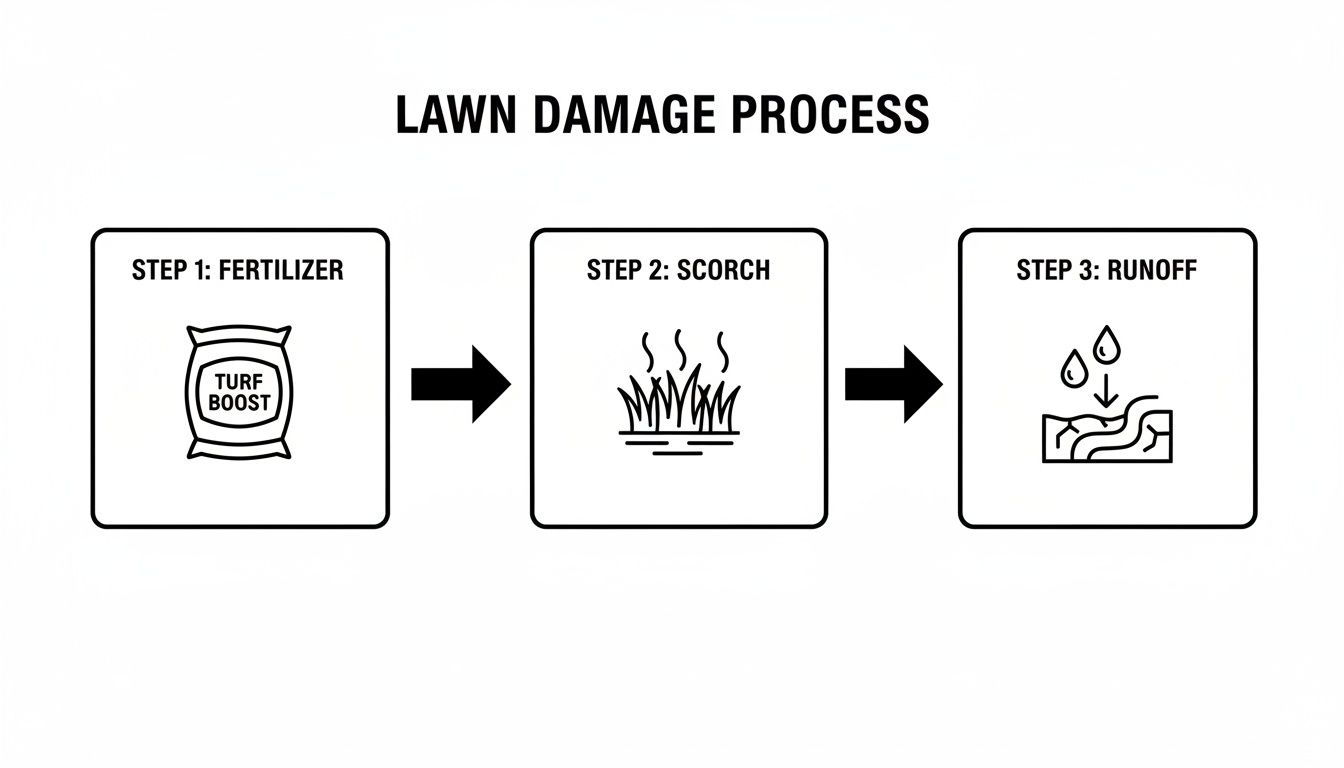
It really highlights the core problem: what doesn't burn your grass often just washes away, which isn't great for our local environment, from Milton to Sugar Hill.
Treatment Breakdown: Your First Steps
Your absolute number one priority is to wash the excess fertilizer salts off the grass blades and deep down past the roots. This is the single most critical step in saving your lawn.
The goal is to apply about one inch of water to the burned areas. But on our dense Georgia clay, you can't just turn on the sprinklers for an hour straight. All that water will just sheet off the surface, creating runoff that carries the fertilizer into storm drains instead of pushing it down where it needs to go.
Local Pro Tip: To properly flush a lawn in our area, you need to use a "cycle and soak" method. Water for 20-30 minutes, turn it off for an hour to let it soak in, and then repeat that cycle 2-3 more times. This slow, deep watering prevents runoff and gives the water a fighting chance to penetrate that tough clay.
Keep this up for a few days in a row. You're trying to dilute the high concentration of nitrogen salts suffocating the plant roots, giving them a chance to breathe and rehydrate. This method works well for both Bermuda and Fescue lawns struggling in the North Atlanta heat.
Stop All Other Lawn Treatments
When your grass is this stressed, the worst thing you can do is pile on more. It’s time to hit the pause button on your entire lawn care routine. Seriously.
Hold off on these activities for now:
- Don't Mow: Mowing is a huge stressor for grass. Let the lawn rest and try to gather its strength before you even think about cutting it. You'll want to wait until you see clear signs of new, healthy growth.
- Don't Apply More Products: This means no herbicides, no insecticides, and definitely no more fertilizer. Your lawn is chemically overloaded, and adding anything else to the mix will only make things much worse.
- Don't Aerate or Dethatch: While these are fantastic for long-term health, performing them on a burnt, fragile lawn can cause severe, sometimes irreversible, damage to the already weakened turf.
Right now, patience is your best friend. Give your lawn the space and time it needs to process the flushing and begin the slow healing process. Rushing back into a routine will only set you back.
The Application Process: Assess and Wait
After about a week of consistent, deep watering, it’s time to step back and see what you're working with. Some parts of your lawn might start to show a faint green hue returning. That’s a fantastic sign! It means the roots survived and are pushing out new growth.
Unfortunately, other spots may stay brown and crispy. In these severely burned areas, the grass was likely killed completely and won't be coming back on its own. This is pretty common where fertilizer was spilled or where you might have overlapped with the spreader.
For homeowners in communities from Johns Creek to Dawsonville, figuring out which spots are truly dead is the key to your next move. These areas are going to need reseeding (for Fescue) or patching (for Bermuda) to fill in. Just be sure to wait for the right season—fall is the prime time for Fescue overseeding here in North Georgia.
If the damage is widespread or you're just not sure what to do next, this is the perfect time to call in a local pro. At Barefoot Organics, we offer free lawn evaluations across the Cumming area. We can help you build a professional restoration plan that actually works for our specific climate and soil.
Bringing Your Cumming Lawn Back for the Long Haul
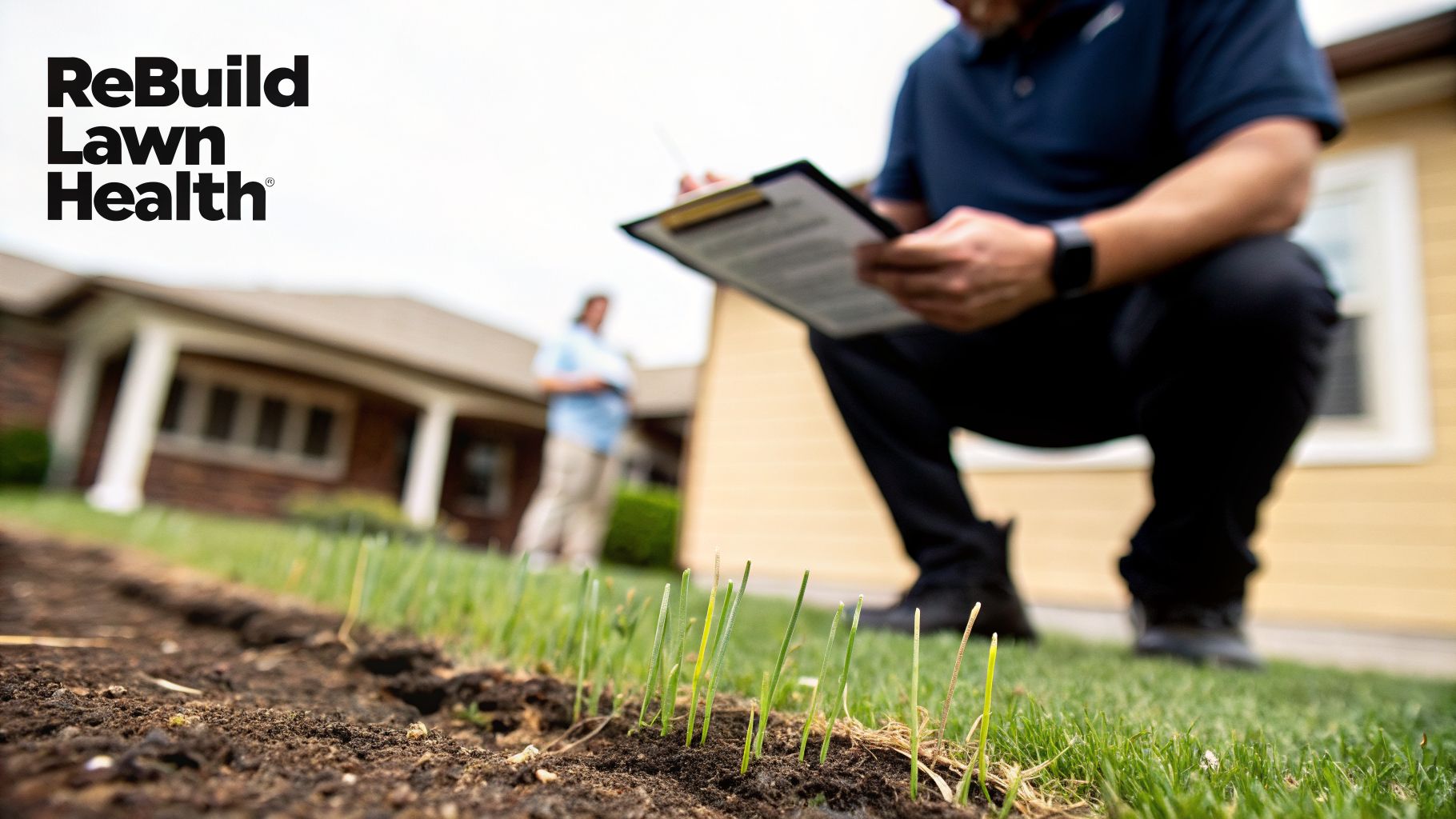
Flushing your lawn with water is a great first-aid step, but let's be honest—it’s a bandage, not a cure. To truly fix the damage from over-fertilizing, you have to go deeper and rebuild your lawn’s health from the soil up. It’s a process, but it’s the only way to create a resilient lawn that can handle our tough North Georgia climate.
This isn't about throwing more products at the problem. It's about restoring a natural, balanced ecosystem in your yard. That’s how you get a lawn that doesn't just survive, but actually thrives—and one you can feel good about your kids and pets playing on.
Start by Ditching the Guesswork with a Soil Test
Guessing is how most lawns get burned in the first place. That’s why any real restoration effort has to begin with a professional soil test. We take core samples from different areas of your yard to get an exact picture of its nutrient levels and, crucially, its pH.
This data tells us exactly what your specific Forsyth County lawn is missing and—just as important—what it has too much of. It takes the guesswork completely out of the equation, letting us build a precise, effective plan just for your turf.
Break Up That Compacted Georgia Clay
If you live anywhere from Milton to Dawsonville, you know the struggle with our dense, red clay. Over time, it gets rock-hard, basically strangling your grass roots. Water, air, and nutrients can’t get down into the soil where they’re needed. When you over-fertilize, those excess salts just sit on top, making a bad situation worse.
This is why core aeration is a must for any serious lawn recovery. We use a machine that pulls out small plugs of soil, creating thousands of little channels. These openings break up the compaction, allowing water to finally flush out the built-up salts and giving your grassroots room to breathe and grow deep. You can explore more about how aeration and overseeding revive North Georgia lawns in our detailed guide.
A deep, strong root system is your lawn's best defense against everything our climate throws at it—from the scorching 90-degree summer heat to unexpected drought. Aeration is the key to building that foundation.
A Smarter, Healthier Way to Feed Your Lawn
Our organic-based programs are designed to break the cycle of fertilizer burn. We focus on feeding the soil to create a healthy environment, rather than just force-feeding the grass. By using controlled-release nutrients and boosting beneficial microbial life, we make sure your grass gets a steady diet of what it needs, right when it needs it.
This approach prevents those damaging surges of nitrogen that cause fertilizer burn and weak, spindly growth. It’s a far more sustainable way to build a thick, green lawn, whether you're in Alpharetta, Suwanee, or right here in Cumming.
To put it in perspective, here’s a look at how a homeowner's quick fixes compare to a comprehensive, professional restoration strategy for our area.
DIY Recovery vs Professional Restoration in North Georgia
| Action | DIY Approach | Barefoot Organics Professional Approach |
|---|---|---|
| Nutrient Management | Flush with water; hope for the best. Stop fertilizing and guess when to restart. | Professional soil testing to identify specific imbalances. Custom-blended, slow-release nutrients to restore soil health without risk of re-burning. |
| Soil Compaction | Limited options. Spike aerators offer minimal, temporary relief. | Core aeration to physically remove plugs of clay, improving drainage, root growth, and flushing of excess salts. |
| Long-Term Health | Focus is on immediate visible recovery. The underlying soil issues often remain. | Focus on rebuilding the soil's ecosystem with organic matter and beneficial microbes for long-term resilience against heat, drought, and disease. |
| Overseeding | Spreading seed on damaged, compacted soil with low germination rates. | Seeding is done after aeration, ensuring excellent seed-to-soil contact for higher germination and a thicker, more durable turf. |
Ultimately, a professional restoration does more than just fix the visible damage. It sets your lawn up for long-term success, building a strong, healthy foundation that's better equipped to handle everything from weed pressure in Buford to summer fungus in Canton.
Why Choose Barefoot Organics in Cumming
When your lawn is yellow and scorched from fertilizer burn, the last thing you need is a generic, one-size-fits-all plan from some national chain. Their playbook wasn't written for Forsyth County's dense clay soil or the specific challenges of keeping Bermuda and Fescue alive through a brutal North Georgia summer. You need a partner who actually understands the ground beneath your feet.
That’s where a local team like Barefoot Organics comes in. We're a Cumming business, through and through. Our team doesn't just work here; we live here. We're your neighbors, dealing with the same stubborn lawn issues you are, from the new construction subdivisions in Dawsonville to the established yards in Johns Creek.
Going with a big-box lawn company often means getting a technician who’s just following a script developed in a corporate office hundreds of miles away. Their plan for your lawn in Cumming is probably the exact same one they use in Ohio. Around here, that approach just doesn't cut it.
We’ve built our reputation on honest, straightforward advice that gets real results for local homeowners. When you call us, you aren't dialing a national hotline; you're calling a lawn expert who was probably just treating a yard down the street in Milton.
We Understand Cumming's Unique Lawn Challenges
We have hands-on, daily experience reviving Bermuda grass after a harsh winter and helping delicate Fescue lawns survive our intense summer heat and humidity. Our strategies are built from the ground up, specifically for North Georgia's unique climate, soil types, and common pests.
This local knowledge makes all the difference:
- Soil Expertise: We know exactly how to amend and aerate our heavy red clay. This soil is notorious for poor drainage and nutrient absorption, which is often the real reason fertilizer burn happens in the first place.
- Grass-Specific Treatments: We don’t use a blanket approach. Our programs are designed around the distinct needs of Bermuda and Fescue lawns, making sure they get the right care at the right time.
- Climate-Aware Scheduling: Our application schedule for pre-emergents and seasonal fertilizers is timed precisely for Forsyth County’s weather patterns, not some generic national calendar. This is key to preventing headaches like crabgrass season and summer fungus before they ever get started.
- Local Pest and Disease Control: We know when to watch for armyworms in Buford and how to spot the first signs of brown patch fungus in Suwanee. This lets us jump in quickly with effective, targeted treatments.
A Partner You Can Trust in Forsyth County
Unlike the national chains that are often focused on volume and upselling, our goal is to build a healthy, resilient lawn that actually needs less intervention over time. We believe in educating our neighbors, which is why we take the time to explain why we recommend a certain treatment, not just what it is.
When you work with Barefoot Organics, you get a team that is genuinely invested in the health of your lawn and the safety of our local environment. We get how important it is to keep kids and pets safe on the grass. We also work hard to protect our local waterways, from Canton to Sugar Hill, from unnecessary chemical runoff.
Get Results That Last
Choosing a local expert means you're not just another address in a database. You're a neighbor. It means getting a lawn care program designed by people who understand that what works in Alpharetta might need a slight tweak for a lawn just a few miles away in Cumming.
It's time to stop the cycle of guessing, burning, and frustration. Don't settle for another season of struggling with your yard. Give Barefoot Organics a call for a free lawn evaluation and see what a truly local, knowledgeable approach can do for your home.
FAQ: Fixing an Over-Fertilized Lawn in Cumming
When you're staring at yellow or brown patches on your lawn, you need answers fast. As lawn care experts serving homeowners from Cumming to Canton, we hear the same urgent questions over and over. Here are some straightforward answers tailored for our North Georgia lawns.
Q: How long does it take for a lawn to recover from fertilizer burn in Georgia?
A: In Forsyth County, recovery time depends on your grass. For tough Bermuda, a light burn can green up in 2-3 weeks with proper watering. For a severe burn, expect 4-6 weeks for runners to fill in. Fescue is more sensitive, especially in the heat; it can take a month or more, and badly scorched areas will likely need fall overseeding to recover fully.
Q: Can my over-fertilized lawn in Cumming be saved?
A: Yes, in most cases, it can be saved if you act quickly. Start flushing the area with slow, deep watering to wash excess salts past the roots. This is often enough for minor burns. However, areas where fertilizer was spilled will likely be completely dead and will require reseeding or patching with new sod once the soil has recovered.
Q: Is it safe for my kids and pets to go on a burnt lawn?
A: No, keep children and pets off a recently over-fertilized lawn. High salt concentrations can irritate paws and skin. More seriously, ingesting the grass can cause vomiting or other health issues. Wait until you have thoroughly flushed the area with water for several days. We recommend waiting at least 48-72 hours after your final watering session.
Q: When is the best time to reseed a burnt lawn in Forsyth County?
A: Timing is everything for seeding in our climate. For Fescue lawns, the best time to reseed is in the early fall, from mid-September through October. For Bermuda, seeding isn't the best option. Small burned areas will fill in on their own. For larger dead patches on a Bermuda lawn, patching with sod from late spring through summer is the most effective fix.
Q: Will weeds come back stronger after fertilizer burn?
A: Unfortunately, yes. Over-fertilizing creates bare patches of soil, which is an open invitation for aggressive weeds like the crabgrass we see all over Forsyth County. A long-term recovery plan that includes core aeration and overseeding is essential to re-establish thick turf that can naturally choke out weeds before they take over your lawn.
Q: What is the best way to water a burnt lawn on Georgia clay?
A: On our dense red Georgia clay, you must use the "cycle and soak" method. Water the burned areas for 20-30 minutes, then turn the sprinklers off for an hour to let it soak in. Repeat this cycle 2-3 times. This prevents runoff and ensures water penetrates deep enough to flush the harmful fertilizer salts away from the grass roots.
Feeling overwhelmed by your lawn's recovery? You don't have to figure this out alone. The experts at Barefoot Organics know exactly how to diagnose and restore lawns damaged by over-fertilizing in Cumming and the surrounding North Georgia communities. We offer a free lawn evaluation to get you started. Call us today and let us build a custom, safe, and effective plan for your yard.
Meta Title:
Fix an Over-Fertilized Lawn in Cumming, GA | Local Guide
Meta Description:
Accidentally burn your lawn in Cumming, GA? Learn how to fix an over-fertilized lawn with our guide. We cover recovery on Georgia clay for Bermuda & Fescue.
URL Slug:
/over-fertilizing-lawn-cumming-ga
Internal Link Suggestions:
- Link "weed control" to
https://www.barefootorganicsllc.com/weed-control-cumming-ga/ - Link "lawn fertilization" to
https://www.barefootorganicsllc.com/lawn-fertilization-cumming-ga/ - Link "seasonal lawn programs" to
https://www.barefootorganicsllc.com/our-programs/ - Link "brown patch fungus" to
https://www.barefootorganicsllc.com/brown-patch-fungus-treatment/ - Link "explore more about how aeration and overseeding revive North Georgia lawns" to remain as is.
- Link "what causes brown spots in grass" to remain as is.
- Link "how to read fertilizer numbers" to remain as is.
- All links to the homepage, contact, and free estimate pages should remain as is.
Schema Recommendations:
{
  "@context": "https://schema.org",
  "@type": "Article",
  "headline": "How to Fix an Over-Fertilized Lawn in Cumming, GA",
  "description": "A comprehensive guide for homeowners in Cumming, GA, on how to identify, treat, and recover a lawn from fertilizer burn, with specific advice for North Georgia's clay soil and climate.",
  "image": "https://cdnimg.co/de707790-5550-4abd-b884-e7ebe4766cef/c0616786-a9ed-4010-986c-71e1ad0e453e/over-fertilizing-lawn-burnt-grass.jpg",
  "author": {
    "@type": "Organization",
    "name": "Barefoot Organics LLC",
    "url": "https://www.barefootorganicsllc.com/"
  },
  "publisher": {
    "@type": "Organization",
    "name": "Barefoot Organics LLC",
    "logo": {
      "@type": "ImageObject",
      "url": "https://www.barefootorganicsllc.com/wp-content/uploads/2023/11/logo.png"
    }
  },
  "datePublished": "2024-05-21",
  "mainEntityOfPage": {
    "@type": "WebPage",
    "@id": "https://www.barefootorganicsllc.com/over-fertilizing-lawn-cumming-ga/"
  },
  "about": {
    "@type": "Service",
    "name": "Lawn Health Restoration",
    "areaServed": {
      "@type": "City",
      "name": "Cumming"
    },
    "provider": {
      "@type": "LocalBusiness",
      "name": "Barefoot Organics LLC",
      "address": {
        "@type": "PostalAddress",
        "addressLocality": "Cumming",
        "addressRegion": "GA"
      }
    }
  },
  "mainEntity": {
    "@type": "FAQPage",
    "mainEntity": [
      {
        "@type": "Question",
        "name": "How long does it take for a lawn to recover from fertilizer burn in Georgia?",
        "acceptedAnswer": {
          "@type": "Answer",
          "text": "In Forsyth County, recovery time depends on your grass. For tough Bermuda, a light burn can green up in 2-3 weeks with proper watering. For a severe burn, expect 4-6 weeks for runners to fill in. Fescue is more sensitive, especially in the heat; it can take a month or more, and badly scorched areas will likely need fall overseeding to recover fully."
        }
      },
      {
        "@type": "Question",
        "name": "Can my over-fertilized lawn in Cumming be saved?",
        "acceptedAnswer": {
          "@type": "Answer",
          "text": "Yes, in most cases, it can be saved if you act quickly. Start flushing the area with slow, deep watering to wash excess salts past the roots. This is often enough for minor burns. However, areas where fertilizer was spilled will likely be completely dead and will require reseeding or patching with new sod once the soil has recovered."
        }
      },
      {
        "@type": "Question",
        "name": "Is it safe for my kids and pets to go on a burnt lawn?",
        "acceptedAnswer": {
          "@type": "Answer",
          "text": "No, keep children and pets off a recently over-fertilized lawn. High salt concentrations can irritate paws and skin. More seriously, ingesting the grass can cause vomiting or other health issues. Wait until you have thoroughly flushed the area with water for several days. We recommend waiting at least 48-72 hours after your final watering session."
        }
      },
      {
        "@type": "Question",
        "name": "When is the best time to reseed a burnt lawn in Forsyth County?",
        "acceptedAnswer": {
          "@type": "Answer",
          "text": "Timing is everything for seeding in our climate. For Fescue lawns, the best time to reseed is in the early fall, from mid-September through October. For Bermuda, seeding isn't the best option. Small burned areas will fill in on their own. For larger dead patches on a Bermuda lawn, patching with sod from late spring through summer is the most effective fix."
        }
      },
      {
        "@type": "Question",
        "name": "Will weeds come back stronger after fertilizer burn?",
        "acceptedAnswer": {
          "@type": "Answer",
          "text": "Unfortunately, yes. Over-fertilizing creates bare patches of soil, which is an open invitation for aggressive weeds like the crabgrass we see all over Forsyth County. A long-term recovery plan that includes core aeration and overseeding is essential to re-establish thick turf that can naturally choke out weeds before they take over your lawn."
        }
      },
      {
        "@type": "Question",
        "name": "What is the best way to water a burnt lawn on Georgia clay?",
        "acceptedAnswer": {
          "@type": "Answer",
          "text": "On our dense red Georgia clay, you must use the 'cycle and soak' method. Water the burned areas for 20-30 minutes, then turn the sprinklers off for an hour to let it soak in. Repeat this cycle 2-3 times. This prevents runoff and ensures water penetrates deep enough to flush the harmful fertilizer salts away from the grass roots."
        }
      }
    ]
  }
}