

If you're searching for an "organic lawn service near me" here in Cumming, GA, you're not alone. More and more, homeowners are looking for ways to get a gorgeous, green yard that's also genuinely safe for their families, pets, and the local environment. It’s a shift away from quick-fix chemicals and a move toward building a healthy, sustainable lawn from the ground up.
Why Cumming Homeowners Are Choosing Organic Lawn Care
From Johns Creek to Alpharetta, Milton, and even up to Dahlonega, there's a growing understanding that a truly healthy lawn begins with rich, living soil—not just a blast of synthetic fertilizer. This simple but powerful idea is the heart of what organic lawn care is all about.
This isn't just a local trend. It's a clear signal of where the entire industry is headed. The U.S. lawn care market is seeing massive growth, largely because homeowners are demanding eco-friendly services. In fact, projections show the market could hit USD 487.1 billion by 2033, and a huge part of that growth is from people choosing organic to protect their soil, water, and local wildlife.
To get a clearer picture, let's look at how these two approaches stack up.
Conventional vs Organic Lawn Care At a Glance
This table quickly breaks down the core differences between the traditional chemical-heavy services and a modern organic program.
| Feature | Conventional Lawn Care | Organic Lawn Service |
|---|---|---|
| Philosophy | Feeds the grass directly with synthetic nutrients. | Feeds the soil to build a healthy ecosystem. |
| Ingredients | Synthetic, chemical-based fertilizers & pesticides. | Natural, plant-based, and mineral-based products. |
| Impact on Soil | Can degrade soil health and kill beneficial microbes. | Improves soil structure and encourages microbial life. |
| Safety | Requires waiting periods before safe entry for kids & pets. | Safe for immediate use by family and pets. |
| Long-Term Results | Creates dependency on frequent chemical treatments. | Builds a resilient, self-sustaining lawn. |
As you can see, the organic path is about creating a fundamentally healthier environment for your grass to thrive in, rather than just treating the symptoms.
A Focus on Family Safety and Environmental Health
For most families in the Cumming area, the number one reason for going organic is safety. Plain and simple. It’s about letting your kids and pets run around and play on the grass without worrying about what they might be exposed to. That kind of peace of mind is priceless.
Conventional treatments often work against nature, effectively sterilizing the soil and killing off the beneficial microbes that your grass needs to absorb nutrients. Organic methods do the opposite—they build a thriving ecosystem right under your feet. This approach ultimately leads to a lawn that is naturally tougher and more resilient against drought, disease, and pests. You can learn more about the philosophy behind going organic and how it pays off in the long run.
An organic lawn care program is an investment in your property's long-term health and your family's well-being. It creates a self-sustaining ecosystem that reduces the need for constant chemical interventions and supports a healthier local environment.
Building a Sustainable Future in North Georgia
This commitment to a healthier lawn is often part of a bigger picture. Homeowners in Cumming and surrounding areas like Johns Creek and Alpharetta realize that their yard is connected to the wider community. Choosing organic helps protect our local waterways like Lake Lanier from chemical runoff and supports vital pollinators like bees and butterflies.
This mindset can easily extend to other parts of your home, like exploring the different types of sustainable building certifications available. By hiring an organic lawn service, you're doing more than just getting a greener lawn—you're actively contributing to a healthier, more vibrant North Georgia for all of us.
You’ve probably noticed words like "green," "natural," and "eco-friendly" popping up everywhere. But when you’re looking for an organic lawn service in areas like Milton or Dahlonega, how do you know if a company is the real deal? It’s a great question, and it shows you're looking to move past marketing buzzwords to find a truly sustainable partner for your lawn.
The secret is to cut through the sales pitch with specific, direct questions. A genuinely organic company is always focused on building healthy soil, not just on making your grass green for a few weeks. They'll be open and transparent about their methods and the products they use, giving you answers that show a real understanding of soil biology.
This infographic breaks down a simple, three-step process for checking a company's organic credentials.
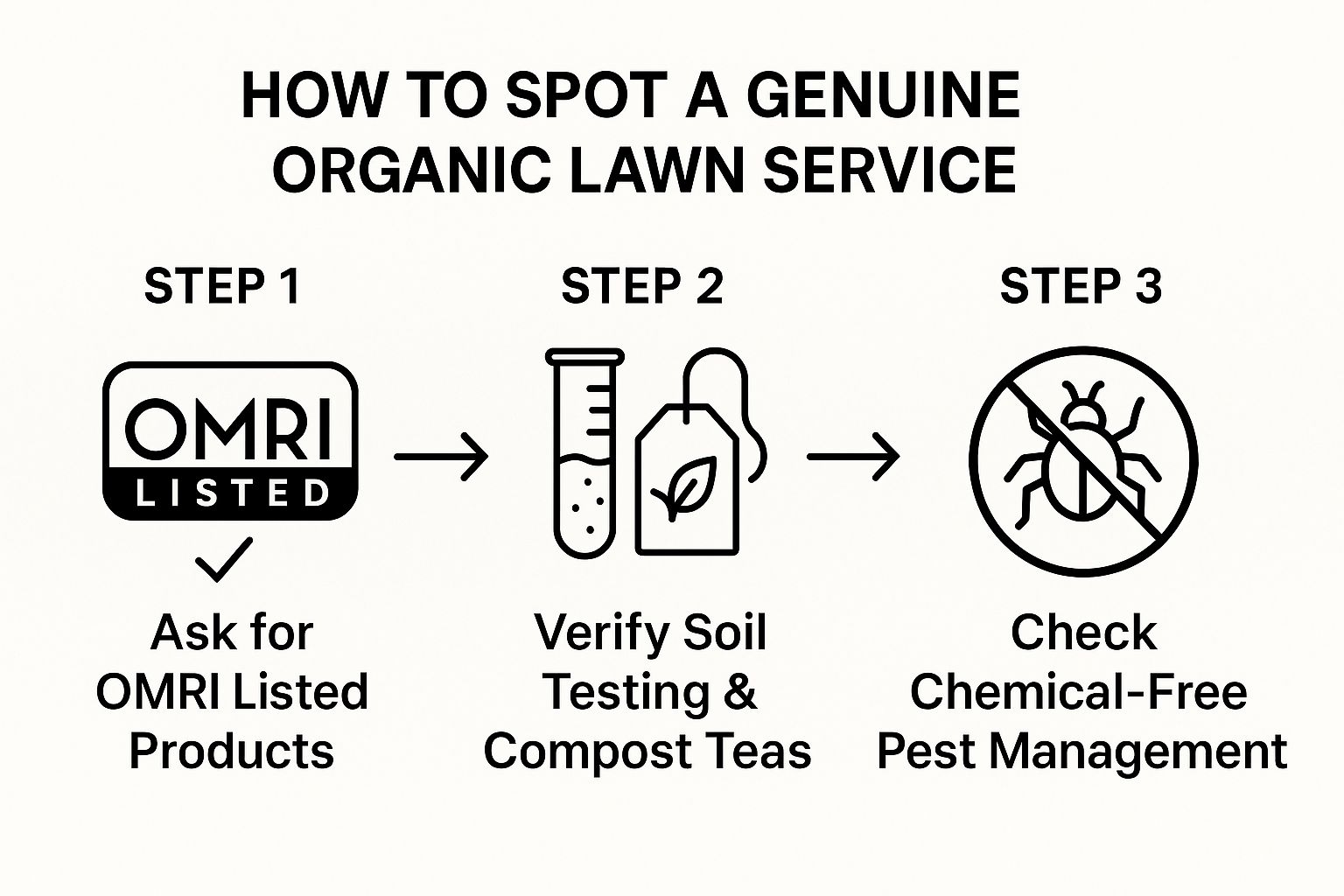
As you can see, it really boils down to checking for certified products, making sure they focus on soil health, and confirming they take a chemical-free approach to problems.
Look for OMRI Listed Products
The most straightforward way to cut through the noise is to ask about the products they use. Don't let them get away with vague answers like "we use natural fertilizers." You need to get specific.
Ask them directly: "Do you use OMRI Listed products?"
The Organic Materials Review Institute (OMRI) is a nonprofit, third-party organization that reviews and verifies products for use in certified organic operations. It’s the gold standard in the industry. If a company is using OMRI Listed products, you can be confident they're using materials that meet the strictest organic standards.
A company truly committed to organic care will be proud to tell you about the OMRI Listed products in their arsenal. If they hesitate or can't name any, that's a huge red flag. It’s a classic sign of "greenwashing"—using eco-friendly marketing to cover up conventional practices.
Inquire About Their Soil-First Philosophy
Here’s a fundamental truth: a legitimate organic service focuses on the soil, not just the grass. Their entire program should be built around creating a living, healthy ecosystem right under your feet. This is a world away from conventional services that just pump synthetic chemicals directly into the plant.
So, how do you know if they're soil-focused? Ask about these key practices:
- Soil Testing: Do they start with a comprehensive soil test before creating a treatment plan? A one-size-fits-all approach is the opposite of organic. They should be analyzing your soil's pH, nutrient levels, and organic matter to build a plan tailored to your yard, whether you're in Alpharetta or Johns Creek.
- Compost Teas: Ask if they brew their own compost teas. These are living, liquid solutions packed with beneficial microorganisms that bring dead, compacted soil roaring back to life. It’s a clear sign of a company that is deeply invested in the science of soil biology.
- Core Aeration: They should be big proponents of annual core aeration, especially for the dense clay soil so common in North Georgia. This is a non-negotiable step for reducing compaction and allowing air, water, and nutrients to get down to the grassroots where they're needed most.
Understand Their Approach to Pests and Weeds
This is where the rubber really meets the road. An expert organic approach to pests and weeds is always proactive, not reactive. The whole goal is to build a lawn that's so thick, healthy, and resilient that it naturally chokes out problems before they can start.
Ask them how they’d handle a common issue like crabgrass or grubs. A true organic pro will talk about things like:
- Using corn gluten meal as a natural pre-emergent to stop weed seeds from ever germinating.
- Introducing or encouraging beneficial insects and using nematodes or milky spore to control grubs biologically.
- Overseeding with high-quality, durable grass varieties to quite literally crowd out weeds.
If their first response is to reach for a spray bottle—even if they call it a "safer" chemical—they probably aren't a truly organic service. Their primary strategy should always be about strengthening the lawn's own defenses first.
What a Genuinely Great Organic Lawn Program Should Include
When you start looking for an "organic lawn service near me," you’re signing up for a whole different philosophy. It’s not about swapping one fertilizer for another. A truly top-notch organic program is designed to build a tough, healthy lawn from the soil up. This is a proactive, science-backed approach that creates lasting health, not just a quick, temporary green-up.
This mindset shift isn't just a local trend here in Johns Creek or Alpharetta; it's happening everywhere. People are waking up to the benefits of safer, more sustainable landscaping. In fact, the organic lawn care market hit a value of about USD 2.0 billion in 2024 and is only expected to climb. This growth is driven by homeowners wanting smarter solutions like biological pest control and natural soil conditioning.
Knowing what to look for is your best tool for picking the right company. Here are the non-negotiables.
They Start with a Real Soil Test
Everything—and I mean everything—in organic lawn care starts with the soil. Any reputable service worth its salt won't touch your lawn without first understanding what it actually needs. That process always begins with a professional soil test.
Think of this test as a blueprint for your lawn's health. It measures the critical stuff:
- pH Levels: This single factor dictates how well your grass can actually use the nutrients in the soil.
- Nutrient Gaps: The test pinpoints exactly what’s missing, whether it's nitrogen, phosphorus, or potassium.
- Organic Matter: This tells you how well your soil holds water and supports the beneficial microbes that are the lifeblood of a healthy lawn.
Without this data, any treatment is a shot in the dark. A company that makes soil testing mandatory isn't upselling you; they're showing you they're serious about creating a custom plan that will actually work.
Core Aeration and Overseeding Are Standard Practice
Here in North Georgia, our soil has a lot of clay, which gets compacted easily. When soil gets packed down, it basically suffocates the grass roots, blocking air, water, and nutrients from getting where they need to go. This is why core aeration isn’t an optional add-on; it’s essential for lawns in Cumming, Milton, and the surrounding areas.
Core aeration involves pulling up small plugs of soil, which physically breaks up that compaction. It instantly creates little channels for oxygen and water to reach the root zone. Honestly, it’s one of the best things you can do for a lawn in this part of Georgia.
The absolute best time to overseed is right after aeration. Spreading high-quality grass seed that's right for our region gives you fantastic seed-to-soil contact. This is how you build a thick, dense turf that naturally chokes out weeds and stands up better to heat and drought.
A thick, healthy lawn is your best defense against weeds and disease. Core aeration followed by overseeding is the one-two punch that builds this natural resilience, drastically cutting down the need for chemicals later on.
They Use Natural Pest and Grub Control
A truly organic lawn service doesn't use synthetic pesticides. Period. Instead, they rely on biological controls and natural solutions to manage common pests like grubs, which can absolutely destroy a lawn's root system. The whole idea is to strengthen the lawn’s own defenses and use nature’s own tools to solve problems.
Effective, organic-minded pest management often includes:
- Beneficial Nematodes: These are your allies. They're microscopic organisms that actively hunt down and eliminate soil pests like grubs, and they're completely harmless to your lawn, your kids, and your pets.
- Milky Spore: This is a naturally occurring bacterium that is the sworn enemy of Japanese beetle grubs, targeting them specifically.
When a company uses methods like these, it shows they’re committed to creating a balanced, healthy ecosystem on your property. You can see how these solutions are built into our specialized lawn care programs to provide safe and highly effective results.
Finding and Vetting Your Local Lawn Care Partner
Alright, you know what a top-notch organic program should look like. Now for the real work: finding the right local pro to make it happen on your lawn.
A quick search for "organic lawn service near me" is going to flood you with options, whether you're in Cumming, Alpharetta, or Dahlonega. The trick isn't just finding a list of names; it's about sifting through them to find a true professional who gets it.
Digging Deeper Than Online Reviews
Online reviews are a decent starting point, but you have to read between the lines. I always skim past the generic five-star ratings and look for detailed comments. What are people saying about specific results, the company's communication, and their overall professionalism? That's where the real gold is.
But honestly, the best move you can make is to ask for local references.
And don't just ask for a list of happy clients. Get specific. Ask for addresses of lawns they currently service right in your neighborhood, be it Johns Creek, Milton, or wherever you are. A company that’s proud of its work won't hesitate. They'll want you to see it.
Take a Sunday drive and see for yourself. This simple step gives you a completely unfiltered look at their results and tells you more than any online review ever could. This isn't just true for lawn care; you can find great general advice for finding and vetting local home service professionals that holds true whether you're hiring a window washer or an organic turf specialist.
How to Get an Accurate Quote
To get a quote you can actually count on, you need to arm them with the right information. Any serious company will want to visit your property, but you can get the process started by giving them a few key details.
- Your Property Address: This lets them use mapping tools to get a solid idea of your turf's square footage.
- Known Issues: Be totally upfront. Got stubborn patches of clover, bare spots from the dog, or a soggy area that never drains? Tell them.
- Lawn History: It’s crucial to mention if your lawn has been treated with traditional chemicals. That history changes how they'll approach the transition to an organic program.
Giving them this info upfront helps a pro put together a proposal that actually means something. The residential market is the heart of this industry—in fact, of the estimated $184 billion in annual revenue, about 59% comes from homeowners just like you. You can dive into more lawn and landscaping industry stats on getjobber.com if you're curious.
When you're comparing organic lawn care quotes, remember this: the cheapest option is almost never the best. A price that seems too good to be true usually means they're cutting corners—think lower-quality products or skipping vital steps like core aeration.
Look for a detailed, full-year proposal. It should clearly spell out every service, the specific products they plan to use, and a timeline for each application. The best partner isn't the one with the rock-bottom price; it's the one who lays out a thorough, science-based plan to build long-term soil health and a lawn you can be proud of.
What to Expect When You Go Organic
Choosing an organic lawn program is genuinely one of the best long-term moves you can make for your property in Cumming, GA. But it’s crucial to go into it with the right mindset. Going organic is a process of restoration, not an overnight zap like you get with chemical treatments. If you set the right expectations from day one, you'll be able to appreciate the powerful, sustainable changes happening just beneath the surface.
I like to think of it as a lawn detox. For years, your grass has probably been propped up by a constant drip of synthetic fertilizers, giving it that quick, but superficial, green-up. When you cut those off, your lawn has to wean itself from that chemical crutch. It has to re-learn how to pull nutrients naturally from healthy, living soil.
This transition period is where a little patience goes a long way.
The First Few Months: A Healing Phase
During the first few months with your new organic service, the most important work is happening where you can't see it—in the soil. Your provider will be focused on building a bustling microbial ecosystem using things like natural amendments and compost teas. This is the bedrock of all future growth.
So, you probably won't see a dramatic, instant pop of green. In fact, you might even notice a few more weeds popping up for a bit. Don't panic! This is completely normal. As the soil chemistry rebalances, there's a small window where opportunistic weeds can sneak in before your new, thicker turf has a chance to crowd them out for good.
Here's what you should look for in the first 3-6 months:
- Softer Soil: The ground should feel less compacted and hard, especially after a service like core aeration.
- Better Drainage: You'll notice that water soaks into the ground more easily instead of just running off the top.
- A Deeper Green: It won't happen overnight, but the color of your lawn will start to look richer and more natural, not that artificial, almost neon green.
A Realistic Timeline for Year One
As you move through the first full year, the visible results will start to catch up with all that foundational work. Any honest organic lawn service near me will tell you that the first year is all about building resilience for the long haul.
By the time you get to the end of that first growing season here in North Georgia, you should absolutely see a real difference. Those subtle improvements from the spring will pave the way for a noticeably thicker and more vibrant lawn by fall. Bare patches will start filling in, and the grass itself will just feel more solid under your feet.
The goal of the first year isn't perfection; it's progress. You are fundamentally changing your property's ecosystem from the soil up. You're building a lawn that will be naturally tougher against drought, pests, and weeds for years to come.
This steady, gradual improvement is the sign of a truly sustainable system. By trusting the process, you’re creating a safe, beautiful, and genuinely healthy lawn in Johns Creek or Alpharetta that will be so much easier to maintain down the road.
Your Top Questions About Organic Lawn Care, Answered
Deciding to go organic with your lawn care is a smart move, but it's totally normal to have questions. In our experience working with homeowners from Cumming to Johns Creek, Alpharetta, and Milton, a few key concerns always pop up.
We want you to feel completely confident about this process. Let's tackle those common questions head-on so you know exactly what to expect.
Is an Organic Lawn Service More Expensive Than a Chemical One?
At the start, you might see a slightly higher price tag. That’s because an organic approach is all about fixing the root cause of lawn problems, not just masking symptoms. We focus on labor-intensive work upfront—things like core aeration and enriching the soil with quality amendments.
Think of it as an investment that pays for itself. A truly healthy organic lawn becomes incredibly resilient, needing less water over time and naturally warding off pests and diseases. You stop paying for constant chemical "fixes" and instead build a self-sustaining lawn that saves you money in the long run.
How Long Until I See Real Results?
This is where a little patience goes a long way. Chemical treatments can give you a quick, almost artificial green-up, but organic care works differently. It's about healing your soil first, creating the foundation for strong, healthy grass.
You'll likely see improvements in soil texture and grass color within the first few months. The most dramatic, 'wow-factor' transformation? That usually takes one to two full growing seasons. The goal here isn't a temporary fix; it's building a beautiful lawn that lasts.
The real magic happens underground first. We're building a thriving ecosystem of microbes in your soil. Once that engine is running, the visible health of your lawn takes off.
Can Organic Methods Actually Control Tough Weeds?
Absolutely, but the strategy is smarter. Our main defense against weeds is to cultivate a lawn so thick and healthy that weeds simply have no room to grow. It’s a proactive approach that focuses on proper mowing, consistent aeration, and overseeding to create a dense turf that chokes out invaders.
For existing weeds or extra prevention, we turn to proven, natural-based products. For example, corn gluten meal is a fantastic natural pre-emergent that stops weed seeds from germinating in the first place. Instead of constantly battling weeds with chemicals, we build a lawn that naturally resists them. Choosing the best organic lawn fertilizer is a huge part of encouraging that dense, weed-suppressing growth.
Ready to create a beautiful, healthy lawn that's safe for your family and pets? Barefoot Organics provides expert, science-backed organic lawn care services across Cumming, Alpharetta, Johns Creek, Milton, Dahlonega, and all of North Georgia. Get your free quote online today!