

When it comes to getting rid of grubs, the best natural methods use living organisms to do the heavy lifting for you. Things like beneficial nematodes or milky spore bacteria are the perfect example—they target and wipe out grubs right in the soil.
The best part? These solutions are completely safe for kids and pets. They work by introducing a natural predator or a highly specific disease that only affects grubs, leaving the rest of your North Georgia lawn's ecosystem healthy and untouched.
Reclaiming Your North Georgia Lawn from Grubs, Naturally
If you're a homeowner in Cumming, Alpharetta, or Johns Creek, you know the frustration. You work hard on your lawn, only to see spongy, brown dead zones pop up out of nowhere. If you're tired of watching grubs sabotage your hard work, you've come to the right place. We’re going to skip the generic advice and get right into a real, family-focused plan using safe, natural methods.
Your lawn is meant to be a playground, a place for bare feet and fetch—not a hazardous zone full of harsh chemicals. This guide is all about showing you how to spot the subtle signs of grub damage that are common here in the Cumming area. We're talking about those odd dry spots that don't seem to get better with water or that sudden, frantic digging from local birds and raccoons.
You'll quickly learn the difference between a real grub infestation and the normal stress our lawns go through in the summer heat. That knowledge gives you the confidence to act before a small problem becomes a major headache.
Why North Georgia Lawns Are a Grub Paradise
It turns out our local climate and soil create an almost perfect breeding ground for beetles, especially the notorious Japanese beetle. The combination of our warm, humid summers and relatively mild winters gives their life cycle a major advantage. Unlike in colder regions, we don't get the deep, hard freezes that would naturally kill off a large portion of the larvae underground.
This is particularly true for the beautiful, well-irrigated lawns you see throughout communities like Milton and Dahlonega. That consistent moisture, which keeps your grass green, also creates the ideal nursery for beetles to lay their eggs and for the newly hatched grubs to thrive just below the surface.
The Downside of Chemical "Quick Fixes"
The go-to solution for many has been broad-spectrum pesticides. Sure, they can kill grubs, but they don't stop there. These chemicals are indiscriminate killers, wiping out beneficial insects like earthworms, bees, and other pollinators that your garden desperately needs. They can also wreck the soil's natural microbiome and pose unnecessary risks to the children and pets playing on the grass.
A healthy lawn is a living ecosystem. The goal of a natural grub killer isn't just to eliminate a pest, but to restore balance to that ecosystem without introducing harmful substances.
Our entire approach is built on working with nature, not declaring war on it. By using biological controls, we can target the grubs with precision, leaving the rest of your lawn's delicate web of life unharmed. In the long run, this creates a far more resilient and genuinely healthy turf.
Setting the Stage for a Grub-Free Lawn
Before we jump into specific treatments, it's critical to understand your opponent. Grubs aren't a surface problem; they live, eat, and do their damage in the soil, devouring grassroots and attacking your lawn from its very foundation. Any effective natural solution has to work where they live—beneath the surface.
Here's what we'll cover to get you on the right track:
- Spotting the Problem: How to accurately diagnose the early signs of grub activity in your Bermuda or Fescue grass.
- Choosing Your Weapon: Exploring powerful natural grub killer options like beneficial nematodes and milky spore.
- Timing is Everything: Pinpointing the perfect window for application to get maximum results in our Georgia climate.
- Playing the Long Game: Building a strong, grub-resistant lawn for the future through smart, organic care practices.
Let's get started on how these natural grub killers can bring your lawn back to life without compromising the safety of your family.
Diagnosing Grub Damage in Your Georgia Lawn
Before you reach for any kind of treatment, you first have to be sure grubs are what's causing your lawn problems. For homeowners across Forsyth County, from Milton to Cumming, telling the difference between grub damage and other common turf issues is the most important first step. The signs can be sneaky at first, but they can quickly spiral out of control.
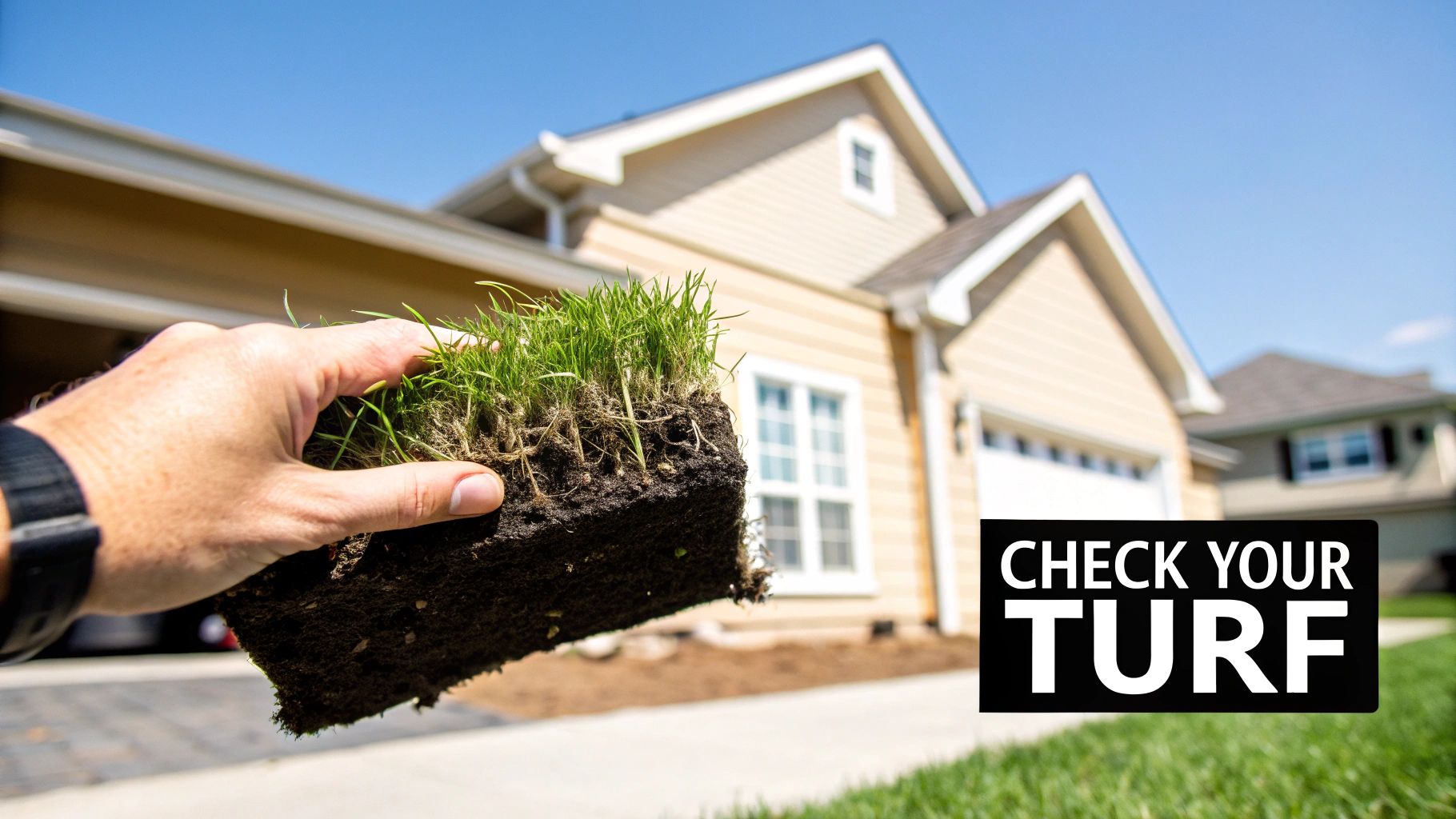
Often, the first thing you'll see are odd-shaped brown patches cropping up in your Bermuda or Zoysia grass. Unlike the uniform browning from summer heat, these spots feel surprisingly soft and spongy when you walk on them. No amount of watering will bring them back to life. That's because grubs are busy feasting on the grassroots below, completely cutting the turf off from the water and nutrients it needs to survive.
Look for These Key Warning Signs
One of the biggest giveaways of a grub problem is a sudden uptick in wildlife digging around your yard. If you’re seeing more birds, moles, or even raccoons tearing up the lawn, they're probably after a protein-packed grub lunch. Frankly, their digging can sometimes do more damage than the grubs themselves.
You can also try a simple "tug test." Go to one of the brown patches and grab a handful of grass. If it peels back like a loose piece of carpet with no roots attached, that’s the smoking gun. The grubs have chewed away everything anchoring the sod to the soil.
Lawn grubs—the larvae of beetles like Japanese beetles and June bugs—are notorious pests, and they’ve fueled a huge demand for eco-friendly pest control solutions. They can devour the roots of both cool-season and warm-season grasses so aggressively that some university studies estimate that bad infestations can wipe out 50–60% of a lawn’s entire root system in just one season. This is especially true in irrigated suburban areas like you’d find in Cumming, Alpharetta, and Johns Creek. You can read more about the growing pest control market trends on Fortune Business Insights.
Is It Grubs or Something Else?
In North Georgia's humidity, it’s all too easy to mistake grub damage for fungal diseases like brown patch or dollar spot, since they all create ugly brown patches. The real difference is in the turf's stability. A fungus attacks the grass blades, but grubs destroy the root system from underneath.
Grub Damage Vs Other Common Lawn Problems In North Georgia
Use this quick comparison guide to help differentiate between grub damage and other common turf issues found in areas like Cumming and Alpharetta.
| Symptom | Likely Grub Damage | Other Possible Causes (Fungus, Drought) |
|---|---|---|
| Brown Patches | Irregular, undefined shapes. Patches feel soft and spongy. | Circular, well-defined rings (brown patch) or small, silver-dollar-sized spots (dollar spot). The entire lawn may brown out uniformly from drought. |
| Turf Feel | Sod pulls up easily like a carpet, with few or no roots. | Sod remains firmly attached to the soil. Grass blades may have lesions, feel dry and crunchy, or show fungal growth. |
| Wildlife Activity | Increased digging by birds, raccoons, armadillos, or moles. | No significant increase in digging activity related to the patches. |
| Response to Water | Patches do not green up, even with consistent watering. | Drought-stressed grass will revive with proper watering. Fungal issues won't improve and may worsen with improper watering. |
So, how do you get a definitive answer? The best way is to dig. Carefully peel back a one-square-foot section of the damaged turf and see what you find. If you count more than five to ten of those little C-shaped, white grubs, you have an active infestation that needs attention.
Pro Tip: The best time to go hunting for grubs is in the late summer or early fall. They’re younger, actively feeding, and closer to the surface, which also happens to be the perfect window for applying most natural treatments.
Knowing for sure that grubs are the problem saves you time, money, and a whole lot of frustration. Once confirmed, you can confidently move forward with a natural grub killer that gets to the root of the problem instead of just masking the symptoms.
Choosing the Most Effective Natural Grub Killer
So, you've done the detective work and confirmed grubs are the problem. What now? Across North Georgia, from the quiet neighborhoods of Johns Creek to the rolling hills of Dahlonega, more and more homeowners are looking for solutions that are tough on pests but easy on everything else. The best natural approaches work with nature, not against it, to bring your lawn's ecosystem back into balance.
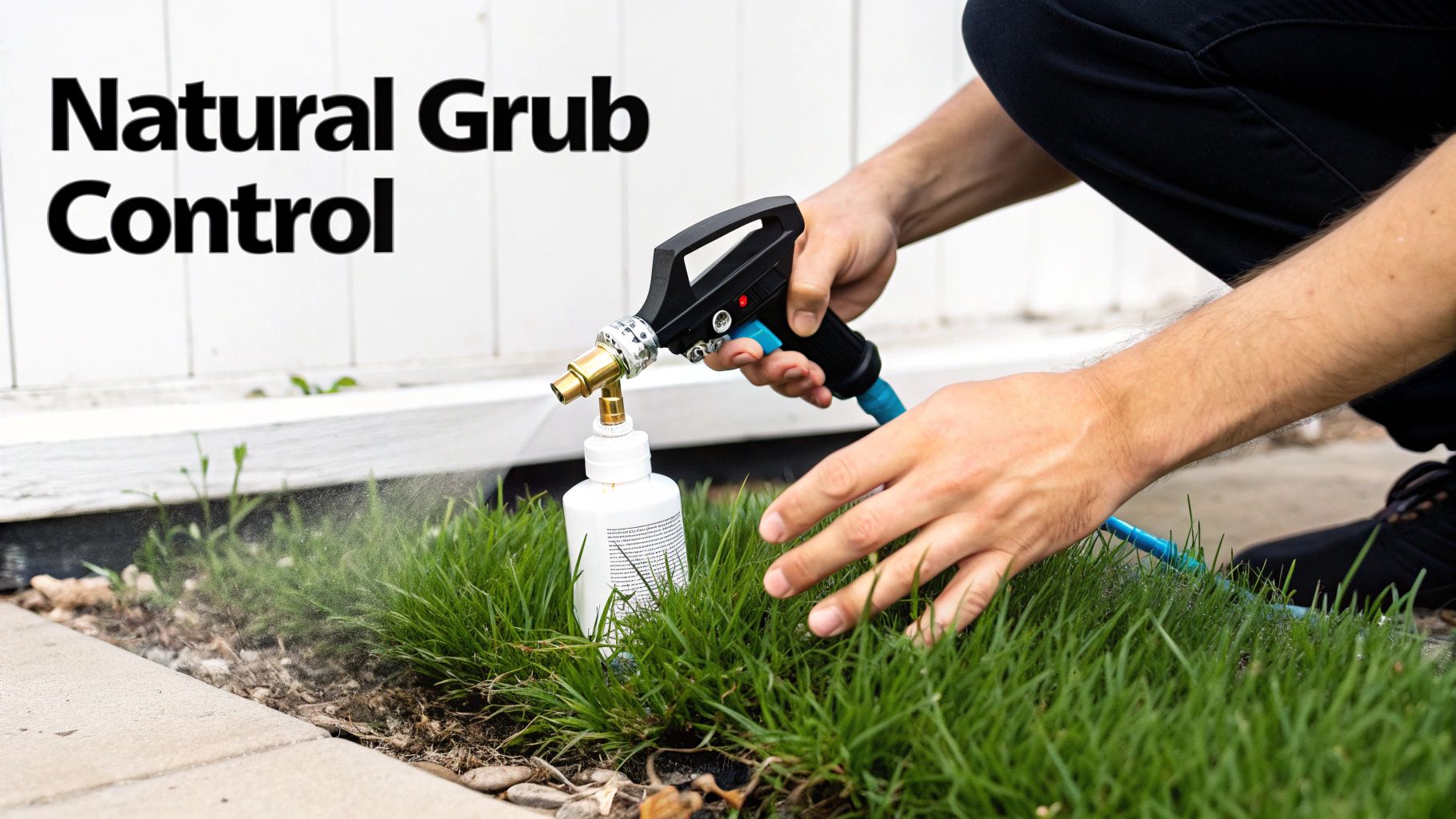
We're seeing a major shift in how people approach lawn care. Instead of reaching for broad-spectrum synthetic insecticides, the focus is now on biological options like beneficial nematodes and microbial products. This isn't just a trend; it's a movement backed by data. Natural pest control methods are the fastest-growing segment of the market. In fact, biopesticides—the category many natural grub killers fall into—are projected to grow at a 9.5% compound annual growth rate from 2025 to 2033. That growth far outpaces traditional chemicals. You can see more data on the pest control market's evolution from sources like Allied Market Research.
Beneficial Nematodes: The Microscopic Grub Hunters
One of the most impressive natural grub killers you can use is beneficial nematodes. Forget the bad nematodes you've heard about that attack plant roots—these guys are the good guys. They are microscopic, soil-dwelling worms that are natural predators of grubs. Think of them as a tiny, targeted army you can deploy right in your lawn.
Nematodes actively hunt down grubs in the soil. When one finds a grub, it enters its body and releases a special kind of bacteria. This bacteria is harmless to anything else but is lethal to the grub, killing it from the inside out in just 24 to 48 hours.
But it doesn't stop there. The nematodes reproduce inside the dead grub, and a new generation soon emerges, ready to continue the hunt. This creates a self-sustaining cycle of pest control right where the problem is happening.
If you're in Forsyth or Cherokee Counties fighting Japanese beetle grubs, the specific strain Heterorhabditis bacteriophora (Hb) is a fantastic choice. It’s a true hunter that actively seeks out its prey under the soil.
Application Tip: Remember, beneficial nematodes are living organisms. They are sensitive to UV light and heat, so apply them to moist soil in the evening or on an overcast day. Watering your lawn before and after you apply them is absolutely essential for their survival and success.
Milky Spore: A Long-Term Grub Suppressor
Another powerful tool in the natural grub control toolbox is milky spore. This is a naturally occurring bacterium (Paenibacillus popilliae) that infects Japanese beetle grubs with a fatal condition called milky disease. Best of all, it’s a highly specific approach that poses zero threat to people, pets, or beneficial insects.
When a grub eats plant roots treated with milky spore, the bacteria start to multiply inside its body. This process turns the grub's internal fluid a milky-white color, which eventually kills it. As the grub decomposes, it releases billions of new spores back into the soil, creating a long-term protective barrier.
The biggest advantage of milky spore is its incredible longevity. It can take a couple of seasons to get fully established, but once it does, it can keep working for 10 years or more. This makes it an amazing preventative strategy, though it's not the best option for a quick fix on a heavy, active infestation.
Getting the Best Results with Milky Spore:
- Targeted Use: Milky spore is a specialist—it only works on Japanese beetle grubs. If other grub species are your problem, nematodes are the more versatile choice.
- Proper Application: It typically comes as a powder. For best results, apply it in a grid pattern across your entire lawn to ensure even coverage, not just in the damaged spots.
- Watering In: After you spread it, give the lawn a light watering. This helps the spores work their way down into the soil where the grubs are feeding.
Other Biological Controls for a Healthy Lawn
Beyond these two fantastic methods, the ultimate long-term strategy is to build a healthy soil food web. The goal is to create an environment that's naturally resilient and less inviting to pests in the first place.
When you encourage a diverse population of soil microbes with organic fertilizers and compost, you naturally suppress pest populations. These beneficial bacteria and fungi create a balanced underground ecosystem. By focusing on soil health, you're not just fighting grubs—you're building a stronger, more self-sufficient lawn. To learn more about safe and effective solutions, explore our guide on finding the right pet-safe grub killer for your family's yard.
Each of these natural methods offers a safe way to take back your lawn. Choosing the right one just depends on your specific situation: the type of grub, how bad the infestation is, and your long-term goals for a healthy, beautiful yard.
Nailing the Timing for Your Grub Treatment
Using a powerful natural grub killer at the wrong time is like trying to fish in a dry riverbed—it's a complete waste of time and money. For those of us dealing with lawns in Cumming, Alpharetta, and all across North Georgia, success comes down to a simple but critical formula: understanding the 'when' and the 'how' based on our local beetle lifecycle. Getting this right is what separates a lush, healthy lawn from a frustrating, grub-infested patch of dirt.
The absolute sweet spot for applying a natural grub killer is in the late summer and early fall. This is your main window of opportunity, typically running from August through early October in our region. Why then? Because this is when the brand-new batch of grubs has just hatched. They're small, immature, and munching away on grassroots right below the surface. They are at their most vulnerable, making them easy targets for natural solutions like beneficial nematodes.
If you see adult Japanese beetles swarming your crepe myrtles in the middle of a hot July, resist the urge to treat the lawn for grubs. At that point, the beetles are just mating and laying eggs; the real grub problem hasn't started yet. On the flip side, waiting too late in the fall is also a mistake. By then, the grubs have grown bigger and started to burrow deeper into the soil to ride out the winter, putting them well out of reach of most treatments.
Setting the Stage for Success
Before you even think about opening the package of nematodes or milky spore, a little prep work can make a world of difference. Think of it as preparing the battlefield. Your target—the grubs—lives down in the soil, so your treatment needs to get there, too.
A crucial first step is to water your lawn deeply the day before you plan to apply anything. This simple action accomplishes two key things: it ensures the soil is moist, which is absolutely essential for the survival and movement of living organisms like beneficial nematodes, and it actually coaxes the grubs to move upward, closer to the surface, bringing them right into the kill zone.
Dry, compacted soil is the biggest enemy of natural grub control. The product will just sit on the surface, unable to penetrate down to where the grubs are feeding.
How to Apply Your Natural Grub Killer
The best way to apply your treatment really depends on what you're using. Whether you've chosen the microscopic hunters of beneficial nematodes or the long-term defense of milky spore, following the instructions is everything. Here in North Georgia, where our weather can be unpredictable, proper application is non-negotiable.
Applying Beneficial Nematodes
These guys are living creatures, and they're incredibly sensitive to heat and direct sunlight. For that reason, you should always apply them in the early morning or, even better, in the evening when the sun is low. An overcast or drizzly day is absolutely perfect.
Most nematodes come in a powder or on a sponge that you mix with water. A basic hose-end sprayer is usually the easiest tool for the job. Just mix the solution according to the package directions, hook it up to your hose, and spray evenly across the entire lawn—not just the brown spots you can see.
Applying Milky Spore
Milky spore is usually applied as a powder or granule. The goal is to get an even distribution across the turf so grubs are guaranteed to ingest it as they feed. I find that a drop spreader works best for granular versions to get consistent coverage. For the powder form, some people map out a grid and drop a small spoonful every few feet.
One of the biggest mistakes I see homeowners make is skipping the watering after they apply the product. This step is absolutely critical. Immediately after you finish, you must water your lawn again for about 15-20 minutes.
This final watering is what washes the nematodes or milky spore spores off the grass blades and down into the soil where the grubs live. It helps the nematodes start their hunt and gets the milky spore in position to be eaten. If you skip this, you might as well have poured your money right down the drain.
Coordinating your treatment with your overall lawn care plan is also a smart move. To see how grub control fits into a bigger picture, take a look at our guide for building a North Georgia lawn care schedule template. By aligning your grub treatment with the right timing and proper application, you give your lawn its best shot at a strong recovery.
Building a Grub-Resistant Lawn Naturally
While it’s great to have a plan for active grub infestations, the real long-term win is creating a lawn that grubs just don’t like. The secret I’ve learned over the years, from Dahlonega to Forsyth County, is to shift from reacting to grubs to proactively preventing them. It all comes down to smart, organic lawn care that builds a strong, resilient turf from the soil up.
A truly thick, healthy lawn is its own best defense. Beetles are surprisingly choosy when it comes to laying their eggs, and they’re looking for easy access to the soil. A dense, robust turf is a fantastic deterrent.
Raise Your Mowing Height
One of the easiest—and most effective—changes you can make is to simply mow your grass a little taller. Forget the super-short, crew-cut look. Aim to keep your Fescue at 3 to 4 inches and use a higher setting for your Bermuda or Zoysia.
Taller grass blades create a much thicker canopy over the soil. This does two key things: it physically blocks beetles from reaching the soil to lay their eggs, and the added shade keeps the soil cooler and helps it hold onto moisture. Both are huge benefits for your turf's root system.
A lawn mowed too short is basically rolling out the welcome mat for pests. Taller grass not only discourages beetles but also encourages deeper roots, making your entire lawn more resilient and drought-tolerant.
Water Smarter, Not Harder
How you water has a massive impact on whether grubs feel at home in your lawn. Beetles are actively drawn to soil that’s consistently damp near the surface—it’s the perfect nursery for their eggs to hatch and for young grubs to thrive. A daily, light sprinkle is a recipe for a grub invasion.
Instead, switch your strategy to deep and infrequent watering. When you do water, let it run for a longer period, but only do it once or twice a week, depending on the heat and rain. This simple change forces your grassroots to grow deeper to find moisture, creating a much stronger turf that can easily withstand a little grub nibbling.
The Critical Role of Healthy Soil
At the end of the day, a grub-resistant lawn starts below the surface. The soil under your grass is a living ecosystem, packed with billions of beneficial microbes, fungi, and bacteria. When that ecosystem is balanced, it naturally keeps pest populations in check and helps your lawn flourish.
Synthetic chemical fertilizers and pesticides can throw this delicate balance completely out of whack, creating a sterile environment where pests can gain the upper hand. The solution is to build up your soil’s organic matter.
- Core Aeration: This is non-negotiable for the heavy clay soil common in North Georgia. Aeration relieves soil compaction, allowing crucial air, water, and nutrients to get down to the root zone where they’re needed most.
- Top Dressing with Compost: After aerating, spreading a thin layer of high-quality organic compost over your lawn is a game-changer. It reintroduces vital organic matter and a thriving population of beneficial microbes back into the soil.
These practices create an environment where the "good guys" in the soil can outcompete the bad. If you want to take a deeper dive, our complete guide on how to improve soil lays out a detailed plan for building a robust foundation for your lawn.
The timeline below shows the right way to apply natural products to get the best results, from prepping the lawn to the all-important final watering.
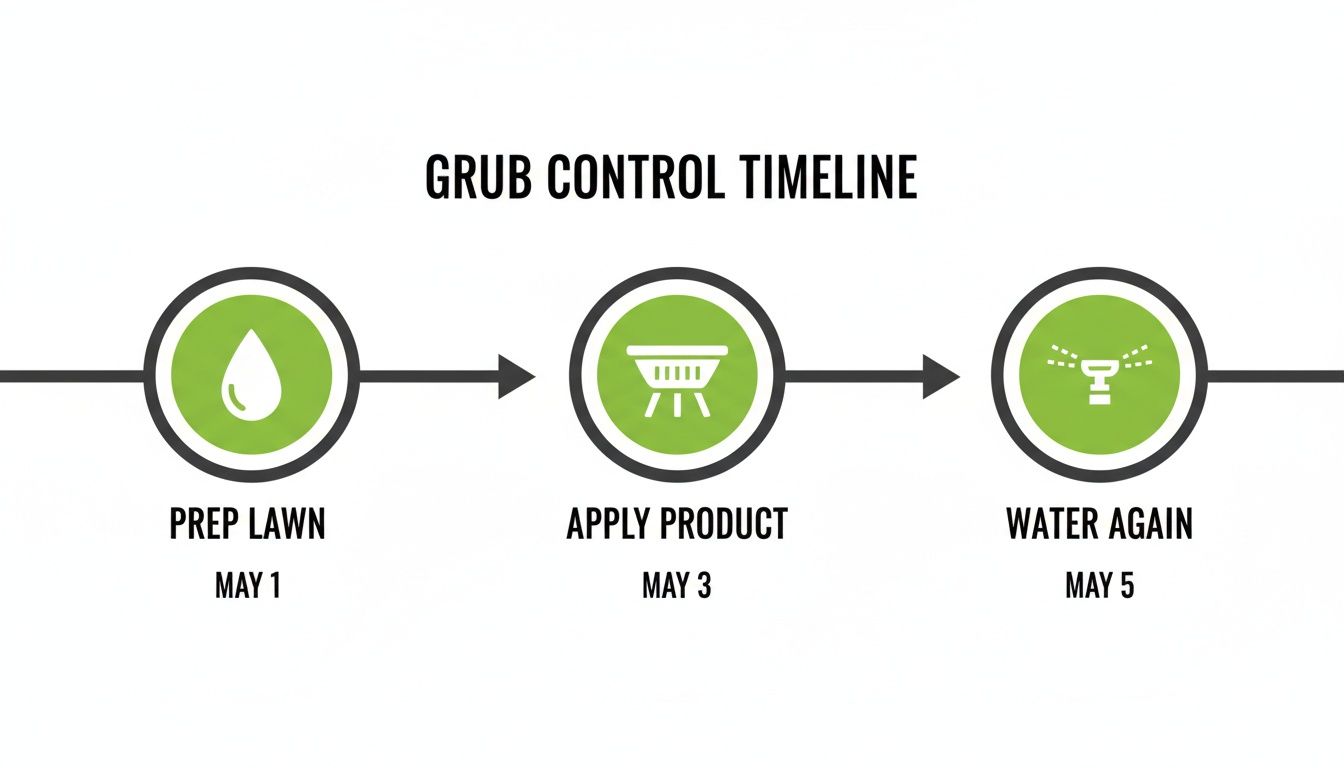
This simple visual breaks down the essential three-step sequence—prep, apply, and water—that ensures your natural treatments can actually reach the grubs in the soil. By following these proactive habits, you aren't just fighting grubs; you're building a fundamentally healthier, more self-sufficient lawn that will be the envy of your Milton or Alpharetta neighborhood.
Why North Georgia Families Trust Barefoot Organics
Choosing a lawn care partner here in North Georgia is about more than just getting rid of pests—it’s about trust. When homeowners from Milton to Cumming call us, they're looking for something more. They want a team that understands our local ecosystem and promises to keep their yards safe for kids, pets, and the pollinators buzzing through their gardens.
That's exactly where we come in. Our approach to wiping out grubs is rooted in that promise. We don’t just spray and pray.
We use professional-grade, fresh, high-quality beneficial nematodes—one of nature's most effective grub killers—and we time the application perfectly for the unique climate in places like Cumming and Johns Creek. It's not a one-off fix; it's a core part of a much bigger strategy.
An Integrated and Safe Approach
We fold our targeted grub treatments right into our holistic Natural Lawn Care Program. The whole point is to build incredibly healthy soil and a resilient lawn that can naturally fend off future problems. This focus on doing things the right way—safely and effectively—is why so many local families are making the switch to organic lawn care.
Choosing a natural grub killer isn't just a trend; it's part of a larger shift toward creating healthier home environments. Families are now actively seeking lawn care that protects their loved ones and our local ecosystem.
You can see this change happening everywhere. The global pest control market is projected to more than double, from $25.1 billion in 2024 to $51.2 billion by 2035. A huge driver of that growth is families right here in our own backyards—in suburbs across Forsyth and Cherokee counties—who are specifically searching for "organic" or "natural" lawn services. You can dig deeper into this shift in the global pest control market data.
Our mission has always been simple: give you a gorgeous, healthy lawn without the chemical worries. We'd love to show you the Barefoot Organics difference firsthand. Get a free quote today, and let's work together to create a beautiful, safe outdoor space your whole family can enjoy.
Your Questions About Natural Grub Control, Answered
If you're used to traditional lawn care in the Cumming or Alpharetta area, the idea of switching to a natural grub killer can feel like a leap of faith. The biggest question we hear is a simple one: Does this stuff actually work?
We get it. You want a solution that’s not just safe for your kids and pets, but one that genuinely protects your investment in your lawn. Let's tackle these common questions head-on with some straight-forward, expert answers.
Are Natural Grub Killers Really As Effective As Chemicals?
Yes, they absolutely are. The trick is understanding that they work differently—and in many ways, much smarter.
When applied correctly, especially during the right window of the grub life cycle, natural solutions like beneficial nematodes are remarkably effective. Think of them as microscopic predators. Instead of a chemical sitting on the surface, these organisms actively hunt down grubs in the soil, right where the problem starts.
While you might not see the instant "zap" you'd get from a harsh chemical, you're getting something far better in the long run. A natural grub killer builds a healthier, more resilient lawn ecosystem. It eliminates the target pest without wiping out the good bugs, earthworms, and microbes your Johns Creek garden needs to truly thrive. It’s a targeted strike, not a carpet bomb.
Expert Insight: The biggest mistake homeowners make is improper timing. Natural controls are living organisms, and applying them at the peak of grub vulnerability is the secret to their success. This is where professional experience makes a huge difference.
How Long Does It Take For Natural Treatments To Work?
Patience is part of the process, but you'll see results faster than you might think. The timeline really depends on the specific treatment used for your North Georgia lawn.
Here's what you can generally expect:
- Beneficial Nematodes: These guys are fast-acting. Once they're in the soil, they start hunting almost immediately. You can expect them to begin killing grubs within 24-48 hours, with a major drop in the grub population noticeable within a week or two.
- Milky Spore: This is the long game, a true investment in your lawn's future health. Milky Spore is a disease that only affects Japanese beetle grubs. It can take a couple of seasons to fully colonize the soil, but once established, it can keep working for 10 years or more.
Natural treatments aren't about a quick, temporary fix. They're about restoring your soil's natural defenses for lasting, sustainable grub control.
Ready to protect your lawn the safe and effective way? The team at Barefoot Organics has the local expertise to apply the right natural grub killer at the perfect time for your North Georgia lawn. Get your free, no-obligation quote today and see the difference for yourself.