

Staring out at a lawn overrun with crabgrass and nutsedge is a frustration every North Georgia homeowner can relate to. Getting rid of weeds for good isn't about a one-time fix; it's about combining smart prevention with the right actions at the right time. The goal is to build a thick, healthy lawn that naturally crowds out those unwanted invaders, and that requires a year-round game plan designed for our local warm-season grasses in places like Cumming, Johns Creek, and Dahlonega.
Winning the Weed War on Your Cumming, GA Lawn
For those of us in Cumming, Johns Creek, and Milton, a beautiful lawn is a point of pride, but keeping it that way often feels like a never-ending battle. Our humid summers and mild winters are practically a welcome mat for aggressive weeds. Whether you're dealing with sprawling patches of crabgrass in Alpharetta or that stubborn nutsedge that keeps popping up in Dahlonega, the fight is real and takes more than just yanking a few weeds here and there.
The secret to winning this war isn’t in a bottle of harsh chemicals. It's all about creating an environment where your grass—be it Bermuda, Zoysia, or another local favorite—is the undisputed king.
Think of it this way: a dense, thriving lawn is your best defense. It creates a thick canopy that leaves little to no room for weed seeds to get the sunlight and space they need to sprout.
It’s Time to Shift Your Lawn Care Mindset
So many of us fall into a reactive cycle. We see a weed, we pull it or spray it, and then we're surprised when more show up. This approach only treats the symptom, not the problem. A truly effective lawn care weed removal strategy flips the script entirely. It’s about building a robust lawn from the soil up.
This means focusing on a few key areas:
- Healthy Soil: Weeds are often nature's way of telling you something is wrong with your soil. It could be compacted, or maybe it's lacking key nutrients. Fixing the soil is the first real step toward getting rid of weeds for the long haul.
- Proactive Prevention: In our region, timing your pre-emergent applications is everything. Getting that protective barrier down before weed seeds start to germinate saves you a world of headache later in the season.
- Smart Lawn Habits: How you mow, water, and fertilize has a huge impact on your lawn's natural defenses. Small tweaks to your routine can make a massive difference in keeping weeds at bay.
Here in Forsyth County and the surrounding areas, the single most powerful weed control tool you have is a thick, healthy stand of grass. When your turf is strong, it outcompetes weeds for sunlight, water, and nutrients. It does the hard work for you.
This guide is designed to cut through the noise and give you practical, actionable advice that works right here in North Georgia. We'll get into the core principles of building rich soil for a beautiful lawn that's safe for your family and pets. From identifying the most common local weeds to timing your treatments perfectly, consider this your roadmap to the lush, green lawn you’ve been wanting.
Identifying Common Weeds in North Georgia
Before you can win the war on weeds, you have to know your enemy. Effective weed removal isn’t about just spraying everything in sight; it's about smart, targeted action. From the lawns of Cumming to the backyards of Milton and Alpharetta, a handful of specific intruders cause most of the problems. Treating them all the same is a surefire way to get frustrated.
The first step is understanding how these weeds live. This one piece of knowledge changes your entire game plan.
-
Annual Weeds: These guys live fast and die young, completing their whole life cycle in a single year. Summer annuals, like the infamous crabgrass, show up in spring and die off with the first frost. Winter annuals, like henbit and chickweed, sprout in the fall and disappear once the summer heat kicks in.
-
Perennial Weeds: These are the stubborn ones that stick around for two or more years. They have deep, tough root systems that let them survive the winter and come back with a vengeance. Dallisgrass and nutsedge are two of the worst offenders we see around here.
Knowing this tells you when to fight. You can't control a summer annual in the fall—it's already on its way out. And if you just pull the top of a perennial, you're guaranteeing it'll be back.
North Georgia's Most Unwanted Weeds
To help you get a handle on what’s popping up in your yard, here's a quick-reference guide to the most common weeds we battle in Forsyth, Gwinnett, and surrounding counties. Being able to spot the difference is the first step toward reclaiming your turf.
| Weed Name | Type (Grassy/Broadleaf) | Key Identifying Features | Peak Season |
|---|---|---|---|
| Crabgrass | Grassy (Annual) | Coarse, light-green blades; grows low, spreading out from a central point. | Summer |
| Nutsedge | Grassy (Perennial) | Shiny, V-shaped leaves; triangular stem (not round); grows faster than turf. | Summer |
| Dollarweed | Broadleaf (Perennial) | Round, bright green leaves the size of a silver dollar; loves wet soil. | Summer |
| Henbit | Broadleaf (Annual) | Hairy, scalloped leaves on a square stem; small purple flowers. | Winter/Spring |
| Dallisgrass | Grassy (Perennial) | Clump-forming with coarse, wide blades and a distinct black seed head. | Summer |
| Chickweed | Broadleaf (Annual) | Small, egg-shaped leaves in pairs; small white, star-like flowers. | Winter/Spring |
This table is a great starting point, but every lawn is a little different. The key is to pay attention to the details—the shape of the leaf, the feel of the stem, and the time of year it appears.
A Closer Look at the Main Culprits
Let's put a face to the name for a few of the most persistent invaders you'll encounter.
Crabgrass (Digitaria spp.)
This is the classic summer annual grassy weed. Crabgrass absolutely loves heat and sun, and it's an expert at finding any thin or bare spots in your lawn. You'll recognize it by its rough, light-green blades that sprawl out from a center point, almost like a crab's legs. If you don't get a handle on it early, it can form huge, ugly patches by mid-summer.
Nutsedge (Cyperus spp.)
People mistake this for grass all the time, but it’s a stubborn perennial that gives itself away with its shiny, almost plastic-looking leaves and breakneck growth speed. The dead giveaway? Roll the stem between your fingers—it's triangular, not round like grass. It spreads through underground tubers called "nutlets," which is why simply pulling it often makes the problem worse. If you see a lot of nutsedge, it's a good sign you might have drainage issues.
For a deeper dive into these and other local troublemakers, this comprehensive guide on the most common weeds in Georgia is an excellent resource for homeowners in our area.
A healthy lawn is truly your best defense, and this graphic breaks down the core principles.
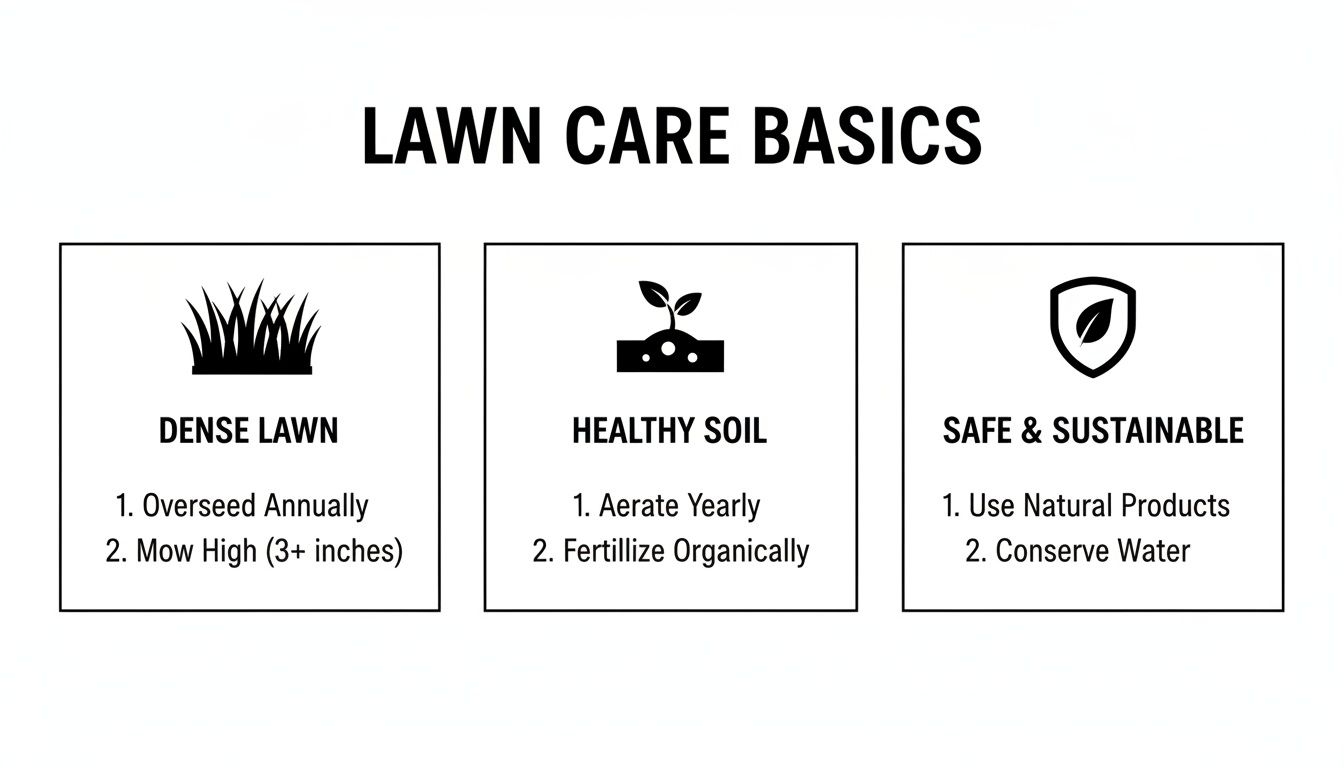
It all comes back to a simple truth: dense turf, healthy soil, and smart lawn care practices are the best way to keep weeds from ever getting a foothold.
More Broadleaf Bullies to Watch For
It's not just the grassy weeds you have to worry about. Several broadleaf plants are common sights in lawns from Milton to Dahlonega, and they're usually easier to spot since they look nothing like your turf.
Dollarweed (Hydrocotyle spp.)
This perennial gets its name from its round, shiny green leaves that are about the size of a silver dollar. Dollarweed is a water-lover, so if you see it, you’re almost certainly overwatering or have poor drainage. It spreads aggressively with underground stems, forming thick mats that can easily choke out your grass.
Henbit (Lamium amplexicaule)
A classic winter annual, henbit is one of the first weeds you’ll see pop up in late winter or early spring, especially in dormant Bermuda or Zoysia lawns. Look for its distinct square stems, hairy leaves with rounded edges, and small, trumpet-shaped purple flowers.
The bottom line is this: figuring out what weed you have is more than half the battle won. It tells you whether you need to stop an annual like crabgrass with a pre-emergent, or if you need a specialized, systemic product to kill a persistent perennial like nutsedge all the way down to its roots.
Effective Weed Removal Techniques for Your Lawn
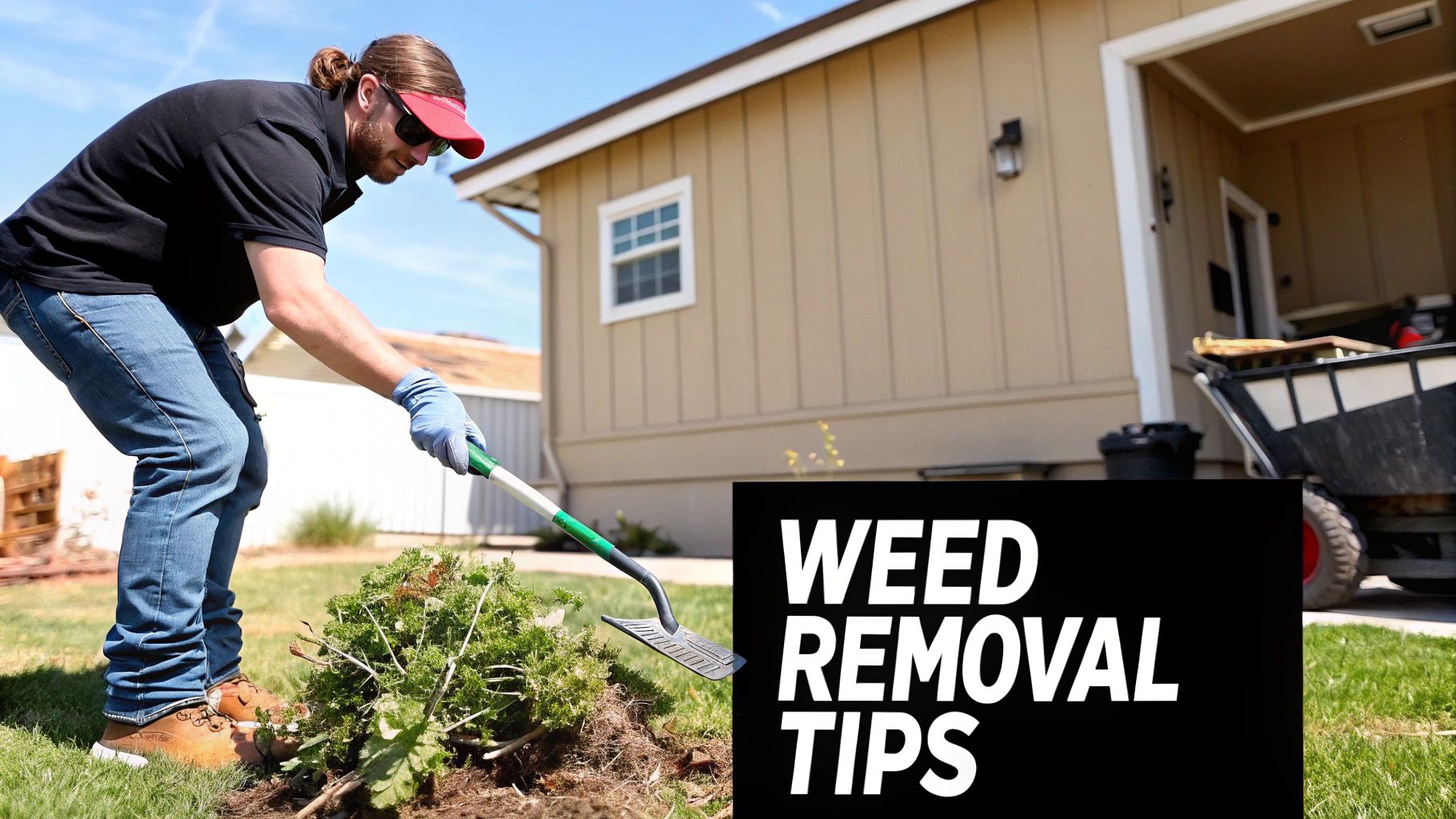
Alright, so now that you can tell the difference between crabgrass and nutsedge on your Johns Creek property, it's time to roll up our sleeves and talk about getting them out. The best way to tackle weeds really depends on what you're dealing with, how bad the infestation is, and frankly, how you prefer to handle your lawn.
From my experience, a multi-layered strategy always beats relying on just one trick. You'll get the best results by combining some good old-fashioned manual effort with smart, timely product applications. Let's dig into the techniques that will get your turf in Cumming back on track.
The Art of Manual Weed Removal
Sometimes, the simplest tools are the most effective. For a few scattered broadleaf weeds like dandelions or dollarweed, your own two hands can be the best solution. But there’s a real technique to it.
If you just yank the top off a perennial weed, you're essentially just giving it a haircut. It’ll be back, and probably with a vengeance.
The secret is getting the entire root system. For stubborn weeds with a deep taproot (dandelions are the classic example), a specialized weeding tool is your best friend. I recommend a stand-up weeder or a simple forked-end tool that lets you get deep into the soil and pry the whole root loose.
- Timing is Everything: The absolute best time to pull weeds is right after a good rain. The soil is soft and moist, making it so much easier to slide the entire root out without it snapping off underground.
- Fill the Void: When you pull a weed, you leave behind a small patch of bare earth. That's a welcome mat for the next weed seed that blows by. Have a small bucket of topsoil and grass seed ready to fill in the hole immediately. This helps your turf reclaim the territory before anything else can.
Hand-pulling is a fantastic, completely organic first line of defense for minor issues. But let’s be realistic—if your Alpharetta lawn is facing a total crabgrass takeover, you’re going to need to bring in the bigger guns.
Pre-Emergent vs. Post-Emergent Herbicides
Understanding the difference between these two products is the cornerstone of successful lawn care weed removal here in North Georgia. They have completely different jobs and are used at totally different times of the year.
Pre-emergent herbicides are all about prevention. They work by creating a barrier at the soil's surface that stops weed seeds from germinating in the first place. Think of it as putting up a "do not enter" sign for seeds. The key thing to remember is that they do absolutely nothing to weeds that are already up and growing.
The golden rule for lawns in Milton and Cumming is to get your pre-emergent down before the soil temperature consistently hits 55°F. That's the magic number when crabgrass and other summer annuals start to wake up and sprout.
Post-emergent herbicides, on the other hand, are reactive. You use these to kill weeds that you can already see growing in your lawn. It is critical to choose the right post-emergent for both the specific weed you're fighting and your grass type, or you could end up damaging your lawn.
The Right Timing for Bermuda and Zoysia Lawns
For our popular warm-season grasses like Bermuda and Zoysia, timing is everything. A proactive schedule is the key to keeping weeds at bay. Here’s a general calendar I recommend for homeowners in our area:
- Late Winter/Early Spring (February-March): This is the most important application of the year. Get your first pre-emergent down to stop summer annuals like crabgrass before they even start.
- Late Spring/Early Summer (May-June): A second, lighter pre-emergent application can extend that protective barrier through the hottest months. This is also the time you'll be spot-treating any broadleaf weeds that snuck through with a post-emergent.
- Fall (September-October): Don't forget this one! Another pre-emergent application now is vital for targeting winter annuals like henbit and chickweed. This stops them from taking over your lawn while it's dormant.
Following this kind of schedule means you're stopping most weeds before you ever see them, which drastically cuts down on how much reactive spraying you'll have to do later.
Choosing Natural and Eco-Friendly Options
More and more homeowners are looking for safer, more natural ways to manage weeds, which is a fantastic trend. While hand-pulling is as organic as it gets, there are some natural spot treatments that can help with small-scale problems. For a deeper dive, our guide on natural weed control methods has some great advice.
It's important to understand the limitations, though. Things like horticultural vinegar can burn the tops of weeds, but it's non-selective (meaning it will harm your grass, too) and often won't kill the deep roots of tough perennials. These methods are usually best for weeds popping up in driveway cracks or mulch beds, away from your turf.
The professional lawn care world is also adapting. Weed control and fertilization are huge parts of the industry, and with the U.S. lawn care market projected to hit USD 77 billion by 2030, there's a major push for effective, natural solutions. For homeowners in Cumming and Johns Creek, this is great news. It means more access to professional, eco-friendly services that protect your family, your soil, and the local ecosystem.
The Best Defense is a Good Offense: Building a Weed-Proof Lawn

If you really want to win the war on weeds, you have to stop thinking about just killing them. The real secret is to make your lawn a place they simply can't survive. A thick, healthy stand of grass is the best weed control there is, creating a dense canopy that starves weeds of the sunlight and nutrients they need to get started.
Shifting your mindset from reactive weed killing to proactive lawn strengthening is a total game-changer for homeowners from Cumming to Alpharetta. You're essentially building a fortress where your grass is the impenetrable wall, and every smart care practice reinforces its defenses.
It All Starts with How You Mow
Your mowing habits have a massive impact on your lawn's ability to fight off invaders. It's so much more than just keeping the yard looking tidy; it's a core part of cultivating strength from the ground up.
For the warm-season grasses we have here in North Georgia, like Bermuda and Zoysia, mowing height is everything. I always tell my clients to keep the grass a little taller—usually in the 2 to 3-inch range. This encourages the roots to grow deeper, making the whole plant more resilient. Taller blades also mean more surface area for photosynthesis, which fuels a stronger lawn that can easily outcompete weeds.
Here's a simple rule of thumb I live by: never cut more than one-third of the grass blade in a single mowing. Following this "one-third rule" prevents you from stressing the grass, which can weaken it and roll out the welcome mat for opportunistic weeds.
Also, check your mower blades. Seriously. Dull blades don't cut the grass; they tear and shred it. This leaves ragged edges that are vulnerable to disease and stress. A sharp blade makes a clean, precise cut, allowing the grass to heal quickly and focus its energy on growing strong.
Water Smarter, Not Harder
When it comes to watering your lawn in Milton or Johns Creek, it's not about how often you water, but how deeply. One of the biggest mistakes I see is light, daily sprinkling. All that does is encourage shallow root systems and create a damp, humid surface perfect for weeds like dollarweed to thrive.
The key is deep, infrequent watering. Give your lawn a good, long soak once or twice a week. This forces the turf's roots to dig deeper into the soil searching for moisture, building a much more drought-tolerant lawn that can handle our hot Georgia summers and crowd out those shallow-rooted weeds.
Feed the Lawn, Not the Weeds
Fertilizer is crucial, but it has to be the right kind at the right time. Dousing your lawn with high-nitrogen fertilizer, especially at the wrong time of year, can trigger a weed explosion. Your goal should be to provide a slow, steady supply of nutrients that builds a strong, resilient turf.
A well-formulated, natural fertilizer program designed for your specific soil and grass type gives your lawn exactly what it needs to get thick and vigorous, leaving very little room for weeds to sneak in.
- Test Your Soil: Don't guess what your soil needs. A soil test tells you exactly what's missing so you're not wasting money or addressing the wrong problem.
- Go for Slow-Release: Choose products that release nutrients gradually. This provides a consistent food source for your grass instead of a quick, unsustainable burst of growth.
- Timing is Key: Always fertilize when your grass is actively growing. This ensures the nutrients are actually absorbed by the turf, not the weeds.
The Foundation: Aeration and Topdressing
Over time, our dense Georgia clay soil gets packed down and compacted, especially in areas where the kids and pets play. Compacted soil chokes off the flow of air, water, and nutrients to the grassroots, leading to a stressed-out lawn that is prime real estate for tough weeds.
Core aeration is your best friend here. The process of pulling small plugs of soil out of the ground physically breaks up that compaction and lets the root zone breathe again. It's one of the single most effective things you can do to improve the health and density of your lawn.
Following up aeration with topdressing—spreading a thin layer of rich compost or organic matter—is like a one-two punch for lawn health. This adds vital organic material back into the ground, improves soil structure, and helps it hold onto moisture better. For a deeper dive, our guide on how to improve soil is a great resource.
By making these smart cultural practices a regular part of your routine, you stop fighting a defensive battle against weeds. Instead, you build a resilient, thriving ecosystem where your lawn is the undisputed champion.
When Your Weed Problem Needs a Professional
Let's be honest. Even with the best intentions and a garage full of products, some weed problems are just plain stubborn. You can spend every weekend on your hands and knees pulling invaders or spraying treatments, only to watch them pop right back up. Knowing when to wave the white flag and call in a professional is a huge part of smart lawn care weed removal—it can save you a ton of time, money, and frustration down the road.
If you feel like you're in a constant, losing battle, that's a pretty clear sign your lawn needs an expert eye. A professional lawn care service can dig deeper to diagnose the root cause, like severe soil compaction or a major nutrient imbalance that’s basically rolling out the welcome mat for weeds on your Cumming property.
Recognizing the Signs It's Time for an Expert
Sometimes, the problem is bigger than a few stray dandelions. It's a full-blown infestation that your current weekend warrior strategy just can't touch. For homeowners here in Alpharetta, Milton, and our surrounding communities, a few key signals mean it’s time to bring in the pros.
- The Weeds Are Winning: If it feels like more than 30% of your lawn is weeds, not grass, it's time for a new game plan. The same goes if you’re fighting the exact same weeds, year after year, with no real progress.
- You're Dealing with Superweeds: Certain perennial weeds—I'm looking at you, nutsedge, dallisgrass, and wild violet—have ridiculously tough root systems. The stuff you buy at the big-box store often just burns their leaves off, leaving the roots intact to sprout again. Professionals have access to specialized treatments and know the precise timing needed to knock them out for good.
- Your Grass Is Thin and Struggling: A weak, patchy lawn is an open invitation for weeds. If your turf lacks the dense, healthy growth needed to naturally crowd out intruders, you're fighting an uphill battle. A pro can put together a holistic plan involving aeration, topdressing, and targeted fertilization to rebuild your lawn from the soil up.
When your own efforts stop making a dent, it's almost always more cost-effective and efficient to bring in a specialist. They create a custom plan that tackles the reason you have weeds, not just the weeds you can see.
The Value of Professional Lawn Care Services
Calling a professional is about so much more than just having someone spray your weeds. You're tapping into a deep well of local knowledge, getting access to better products, and implementing a real strategy designed specifically for your North Georgia lawn. Experts get the unique challenges our red clay soil and humid climate present.
They bring a level of precision that’s almost impossible to replicate on your own. This isn’t just guesswork; we’re talking about detailed soil analysis to pinpoint nutrient gaps, access to professional-grade organic products that work better and are safe for your family, and a customized application schedule that targets weeds when they're most vulnerable.
It's a growing field for a reason. The U.S. lawn care market is expanding, and southern regions like ours make up a huge 39% of that market. This just goes to show how much homeowners value professional, sustainable lawn care that delivers real, lasting results. You can read more about what’s driving this trend in this in-depth industry analysis on imarcgroup.com.
Ultimately, partnering with a professional service in the Dahlonega or Johns Creek area is an investment. It's an investment in your property's health, its curb appeal, and frankly, your own peace of mind. You get to reclaim your weekends and simply enjoy a beautiful, weed-free lawn.
Answering Your Top North Georgia Weed Control Questions
Even with the best game plan, questions are bound to pop up. When you're out in your yard, it's easy to second-guess your timing or methods. Let's tackle some of the most common questions we hear from homeowners across Cumming, Dahlonega, and the surrounding areas about lawn care and weed removal.
When Is the Absolute Best Time to Apply Pre-Emergent?
This is a fantastic question, and the answer comes down to one thing: soil temperature. You're trying to get that protective barrier down before weed seeds have a chance to wake up and germinate. For stubborn summer annuals like crabgrass, the magic number is 55°F.
Here in North Georgia, the soil usually hits that temperature sometime between late February and mid-March. A great natural cue I always look for is when the dogwood trees start showing their first blooms. If you miss that window, don't panic, but getting it down before the soil consistently stays at 55°F gives you the best shot at a weed-free summer.
Why Do Weeds Keep Coming Back in the Same Spots?
It's frustrating, isn't it? If you have weeds that just love one particular spot, it's almost always a sign of an underlying soil problem. That area is likely suffering from heavy compaction, poor drainage, or a lack of key nutrients. Weeds are opportunists; they'll set up shop wherever your turf is struggling to survive.
So, instead of just zapping the weed, you've got to fix the environment it loves. For our heavy clay soil in places like Alpharetta and Milton, core aeration is an absolute game-changer. It loosens up that compacted ground, letting air, water, and nutrients finally get down to the grassroots. This helps your turf get strong enough to muscle out the intruders for good.
The weeds you see are often just symptoms of a deeper problem. Address the soil health—compaction, pH, nutrient levels—and you'll find that your grass will start to win the battle on its own.
Will Pulling Weeds by Hand Actually Make It Worse?
This really depends on what you're pulling. For shallow-rooted annuals like chickweed or a young crabgrass plant, hand-pulling is a great strategy, especially after a good rain when the soil is soft. The trick is to make sure you get the entire root.
But for aggressive perennial weeds like nutsedge, pulling them can backfire spectacularly. Nutsedge spreads through little underground tubers called "nutlets." When you yank the plant, you often leave these nutlets behind, and the disturbance actually signals them to sprout. That's why you can pull one nutsedge plant and have three pop up in its place a week later. For weeds like that, a targeted, systemic post-emergent herbicide is a much smarter approach.
Can I Reseed My Lawn and Use Weed Control at the Same Time?
This is a tricky situation. The vast majority of pre-emergent herbicides are non-selective, which means they're just as good at stopping grass seed from sprouting as they are at stopping weed seeds. You absolutely cannot put down seed and a standard pre-emergent at the same time.
If you're trying to overseed some bare patches in your Bermuda or Zoysia lawn, you have to be patient. As a rule of thumb, you'll need to wait at least 8-10 weeks after a pre-emergent application before you can even think about seeding.
For our warm-season grasses, the best strategy is usually to focus on making the existing turf thicker and healthier through proper fertilization, aeration, and smart mowing. This encourages the grass to spread and fill in those thin spots all on its own.
Ready to stop guessing and start enjoying a beautiful, healthy lawn? The team at Barefoot Organics has the local knowledge and natural solutions to create a customized plan for your property. We tackle the root cause of your weed problems to deliver lasting results you can feel good about. Get your free, no-obligation quote today and see the difference a professional, eco-friendly approach can make. Visit us at https://barefootorganicsllc.com to learn more.