

It’s a feeling every homeowner in Cumming, GA knows all too well. You step outside with your morning coffee, ready to admire your hard work, only to find your prize-winning hostas chewed down to sad-looking stems. What was once a source of pride has become a 24/7 all-you-can-eat buffet for the local deer population. If you’re tired of seeing your landscape investment get eaten overnight, Barefoot Organics can help. Our lawn health programs create a strong foundation that makes your entire yard less inviting to pests.
The frustrating truth is that a hungry deer isn't picky, and in Forsyth County, they are a constant presence. This turns what might seem like a small nuisance into a very real threat to the time, money, and effort you've invested in your landscape. Protecting it isn't about finding one magic bullet; it's about building a smart, layered defense that works for our local North Georgia climate.
Ready to protect your landscape? Call Barefoot Organics today for a free lawn evaluation and start building a stronger, more resilient yard.
Why Deer are a Major Problem for Cumming Lawns
Waking up to a garden raid is a uniquely disheartening experience for any Forsyth County homeowner. That beautiful row of tulips you planted last fall? Gone. The vegetable patch you were so excited about? Trampled and nibbled. It’s not just your imagination—the problem is getting worse across Cumming and surrounding areas like Johns Creek and Alpharetta.
What used to be a rare, almost charming, sighting of a deer at the edge of the woods has become a daily battle in neighborhoods from Milton all the way to Dawsonville. As our North Georgia communities grow, we're building homes deeper into their territory. They are no longer just woodland creatures; they're our neighbors, and they’ve developed a serious taste for the expensive, cultivated plants in our yards.
A Growing Problem Across North Georgia
This isn't just an annoyance; it's a direct assault on your property. When you add up the cost of replacing hydrangeas, azaleas, and other favorites, the financial hit can be significant, especially if you're trying to meet subdivision HOA standards. More than that, there's the emotional toll of seeing your beautiful sanctuary destroyed overnight. You are definitely not alone in this fight.
The deer population crisis affecting North American homeowners has reached unprecedented levels, with current estimates indicating more than 20 million white-tailed deer inhabiting the United States. State Farm Insurance paid $3.8 billion in a single year for deer damage claims alone.
For those of us in areas like Johns Creek and Suwanee, this means our gardens are under constant pressure. To learn more about this trend, you can find some great insights about the rising deer population and its impact on homeowners.
In this guide, we're skipping the generic advice and focusing on practical, locally-tested solutions that actually work in our Georgia climate. We’ll get into everything you need to reclaim your yard, from physical barriers that can handle our red clay soil to deer-resistant plants that can take the summer heat. Whether you're in a new build in Canton or an established neighborhood in Alpharetta, these are the strategies that will help you finally keep deer out of your garden for good.
The Treatment Breakdown: Creating a Deer-Resistant Yard
Let’s be honest: while repellents and deer-resistant plants can certainly help, they’re often just a temporary truce in the ongoing battle for your garden. If you’re serious about protecting your landscape investment, a physical barrier is the only truly reliable solution.
In Forsyth County, installing a fence means more than just sinking posts. You're dealing with our signature red Georgia clay soil and hilly terrain, so the structure has to be solid. But most importantly, it has to be built to a standard that a determined white-tailed deer can't beat.
When you're up against deer, height is the name of the game. A standard 4- or 6-foot fence is little more than a minor hurdle for a deer with its eye on your prized hostas or tulips.
The absolute, non-negotiable minimum height for an effective deer fence is 8 feet. I've seen it time and time again—anything shorter is a gamble, and in areas with heavy deer pressure like Alpharetta and Milton, it’s a gamble you’ll almost always lose.
Feeling overwhelmed? This little decision guide can help you figure out where to start.
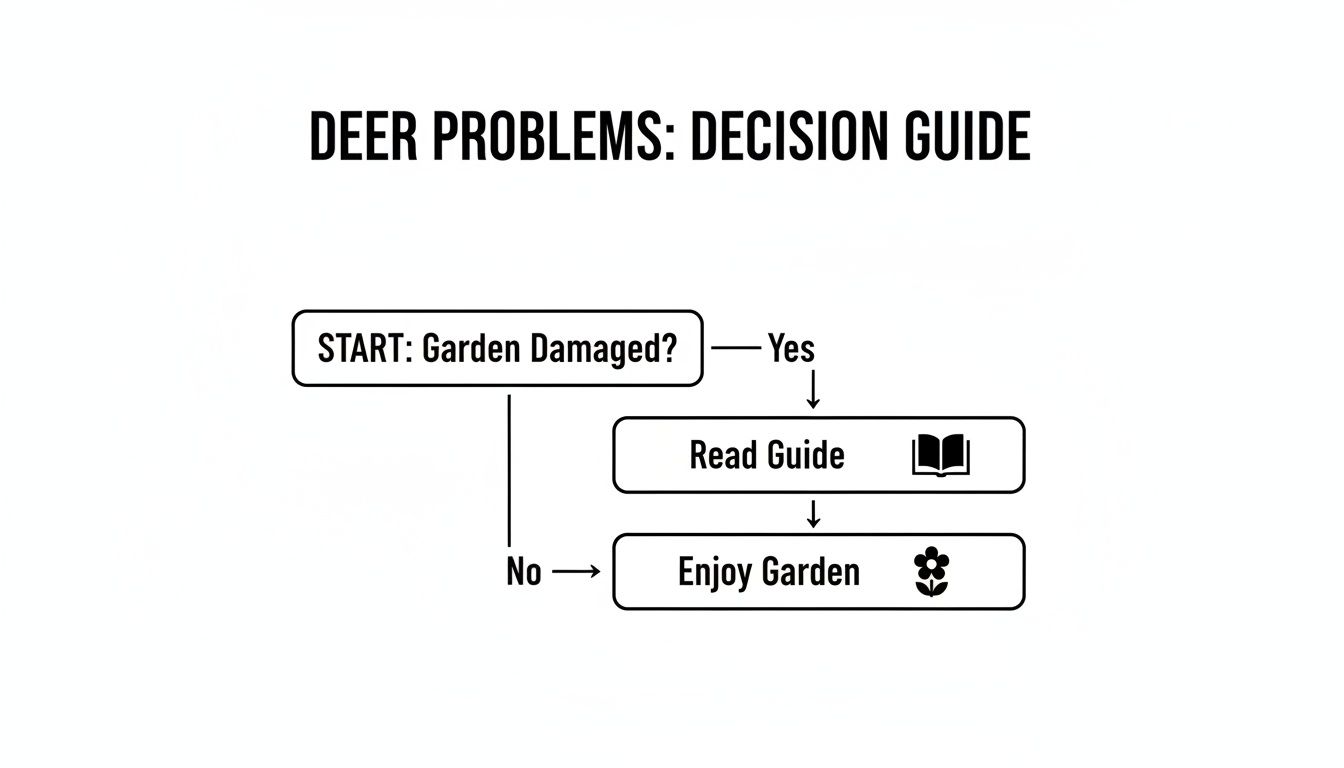
Comparing Deer Fencing Options for Cumming, GA Homes
The right fence for your Cumming property really comes down to a few key factors: your budget, the look you’re going for, and any HOA rules you might have to navigate. There are a few go-to options we see work best in our area.
Here’s a quick breakdown of the most common choices to help you decide.
| Fence Type | Effectiveness | Estimated Cost | Best For |
|---|---|---|---|
| Polypropylene Mesh | Excellent | $$ – $$$ | Large properties or preserving views; it's strong and nearly invisible. |
| 8-Foot Wood Privacy | Excellent | $$$ – $$$$ | Homeowners needing privacy and security; often pre-approved by HOAs. |
| Woven Wire / Metal | Excellent | $$ – $$$$ | Maximum durability and security, especially for a more agricultural aesthetic. |
Each of these can be a fantastic solution, but the "best" one is the one that fits your yard and your life. Let's look a little closer at what makes each one tick.
A Closer Look at Your Fencing Choices
Polypropylene Mesh Fencing: This is my top recommendation for garden protection specifically. It's incredibly strong but almost disappears into the landscape from a short distance, so you don't lose your beautiful view. It’s a perfect fit for larger properties in places like Dawsonville or Canton where you want protection without feeling boxed in.
Wooden Privacy Fencing: If privacy is your main goal anyway, upgrading to an 8-foot solid wood fence kills two birds with one stone. It will absolutely keep deer out, as long as you make sure there are no gaps underneath for them to squeeze through. This is a very popular, and usually HOA-friendly, choice throughout Forsyth County.
Woven Wire or Metal Fencing: For a more rustic look or just pure, brute-force durability, you can't beat woven wire. If you want something that's both tough and relatively easy on the wallet, quality chain link fencing is another great way to secure the perimeter of your garden.
What If a Full Fence Isn't an Option?
An 8-foot perimeter fence just isn't practical for every yard, especially in denser neighborhoods like Buford or Sugar Hill, or if you only need to protect one specific area. Don't worry, you still have great options.
Think targeted. Individual plant cages made of wire mesh are perfect for shielding vulnerable shrubs and young trees until they're established. For a vegetable patch, you can build a smaller, dedicated enclosure or use floating row covers suspended on hoops. These smaller-scale tactics are much more budget-friendly and allow you to protect your most precious plants without turning your entire yard into a fortress.
Don't let deer ruin your hard work. Protect your lawn and garden by calling Barefoot Organics for a free evaluation and learn about our organic-based programs.
The Application Process: Using Repellents and Scare Tactics in Georgia's Climate
So, a full-scale fence isn't in the cards for your Cumming yard. That’s perfectly fine. Repellents and scare tactics can be your next best bet, but there’s a catch when you're gardening in North Georgia. Our notorious high summer humidity and sudden downpours can wash away your efforts in minutes. Knowing how to work with our climate, not against it, is the secret to saving your plants (and your sanity).
Scent-Based vs. Taste-Based Repellents
Not all repellents are created equal. They generally work in one of two ways, and knowing when to use each is crucial for anyone gardening in places like Cumming or Johns Creek.
Scent-Based Repellents: These products smell bad—at least to a deer. Think coyote urine or putrescent egg solids. The goal is to create a "bubble of fear" around your prized plants, making deer too jumpy to stick around and munch. The downside? That smell fades fast, especially after one of our classic Forsyth County deluges.
Taste-Based Repellents: Instead of smelling bad, these make your plants taste awful. Ingredients like capsaicin (the stuff that makes hot peppers hot) give deer a nasty surprise without hurting the plant. After a few unpleasant bites, they learn that your garden isn't the all-you-can-eat buffet they thought it was.
Here’s the most important piece of advice I can give you: rotation is everything. Deer are smart. If you use the same repellent all season, they’ll get used to it and start ignoring it. We always tell our clients in Cumming to switch between a scent-based and a taste-based product every few weeks to keep the deer guessing.
Making Repellents Work in the Cumming Climate
I’ve seen countless homeowners in Alpharetta and Suwanee get frustrated after spraying a repellent once and expecting it to last for months. In our weather, that’s just not realistic.
With spray repellents, you have to reapply them after every decent rainstorm. A good personal rule is to get back out there after any storm that drops more than a half an inch of rain. Always try to spray on a dry, calm day so the product has a chance to stick to the leaves.
If that sounds like too much work, you might have better luck with granular repellents. You just shake them on the ground around the plants you’re trying to protect. They hold up much better against rain and release their scent slowly, which is a huge plus during our wet seasons. Even then, you’ll want to reapply them every 4-6 weeks for consistent protection.
And if you have pets and kids, make sure you're choosing products that are safe for them. We specialize in pet-safe lawn treatments that keep your yard healthy without conflicting with your deer-proofing strategy.
Do Scare Tactics Actually Work?
Yes, they can work surprisingly well—but only if you keep things unpredictable. A scarecrow that never moves or a few shiny pie tins will become part of the landscape to a deer in just a few days. The trick is to use deterrents that are dynamic.
Motion-activated sprinklers are my personal favorite. A deer wanders too close, gets a startling blast of water, and learns very quickly to stay away from that area. Ultrasonic devices that let out a high-frequency noise (that we can’t hear) when they detect motion can also be effective. The key with both of these is to move them around the garden every week or so. This prevents deer from just figuring out a "safe" route to bypass the device.
Landscaping with Deer-Resistant Plants in Cumming
While fences are a great defense and repellents have their place, one of the most effective long-term strategies is to work smarter, not harder. This means landscaping with plants that deer simply don't want to eat. It’s not about giving up on a beautiful garden; it's about making clever choices that turn your yard from an all-you-can-eat buffet into a place they’ll just pass by.
We're not just talking about any plants, but ones that can stand up to our unique conditions here in Cumming.
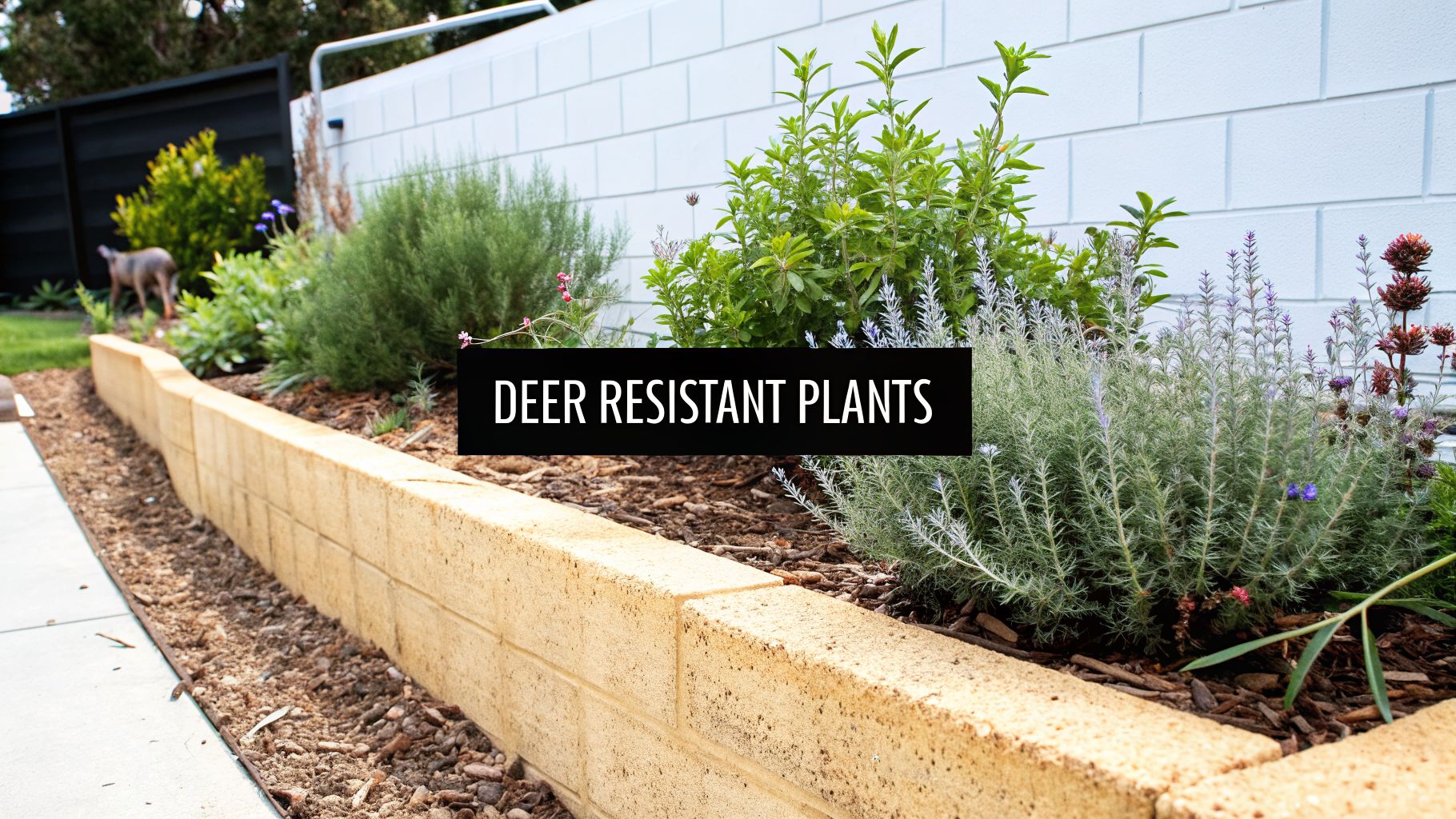
The secret is to get inside a deer’s head. They choose what to eat based on scent, texture, and taste. Anything with fuzzy leaves, a powerful fragrance, or spiky thorns is usually the last thing they’ll try.
Building Your Deer-Resistant Plant Palette for Cumming
For anyone gardening in Forsyth County, the real challenge is finding plants that can handle both our determined deer and our tough climate. You need plants that won't give up during a 90+ degree August afternoon and can actually grow in our signature Georgia clay soil.
Here’s what I’ve found works best for gardens in Cumming, Alpharetta, or Milton:
Plants with Strong Aromas: Deer have incredibly sensitive noses, which we can use against them. Planting aromatic herbs like Rosemary, Lavender, and Thyme around the edges of your garden beds creates a fragrant barrier they hate. The same goes for ornamentals like Marigolds and Scented Geraniums—their smell is a powerful deterrent.
Plants with Fuzzy or Fibrous Leaves: It all comes down to mouthfeel. A plant with a weird texture is often enough to make a deer move on. Think about the fuzzy, soft leaves of Lamb's Ear or the tough, fibrous foliage of a Yucca. Most ornamental grasses also fall into this category and are fantastic, low-maintenance choices.
Thorny and Prickly Plants: This one is pretty straightforward—no one likes getting poked in the face while trying to eat. Thorny shrubs like Barberry and Holly can form a formidable, living fence around the more delicate plants you want to protect.
Choosing the right plants does more than just protect your garden; it supports local ecology. Research shows white-tailed deer often prefer to eat native plants over invasive ones, which can harm our local plant diversity. By selecting deer-resistant species, you not only save your garden but also help protect North Georgia's natural environment. You can learn more about how deer eating habits impact forest health from recent studies.
Plants to Avoid in High-Pressure Areas
Knowing what not to plant is just as crucial as knowing what to plant. This is especially true if your property in Johns Creek or Suwanee sits right on a "deer highway"—a path they use every single day. Some plants are pure candy to them and will draw them in no matter what else you have in the yard.
Unfortunately, this list includes some of our most beloved Southern classics. Hostas, Daylilies, and Tulips are practically a guaranteed deer magnet. Many popular varieties of Hydrangeas and Azaleas are also at the very top of their favorite foods list.
If you can't live without them, you'll have to commit to a solid fence or a very consistent repellent schedule. A much easier approach? Swap them for less-tasty alternatives that give you a similar aesthetic without the constant battle.
Why Choose Barefoot Organics in Cumming
When you're trying to stop deer from eating your garden, it's easy to focus solely on the flower beds and veggie patches. But we often forget about the biggest part of our landscape: the lawn itself. A thin, weed-filled lawn is an open invitation for deer to wander right up to your home, using it as a path to your prized plants.
At Barefoot Organics, we're not a big corporate chain. We're a local Cumming business owned by folks who live and work right here in Forsyth County. Our entire philosophy is built on the idea that a healthy landscape starts from the soil up. A thick, vibrant lawn is more than just pretty—it’s a less inviting environment for all sorts of pests, including deer.
For those of us in Cumming, Alpharetta, and across Forsyth County, keeping a lawn healthy is a year-round job. A stressed Fescue lawn baking in the 90+ degree summer heat or a Bermuda lawn full of crabgrass isn't just an eyesore; it creates weak points that critters can easily exploit. Our organic-based lawn care programs are designed specifically for the challenges we face in North Georgia, from our heavy red clay soil to our intense summer heat and crabgrass season.
We focus on building deep, strong root systems that help your Fescue survive the summer and your Bermuda choke out weeds. The result is a lawn that's naturally more resilient. Protecting your landscape is about more than just spraying repellents on your hydrangeas. It’s about cultivating the health of your entire property. A robust lawn is your first and most foundational layer of defense.
If you’re curious about our soil-first approach to lawn health near me, you might find our guide to natural pest control for lawns helpful. Working with a local expert who truly understands our unique climate is the key to a landscape that thrives from the turf all the way to the treetops.
Cumming, GA Deer-Proofing FAQ
After years of helping folks in Cumming and all over North Georgia, we've heard just about every question you can imagine when it comes to keeping deer out of the garden. Here are the questions we get most often from your neighbors, along with some practical, no-nonsense answers based on our experience in Forsyth County.
Q: Are any plants genuinely 100% deer-proof in Cumming, GA?
A: In Cumming, GA, no plant is truly 100% deer-proof. A starving deer in a dry Forsyth County summer will try anything once. However, plants with strong smells like Rosemary and Lavender, fuzzy leaves like Lamb's Ear, or thorny branches like Barberry are highly deer-resistant and your best bet for a less-tasty landscape.
Q: How high does a deer fence really need to be in Forsyth County?
A: For the white-tailed deer we have here in Forsyth County, a fence needs to be at least 8 feet tall to be effective. Deer in areas like Cumming and Milton are incredible jumpers and can easily clear a standard 6-foot fence if they are motivated by your prize-winning roses on the other side.
Q: Do deer repellents still work after it rains in North Georgia?
A: Rain is the biggest enemy of spray repellents in our humid North Georgia climate. Most liquid sprays wash off and must be reapplied after any significant downpour. For better results in Cumming, consider using granular repellents which last longer in wet weather and be sure to rotate between different products to keep deer from getting used to the scent.
Q: Will my dog keep deer away from my yard in Cumming?
A: A dog can definitely help, as a sudden bark will scare deer away. However, deer are most active at dawn and dusk. In Cumming subdivisions, they have become bold and will often just wait for your dog to go back inside. A dog is a good deterrent but is rarely a complete solution on its own.
Q: What time of day are deer most active in Cumming neighborhoods?
A: In Cumming and across North Atlanta, deer are crepuscular, meaning they are most active during twilight hours—at dawn and dusk. This is when they feel safest to move and browse for food, often using the low light to their advantage as they travel through local subdivisions and along wooded property lines.
Q: Can other lawn pests in Georgia attract deer?
A: It's less about pests attracting deer and more about how poor lawn health creates an inviting environment. For example, a yard with a bad tick problem is one you'll spend less time in, making it feel wilder and safer for deer. By managing your lawn's entire ecosystem with a program like ours, including services like natural tick control for your yard, you make it less welcoming for all unwanted visitors.
Protecting your garden is a huge step, but a truly beautiful landscape starts with the lawn itself. A thick, healthy lawn is the foundation for everything else and is naturally more resilient to stress from pests and our tough Georgia climate. At Barefoot Organics, we build strong lawns from the soil up with treatments designed specifically for Cumming homeowners.
If you're ready for a lawn that's as healthy and beautiful as your protected garden, we're here to help.