

For homeowners in North Georgia, from Cumming to Johns Creek and Alpharetta, the path to a beautiful lawn often comes down to two choices: hydroseeding or sod. It’s a classic trade-off. Hydroseeding is the budget-friendly, customizable route that builds a lawn from the ground up, encouraging deep, healthy roots perfect for our local clay soil. On the other hand, sod delivers the instant gratification of a mature, green carpet, a must-have when time is of the essence.
Choosing the Right New Lawn for Your Georgia Home
Deciding how you'll establish your new lawn is one of the biggest landscaping decisions you'll make for your home, whether you're in Milton or Dahlonega. This choice goes far beyond the initial look and cost; it dictates the long-term health, maintenance needs, and overall resilience of your grass. It's the foundation for years of curb appeal and family enjoyment.
For most of us in the Cumming area, especially with kids and pets running around, the dream is a thick, durable, and safe yard. Getting a handle on the real-world differences between hydroseed and sod is the first crucial step to making that dream a reality.
Key Factors for North Georgia Homeowners
When you stack hydroseed and sod against each other, your specific property and what you value most will steer you to the right answer. Here are the big questions you need to ask yourself:
- Speed and Usability: Do you have a party planned in a month in your Johns Creek home and need an instant green lawn, or can you be patient for several weeks while your grass sprouts and matures?
- Budget: Are you trying to cover a large property in Forsyth County without breaking the bank, or is a higher upfront investment for immediate results a price you’re willing to pay?
- Customization: Do you have tricky spots like deep shade, intense sun, or steep slopes around Dahlonega that demand a specific blend of grass? To dive deeper, check out our guide on the best grass seed for Georgia.
- Long-Term Health: Is your ultimate goal a drought-tolerant lawn with deep roots anchored firmly in our local soil, or is the day-one aesthetic the top priority?
This visual breaks down the core differences in cost, speed, and root development at a glance.
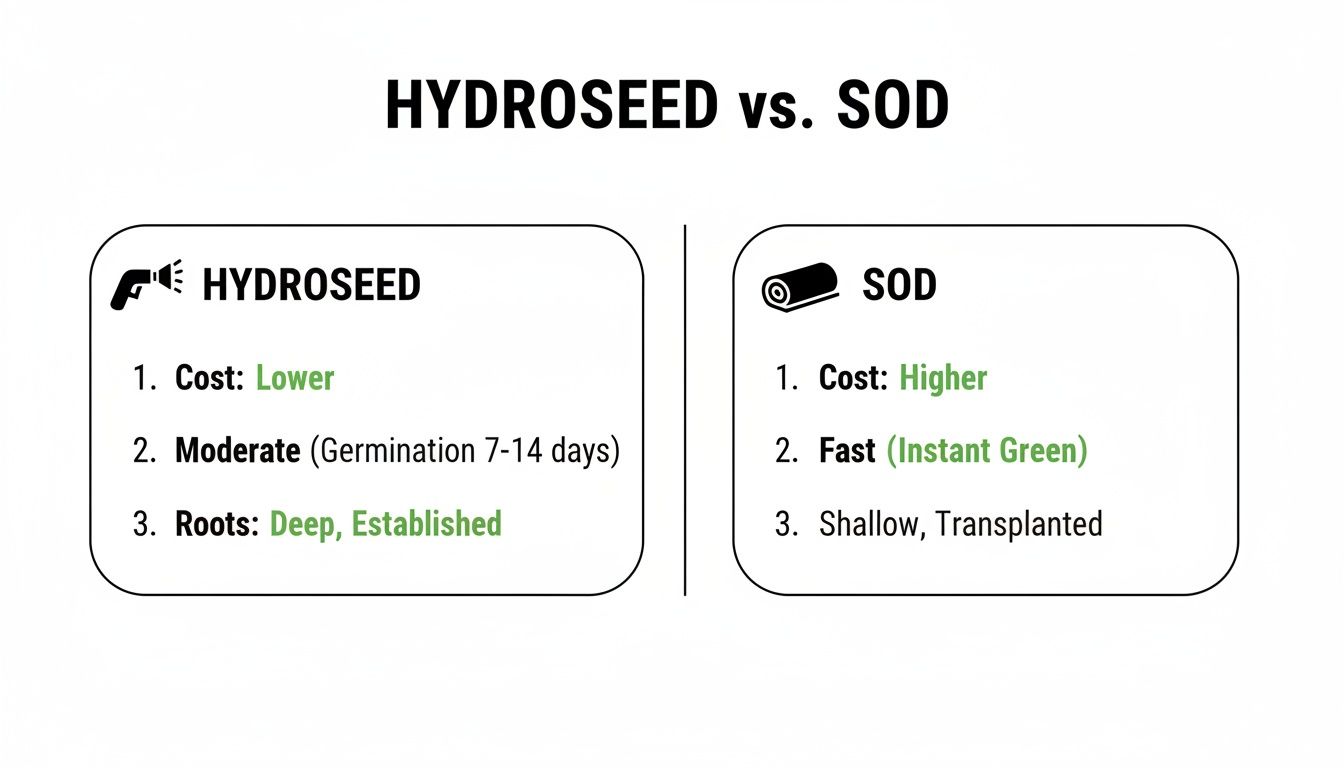
As you can see, there's a clear give-and-take. Hydroseeding requires patience but is much easier on the wallet, while sod delivers that "wow" factor immediately but comes with a premium price tag.
Hydroseed vs Sod At a Glance
Sometimes, you just need a straightforward, side-by-side comparison. This table boils down the essential differences to help you see which option aligns best with your project's needs.
| Factor | Hydroseeding | Sod |
|---|---|---|
| Initial Cost | Lower, often 50-75% less expensive | Higher, a significant upfront investment |
| Lawn Appearance | Green slurry initially; grass visible in 1-2 weeks | Instant lush, green lawn on day one |
| Time to Usable Lawn | 6-8 weeks for light use; several months to mature | 2-3 weeks for light use; fully rooted in 4-6 weeks |
| Seed Customization | Highly customizable for shade, sun, and soil type | Limited to the grass types available from the sod farm |
| Root Establishment | Roots grow directly into native soil for a stronger system | Roots must adapt from farm soil to your yard's soil |
Ultimately, both methods can lead to a fantastic lawn. The key is understanding these trade-offs and choosing the one that fits your timeline, budget, and long-term vision for your property.
Comparing the Installation Methods
To really understand which option is right for your North Georgia home, you need to look at how each lawn gets started. Hydroseeding and laying sod are worlds apart in their approach, from the prep work involved to the actual application, and these differences directly shape the final outcome.
No matter which path you choose, a great lawn starts with the soil. This is a non-negotiable first step. We have to clear out all the rocks, weeds, and old grass, then grade the area so water drains away from your house. For those of us in places like Cumming and Alpharetta, this is also the perfect time to work some amendments into our classic red clay.
The Hydroseeding Process
Hydroseeding is a pretty slick, modern way to plant a lawn. We're essentially spraying on a liquid mixture—a slurry—that contains everything the grass seed needs to get off to a roaring start. It's fast, efficient, and incredibly versatile.
So, what’s in this green goo? It's a carefully balanced mix:
- Grass Seed: This isn't just any seed. It's a custom blend chosen specifically for your property, whether you've got a sun-drenched lot in Cumming or a shady yard in Alpharetta.
- Mulch: Usually a wood fiber product, this holds in moisture like a sponge, keeps birds from feasting on your seed, and prevents soil erosion.
- Fertilizer: A special starter blend gives the seeds the immediate nutrition they need for quick germination and healthy early growth.
- Tackifier: This is the secret sauce. It’s a bonding agent that makes the slurry stick to the ground, which is a lifesaver on the sloped and hilly terrain we see all over North Georgia, from Milton to Dahlonega.
We spray this all-in-one cocktail evenly across the prepared soil from a large tank, leaving behind a distinctive green-blue coating. The real beauty of this method is that it ensures every seed is in direct contact with the soil, encouraging roots to dig deep into your native ground from day one.
The biggest win for hydroseeding installation is that the grass grows in place. It establishes itself right in your property's soil, avoiding the "transplant shock" that can set sod back and building a tougher, more resilient lawn for the long haul.
The Sod Installation Process
Sod gives you that "wow" factor of a finished lawn almost instantly. The trade-off is that it’s a much more physically demanding process that requires a careful hand to make sure the grass successfully takes to its new home.
Once the soil is prepped and amended, pallets of fresh sod rolls arrive at your property. These things are heavy, and the clock is ticking. The sod has to be laid quickly, usually the same day it’s delivered, or it will start to dry out and die.
Our crew lays each piece of sod one by one, staggering the seams like a bricklayer would to avoid unsightly lines. We trim the edges precisely to fit around your driveway, flower beds, and walkways in your Johns Creek or Milton home. The final, crucial step is to go over the entire lawn with a heavy roller. This presses the sod firmly against the soil, squeezing out any air pockets and giving the roots the best possible chance to knit into the ground below.
Breaking Down the Cost for Your Lawn
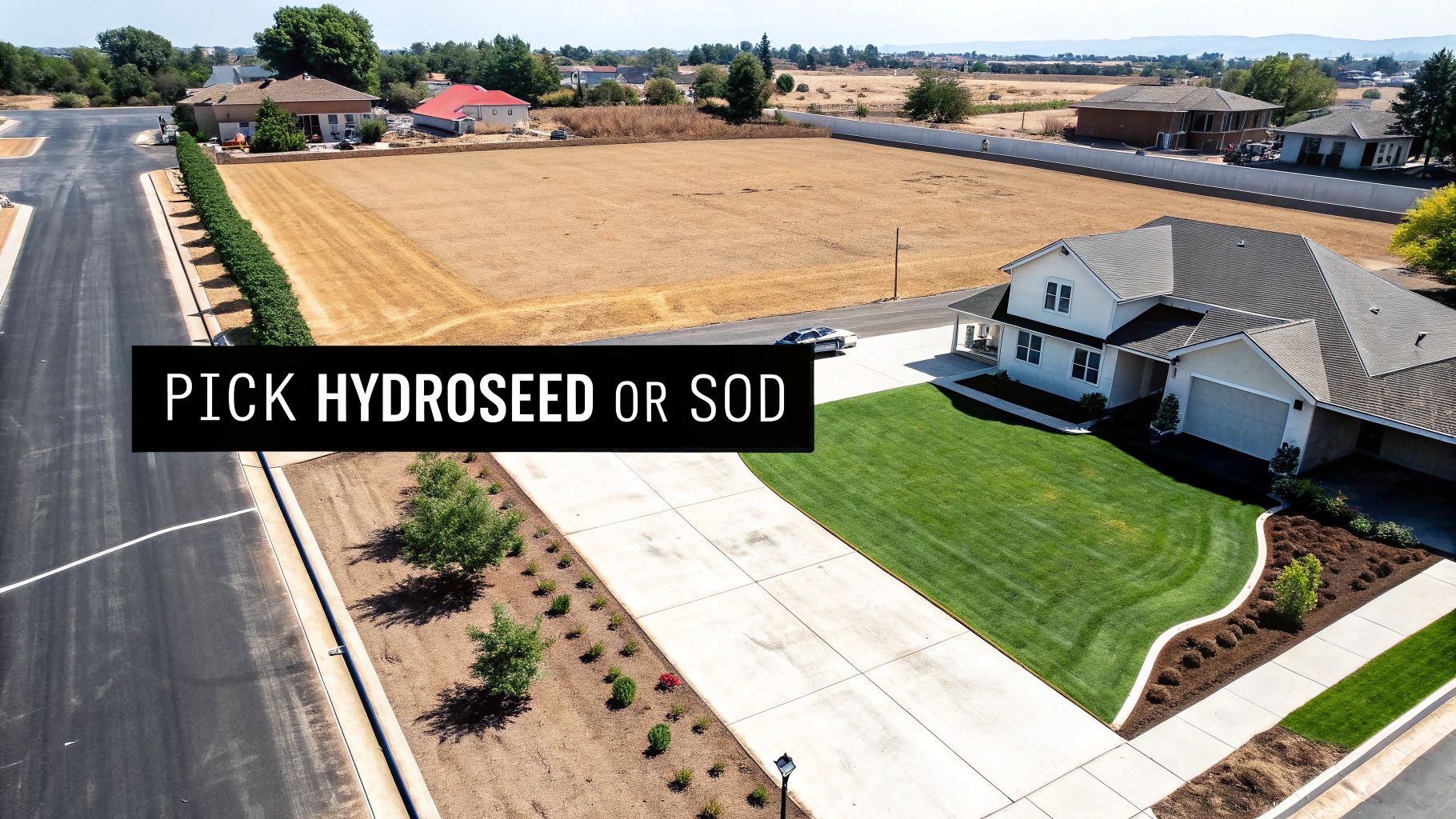
When it comes to establishing a new lawn in North Georgia, the budget is often the bottom line. Let’s be frank: the cost difference between hydroseeding and sod isn't just a small gap—it's a chasm, especially on the larger properties common in areas like Alpharetta, Cumming, and Milton. Understanding where your money is going is the key to making a smart investment in your home's curb appeal.
So, what drives this price disparity? It really comes down to materials and labor. Sod is a finished product. Think of it as a heavy, perishable carpet of mature grass that has to be cut, loaded onto pallets, shipped, and then meticulously laid by hand, piece by piece, all within a tight window. That's a lot of handling, which means a lot of labor costs.
Hydroseeding, on the other hand, is all about efficiency. A small, skilled crew can show up and spray a huge, prepared area in just a few hours. That all-in-one slurry covers the ground quickly and evenly, slashing the time and manual labor involved. Those savings get passed directly to you.
Hydroseeding: The Budget-Friendly Choice
For homeowners with those sprawling lawns you see in Cumming or Forsyth County, hydroseeding is a no-brainer from a financial perspective. The cost per square foot is a fraction of what you'd pay for sod, making it the clear winner for covering a lot of ground without emptying your wallet. You get a high-quality, custom-blended lawn without the premium price tag.
This affordability opens up your budget for other things that make a huge difference in the long run, like investing in better soil amendments or a dedicated organic care program. It’s a strategic play for anyone who values long-term quality over instant results.
Sod: The Premium for Instant Green
The high price of sod buys you one thing hydroseeding can't: a mature, green lawn, right now. You’re essentially paying for the time, water, and resources the sod farm already poured into growing that turf to perfection. For a tiny courtyard in a dense Milton or Alpharetta neighborhood, or if you're hosting a big event next week, that premium might be worth every penny.
But start scaling that up to the half-acre lots common throughout the Cumming area, and the cost of sod can get out of hand, fast. The sheer amount of material and the back-breaking labor needed for installation can catapult the project into a completely different financial league.
The decision often boils down to a simple question: Are you paying for a process or a product? Hydroseeding is an investment in an efficient establishment process, while sod is a purchase of a finished product. For large areas, the process is almost always more cost-effective.
A Real-World Cost Comparison
Let's put some real numbers to this. We'll use a typical 5,000-square-foot lawn—a pretty standard size you'd find in many North Georgia subdivisions from Johns Creek to Dahlonega.
- Hydroseeding: For a lawn this size, you're likely looking at a cost around $1,000, give or take, based on your specific seed blend and site prep needs.
- Sod Installation: That same 5,000-square-foot area could easily run you between $4,000 and $8,750. Sometimes even more, depending on the grass type and how difficult it is to access your property.
This isn't just a local trend. National data consistently shows hydroseeding costs anywhere from one-third to one-ninth the price of sod for residential lawns. In a market like Georgia, where suburban homes with generous yards are the norm, those numbers make a powerful argument. For homeowners across Cumming and the surrounding areas, the math usually points to hydroseeding as the most economical path to a beautiful lawn. You can learn more about national hydroseed cost analyses to see how these figures stack up nationwide.
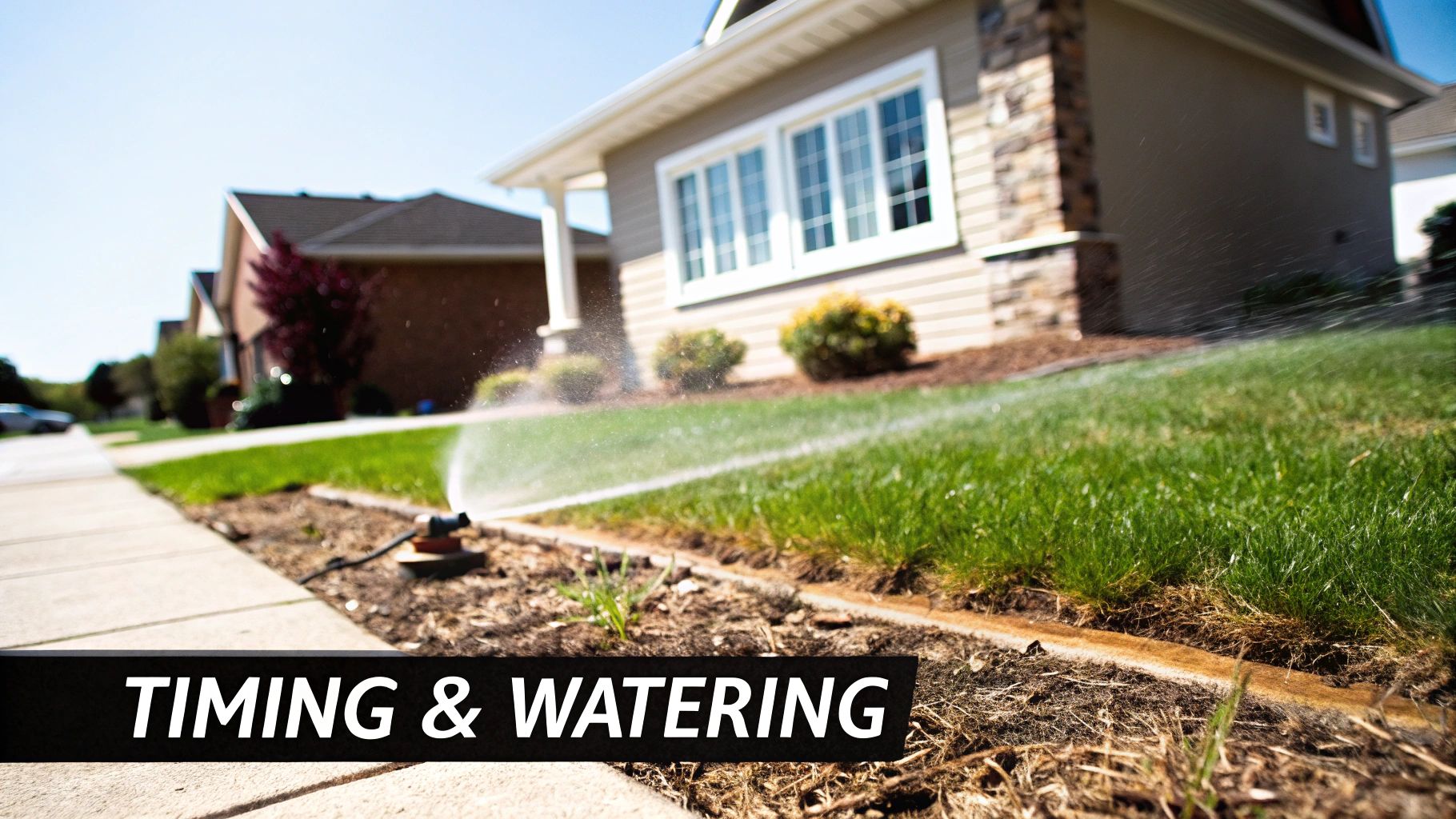
Timeline and Watering: The Reality Check for North Georgia Lawns
When it comes down to it, the choice between hydroseeding and sod often boils down to two very real-world questions for families in Milton and Johns Creek: "How fast will I get a lawn?" and "What am I getting myself into with watering?"
The answers couldn't be more different. One is a sprint to the finish line, offering instant gratification but demanding intense care right out of the gate. The other is a marathon, asking for patience and consistent nurturing as your lawn grows from scratch.
The Race to a Usable Lawn
The time it takes to get a lawn you can actually use is a huge dividing line. Sod is the clear winner if you need immediate results. The moment the last roll is laid, you have a finished, green lawn. It’s a game-changer for homeowners who have an event coming up or just can't stomach looking at a muddy yard for another month.
Hydroseeding, on the other hand, is all about the long game. You start with that distinctive green slurry covering your soil, and the magic happens slowly over the next few weeks and months. It’s a process that requires you to trust the process, but the payoff is a lawn that has grown up entirely in your yard's unique environment.
Breaking Down the Establishment Timelines
Sod gives you that "wow" factor instantly, but it’s not ready for a backyard barbecue on day one. You'll need to stay off it for about two to three weeks to give the roots a chance to start tacking down into the soil. For the lawn to become truly established, with deep, strong roots, you’re looking at about four to six weeks.
Hydroseeding works on a more natural, gradual schedule. Here's a typical timeline:
- First Sprouts: Expect to see the first signs of life—tiny green shoots—in about 10 to 21 days. This depends a lot on the seed mix and the time of year.
- First Mow: Your new lawn will likely be ready for a very gentle first mowing in about four to six weeks.
- Full, Lush Lawn: Getting that dense, mature, and truly established lawn can take anywhere from six to twelve months.
This is a make-or-break factor for families with kids and pets. For a household in Alpharetta or Milton that needs a safe place for play sooner rather than later, the quick turnaround of sod is often the deciding factor.
The trade-off is simple: Sod gives you a walkable lawn in less than a month. Hydroseeding demands a longer-term vision but rewards your patience with a lawn perfectly adapted to its home from day one.
The All-Important Watering Commitment
Your life for the first month is going to look very different depending on which option you choose. Both require a lot of water to get going, but the way you water is completely different. Nailing this is non-negotiable for success, especially under the hot Georgia sun.
A freshly hydroseeded lawn is incredibly fragile. The key is keeping the seedbed constantly moist—but never a soupy mess. This usually means light, frequent watering, sometimes two to four times a day for the first few weeks. That mulch in the slurry is a big help in holding moisture, but you can't let it dry out.
New sod needs the opposite approach: deep, heavy soakings done less often. The goal is to drench the sod mat and the top inch of soil beneath it, which encourages the roots to grow down deep to find water. For a detailed playbook, check out our guide on how to water new sod.
From establishment time to water usage, the differences between hydroseed and sod have real implications for families all over North Georgia. Sod delivers an instant lawn you can walk on in a few weeks, while hydroseeding takes longer but allows for custom seed blends perfect for the diverse properties in Alpharetta and Cumming.
What About Long-Term Lawn Health?
The initial green is exciting, but the real measure of success for a new lawn—whether you choose hydroseed or sod—is how it looks and performs a year or two down the road. For homeowners across the Cumming area, the goal isn't just a green lawn; it's a sustainable, resilient, and safe space for kids and pets to play. This long-term health is all about the root system, and the installation method plays a huge role in how it develops.
Hydroseeding has a distinct advantage here: the grass grows directly in your property's native soil from day one. The seeds germinate and immediately start sending roots deep into the ground they're meant to live in, adapting to the unique conditions of your yard from the very beginning.
This process naturally encourages a deeper, more extensive root network. A lawn with deep roots is simply tougher. It's more drought-tolerant, better at finding its own nutrients, and more resilient against the stress of a hot Georgia summer. You're essentially building a lawn from the ground up to thrive right where it's planted.
Root Systems and Soil Compatibility
Sod gives you that instant "wow" factor, but it also introduces a layer of foreign soil to your property. The grass was grown on a turf farm, likely in soil that's very different from the red clay so common in places like Dahlonega or Milton. This can create some long-term headaches.
Sometimes, the sod's roots struggle to push through that new, often denser soil underneath. This can result in a shallow root system, a condition often called "transplant shock," which can make the lawn much more dependent on frequent watering and fertilizer for the first few years.
The biggest long-term win for hydroseeding is that it completely sidesteps soil compatibility problems. Your lawn establishes itself in its forever home from the start, creating a fundamentally healthier and more self-sufficient turf for years to come.
When you have incompatible soil layers, it can act like a barrier, preventing water and nutrients from moving freely. The lawn might look perfectly fine on the surface while secretly struggling underneath, leaving it vulnerable to disease and pests. A critical step to prevent this is to work on your existing soil foundation. You can dive deeper into this with our guide on how to improve soil for a truly healthy lawn.
Chemical Needs and Maintenance Over Time
It's simple: a healthier root system means a less needy lawn. Because a hydroseeded lawn’s roots run deeper and are better adapted, the turf is far more efficient at finding its own water and nutrients. Over the years, this can dramatically cut down on the need for constant chemical treatments.
On the other hand, a sod lawn with a shallow root system may require more intensive care to stay looking its best. You might find yourself needing more frequent fertilization to make up for its limited ability to draw nutrients from the soil, along with stricter watering schedules just to survive dry spells.
This difference has a real impact on your wallet and your peace of mind, especially for families in Cumming and Johns Creek who want a low-chemical environment for their kids and pets. Choosing an installation method that fosters natural resilience is a smart, proactive step toward a safer, more sustainable yard.
In fact, long-term comparisons show that while sod provides immediate cover, it often requires more chemical inputs in the first year to correct soil imbalances, which drives up maintenance costs. For homeowners in Forsyth County and the Alpharetta area looking for a safe yard, pairing hydroseeding with a natural lawn care program can reduce the need for corrective chemical treatments by 20–50% over the first few years compared to poorly installed sod.
Making the Right Choice for Your North Georgia Property
We've walked through the costs, timelines, and long-term care for both hydroseeding and sod. Now it's time to put it all together and figure out what makes the most sense for your home. This isn't about which method is universally "better," but which one fits your specific property, budget, and expectations right here in North Georgia.
The best choice really boils down to your priorities. Is getting a perfect, usable lawn as fast as possible your main goal? Or are you more focused on long-term value and creating a lawn perfectly suited to your yard's unique quirks? Your answer is the key to deciding between hydroseed and sod for your place in Cumming, Johns Creek, or Milton.
Real-World Scenarios for Local Homeowners
Let's look at some common situations we run into every day across Forsyth, Gwinnett, and Cherokee counties and see which option wins out.
You should probably go with sod if:
- You're on a tight deadline. Hosting a graduation party in your Johns Creek home or a big family get-together next month? Sod delivers that instant "wow" factor. It’s a finished lawn, ready to go.
- Your yard is small but gets a lot of action. For compact, high-traffic areas where kids and pets will be running around, sod’s mature density and quick usability are a huge advantage.
- You're just patching up a few trouble spots. If a recent landscaping project tore up a section of your yard in Cumming, laying a few squares of sod is the quickest and cleanest way to fix it.
Hydroseeding is likely your best bet if:
- You have a lot of ground to cover on a budget. For those larger properties in Alpharetta or Dahlonega, hydroseeding makes a beautiful, healthy lawn achievable without a massive upfront investment.
- You need a specific grass blend for a tricky yard. Got a mix of deep shade under old oaks in Milton and spots that get blasted by the sun all afternoon? A custom hydroseed mix can be tailored to thrive in those exact conditions, something a single-variety sod can't do.
- You’re playing the long game for root health and drought tolerance. A hydroseeded lawn grows its roots directly into our tough Georgia clay from the very beginning. This creates a deeper, stronger root system that’s naturally more resilient over time.
At the end of the day, the goal is a beautiful, healthy lawn you can enjoy for years. Hydroseeding is an investment in a custom-grown foundation, while sod is an investment in an immediate, mature result.
Your Final Decision and What to Do Next
Both paths can lead to a gorgeous lawn. The trick is to match the method to your property's needs and your family's lifestyle. It's a classic trade-off: the instant gratification of sod versus the long-term savings and customization of hydroseeding. For homeowners thinking about their entire outdoor space, you might even find that some areas are better suited to other options. It's worth looking into lawn alternatives beyond traditional grass as part of your planning.
The absolute best way to make a confident decision is to get an expert opinion right on your property. A professional can take a look at your soil, measure the space, and talk through what you're hoping to achieve, giving you a clear path forward that actually fits your budget.
If you’re ready to get started on turning your yard into a lush, green oasis, we’re here to help. Contact Barefoot Organics today for a free, no-obligation quote and a personalized consultation. We'll help you figure out if hydroseed or sod is the perfect fit for your North Georgia lawn.
Answering Your Lawn Installation Questions
When you're trying to decide between hydroseed and sod, a few key questions always come up. Homeowners in places like Cumming and Alpharetta want to make sure they're making the right call for their specific yard. Let's tackle some of the most common ones we hear.
Which Method Is Better for Hilly Yards?
If you've got a sloped yard, which is pretty common from Dahlonega down to Johns Creek, hydroseeding is almost always the better choice. The magic is in the tackifier, a special bonding agent that's mixed right into the hydroseed slurry. Think of it as a natural glue that makes the whole mix—seed, mulch, and fertilizer—stick to the soil, even on a steep incline.
This sticking power does two critical things. It keeps the seed from washing away during one of our classic Georgia downpours and acts as a blanket to prevent soil erosion while the new grass is taking root. You can lay sod on a slope, but it's a lot trickier to get it to stay put without shifting or creating gaps between the pieces.
Can You Mix Hydroseeding and Sod on One Property?
Yes, and it’s a brilliant strategy we often recommend. Combining both methods lets you play to the strengths of each, giving you a great lawn while being smart with your budget.
For instance, you might lay down tough, ready-to-use sod in the high-traffic area in your Milton backyard where your kids and dogs are always running around. This gives you an instant, durable play space. For the rest of the yard, you can use hydroseeding to cover the larger, less-used areas much more affordably. This hybrid approach gives you the best of both worlds: instant gratification where it counts and cost-savings everywhere else.
Combining sod for high-traffic zones and hydroseeding for larger, open areas is a practical solution that maximizes your budget without compromising on the quality of your lawn.
What Is the Best Time for a New Lawn in North Georgia?
Timing is absolutely critical for getting a new lawn established in our climate. Your best windows for planting are the milder seasons: spring and fall.
Cool-season grasses like Fescue, which are very popular around here in the Cumming and Alpharetta area, do best when planted between September and November. The soil is still warm enough for the seeds to germinate, but the cooler air puts less stress on the new grass as it grows. Spring, from March to May, is your next best bet, but you'll have to be on top of your watering game as the summer heat starts to build. We strongly advise against installing a new lawn, with either method, in the middle of a hot Georgia summer.
Ready to figure out the perfect plan for your property? The team at Barefoot Organics has the local expertise to guide you. Contact us today for a free, personalized quote and consultation.