

So, you've got your soil test results back. That’s the first real step toward a better lawn. Now, the trick is figuring out what all those numbers for pH, Nitrogen (N), Phosphorus (P), and Potassium (K) actually mean for your yard. For us here in Cumming and the surrounding North Georgia area, these values are the key to understanding everything from weak growth to stubborn weeds. Let's break down how to read the most important parts of your report.
Your North Georgia Soil Test Report Explained
When you first open that soil analysis for your home in Cumming or Johns Creek, it can look pretty overwhelming. You're hit with a page full of charts, scientific terms, and numbers that don't exactly spell out how to fix that sad, patchy spot by the driveway. But don't let it intimidate you. Think of this report as a personalized health blueprint for your lawn.
The secret to reading a soil test is to focus on the big-ticket items first. Before you get bogged down in the finer details like micronutrients or cation exchange capacity, find the main characters: pH and the "big three" macronutrients, N-P-K. These four elements really do control almost everything about your lawn's potential for success.
The Foundation of a Healthy Lawn
Your soil test is basically a diagnostic tool. If your Fescue lawn in Alpharetta keeps yellowing or your Bermuda grass in Milton just seems thin and weak, the "why" is almost certainly buried in these initial numbers. They show you the invisible problems that you can't fix with watering and fertilizer alone.
For those of us across North Georgia, from Dahlonega all the way down to Forsyth County, our native red clay soil usually brings the same set of challenges. It tends to be acidic and compacted, which makes it tough for grass to grab the nutrients it needs to get healthy. This test takes all the guesswork out of the equation.
A professional lab analysis gives you the hard data you need to build a smart, effective, and eco-friendly lawn care plan. It ends that cycle of just throwing down generic products and hoping for the best, which saves you money and protects our local environment in the long run.
What to Look for First
When you open that report, your eyes should immediately scan for these core metrics. They’re the foundation for any plan of action and have the biggest impact on turf health in our area.
- Soil pH: This is the big one. It measures your soil's acidity or alkalinity and acts as the gatekeeper, controlling whether your lawn can even absorb the other nutrients you give it.
- Nitrogen (N): The fuel for that deep green color and vigorous, leafy growth.
- Phosphorus (P): Absolutely critical for strong root development. If you're putting down new sod or seed, this number is huge.
- Potassium (K): Think of this as your lawn's immune system. It helps the grass fend off drought, disease, and everyday stress.
To give you a quick reference, I've put together a table summarizing the key metrics and what you should be aiming for with our common North Georgia grasses.
At-a-Glance Guide to North Georgia Soil Test Metrics
This table is a cheat sheet for the most critical values on your soil test and the ideal ranges for the turfgrasses we see most often in our area.
| Metric | What It Measures | Ideal Range (Bermuda/Zoysia) | Ideal Range (Fescue) |
|---|---|---|---|
| Soil pH | Acidity / Alkalinity | 6.0 – 6.5 | 6.2 – 6.8 |
| Phosphorus (P) | Root Growth & Energy | 40 – 60 lbs/acre | 50 – 70 lbs/acre |
| Potassium (K) | Stress & Disease Resistance | 100 – 140 lbs/acre | 120 – 160 lbs/acre |
| Organic Matter | Nutrient & Water Retention | 2% – 4% | 3% – 5% |
Note: Nitrogen (N) is highly mobile in soil, so most standard tests don't provide a precise level. Recommendations are typically based on turf type and time of year.
Understanding the ideal ranges is your first practical step. An "optimal" reading for a Zoysia lawn is a little different than for Fescue, and a good report will give you that specific guidance. By starting here, you can quickly connect the numbers on the page to the real-world problems you see in your yard, turning that complex data into a clear path forward.
Why Soil pH Is the Key to a Healthy Lawn
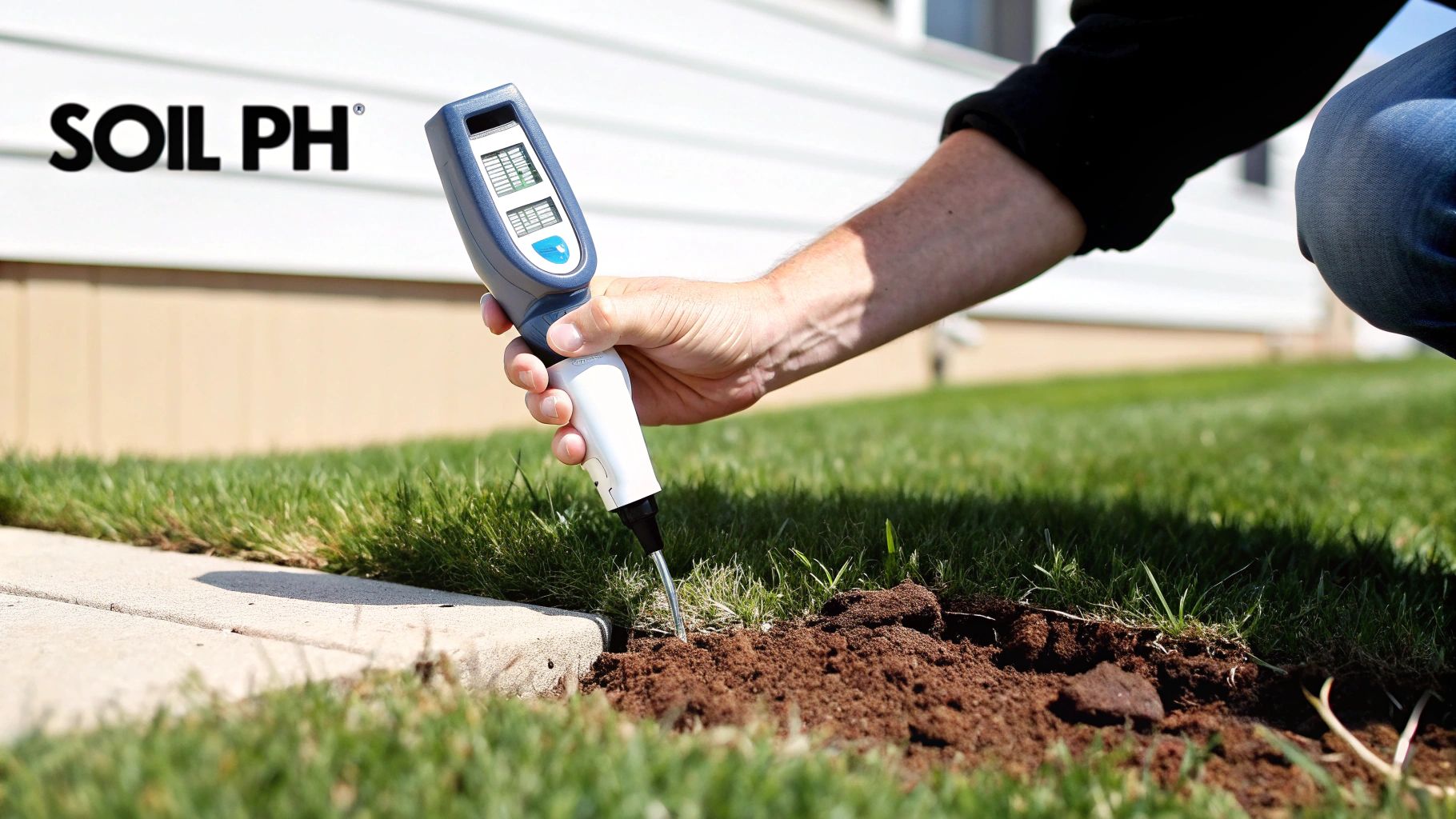
If there's only one number you pay attention to on your soil test, make it this one. Soil pH is the master key that unlocks your lawn's ability to use every other nutrient in the ground.
Think of it like a gatekeeper. If your pH isn't right, the gate to nutrient absorption stays locked, no matter how much fertilizer you throw down. It's the foundation of everything.
The pH scale measures acidity and alkalinity, running from 0 to 14. A 7.0 is perfectly neutral. Anything below 7.0 is acidic, and anything above is alkaline. Here in North Georgia—from Alpharetta to Dahlonega—this number is a big deal because our famous red clay soil is almost always acidic. It's not uncommon for us to see a starting pH in the low 5s, which is way too low for happy turfgrass.
Understanding Nutrient Lockout
When your soil pH is out of balance, something frustrating happens: nutrient lockout. This is the classic "why isn't my fertilizer working?" problem. The soil's chemistry literally changes in a way that binds up essential nutrients, making them completely unavailable for your grass to absorb.
Picture your lawn's roots trying to eat a meal that’s locked in a safe. The food is right there, but they can't get to it. A low pH locks away crucial players like nitrogen and phosphorus, while a high pH can restrict access to micronutrients like iron. This single concept is critical when you're learning how to read soil test results because it explains so many common lawn failures.
Your soil’s pH level directly controls the availability of every nutrient your lawn needs to thrive. An imbalanced pH means you're not just wasting money on fertilizer—you're feeding the soil, not the grass. Correcting the pH is always the first step toward a healthy lawn.
Reading Your pH Value for Georgia Lawns
Your lab report will give you a specific pH number. For the warm-season grasses we see all over Johns Creek, like Bermuda and Zoysia, the sweet spot is slightly acidic, somewhere between 6.0 and 6.5. For cool-season grasses like Fescue, which do well in shadier yards, the ideal range is a little higher, from 6.2 to 6.8.
Here’s a quick guide to what your number means:
- Below 6.0 (Acidic Soil): This is the most common result we see. The game plan is to apply lime to raise the pH. The lower the number, the more lime you’ll need.
- Between 6.0 and 7.0 (Ideal Range): Great news! Your pH is right where it needs to be. Your job is simply to maintain it.
- Above 7.2 (Alkaline Soil): This is less common in our native clay but can pop up, especially in newer subdivisions with construction backfill. The fix here is applying elemental sulfur to gently lower the pH.
Ever struggled with a yellowing lawn that just won't green up, even after you've fertilized? An off-balance pH is the most likely culprit. The grass is starving for nutrients that are already in the soil but completely inaccessible. For a closer look at the sampling process, check out our guide on how to test soil pH.
Fixing your soil’s pH isn't an overnight solution; amendments like lime can take months to fully work their magic. But it is, without a doubt, the most powerful and lasting change you can make. By adjusting the pH, you open the gate, allowing your lawn to finally access the food it needs to build strong roots, fight off disease, and become a truly beautiful, barefoot-worthy lawn.
Decoding the Macronutrients: N, P, and K
Once you have a grip on your soil's pH, the next major players on your report are Nitrogen (N), Phosphorus (P), and Potassium (K). These are the "big three" primary macronutrients, the main course in your lawn's diet. Getting their balance right is absolutely fundamental to growing a thick, healthy lawn here in North Georgia.
Think of them as a team of specialists, each with a critical job. Understanding what each one does helps you move beyond grabbing a generic bag of fertilizer and start feeding your lawn exactly what it needs to thrive. It's the difference between guessing and knowing.
Nitrogen (N): For Lush, Green Growth
Nitrogen is the one everyone knows, and for good reason. It’s the engine that drives that vibrant green color and vigorous top growth we all associate with a great-looking lawn. When your grass has enough nitrogen, it can crank out chlorophyll, which is exactly what gives it that deep, rich hue.
A nitrogen deficiency is usually pretty obvious. The classic sign is yellowing grass, which often starts with the older, lower leaves. You'll also notice that growth is slow and the turf just looks thin. Your soil test provides the baseline, helping you choose a fertilizer program that delivers a steady, controlled supply all season long.
Phosphorus (P): For Strong, Deep Roots
Phosphorus is the foundation builder. Its main job is to fuel strong root development, making it absolutely essential for new sod, freshly sown seed, or any young lawn trying to establish itself in our tough clay soil. Strong roots create a more resilient lawn that's better at finding water during a dry spell and can handle more foot traffic.
Interestingly, many established lawns around Cumming and Alpharetta already have plenty of phosphorus, sometimes even high levels from years of past fertilizing. It's a classic mistake to add more when it isn't needed. Excess phosphorus won't help your grass, and even worse, it can run off into our local waterways like Lake Lanier, causing significant environmental harm. Your soil test is the only way to know for sure where you stand.
Potassium (K): For All-Around Health and Defense
Potassium is your lawn's personal bodyguard and multi-tool. It doesn't trigger the dramatic green-up you see from nitrogen, but its role is every bit as critical. Potassium strengthens the grass on a cellular level, regulating dozens of internal processes that keep it healthy.
Potassium is like the immune system for your lawn. It helps your grass manage stress from drought, tolerate Georgia's intense summer heat and winter cold, and fight off common turf diseases. A deficiency often results in a weak, tired-looking lawn that seems to catch every problem that comes its way.
Reading your soil test results correctly is so important because it shows you how these three nutrients work together. The goal isn't just to have "enough" of each one, but to achieve the right balance. Research on crop responses has shown time and again that once a nutrient hits an optimal level, adding more does nothing to improve plant health—it just plateaus and leads to waste. You can see more on this in the University of Delaware's guide to categorizing soil nutrient levels.
This is exactly why a generic "triple 10" fertilizer is often the wrong choice for established North Georgia lawns, which frequently have plenty of phosphorus but are starving for potassium. Using your soil test as a guide allows you to apply only what’s necessary. Our detailed guide on how to fertilize a lawn can walk you through applying these principles for fantastic results.
Beyond soil, the skill of decoding various labels and reports is useful in many parts of life, from lawn products to pet food. By mastering N-P-K, you’ve taken a huge step toward a smarter, more effective, and more eco-friendly lawn care strategy.
Reading Beyond the N-P-K for a Truly Resilient Lawn
A truly resilient lawn is built on more than just the "big three" nutrients. While N-P-K grabs all the headlines, the supporting cast—secondary nutrients, micronutrients, and organic matter—is what creates deep, lasting soil health. Learning to read these parts of your soil test is what separates a good lawn from a great one here in North Georgia.
These details reveal the subtle imbalances that cause those frustrating, persistent problems. They're the key to building a lawn that doesn’t just survive our climate, but actually thrives in it.
Secondary Nutrients: Calcium and Magnesium
Digging past the primary nutrients, your report will show levels for Calcium (Ca) and Magnesium (Mg). These two are absolute workhorses in your soil, and their functions are directly tied to the pH issues we see so often in places like Alpharetta and Milton.
Calcium is all about strengthening the cell walls of your grass, making it tougher and more resistant to disease. Magnesium, on the other hand, is the central component of the chlorophyll molecule itself—without enough of it, your lawn literally can’t be green. Their levels are almost always linked to your soil’s pH and the type of lime used to fix it.
Micronutrients: The Small but Mighty Players
Next up is the list of micronutrients, which usually includes Iron (Fe), Manganese (Mn), and Zinc (Zn). Your grass only needs these in tiny amounts, but a deficiency can cause surprisingly big problems.
Ever had a yellow lawn that just won't green up, no matter how much nitrogen you put down? An iron deficiency is a classic culprit. This condition, known as iron chlorosis, is especially common when soil pH is too high (alkaline), which effectively locks up the available iron so the plant can't use it. This is a perfect example of how one number on your report directly impacts another, and it’s why a lab test is so much more valuable than a simple DIY kit.
A micronutrient deficiency can easily mimic the symptoms of a larger problem, sending homeowners down the wrong path. Reading these values correctly on your soil test saves you from wasting time and money chasing a solution that won't work.
Organic Matter: The Heart of Your Soil
If pH is the gatekeeper of nutrients, then Organic Matter (OM) is the very lifeblood of your soil. This number, shown as a percentage, might be the single most important metric for improving our dense, heavy Georgia clay. Organic matter is simply the dark, rich, spongy material formed from decomposed plants and other life.
For lawns across Cumming and Johns Creek, a low organic matter percentage—often below 2%—is a direct cause of the issues we see every day:
- Compaction: Clay particles get packed together like bricks, choking out grassroots and preventing water from getting in.
- Poor Drainage: Water pools on the surface after a storm instead of soaking down, leading to soggy spots and runoff.
- Low Nutrient Retention: The soil has no "grip," so it can't hold onto nutrients long enough for your grass to absorb them. They just wash away.
Increasing your soil's organic matter with practices like topdressing with compost directly solves these problems. It builds better soil structure, helps the ground hold water during our hot summers, and feeds the beneficial microbes that make nutrients available to your grass. For our local turfgrasses, an ideal OM level is somewhere between 3-5%.
Making Sense of Units and Values
As you get comfortable with your report, you'll see that nutrient levels are reported in different units, most commonly parts per million (ppm) or pounds per acre (lb/acre). It's helpful to know which measurement your lab uses to interpret the results correctly. For instance, converting between the two often involves a simple multiplier, where lb/acre is roughly ppm multiplied by two—a quick calculation based on soil density and lab calibration.
Ultimately, building a truly resilient lawn means looking at the bigger picture. A healthy lawn depends on being mindful of how outside factors contribute to soil vitality, which can even include understanding the broader environmental impact of waste on soil health. When you start looking beyond just N-P-K, you empower yourself to build a lawn that is genuinely healthy from the ground up.
Turning Your Soil Test Into an Action Plan
Alright, you've got the numbers. Now what? The real magic happens when we turn that piece of paper into a practical game plan for your yard. This is where we move from theory to getting our hands dirty, creating a strategy that works with our native North Georgia red clay, not against it.
A report full of numbers is just information. An action plan turns that info into a beautiful, healthy lawn. Let's walk through how to build a customized treatment schedule that nurtures your soil back to life using smart, eco-friendly methods.
Addressing Low pH in Georgia Clay
For homeowners in Forsyth County and the surrounding areas, the most common starting point is fixing low soil pH. If your report shows a pH below 6.0, your first priority is applying lime. It sounds simple, but there's a right and a wrong way to do it.
Your soil test holds the key by listing your Calcium (Ca) and Magnesium (Mg) levels. This detail is crucial for choosing the right kind of lime:
- Dolomitic Lime: Grab this if your report shows low pH and low Magnesium. It’s a two-for-one deal, containing both calcium and magnesium carbonate to fix both issues at once.
- Calcitic Lime: This is your best bet if your Magnesium levels are fine (or even high), but your pH is still in the acidic range. It's mostly calcium carbonate, so you won't risk overdoing it on the magnesium.
Applying the right amount is just as important as choosing the right type. Your lab report will give you a specific rate, usually in pounds per 1,000 square feet. Stick to it. Applying too little is a waste of time, and slinging too much can shock the soil and send your pH swinging in the opposite direction. For a complete walkthrough, check out our guide on how to apply lime to your lawn.
Creating a Plan for Compaction and Low Organic Matter
Another problem we see all the time in local soil tests is low Organic Matter (OM), which almost always goes hand-in-hand with compacted soil. An OM percentage below 2% is a huge red flag. It means your soil is dense, struggles to hold water and nutrients, and is basically suffocating your grassroots.
The solution is a powerful one-two punch that builds a better soil structure over time:
- Core Aeration: This is non-negotiable for our heavy clay. Pulling up small plugs of soil physically breaks up compaction, creating channels for air, water, and nutrients to finally reach the root zone.
- Organic Topdressing: Right after aerating is the perfect time to spread a thin layer of high-quality, screened organic compost. The compost falls into the aeration holes and gets to work, slowly and steadily increasing your soil's organic matter.
This combination is foundational for long-term lawn health, physically loosening the soil while biologically enriching it.
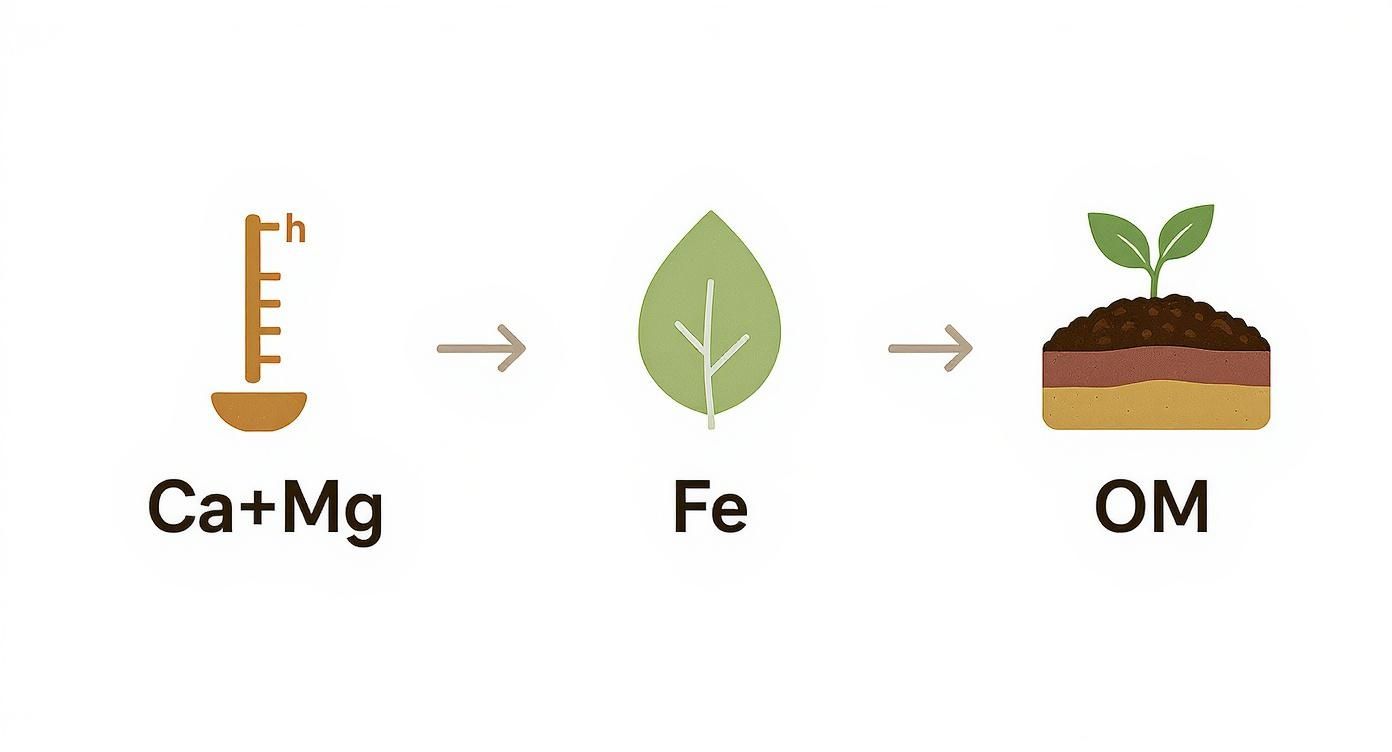
As this image shows, all these elements are connected. Getting the pH and organic matter right is what makes critical nutrients like iron available for your grass to actually use.
Selecting the Right Organic Amendments
Finally, your action plan needs to tackle any specific nutrient gaps your test uncovered. Forget the generic, one-size-fits-all fertilizers. Your report lets you be a surgeon, applying only what your lawn truly needs.
An action plan based on your soil test is the most responsible way to care for your lawn. It ensures you’re applying only what is necessary, which protects local waterways from nutrient runoff, saves you money, and delivers far better results.
Here are a few common scenarios we see:
- Low Potassium (K) with High Phosphorus (P): This is incredibly common in established Georgia lawns. In this case, you’d look for an organic fertilizer high in potassium but with zero phosphorus, like sulfate of potash.
- Iron (Fe) Deficiency: If your pH is in a good range but your iron is low, a liquid iron supplement is a great way to get a quick green-up without messing with other nutrient levels.
- Overall Low Fertility: For a lawn that’s just plain hungry and low across the board, a balanced, slow-release organic fertilizer is the perfect choice to gently replenish all the essential nutrients.
Remember, soil is a living, changing thing, so a perfect measurement is impossible. Labs know this and use statistical analysis to provide reliable estimates. That's why following their specific recommendations—which are based on tons of data—is always your surest path to a great-looking lawn.
Your Top Georgia Soil Test Questions Answered
Even with your report in hand, a few questions are bound to pop up. It's totally normal. Translating all that data into real-world action for our unique Georgia clay can feel a little intimidating at first. Let's walk through some of the most common questions we get from homeowners in Cumming, Milton, and across North Georgia.
The whole point of a soil test is to act on it with confidence. Clearing up these last few details will get you there.
How Often Should I Be Testing My Soil Here in Georgia?
For a typical, established lawn in places like Alpharetta or Johns Creek, getting a soil test every 2-3 years is the perfect sweet spot. Our heavy clay soils don't tend to fluctuate wildly year-to-year, so this frequency gives you a great read on long-term trends without overdoing it.
Now, there are a couple of exceptions. If you're correcting a serious problem—say, your first test came back with a wildly low pH—you'll want to test annually for a year or two. This lets you track how well your lime applications are working. The same goes for establishing a brand-new lawn; yearly testing at the start is a smart move.
As for timing, I always recommend taking your sample in the fall or early winter. There's a good reason for this. It gives amendments, especially lime, the entire winter to react with the soil, so your lawn is perfectly prepped for the spring growing season.
My Test Says a Nutrient is "High." Is That a Bad Thing?
Yes, it absolutely can be. In soil science, more is rarely better. In fact, having an excessively high level of one nutrient, especially Phosphorus (P), can kick off a cascade of problems for your turf.
For one, it can actually prevent your grass from taking up other vital micronutrients, like iron and zinc. The nutrients might be in the soil, but the plant can't access them—a classic case of nutrient lockout. Your lawn ends up with a deficiency even when the soil is technically full.
High Nitrogen and Phosphorus levels are also a major environmental red flag. During a heavy rain, that excess N and P can easily run off your lawn and flow into local waterways like Lake Lanier. This runoff is a primary cause of harmful algae blooms that choke out aquatic life and harm our local ecosystem.
Seeing a "High" reading on your report is a clear stop sign. It means you should not apply any fertilizer containing that nutrient until future tests show the level has come down. It’s crucial information for protecting both your lawn and our local environment.
Are Those Cheap DIY Soil Test Kits Any Good?
I get this question a lot. While a simple DIY kit from a big-box store can give you a ballpark idea of your pH and N-P-K levels, it's just not in the same league as a professional lab analysis from a place like the UGA Extension. The difference in accuracy, detail, and reliability is night and day.
It's like comparing a first-aid kit to a doctor's diagnosis. The lab test is just so much more precise. It gives you critical data that the little color-coded kits can't touch:
- Organic Matter Percentage: This tells you about your soil's structure and overall health.
- Micronutrient Levels: These reports uncover the hidden deficiencies (like iron or boron) that often cause those stubborn, mystery lawn problems.
- Cation Exchange Capacity (CEC): This is a key metric for understanding how well your soil can hold onto and supply nutrients to your grass.
- Specific Application Rates: Instead of a vague suggestion, you get exact, science-based recommendations for what to add.
When you're making decisions about what to put down on your lawn in Dahlonega or Roswell, that precision is everything. It stops you from wasting money on products you don't need and, more importantly, prevents you from applying unnecessary chemicals into the environment.
Ready to skip the guesswork and get a lawn care plan based on what your soil actually needs? At Barefoot Organics, we use this same scientific approach to build beautiful, resilient lawns that are safe for your family and pets. Get your free online quote today.