

Getting the square footage of your lawn is the single most important first step for any successful lawn care plan. It's the foundation for everything else. At its core, the process is pretty simple: you measure the different parts of your turf, calculate their individual areas, and add them all up while subtracting the non-grassy spots.
Why an Accurate Lawn Measurement Matters in North Georgia
Before you can get that picture-perfect lawn you've been dreaming of for your home in Cumming or Alpharetta, you have to know exactly how big it is. This isn't just about crunching numbers—it’s about laying the groundwork for a successful treatment plan, from applying the right amount of organic fertilizer to setting up an efficient watering schedule for our unique Georgia climate.
Knowing how to measure your lawn's square footage is also the secret to saving money and avoiding product waste. I've seen it time and again: without a precise figure, homeowners in Johns Creek, Milton, and beyond either over-apply or under-apply treatments. This leads to disappointing results and money down the drain. An exact measurement ensures every lawn application is perfectly dosed for what your yard actually needs.
From Guesswork to Precision
Many folks I talk to in Johns Creek and Milton are surprised to find that what they thought was a simple rectangular yard is actually a puzzle of different shapes. Taking just a few minutes to measure properly shifts your whole approach from pure guesswork to a science. It's a simple action that puts critical data in your hands.
An accurate measurement does more than just calculate area; it gives you complete control over your lawn care budget and outcomes. It’s the difference between hoping for a healthy lawn and actively creating one.
This guide will walk you through a few straightforward methods for any type of lawn, whether you're using a trusty tape measure or some of the newer digital tools. Once you understand your lawn's true size, you can take the next step with total confidence. For example, you can use that number when you get an instant lawn care estimate for our Natural Lawn Care Program, making sure the quote you receive is spot-on and free of any surprises.
Choosing The Right Tools For The Job
Before you can get an accurate square footage of your lawn, you need to decide how you're going to measure it. Don't worry, you won't need a professional surveyor's kit. For most homeowners from Cumming to Alpharetta, the right tools are probably already in the garage or even on your phone.
The best method really comes down to your property's layout and what you’re comfortable with.
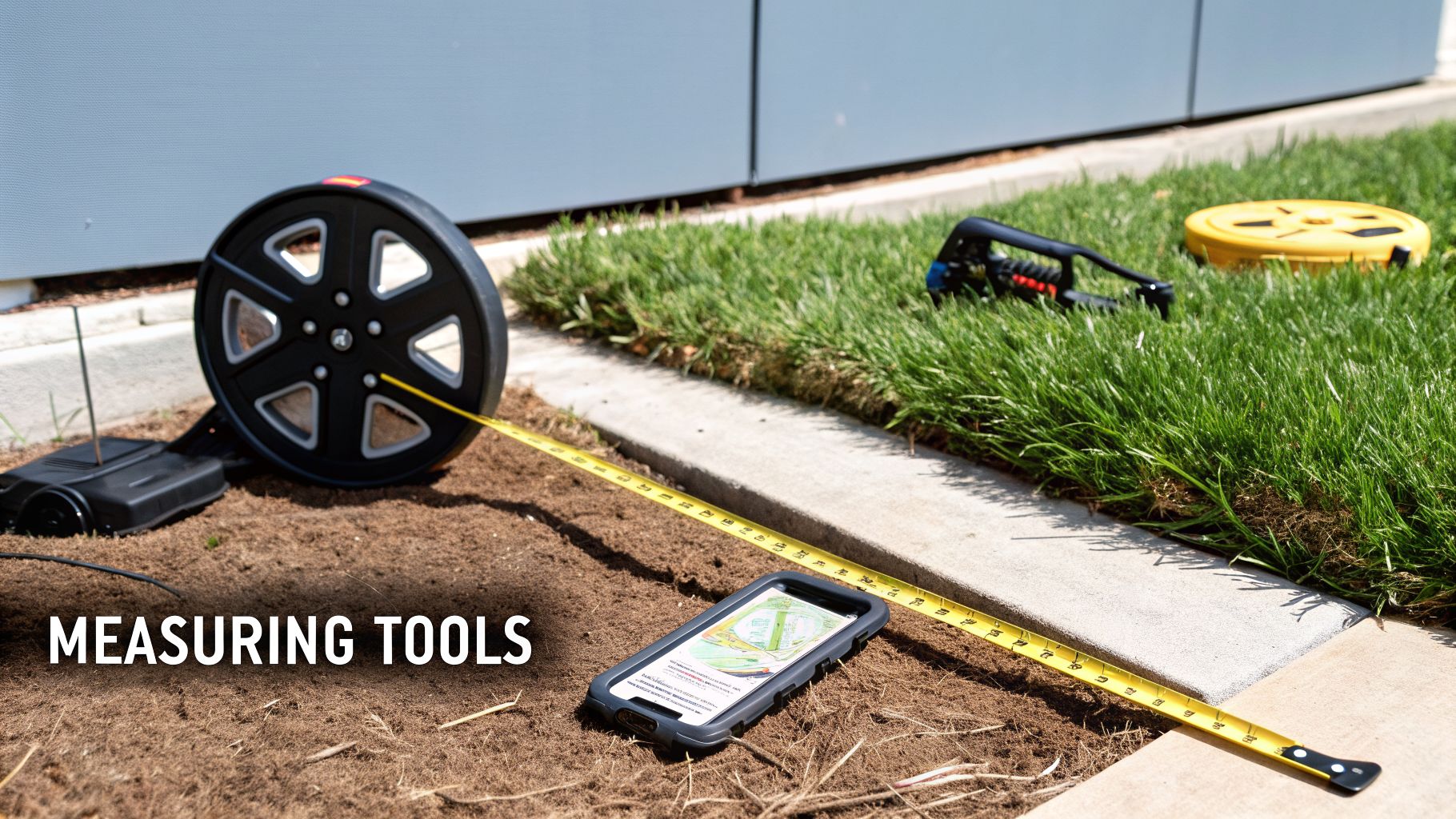
Let's walk through the pros and cons of the most common tools, from old-school classics to modern digital solutions. Understanding your options is the first step toward measuring with confidence.
Low-Tech Trustworthy Tools
For most standard suburban lawns, you can't beat the classics. These methods are straightforward, reliable, and you likely have what you need on hand.
- 100-Foot Measuring Tape: This is your best friend for small-to-medium yards with straight lines and simple shapes. It's incredibly accurate. The only trick is to make sure you pull it taut—any slack can skew your numbers.
- Measuring Wheel: If you have a larger property or one with gentle slopes, like many homes around Johns Creek and Cumming, a measuring wheel is a game-changer. You just walk the perimeter, and the wheel tracks the distance. It’s so much faster than wrestling with a long tape measure. Just try to walk in as straight a line as you can.
Of course, don't forget a notepad and pencil (or your phone's notes app) to jot down your numbers as you go!
High-Tech And Digital Options
If you'd rather stay on the porch, a few digital tools can give you a surprisingly good measurement without ever stepping on the grass. These are fantastic for getting a quick estimate, especially for properties in hilly areas like Dahlonega.
Google Earth Pro is a powerful and free tool. You can pull up a satellite view of your address, zoom in, and use the polygon tool to trace the outline of your turf areas. It instantly calculates the square footage. The main drawback is that heavy tree cover, common in our area, can sometimes hide the true edges of your lawn, forcing you to guess a little.
A hybrid approach often works best. Start with a satellite tool for the big picture, then grab a tape measure to double-check any tricky spots or areas hidden under trees. This gives you the best of both worlds: speed and accuracy.
There are also specialized digital tools like Exayard landscape takeoff software that are built specifically for calculating areas for landscaping projects. No matter your choice, the goal is a reliable number. A precise measurement is just as fundamental to good lawn care as knowing how to measure soil moisture.
Comparing Lawn Measurement Tools
To help you decide, here’s a quick look at common tools for measuring lawn square footage, highlighting their accuracy, ease of use, and the best scenarios for North Georgia lawns.
| Tool | Best For | Accuracy | Effort Level |
|---|---|---|---|
| Measuring Tape | Small, simple, rectangular lawns | Very High | Medium |
| Measuring Wheel | Large or irregularly shaped properties | High | Low |
| Smartphone App | Quick estimates, simple shapes | Medium | Very Low |
| Satellite Imagery | Large properties, initial estimates, difficult terrain | High | Very Low |
Ultimately, the best tool is the one that gives you a number you trust. A few minutes of measuring can save you a lot of guesswork and ensure you're getting the right service for your lawn.
Measuring Your Lawn: Squares, Rectangles, and Other Common Shapes
Most lawns here in North Georgia, whether you're in a planned community in Johns Creek or on a larger lot out in Milton, aren't just one big, open field. The secret to getting an accurate measurement is to stop looking at your yard as a whole and start seeing it as a collection of simpler shapes. The most common, and easiest to measure, are squares and rectangles.
This is the best place to start. Grab your tape measure or measuring wheel and find the length and width of the largest rectangular chunk of your grass. I usually walk the longest side first to get the length, then the shorter side for the width.
Once you have those two numbers, the math is about as simple as it gets. The formula is just Area = Length × Width.
A Quick Example from an Alpharetta Backyard
Let's picture a pretty standard rectangular backyard in an Alpharetta neighborhood—the main spot where the kids and the dog run around.
- You walk from the edge of your patio straight to the back fence and clock it at 60 feet.
- Then, you measure from one side of the property to the other and get 40 feet.
- Just multiply them: 60 feet × 40 feet = 2,400 square feet.
Make a note of that number. You've just figured out the biggest piece of the puzzle. For many homes in our area, this one calculation covers the vast majority of the turf area.
What About Triangles and Odd Corners?
Of course, not every lawn is a perfect box. You'll often run into triangular patches of grass, especially on corner lots or where a walkway cuts across the yard at an angle. Don't worry, the formula for this is also straightforward: Area = (Base × Height) / 2.
The "base" is just one side of the triangle. The "height" is the measurement from that base line to the opposite point, making sure you measure at a right angle (think of the letter 'T'). For instance, a corner of your property up in Dahlonega might form a triangle with a base of 20 feet and a height of 30 feet. The math would look like this: (20 × 30) / 2 = 300 square feet.
Getting this measurement right is the single most important first step toward a healthy lawn. In North Georgia's climate, the right amount of product can make all the difference, and it all starts with knowing your square footage.
This isn't just about getting a quote; it's about proper lawn care. Take a common suburban lawn in Cumming measuring 50 feet by 25 feet. That's 1,250 square feet. Using this precise method helps over 70% of homeowners avoid over- or under-applying fertilizer, a common mistake that can either damage your lawn or waste your money. This exact approach has been recommended for decades, as you can see in this guide for home lawns from Clemson University.
Handling Circles and Curved Beds
So what do you do with those beautiful, curved landscape beds or maybe a circular patch of grass around a fire pit? For a full circle, the formula you need is Area = π × r² (remember, π is about 3.14, and 'r' is the radius). The radius is simply the distance from the very center of the circle out to its edge.
If you only have a half-circle, just use the same formula and then divide your answer by two.
Let's say you have a small decorative circle of turf with a radius of 5 feet. The area would be 3.14 × (5 × 5), which comes out to 78.5 square feet. It might not seem like much, but these small, odd-shaped areas really do add up and get you much closer to an accurate total.
Dealing with Irregular and Curved Lawns
What about lawns that don't fit into a perfect box? From the rolling properties near Lake Lanier to the beautifully landscaped yards in Milton and Johns Creek, many North Georgia properties feature unique curves and odd shapes that make a simple length-times-width calculation feel impossible.
For these more complex areas, there's a pro trick that’s surprisingly easy for any homeowner to master. It’s called the offset method.
This technique is all about breaking down a complicated shape into smaller, more manageable sections. Instead of trying to find a formula for a giant, swooping curve, you just find its average width and multiply it by its length. It’s a reliable way to measure even the most unique properties.
How to Use the Offset Method
First things first, find the longest straight line you can run within the irregular area. This becomes your baseline. Stretch a tape measure from one end to the other and jot down this length.
Next, you'll take a series of width measurements that are perpendicular to that baseline. As you walk along your baseline, stop at regular intervals—every 5 or 10 feet works well—and measure the width of the lawn from one edge to the other, crossing your baseline at a 90-degree angle. These measurements are your "offsets."
The more offsets you take, the more accurate your final number will be. Once you've got all your offset measurements, it's simple math from there:
- Add all the individual offset lengths together.
- Divide that total by the number of offsets you took. This gives you the average width.
- Multiply that average width by the length of your baseline.
The simple formulas below are the building blocks for measuring any lawn. Once you know them, you can combine them or use the offset method to figure out any shape you’re facing.
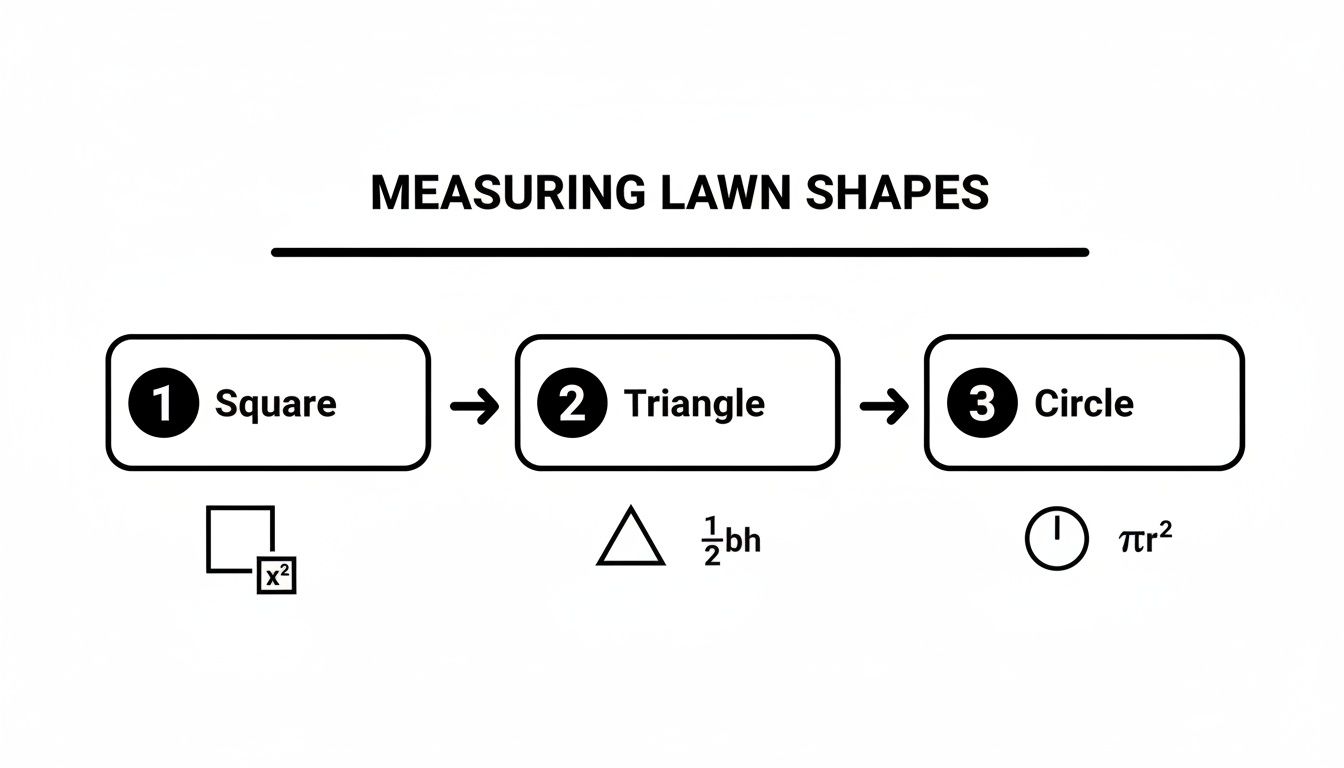
This method is a game-changer for homeowners with those quirky, curved lawns you see in places like Cumming or Dahlonega. Let's walk through an example.
Imagine stretching a 50-foot baseline from your patio to a tree line. Along that line, you measure the width (your offset) every 10 feet. You get readings of 26 ft, 24 ft, 18 ft, 30 ft, and 28 ft.
Add them up: 26 + 24 + 18 + 30 + 28 = 126 feet.
Divide by the number of offsets (5): 126 / 5 = 25.2 feet (your average width).
Finally, multiply that by your baseline: 25.2 ft x 50 ft = 1,260 square feet. Just like that, you have a solid number for a tricky shape. You can dig deeper into this and other reliable guides on lawn measurement techniques if you want to learn more.
A High-Tech Shortcut for Tricky Perimeters
If laying out tape measures sounds like a chore, you can get a similar result with a lot less effort using online tools. Free satellite mapping services like Google Earth Pro let you trace the exact perimeter of your lawn, no matter how curvy or unusual it is.
Expert Tip: Using the polygon or path tool in Google Earth, you can just click along the edge of your lawn to create a custom shape. The software automatically calculates the enclosed square footage, giving you a highly accurate measurement in seconds.
This digital approach is perfect for getting a quick, reliable number for those challenging properties we see all over the Cumming area. It guarantees every homeowner can get a precise measurement without the headache.
Putting It All Together: Your Final Lawn Square Footage
Alright, you've done the legwork. You’ve measured all the different parts of your lawn—from that straightforward rectangular patch in your Alpharetta front yard to the tricky, curved edges of your backyard in Dahlonega. Now it’s time to turn those individual measurements into one solid, usable number.
The process is pretty simple: add up all the grassy areas, then subtract everything that isn't grass.
First, take the square footage you calculated for every single patch of turf and add them together. This gives you what we call the gross square footage. It’s the grand total of all potential lawn space, but it's not the number we'll use for your treatment plan just yet.
Don't Forget to Subtract the Non-Lawn Areas
This is probably the most important part of getting an accurate measurement, and it's where I see a lot of folks from Cumming to Milton go wrong. You have to subtract the areas that don't have grass. If you skip this, you’ll end up with an inflated number, which could mean paying for services you don’t actually need.
Take another walk around your property, but this time, focus on measuring the "interruptions"—the hardscapes and landscape features that break up your lawn.
- Driveways and Walkways: Measure the length and width of your concrete driveway and any stone or paver paths.
- Patios and Decks: Get the square footage of your patio, pool deck, or any other outdoor living spaces sitting on what would otherwise be lawn.
- Flower Beds and Mulch Rings: Those big, beautiful garden beds and the mulched areas around your trees need to be accounted for.
- Sheds, Pools, and Playsets: You obviously wouldn't count the footprint of your house, but don't forget to subtract outbuildings, pools, or large playsets, too.
The whole point of this exercise is to find your net treatable square footage. That's the exact, real-world area where our lawn care products will be applied. Getting this number right ensures every dollar you invest goes directly into making your actual lawn healthy and beautiful.
A Real-World North Georgia Example
Let's walk through a quick example. Imagine a typical property over in Johns Creek to see how the math plays out.
You've already measured the lawn itself.
- Front Yard (Rectangle): 2,000 sq. ft.
- Back Yard (Irregular): 3,500 sq. ft.
- Gross Total Lawn Area: 2,000 + 3,500 = 5,500 sq. ft.
Now, you go back and measure the non-grass surfaces.
- Concrete Driveway: 700 sq. ft.
- Stone Patio: 400 sq. ft.
- Large Mulch Bed: 150 sq. ft.
- Total Deductions: 700 + 400 + 150 = 1,250 sq. ft.
Finally, you just do the simple subtraction:
5,500 sq. ft. (Gross) – 1,250 sq. ft. (Deductions) = 4,250 sq. ft.
And there it is. Your final, treatable lawn area is 4,250 square feet. That's the precise number you'll want to have handy when you're getting quotes or figuring out how much product to buy.
Putting Your Measurement to Work for a Healthier Lawn
So, you've got your number. That square footage figure is more than just a measurement—it's the single most important tool for building a genuinely healthy lawn for your North Georgia home. When you know the exact size of your turf, you stop guessing and start being precise, ensuring every treatment is perfectly calibrated for your property in Cumming or Johns Creek.
This precision is exactly how we operate at Barefoot Organics. It’s the foundation of our Natural Lawn Care Program. We take your measurement and use it to apply the perfect amount of natural, soil-building products. This approach creates a resilient, robust lawn without the harsh chemicals, giving you a space that’s truly safe for your kids and pets to run around on.
Get Your Fast and Free Online Quote
With your final number in hand, the next step is easy. You can plug that measurement directly into our website to get a fast, free, and accurate quote. We believe in total transparency, so you’ll know exactly what to expect right from the start. It’s the best first step you can take toward a gorgeous lawn that also protects our local environment here in Alpharetta, Milton, and the surrounding communities.
An accurate measurement ensures not one drop of product is wasted. It’s how we deliver targeted, effective care that respects both your budget and our shared Georgia ecosystem, from the soil up.
Knowing your lawn's size empowers you in other ways, too. You can confidently apply the right amount of fertilizer or soil amendments. It even helps you get more value from understanding your soil test results, as you’ll know exactly what your turf needs on a micro-level.
Of course, a great lawn is more than just healthy—it should also look the part. For a smoother, more manicured appearance, check out our guide on how to level a bumpy lawn.
Answering Your Lawn Measurement Questions
Over the years, we've heard just about every question in the book from homeowners across North Georgia, from Cumming to Dahlonega, about getting their lawn size right. Let's tackle a few of the most common ones we run into.
How Close is "Close Enough" for My Measurement?
You don't need to be a professional surveyor, but getting your measurement within 5-10% of the actual size is a solid target.
A reasonably accurate number is key. It ensures you get a fair quote for services like our Natural Lawn Care Program and that you don't overbuy product for your own weekend projects. For us, it means we can calibrate our organic treatments perfectly to give your turf exactly what it needs to thrive.
What’s the Best Way to Measure a Hilly or Sloped Lawn?
Slopes can definitely throw a wrench in your calculations, and we see plenty of them in hilly spots around Milton, Alpharetta, and Dahlonega.
The best tool for the job here is a measuring wheel. It follows the actual contour of the ground, giving you a true surface area measurement—which is exactly what we need for applying treatments. Satellite tools like Google Earth also do a surprisingly good job of accounting for topography.
If all you have is a tape measure, just know your final number will be slightly smaller than the true surface area. For most residential slopes we see in the area, the difference is usually small enough not to worry about.
A critical word of advice: Never use the total lot size from your property records. That number includes your house, driveway, flower beds, and everything else. Measuring only the grass ensures you get a correct quote and only pay for the turf we're actually treating.
It’s the most transparent and fair way to price our services, right from the very beginning.
Ready to turn that number into a beautiful, healthy lawn? If you want help with weed control or lawn care in Cumming and North Georgia, get a free quote from Barefoot Organics.
You can get a free, instant online quote today by visiting us at https://barefootorganicsllc.com.