

To get your soil less acidic, you'll need to work in alkaline materials. Things like agricultural lime, wood ash, or a really high-quality compost can do the trick. For most lawns here in Cumming and across North Georgia, putting down pelletized lime in the fall is your best bet. It works slowly, raising the soil pH over the winter and unlocking all those nutrients your grass needs to get a great start in the spring.
Why North Georgia Soil Is a Challenge for Your Lawn
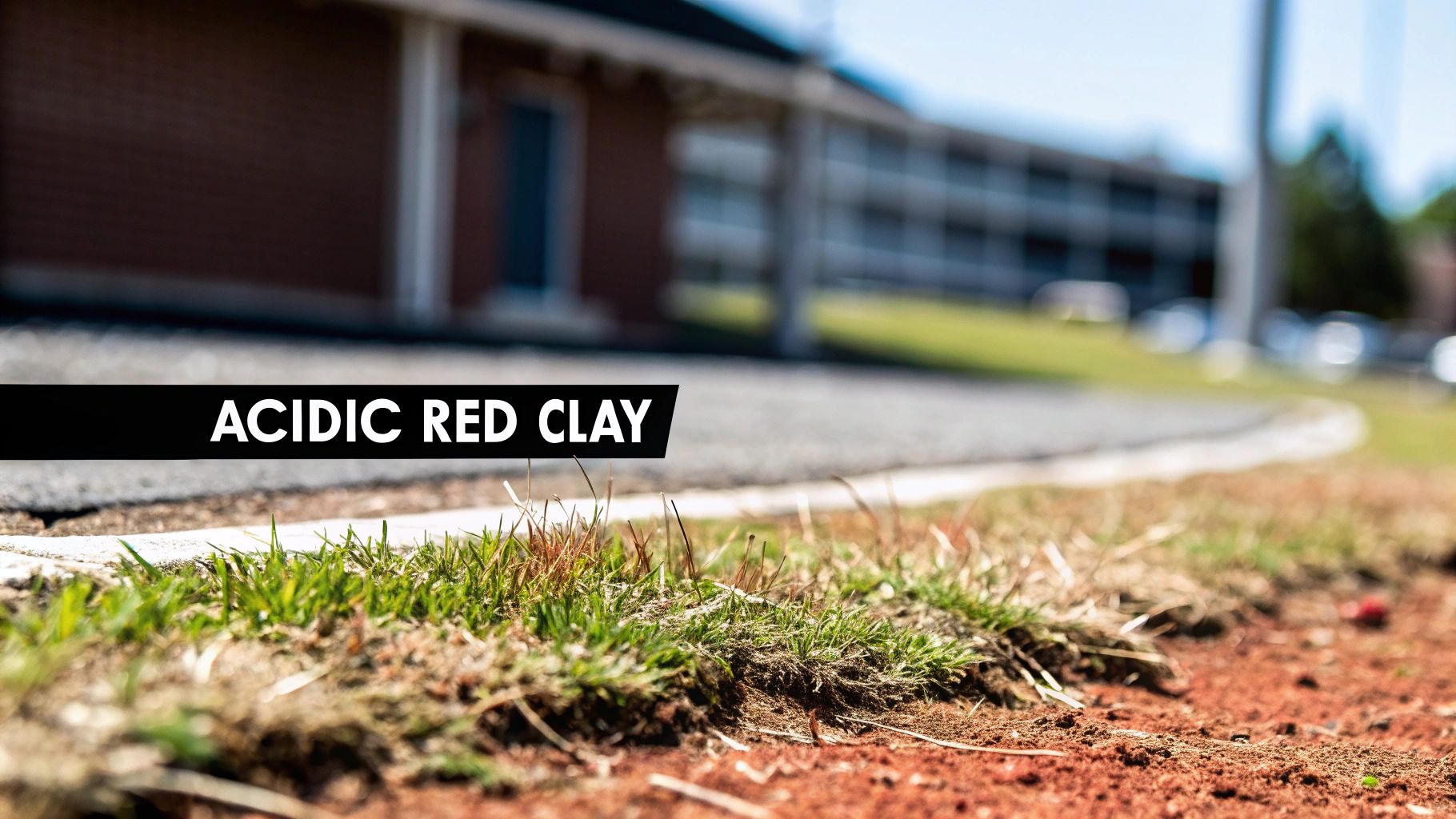
If you've ever tried to dig a hole anywhere from Johns Creek to Dahlonega, you know all about our famous red clay. It's a signature of the North Georgia landscape, but it can be a real headache for anyone trying to grow a lush, green lawn. The root of the problem is its natural chemistry.
Our clay is naturally acidic, and the heavy rainfall we get just makes it worse. As all that rain soaks into the ground, it washes away (or leaches) crucial alkaline minerals like calcium and magnesium. Over time, this process drives the soil's pH down, making it more and more "sour."
The Problem with Low pH
When soil pH drops too low, it basically creates a toxic environment for your grass. The acidity "locks up" vital nutrients, making them chemically unavailable to the roots. You could be spreading the most expensive fertilizer in the world, but if your soil is too acidic, your grass is just starving.
Imagine transforming your North Georgia lawn from a patchy, struggling mess into a lush, vibrant green carpet safe for kids and pets. That journey starts by fixing the acidic soil—a common issue in areas like Cumming, Alpharetta, and Forsyth County, where red clay soils often dip below the ideal pH of 6.5. Globally, the average soil pH is around 6.36, but in humid regions like our own, it often skews acidic, sometimes dropping to 5.5 or even lower. This stresses your turf and rolls out the welcome mat for weeds.
This nutrient lockout is exactly why so many lawns in Milton and Alpharetta look weak and patchy, no matter how much their owners fertilize and water them.
Spotting the Signs of Acidic Soil
So, how do you know if your lawn is crying out for help? The symptoms of acidic soil are easy to mistake for other problems, but when you see a few of them together, they paint a pretty clear picture of a pH imbalance.
Before you even grab a soil test, you can look for some common clues. This table breaks down what you might be seeing and why it's happening.
Signs Your North Georgia Soil Might Be Too Acidic
| Symptom | What You See in Your Lawn | Why It Happens |
|---|---|---|
| Persistent Weeds | Lots of crabgrass, dandelions, or plantain popping up everywhere. | Many common weeds actually prefer acidic conditions where your grass struggles to compete. |
| Yellowing Turf | Your grass looks pale green or yellowish, even right after you fertilize. | This is a classic sign of nutrient deficiency—the low pH is preventing the grass from absorbing nitrogen. |
| Moss Takeover | Patches of moss are creeping into thin or bare spots in your lawn. | Moss thrives in damp, shady, acidic soil. It's a huge red flag that your pH is too low for grass. |
| Poor Fertilizer Response | You apply fertilizer, but the lawn just doesn't green up or look any healthier. | The nutrients are there, but the soil's chemistry has them "locked up" and unavailable to the roots. |
Seeing one or two of these issues is a good reason to investigate further. If your lawn checks multiple boxes, it's almost certain your soil pH is the culprit.
Understanding this connection between our red clay, our weather, and your soil's pH is the first real step toward getting the dense, healthy lawn you're after. Of course, acidity isn't the only challenge; many homeowners also have to deal with damage from pets. For those specific issues, you can find a good Dog Urine Lawn Treatment guide to help.
Ultimately, realizing this is a fundamental soil health problem—not just a lawn problem—is what makes a simple soil test the most powerful tool you have.
How to Properly Test Your Soil's pH
Before you even start thinking about how to make your soil less acidic, you need a baseline. You have to know your starting point.
Guessing your soil's pH is like trying to navigate the backroads of Dahlonega without a map—you’ll just waste time, effort, and money on amendments that might do more harm than good. An accurate pH reading is the foundation of any effective lawn care strategy.
The good news? You've got options, from quick DIY kits to comprehensive professional lab analyses. Each has its place, depending on the level of detail you need.
DIY Soil Kits vs. Professional Lab Testing
When it's time to test, you can go one of two routes. Walk into any local garden center in Alpharetta or Cumming, and you'll find simple, inexpensive DIY soil test kits. These usually come with a test tube, a powder capsule, and a color chart. They're fine for a quick, ballpark estimate of your soil's pH.
The big drawback, however, is their accuracy. A DIY kit might tell you your soil is acidic, but it won’t give you the precise number you need to calculate exactly how much lime to spread. It also won't tell you a thing about critical nutrient levels, like phosphorus or potassium.
For a much clearer and more actionable picture, a professional lab test is the only way to go. Here in Georgia, the UGA Extension is a fantastic resource. Their soil tests deliver a precise pH reading along with a full nutrient analysis. Most importantly, they provide specific recommendations on exactly how much lime your lawn needs per 1,000 square feet. This completely removes the guesswork.
We’ve known for decades that acidic soils dominate the U.S. Southeast. While the topsoil pH might hover around 6.3, the subsoils in rainy areas like ours can drop dramatically. Below a pH of 5.5, crucial nitrogen-fixing bacteria simply can't function. A proper soil test is the only way to know what’s really going on under the surface.
How to Collect a Reliable Soil Sample
An accurate lab result starts with a good sample. Grabbing a single scoop of dirt from one random spot just won't do, as pH can vary quite a bit across your property. To get a true average, you need to collect a composite sample.
Here’s how we get a reliable sample from lawns in Johns Creek and Milton:
- Get your tools ready. You'll need a clean plastic bucket, a garden trowel or soil probe, and the sample bag from the lab. Make sure not to use a galvanized or brass bucket, as the metals can contaminate your sample and skew the results.
- Take samples from multiple spots. Walk your lawn in a zigzag pattern and collect 10-15 small cores of soil from different areas. Before digging, pull back any grass or thatch on the surface.
- Dig to the right depth. You want to test the root zone where the action happens. For an established lawn, aim for 4-6 inches deep. For a vegetable or flower garden, go a bit deeper, to about 6-8 inches.
- Mix it all up. Throw all your small samples into the clean bucket and mix them together thoroughly. This gives you a single, representative sample of your entire lawn's soil.
- Prepare it for the lab. Scoop out about one or two cups from your mixed soil and spread it on a newspaper to air dry. Don't try to speed things up with a heater. Once it's dry, pop it in the sample bag and send it off.
This process ensures the report you get back is a true reflection of your lawn's current condition. If you want a more detailed walkthrough, feel free to check out our dedicated guide on how to test soil pH.
Picking the Right Soil Amendment for Your Lawn
Alright, you've got your soil test results back. That piece of paper is your roadmap, telling you exactly what’s going on beneath your grass. Now comes the fun part: choosing the right tool for the job. Raising your soil's pH isn't a one-size-fits-all solution, especially with the unique red clay we have here in North Georgia.
What you choose will really depend on what your soil is missing, how quickly you need to see results, and your overall philosophy on lawn care. For most folks around Cumming and Alpharetta, the answer is usually lime, but even that simple answer has a few wrinkles.
The Great Lime Debate: Calcitic vs. Dolomitic
Head over to any garden center, and you’ll see big bags of agricultural lime. It's the most straightforward and effective way to raise soil pH. But you'll probably spot two main types: calcitic lime and dolomitic lime. Knowing the difference is crucial for giving your Georgia lawn exactly what it craves.
- Calcitic Lime: This is basically just calcium carbonate. It’s perfect if your soil test shows a low pH but your magnesium levels are already in the healthy range.
- Dolomitic Lime: This one’s a two-for-one deal, containing both calcium carbonate and magnesium carbonate. Our heavy clay soils in places like Forsyth County are notorious for being low in magnesium. If your UGA Extension report flags a magnesium deficiency, dolomitic lime is hands-down the best choice. It fixes the pH and adds that essential secondary nutrient in one go.
Honestly, for most of us battling that signature red clay, dolomitic lime is the smarter play. It tackles two common problems at once, improving everything from how your grass absorbs nutrients to the very structure of the soil itself.
Natural and Alternative Options to Consider
While lime is definitely the king of pH adjustment, it’s not the only option on the table. If you're in Milton and prefer a more organic approach, or just want to use resources you already have, there are a couple of other effective choices.
One popular alternative is wood ash from your fireplace or fire pit. Wood ash is highly alkaline and works much faster than lime to get that pH number up. But—and this is a big but—that speed comes with a serious warning: it is incredibly easy to overdo it. A little goes a very long way, and dumping too much can send your pH skyrocketing in the other direction, creating a brand new headache.
Expert Tip: If you decide to go the wood ash route, apply it like you're just dusting a cake—very lightly. And never, ever use ash from treated, painted, or manufactured wood, as it can leach nasty chemicals into your soil.
Picking the right amendment is the most critical step after testing. Here’s a quick breakdown to help you decide.
Comparing Common Soil Amendments for North Georgia Lawns
| Amendment | Best For | Speed of Action | Key Benefit |
|---|---|---|---|
| Dolomitic Lime | Acidic clay soils low in magnesium | Slow to Moderate | Raises pH and adds essential calcium and magnesium simultaneously. |
| Calcitic Lime | Acidic soils with adequate magnesium levels | Slow to Moderate | Purely raises pH with a strong dose of calcium. |
| Wood Ash | A quick pH boost for very acidic soils | Very Fast | A natural, fast-acting amendment, but requires careful application. |
| Compost | Long-term soil health and gentle pH buffering | Very Slow | Improves soil structure, adds organic matter, and slowly buffers pH over time. |
As you can see, the best choice really depends on what your soil test tells you and how you want to manage your lawn's health.
The Slow-and-Steady Power of High-Quality Compost
For homeowners truly committed to a natural lawn care program, you just can't beat high-quality compost. It won't raise pH as dramatically or as quickly as lime, but its long-term benefits for our stubborn clay soil are absolutely huge.
Think of compost as a natural pH buffer. It gently nudges acidic soil toward a healthier, more neutral range over time. Even more importantly, it works wonders on soil structure. Adding that rich organic matter to our dense clay helps with aeration and drainage, breaks up compaction, and feeds the microscopic life that forms the foundation of a healthy lawn ecosystem.
This holistic approach doesn’t just put a band-aid on a symptom (low pH); it fundamentally improves the health of your soil. The market for these solutions is growing fast, with the global soil pH adjusters market expected to reach USD 7.72 billion by 2033. It’s not just hype; solid research shows that raising soil pH from 6.2 to 7.2 can increase grass root biomass by a whopping 24%, making your lawn tougher against our brutal Georgia summers. You can dive into the full research on the impact of soil amendments to see the data for yourself.
By making compost a regular part of your routine, you're not just tweaking chemistry—you're building a resilient, healthy foundation that will support a beautiful green lawn for years to come.
Applying Soil Amendments for the Best Results
Okay, you've got your soil test results and you've picked out your amendment. Now for the fun part: putting that data to work and actually transforming your soil. Applying these amendments correctly is more than just slinging pellets around; it’s about precision, timing, and using the right technique to get that material down where it can start making a real difference.
Calculating Your Application Rate
That soil test report is your roadmap. It takes all the guesswork out of the equation by telling you exactly how much lime (or whatever you're using) your lawn needs, almost always in pounds per 1,000 square feet. Trying to wing it without this information is a recipe for disappointment.
Let's walk through a real-world example. Say you've got a 5,000-square-foot lawn in Johns Creek, and your UGA Extension report recommends 50 pounds of dolomitic lime per 1,000 square feet. The math is simple:
- First, figure out how many "units" of 1,000 sq. ft. you have: 5,000 sq ft / 1,000 sq ft = 5.
- Next, multiply the recommended rate by that number: 50 lbs x 5 = 250 pounds of lime needed for the entire lawn.
Getting this right is critical. If you use too little, you'll barely move the needle on your pH. If you use too much, you can overshoot your target and make the soil too alkaline, which brings a whole new set of headaches.
The Right Tools and Technique for Even Coverage
Once you know your total, the challenge is spreading it evenly. You're aiming for consistent, uniform coverage—not a striped, patchy mess. For pretty much any homeowner in Alpharetta or Cumming, the best tool for the job is a broadcast spreader.
I see a lot of people try to use a drop spreader, and it's almost always a mistake for this task. Drop spreaders are great for creating sharp edges along a driveway, but they leave distinct stripes in the lawn, leading to uneven pH correction. A broadcast spreader, however, throws the material in a wide, overlapping arc, which is exactly what you want for a uniform application.
Here's the technique we use to get it perfect every time:
- Calibrate first. Start with the setting suggested on the product bag, but don't be afraid to tweak it.
- Cut the rate in half. Set your spreader to apply only half of the total amount you calculated.
- Walk the lawn in one direction. Cover the entire area walking in a north-south pattern.
- Crisscross your path. Fill the spreader with the remaining half and do it all again, this time walking east-west.
This two-pass, crisscross method is a simple pro tip that guarantees every square inch gets covered, eliminating stripes and missed spots. It makes a huge difference.
This diagram shows the most common choices for raising your soil's pH and getting it back in balance.
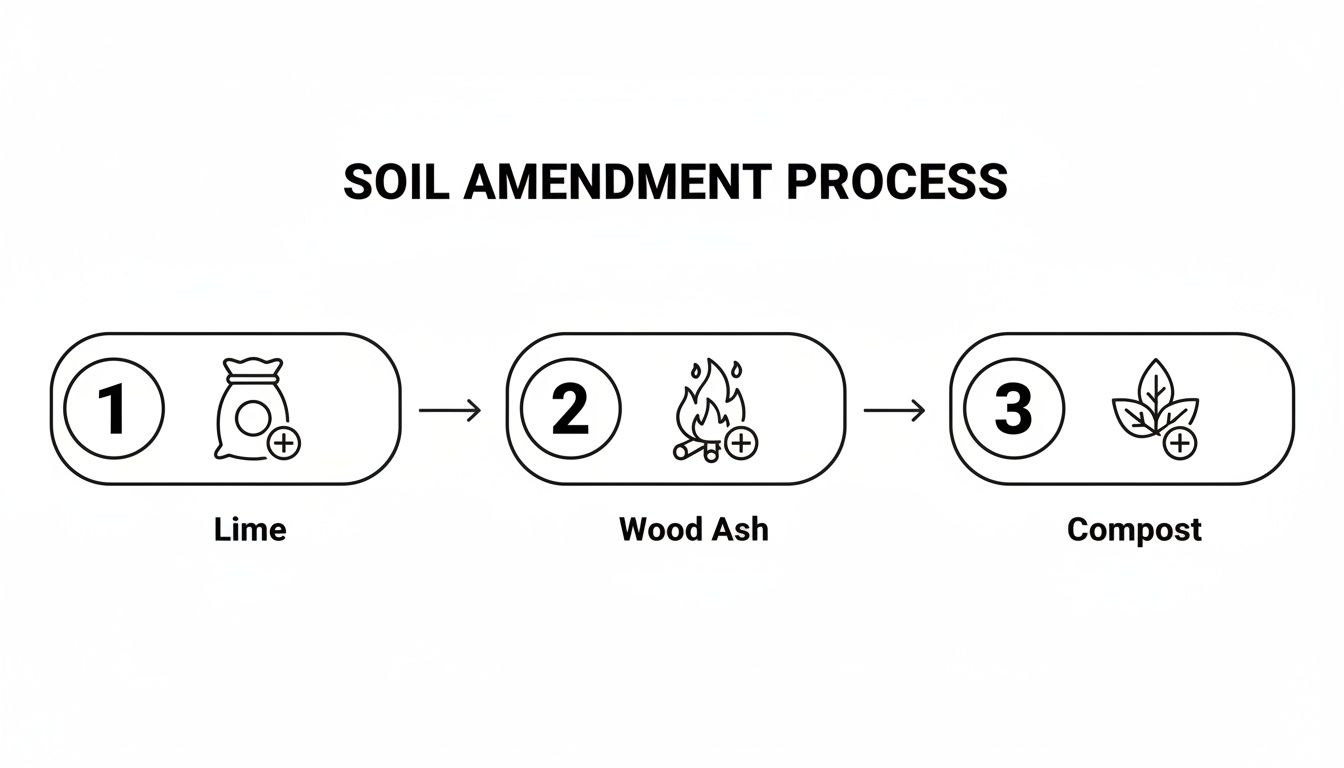
As you can see, lime, wood ash, and compost can all get the job done, but they offer different benefits and work on different timelines.
Timing Is Everything in North Georgia
When you apply lime is just as crucial as how you apply it. For us here in North Georgia, from Cumming all the way up to Dahlonega, the absolute best time to apply lime is in the fall and winter.
There are a couple of solid reasons for this. For one, our local turf grasses like fescue and Bermuda are dormant, so there’s no risk of burning them. More importantly, the natural freeze-thaw cycles of a Georgia winter, combined with rain and snow, do a fantastic job of breaking down the lime and working it deep into our stubborn clay soil. This gives the lime months to react with the soil, so by the time spring rolls around, your lawn's pH is already on the rise and ready for new growth.
The Pro Move: Pairing Lime with Core Aeration
Want to get the absolute most out of your lime application and see results faster? Combine it with core aeration. It’s a game-changer.
Our heavy North Georgia clay gets compacted easily, making it tough for anything—water, air, or lime—to get down to the roots. Core aeration pulls up small plugs of soil, creating thousands of tiny channels into the root zone.
When you spread your lime right after aerating, the granules fall directly into those holes. This gives the amendment a shortcut, getting it deeper into the soil profile where it can work its magic much more quickly. For more details on the process, check out our guide on how to apply lime to your lawn in North Georgia.
Common Mistakes to Avoid When Raising Soil pH
Even with the best intentions, it's easy to make a few missteps when trying to sweeten up your soil. We see it all the time with homeowners from Dahlonega to Johns Creek. Learning from these common errors will save you time, money, and a whole lot of frustration down the road.
Applying Lime Without a Soil Test
This is the big one. The single biggest mistake you can make is applying lime based on a guess. It’s like driving blindfolded down Highway 400—you might be headed in the right direction, but you have no idea where you're really going.
You might think your soil is acidic, but you don't know how acidic. If you apply too little, you've wasted your effort and won't see any real change. But apply too much, and you can send your pH skyrocketing past the ideal range, making the soil too alkaline. That just trades one problem for another, locking up a whole new set of nutrients your grass desperately needs.
A soil test from the UGA Extension is your roadmap. It takes all the dangerous and expensive guesswork out of the equation, telling you exactly where you're starting and how much lime to apply.
Applying Too Much, Too Fast
So, you got your soil test results back and you're ready to go. It can be tempting to dump the entire recommended amount on your lawn at once, hoping for a quick fix. This is a classic mistake. Over-applying lime can shock the soil's chemistry and can even burn your turf.
A critical rule of thumb we follow for lawns in Alpharetta and Cumming is to never apply more than 50 pounds of lime per 1,000 square feet in a single application. If your soil test calls for more than that, you absolutely must split it up. Plan for two separate applications, ideally one in the fall and another in the spring.
This gradual approach lets the soil adjust safely and effectively. You're trying to nurture an ecosystem, not overwhelm it.
Expecting Overnight Results
Look, correcting years of soil acidity is a marathon, not a sprint. Lime is a slow-acting amendment, especially when working with our dense North Georgia clay. It needs time, moisture, and microbial activity to break down and actually change the soil chemistry.
You won't see a dramatic transformation in a week or even a month. True success is a gradual process that unfolds over several months to a year. Instead of looking for an instant green-up, watch for these subtle but important signs of improvement:
- Deeper Green Color: Your lawn will slowly develop a richer, deeper hue as nutrients become more available.
- Fewer Weeds: As the turf thickens and gets healthier, it will naturally start to crowd out those pesky acid-loving weeds.
- Better Fertilizer Response: When you do fertilize, you'll notice a much more significant and lasting green-up than before.
Setting realistic expectations is key here. Think of this as a long-term investment in your soil's health, not a quick cosmetic fix. By avoiding these common pitfalls, you set yourself up for real, lasting success. While some DIY solutions might seem tempting, it's worth noting the risks; for instance, you can learn more about why using common household items like baking soda on your lawn is often a bad idea.
Answering Your North Georgia Soil Health Questions
Even with the best plan, questions always pop up. Over the years, we've heard just about everything from homeowners across Cumming and Alpharetta. Here are a few of the most common things people ask as they start improving their soil.
How Long Does It Take for Lime to Actually Work?
This is probably the number one question we get, and the answer is: it’s a marathon, not a sprint. Adjusting soil pH is a gradual process. You’ll typically start to see meaningful changes in your soil's pH over the course of 6 to 12 months.
The exact timing really depends on a few things: the type of lime you use, your specific soil composition, and whether you paired the application with core aeration. Aeration is a huge help here in North Georgia because it opens up channels for the lime to work its way down into our dense clay.
Is Pelletized Lime Safe for My Kids and Pets?
Absolutely, as long as it's applied correctly. Pelletized lime is a safe and effective option for family lawns. The key is to water it in thoroughly after application. Once the pellets have dissolved and soaked into the soil, the area is perfectly safe for your kids and pets to get back to playing.
Of course, having a professional handle the application gives you that extra peace of mind, knowing it's been done correctly and safely from the start.
Key Takeaway: In acidic soil, nutrients from fertilizer get chemically 'locked up' and are unavailable for your grass to absorb. Correcting the pH is essential to unlock your soil's potential and get the full benefit of any fertilizer you apply.
Can I Just Use More Fertilizer Instead of Lime?
I hear this a lot, especially around the Johns Creek area, but it's a mistake that can waste a lot of time and money.
Think of it this way: your lawn might be sitting at a feast, but if its mouth is taped shut, it can't eat. Acidic soil "tapes the mouth shut" by locking up nutrients. Piling on more fertilizer won't solve the problem. You have to fix the pH first so your grass can actually absorb the food you’re giving it.
Stop guessing and start building a healthier, safer lawn today. The experts at Barefoot Organics specialize in natural lawn care solutions perfect for North Georgia’s unique soil. Get your free, no-obligation quote by visiting our website at https://barefootorganicsllc.com.