

If you want to fix your soil, you first need to know what you're working with. For most of us here in North Georgia, that means dealing with dense red clay. The goal is to add the right amendments—usually organic matter—to break up that compaction, balance the pH, and create a foundation where your grass can finally put down deep roots and thrive.
Tackling North Georgia's Famous Red Clay
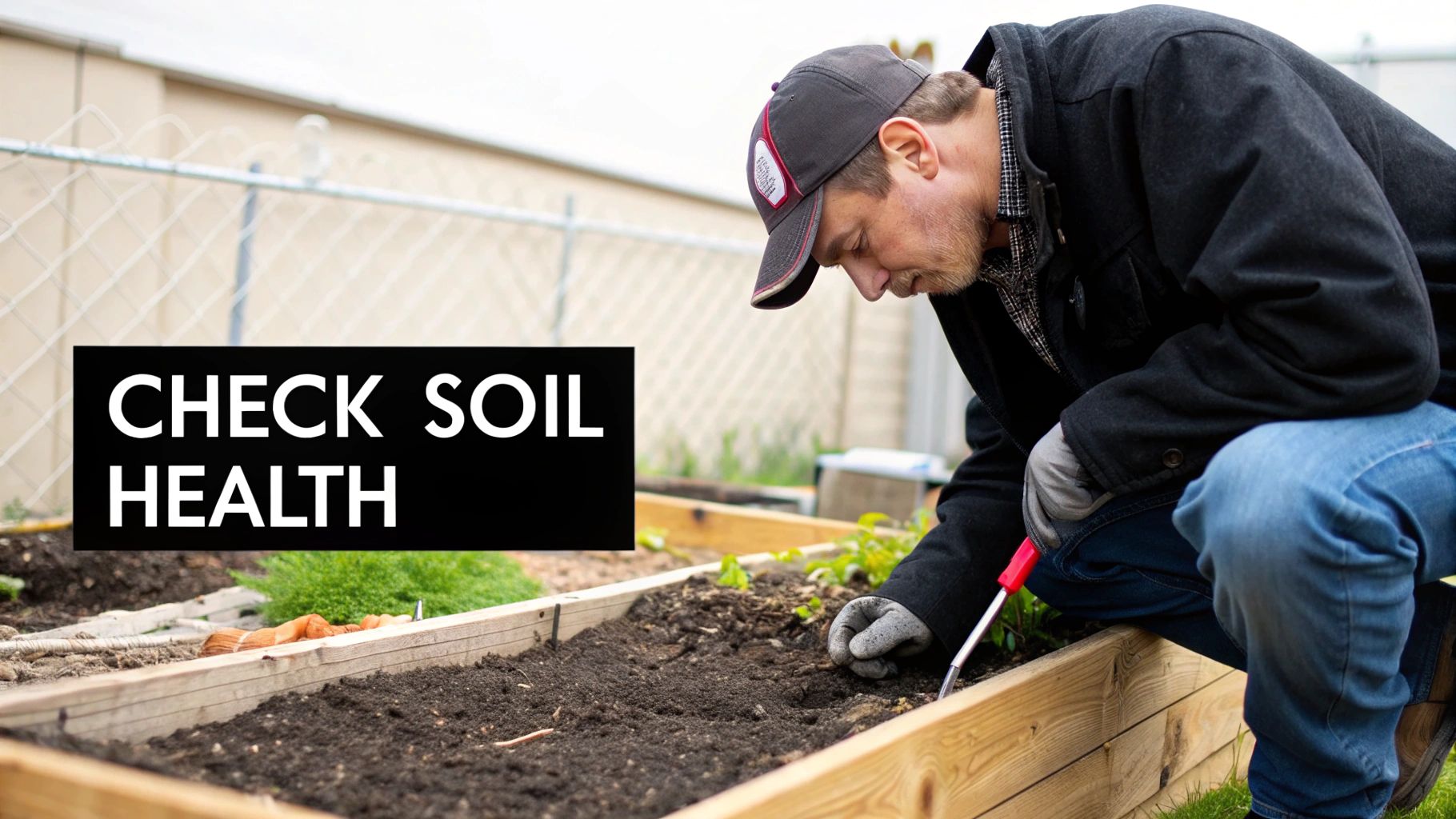
Anyone who's tried to grow a lawn in Cumming, Alpharetta, or Milton knows the struggle all too well. It’s not just a color; that infamous Georgia red clay is a stubborn, dense foundation that seems to fight you every step of the way.
It’s a frustrating cycle, isn't it? You water, you fertilize, you do everything you're supposed to, but the results are just… meh. The real problem isn't your grass seed or your fertilizer schedule. It's the very ground your lawn is trying to survive in.
Why Is Georgia Clay So Frustrating?
Our local soil has a unique makeup that creates a few major headaches for homeowners. Once you understand what’s happening beneath the surface, you can start to fix it for good.
-
Rock-Hard Compaction: Clay is made of tiny, fine particles that get squeezed together over time, especially after new construction or even just from kids playing in the yard. This creates a layer that’s almost as hard as concrete, suffocating the roots and starving them of air and water.
-
Awful Drainage: Ever notice big puddles on your lawn that stick around for hours after a storm? That’s compacted clay at work. Water can't drain through it, creating soggy, bog-like conditions that are a perfect breeding ground for lawn diseases.
-
Nutrient Lock-Up: Our clay is also typically acidic. A low pH has a nasty side effect: it chemically "locks up" vital nutrients in the soil. That means your grass can't access the nitrogen and phosphorus it needs to be healthy, no matter how much you fertilize.
The secret to a truly great North Georgia lawn isn’t just about feeding the grass on top. It’s about completely changing the structure and chemistry of the soil underneath. You have to learn to work with the clay, not against it.
This is exactly why generic, one-size-fits-all lawn care advice so often fails here. We have to get to the root of the problem by improving the soil’s physical and chemical properties.
It’s a local problem with global significance. Experts are sounding the alarm, predicting that if we continue on our current path, a shocking 95% of the Earth’s land could be degraded by 2050. This has huge implications for our food supply. You can read more about these global soil degradation trends on earth.org. By starting in your own yard, you're doing your small part for better land stewardship.
Stop Guessing and Start Testing Your Soil
Before you throw down a single bag of fertilizer or lime, you need to know what you’re working with. A soil test is the single most important first step you can take. Think of it as a blood test for your lawn—it gives you a precise, scientific baseline that reveals exactly what’s happening down in the root zone.
So many homeowners I see in the Johns Creek and Alpharetta areas are working blind. They end up wasting a lot of money on products their soil doesn’t even need, all because they skipped this foundational step. A simple test takes all the guesswork out of the picture.
Why a Soil Test Is a Must-Do in North Georgia
The process couldn't be easier, and the payoff is huge. All you have to do is grab a few small soil samples from different spots in your lawn, toss them together in a clean bucket, and drop the combined sample off at your local UGA Extension office. If you're in Forsyth County, there’s one right in Cumming, and every other county has one too.
In about two weeks, you'll get back a detailed report. This isn't just a sheet of confusing numbers; it’s a personalized prescription for your lawn's health.
Your soil test report is your roadmap. It translates the chemistry of your soil into a clear to-do list, making sure every dollar you spend and every action you take is targeted, effective, and right for your yard.
This one step prevents you from over-fertilizing, which is bad for your wallet and the local environment. More importantly, it stops you from applying amendments that do absolutely nothing to fix the real issues baked into our famous red clay.
Decoding Your North Georgia Soil Test Results
When you get that report back from the UGA lab, it's going to have a lot of information. Don't get overwhelmed. You just need to focus on a few key metrics to build a solid soil improvement plan.
Use this quick reference to understand the key metrics on your local soil test report and what they mean for your lawn.
Decoding Your North Georgia Soil Test Results
| Metric | Ideal Range for Lawns | Common Georgia Clay Reading | What It Means for Your Lawn |
|---|---|---|---|
| Soil pH | 6.0 – 7.0 | 4.5 – 5.5 | At low pH levels, essential nutrients get "locked up" and become unavailable to your grass, no matter how much you fertilize. |
| Phosphorus (P) | Medium to High | Often Low | Crucial for root development, especially for new grass. Our clay often holds onto phosphorus tightly, making it hard for plants to access. |
| Potassium (K) | Medium to High | Varies | Helps with overall plant health, drought tolerance, and disease resistance. Deficiencies are common. |
| Calcium (Ca) | High | Often Low | Directly tied to pH. Low calcium is a tell-tale sign of acidic soil that needs lime to raise the pH. |
| Magnesium (Mg) | Medium to High | Usually Sufficient | A key component of chlorophyll. It's less of a concern here than Calcium, but the test will flag any major deficiency. |
Once you understand these numbers, you can confidently choose the right products and a plan of attack that will actually work.
Your report will point you to the most critical numbers, but the soil pH is king here in Georgia. Our native clay is naturally acidic, often with a pH well below 6.0. When the pH is that low, your grass is essentially starving because the acidity prevents it from absorbing nutrients in the soil. For a more detailed look at the process, check out our guide on how to test your soil pH.
The report will also give you readings for the big three macronutrients: Nitrogen (N), Phosphorus (P), and Potassium (K). These are the N-P-K numbers on every fertilizer bag. Your test will recommend the specific ratio your lawn is hungry for.
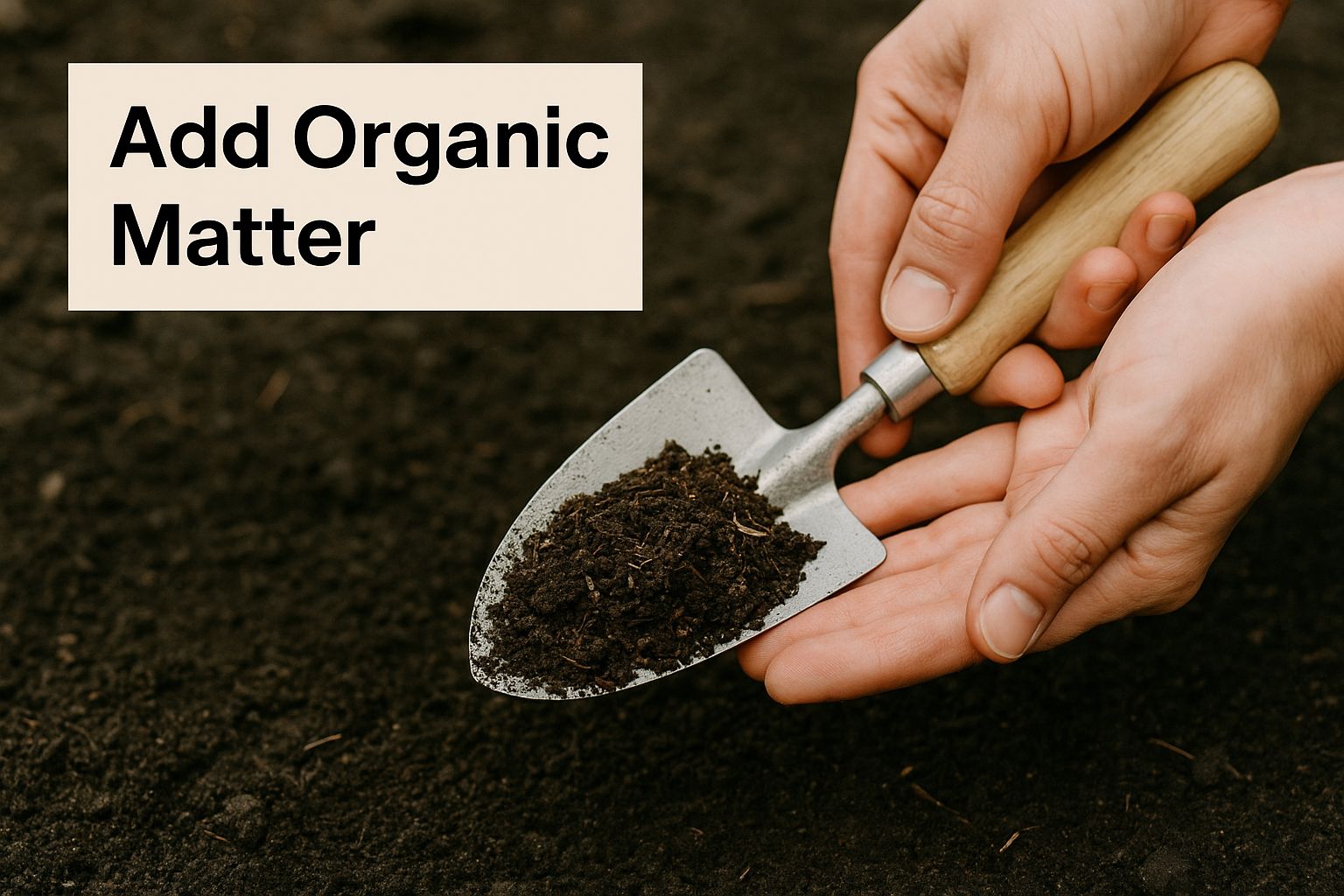
Regardless of what your test says, one of the best things you can do is consistently add high-quality organic matter. A topdressing of good compost helps break up compacted clay, lets water and air penetrate the soil, and provides a slow-release buffet of nutrients for your turf.
With these insights from your soil test, you're officially ready to start amending your soil and bringing it back to life.
The Best Amendments for Georgia Clay
With your soil test results in hand, you’ve got a clear roadmap of what your lawn is crying out for. Now comes the fun part: picking the right tools to fix the problem. For those of us dealing with lawns in Cumming, Alpharetta, and nearby, this usually means finding amendments that can tackle our infamous dense, compacted red clay and build a healthier foundation.
The real goal here isn’t just to throw fertilizer at the grass. It's to fundamentally change the soil structure itself. You want to transform that hardpan clay into a more porous, crumbly, life-sustaining medium. The good news is that the best materials for the job are easy to find right here in North Georgia.
The Power of Organic Matter
If there's one silver bullet for improving Georgia clay, it’s organic matter. Think of it as the ultimate soil conditioner. When you add materials like compost, you’re introducing billions of beneficial microbes that get to work aggregating tiny clay particles. This creates natural channels for air and water to move through.
This is the secret to improving your soil’s physical structure. A brand new lawn in a Milton subdivision, built on subsoil that's been scraped clean, has almost zero organic content. On the other hand, an older, established yard in Dahlonega might have a decent base but still suffer from compaction from years of foot traffic. In both scenarios, compost is the answer.
A study from the Global Assessment of Land Degradation and Improvement (GLADA) found that while 28.5% of the Earth's land is degrading, targeted policies have improved biological productivity on 26% of global land. This just goes to show that proactive, sustainable soil management practices really do work.
Adding organic matter kickstarts a natural process. It improves drainage, boosts nutrient availability, and makes your soil far more resilient to our local weather extremes, from summer droughts to heavy downpours.
Building Your Soil Amendment Shopping List
When you head to the local garden center, you’ll find a few key products that are perfect for our local soil. Each one plays a slightly different, but crucial, role in bringing your soil back to life.
Here are the top amendments I always recommend:
- Organic Compost: This is the non-negotiable champion. High-quality compost introduces a massive diversity of microbial life and stable organic matter. It’s the single fastest way to improve your soil’s texture and fertility. The https://www.barefootorganicsllc.com/host-compost-benefits/ are extensive, and well worth learning about.
- Pine Bark Fines: You might see this labeled as "soil conditioner." These finely shredded pine bark pieces are fantastic for physically breaking up compaction. Their larger particles wedge between the tiny clay platelets, creating immediate improvements in aeration and drainage. Plus, they decompose slowly, offering long-term structural benefits.
- Lime: Your soil test almost certainly recommended lime, and for good reason. Lime is essential for raising the naturally low pH of our acidic clay. By neutralizing the soil, you "unlock" nutrients that are already present but inaccessible to your grass roots. You’ll see two main types: dolomitic lime (contains magnesium) and calcitic lime (higher in calcium). Your soil test should specify which one is best for your yard.
By combining these amendments, you create a powerful blend that addresses Georgia clay’s biggest challenges all at once: compaction, poor drainage, and acidity. This is how you build a healthy, living soil ecosystem from the ground up, not just for this season, but for years to come.
Give Your Lawn Some Breathing Room: Aeration and Topdressing
Adding amendments is a great start, but to really tackle North Georgia's compacted clay, you have to get physical. Two key practices—core aeration and topdressing—are the one-two punch your lawn needs. This combination doesn't just offer a temporary fix; it physically breaks up that rock-hard soil and builds a brand-new, healthy foundation from the ground up.
Imagine your lawn's soil is like a hard, dry sponge. Pour water on it, and most of it just rolls right off. Aeration is like poking thousands of tiny holes in that sponge, creating channels for water, air, and nutrients to finally soak down deep to the roots.
Why Core Aeration Is a Must for Clay Soil
When we talk about aeration, we mean core aeration. This is where a machine physically pulls small plugs, or "cores," of soil out of the ground. It's not just about poking holes; it's about removing chunks of compacted soil, which is an absolute game-changer in places like Cumming and Johns Creek where heavy clay is the standard.
This process gives your lawn immediate relief from compaction. Suddenly, there are channels for everything your grassroots have been starving for.
You'll see those little soil plugs all over the lawn, and while they might look a bit messy, they’re actually little goldmines of microbes. Over the next week or two, they'll break down and return valuable organic matter right back to the soil surface.
This kind of soil work is more important than ever. Globally, we're facing a soil crisis. Right now, a staggering 75% of the world's soils are degraded, which impacts 3.2 billion people. If we don't change course, that number could hit 90% by 2050. Global organizations are working to reverse this trend, which just goes to show that improving the soil—even in your own yard—is a crucial effort. You can discover more insights about these global soil health initiatives from UNESCO.
The Perfect Partner: Topdressing
The absolute best time to topdress is right after you aerate. Think of it as the perfect follow-up. Topdressing simply means spreading a thin layer (about a quarter-inch) of rich, organic material like compost over the entire lawn.
With all those fresh holes from aeration, the nutrient-dense compost falls directly into the root zone, exactly where you want it.
This isn’t just about feeding your grass for one season. It’s about building a new layer of topsoil over time. You are permanently improving the structure, drainage, and fertility of the ground your lawn lives on.
Timing is everything, and it really depends on what kind of grass you have here in the Alpharetta area:
- For Fescue lawns: The sweet spot is in the fall, from September to November. This gives the cool-season grass plenty of time to recover and establish strong roots before winter.
- For Bermuda lawns: You'll want to aim for late spring or early summer, typically May through July. This is when warm-season grass is growing at its peak and will fill in quickly.
A high-quality topdressing mix introduces a fresh army of microbes and organic matter that immediately gets to work breaking down the surrounding clay. It's a slow but steady process that transforms dense, lifeless clay into a crumbly, living soil ecosystem.
If you want to see how this can bring a struggling lawn back to life, you can learn more about our professional top dressing application. It truly is the secret to getting that thick, resilient turf you’ve been aiming for.
Keep Your Soil Healthy for the Long Haul
So you’ve put in the hard work of testing, amending, and topdressing your soil. That’s a huge step, but the job isn't quite finished. Think of it less like a one-and-done project and more like the start of a new, healthier relationship with your lawn.
The goal now shifts to simple, sustainable practices. This ongoing maintenance protects your investment and ensures your lawn doesn’t just survive but actually thrives, season after season, building real resilience against our unpredictable North Georgia climate. You're trying to create a self-sustaining cycle where the soil gets better all on its own.
Adopt Smarter Lawn Care Habits
One of the most effective, and easiest, ways to continuously feed your soil is a practice called grasscycling. It sounds fancy, but it just means leaving the grass clippings on your lawn after you mow. Don't bag them!
Those little clippings are packed with nitrogen and other nutrients. They break down quickly, feeding the soil and building up that crucial layer of organic matter. It’s basically a free, all-natural fertilizer treatment every time you cut the grass.
Watering habits also play a huge role. Many homeowners make the mistake of watering lightly every day. Instead, water deeply but less often. This simple change forces the grass roots to dig deeper for moisture, creating a tougher, more drought-tolerant lawn that won't wilt during those scorching summers we get in Alpharetta and Dahlonega.
Think of soil maintenance as a marathon, not a sprint. It’s the consistent, simple actions that build a resilient foundation. The payoff is a lawn that only gets healthier and stronger as the years go by.
When you combine these habits, you kickstart a powerful feedback loop. Healthier soil grows stronger grass, and that stronger grass contributes more organic matter back to the soil.
Your Seasonal Soil Maintenance Calendar
Keeping your soil in top shape follows a simple, predictable rhythm throughout the year. Knowing what to do and when to do it prevents things from feeling overwhelming. Here’s a straightforward calendar for homeowners in the Cumming area and beyond.
- Spring (March-May): As you fire up the mower for the season, start grasscycling from the very first cut. For warm-season grasses like Bermuda or Zoysia, this is also the window to apply a pre-emergent to head off crabgrass.
- Summer (June-August): Your main job is smart watering. Aim for one deep watering session per week that delivers about one inch of water. This is far better than several shallow sessions and is the key to deep root growth.
- Fall (September-November): This is prime time for fescue lawns. If you aerated and overseeded, this is when you’ll really see the fruits of your labor. It’s also the ideal time to do a follow-up soil test to check your progress.
- Winter (December-February): Your lawn is dormant, so active maintenance takes a backseat. Use this downtime to get your mower blade sharpened and plan for the year ahead.
Making it a habit to re-test your soil every two to three years is a game-changer. It shows you exactly how your efforts are paying off and helps you make minor, targeted tweaks instead of guessing. It’s the best way to ensure your lawn's foundation just keeps getting better.
Answering Your Georgia Soil Questions
Once you get into the nitty-gritty of testing and amending your soil, a few questions always pop up. It's only natural. Over the years, I've heard the same handful of concerns from homeowners in Cumming, Milton, and all over North Georgia as they start to really dig into their lawn care.
Let's tackle some of the most common ones right now.
How Long Does This Actually Take To Work?
This is always the first question, and it's a fair one. While you'll see some quick wins—like how much better your lawn soaks up water right after a core aeration—the real, lasting changes to the soil structure don't happen overnight. Think of it less like a quick fix and more like nurturing a living ecosystem beneath your feet.
You should start seeing a real difference in your lawn's color and thickness within one full growing season. But that incredible transformation from hard, red clay to rich, dark soil? That's a multi-year journey. The most important thing is staying consistent.
Don't lose heart if your yard doesn't look like a PGA fairway in three months. Great soil health is built season after season. Each time you aerate and topdress, you're adding another layer, building a permanently better foundation for your grass.
Is It Possible To Add Too Much Compost?
Absolutely, and it's a great question to ask. Compost is gold for our local clay, but you can definitely have too much of a good thing. Piling on a super thick layer can cause a few headaches for your lawn.
For one, a heavy blanket of compost can literally smother the grass, especially if you don't work it down into the aeration holes. It can also create a weird drainage situation where the compost layer gets waterlogged, but the dense clay underneath still won't let the moisture pass through.
When you’re topdressing your lawn, a little goes a long way:
- Stick to the right depth: You're aiming for a very thin layer, no more than 1/4 to 1/2 inch deep.
- Work it in: Once it's spread, grab a landscape rake and use the back of it to gently brush the compost down into the grass and fill in the aeration holes.
- Check your work: You should still be able to see plenty of grass blades poking up through the compost.
Keeping these tips in mind ensures your lawn gets all the incredible benefits without any of the unintended consequences.
What’s The Best Way To Handle Erosion on a Hill?
North Georgia has no shortage of hills, especially as you get up toward the Dahlonega area. Erosion is a massive problem on sloped yards, where one good thunderstorm can wash away your topsoil and all your hard work.
On a slope, core aeration is your single best tool. Those thousands of little holes act like mini reservoirs, catching rainwater and giving it a chance to soak deep into the soil instead of just running off. When you follow that up with a compost topdressing, you're helping to bind the soil particles together, making your yard far more resistant to washing out.
Ultimately, a thick, healthy lawn with a deep root system is the best erosion control nature ever designed.
Ready to stop guessing and start building the foundation for a beautiful, healthy lawn? The team at Barefoot Organics specializes in natural lawn care solutions perfectly suited for North Georgia's unique soil challenges. We use proven techniques like core aeration and premium topdressing to bring your soil back to life. Get your free online quote and see the difference our expert care can make.