

Getting rid of mushrooms for good is about more than just yanking them out of the ground. The real solution lies in changing the soil conditions that let them pop up in the first place. You need to tackle excess moisture, get rid of decaying organic material, and improve your soil's ability to breathe.
While fungi are a sign of a living, active soil ecosystem, a full-blown mushroom invasion tells you the balance is off. Your lawn has become too friendly for them.
Your Guide to a Mushroom-Free North Georgia Lawn
It’s always a little frustrating when a patch of mushrooms suddenly appears on your Cumming or Alpharetta lawn, especially when you've been working hard to keep it pristine. Your first instinct is probably to just pick them, but that's like trimming the leaves off a weed—it doesn't solve the problem. Those mushrooms are just the visible "fruit" of a massive underground network called mycelium.
This guide goes beyond the quick fixes. We’re going to dig into the root causes we see right here in North Georgia, from Cumming to Dahlonega, where our infamous heavy clay soil and humid climate create the perfect storm for fungal growth.
Understanding the Fungal Foe
Think of mushrooms as nature's cleanup crew. They pop up wherever there's decaying organic stuff to eat, breaking it down and cycling nutrients back into the soil. Here in areas like Johns Creek and Milton, that underground buffet is often plentiful.
So, what are they feasting on? Common culprits include:
- Buried wood from old construction projects or landscaping.
- The remains of an old tree stump and its sprawling root system.
- A thick, spongy layer of thatch (all that dead grass).
- Compacted soil that holds onto water for too long.
- Pet waste that hasn't been picked up.
Ultimately, their presence is a clear sign that your lawn's ecosystem is out of whack. This isn't just about looks; it's about the long-term health of your grass.
A Strategy for Lasting Control
Instead of playing whack-a-mole every time a new mushroom appears, we need a proactive strategy. The goal is to make your lawn an inhospitable place for fungi by cutting off their food and water supply and breaking up their preferred living conditions.
It’s fascinating to think that the global mushroom market, valued at USD 64 billion in 2024, hinges on precise environmental control. Commercial growers use advanced techniques to manage every variable and prevent unwanted fungal growth—we can apply that same core principle to our lawns. You can learn more about the scale of mushroom cultivation and management to see just how critical these factors are.
Consider mushrooms a messenger from your soil. They are telling you that there's too much moisture and a hidden food source underground. Listening to this message is the first step toward reclaiming your lawn.
By focusing on creating a healthier, more resilient yard, you won't just get rid of the mushrooms you see today. You'll stop them from coming back, season after season. Let’s get started on building that mushroom-resistant lawn.
When you first notice mushrooms, a quick and decisive response can make a big difference. Here’s a simple plan to follow.
Immediate Action Plan for Lawn Mushrooms
| Action | Why It's Important | What to Avoid |
|---|---|---|
| Pluck or Mow Them | Removes the visible part before it can release spores, which spread more fungi. | Don't kick them over. This just spreads spores everywhere. |
| Bag and Dispose | Prevents spores from escaping and finding new places to grow in your yard or compost bin. | Never add them to compost. You'll just reintroduce the problem later. |
| Identify Wet Spots | Mushrooms love moisture. Find the soggy areas that are encouraging their growth. | Don't ignore the problem. A few mushrooms can quickly become a colony. |
| Inspect for Debris | Look for buried wood, old roots, or thick thatch that could be feeding the fungus. | Don't use fungicides indiscriminately. Most are ineffective on the underground mycelium. |
Following these initial steps helps contain the immediate issue while you prepare to address the deeper, underlying causes in your soil.
Uncovering Why Mushrooms Are Popping Up in Your Yard
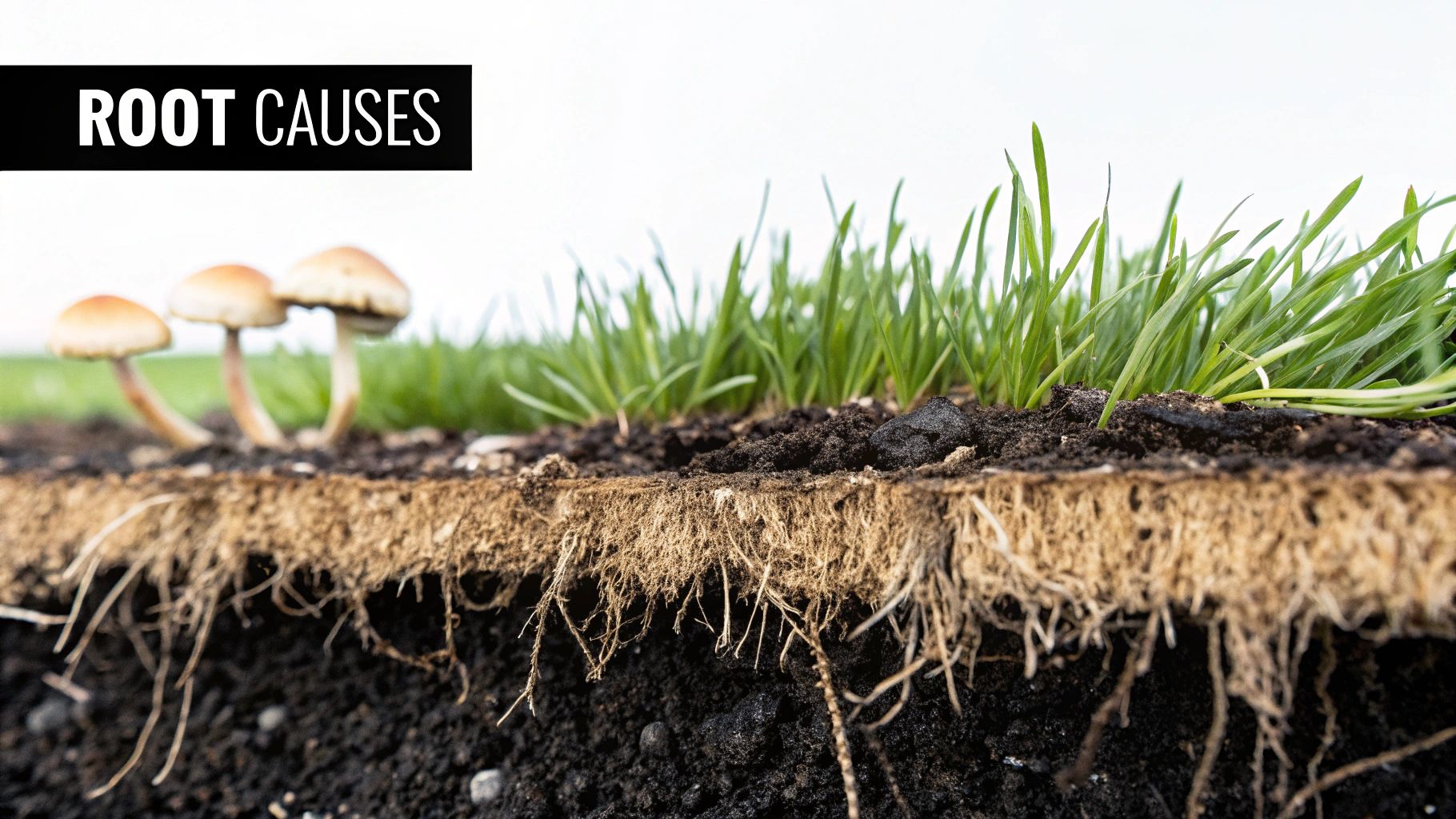
Before you can get rid of mushrooms for good, you need to play detective and figure out why they chose your yard in the first place. Mushrooms aren't just random annoyances; they're a clear signal that specific conditions are brewing right under your feet. Think of them as just the tip of the iceberg—the visible part of a vast underground fungal network called mycelium, which is nature's own recycling crew.
This hidden network needs two simple things to thrive: a steady source of moisture and plenty of organic material to eat. Here in North Georgia, from the damp springs in Dahlonega to the humid summers in Milton and Alpharetta, we have the moisture part covered. When you pair our climate with a hidden food source in your lawn, you’ve basically rolled out the red carpet for fungi.
The Hidden Feast Beneath Your Grass
Mushrooms are decomposers, which means they live to break down dead organic matter. Your lawn might look perfectly manicured on the surface, but underneath, it could be hiding an all-you-can-eat buffet for that mycelium. Finding and removing this food source is the single most important thing you can do for long-term mushroom control.
From our experience working on lawns across Cumming, Johns Creek, and the surrounding areas, these are the most common culprits:
- Old Tree Roots: Did a tree come down a few years ago? Its massive root system is likely still underground, slowly decaying and providing a long-lasting meal for fungi.
- Buried Construction Junk: It’s amazing what we find buried in yards. Builders often leave behind scrap wood and other organic debris, creating a jackpot for mushroom-producing fungi.
- Decomposing Mulch or Compost: A thick, old layer of mulch or compost that hasn't been properly integrated can turn into a fungal breeding ground. Learning how to apply compost correctly makes a huge difference.
- Heavy Thatch: That spongy layer of dead grass and roots between the soil and the green blades is called thatch. Once it gets thicker than half an inch, it holds moisture like a sponge and gives fungi a constant food supply.
- Pet Waste: Forgotten droppings from your furry friends are another rich organic snack that fungi are more than happy to clean up.
Our Notoriously Stubborn North Georgia Clay
Besides food, the soil itself is a huge factor. Anyone living in Cumming, Johns Creek, or anywhere in Forsyth County knows exactly what we’re talking about: our heavy, compacted red clay. This soil type is a unique headache for lawn care.
Clay particles are incredibly fine and they pack together tightly, which is a nice way of saying they don't drain. At all. After a big storm or even just running the sprinklers, that soil stays soggy for a long time. This creates the exact damp, low-oxygen environment that mycelium adores. The lack of airflow in compacted soil also chokes out the beneficial microbes your lawn needs to stay healthy and fight off problems.
Think of your soil like a sponge. Sandy soil is a coarse, hole-filled sponge that lets water drain right through. Our heavy clay, on the other hand, is like a super-dense, fine-pored sponge that clings to every drop of water, suffocating grass roots and inviting fungal freeloaders.
When you've got compacted clay soil, you're not just dealing with one problem; you're creating a perfect storm for mushrooms. The best long-term strategy is to improve soil drainage and break up that compaction. By tackling these two core issues—the underground food and the waterlogged soil—you can finally stop playing whack-a-mole with mushrooms and start building a lawn that’s naturally resistant to them.
How to Safely Get Rid of Lawn Mushrooms
Alright, now that you know why mushrooms are popping up, let's talk about how to deal with the ones you can see. For most homeowners we talk to in Cumming and Alpharetta, getting rid of visible mushrooms is all about keeping the yard looking good and, more importantly, keeping curious kids and pets safe.
The good news is that removing them is pretty simple. Your main goal is twofold: get the mushroom out before it has a chance to drop its spores, and do it without making things worse for your lawn or family. Think of spores as microscopic seeds that allow the fungus to spread. Acting fast can stop a small patch from becoming a yard-wide problem.
Your Best Bet: Good Old-Fashioned Manual Removal
Honestly, the most effective and safest way to get rid of mushrooms is also the simplest: just pull them out or mow them over. It takes a little elbow grease, but it means you aren't adding any unnecessary chemicals to your soil. The real key here is being consistent.
Hand-Pulling Mushrooms
For those bigger, more obvious mushrooms, grabbing them by the base and pulling them straight out is the way to go.
- Always Wear Gloves: Look, most lawn mushrooms are harmless, but can you tell the difference with 100% certainty? It's tough even for experts. A simple pair of gloves is a smart precaution against skin irritation or accidentally touching something nasty.
- Pull, Don't Kick: I see this all the time. Kicking a mushroom over is one of the worst things you can do. It's like a little spore explosion, scattering them all over your lawn and basically planting the next generation for you. Be gentle and pull the entire thing out.
- Use a Trowel for Tough Spots: If the stem snaps and leaves the base behind, just use a small hand trowel to pop the rest of it out of the soil.
Mowing Over Mushrooms
Got a big cluster of smaller mushrooms? Mowing is a perfectly fine and practical alternative. It's a quick way to decapitate them before they mature and release those spores.
Key Takeaway: If you mow over mushrooms, you must use a bagging attachment. Mowing without a bag just chops them up and sprays the pieces and spores everywhere, completely defeating the purpose.
The Right Way to Throw Them Out
What you do with the mushrooms after you've picked them is just as important as how you picked them. Don't let all that hard work go to waste by letting the spores escape.
Simply toss all the mushrooms and their pieces into a plastic bag, seal it up tightly, and put it in your regular household trash.
A word of caution: Never, ever put mushrooms in your compost pile. A compost bin is a fungus's dream environment. You’ll just end up spreading the problem all over your lawn and garden beds later when you use the compost.
Why Fungicides Aren't the Answer
It's tempting to reach for a chemical spray, but fungicides are almost never the right tool for this job. The products you'll find at the big box stores are formulated for lawn diseases like brown patch, not for the type of fungi that produce mushrooms.
Spraying a fungicide on a mushroom is like spraying weed killer on an apple—it might kill the fruit, but it does absolutely nothing to the tree that grew it. The real organism, that vast underground network called mycelium, remains completely untouched and will just send up new mushrooms when the conditions are right again.
Worse yet, these chemicals can disrupt the delicate balance of your soil, harming the beneficial microbes that are essential for a healthy lawn. The most effective long-term strategy is always to improve your soil's health and make your lawn a less inviting place for fungi to begin with. You can learn more about how to aerate and dethatch your lawn to improve soil structure and create conditions that naturally discourage mushrooms.
Building a Mushroom-Resistant Lawn Environment
Let's be honest: true, long-term mushroom control has very little to do with plucking the ones you see. That’s just a temporary fix.
The real secret to getting rid of mushrooms for good is to fundamentally change the environment of your lawn. You have to transform it from a fungal paradise into a place where they simply can’t thrive. This means tackling the core issues that invite them in the first place, like poor drainage, compacted soil, and an overabundance of their favorite food—decaying organic matter.
For lawns in Cumming, Alpharetta, and across North Georgia, this proactive approach is everything. Instead of constantly reacting to new mushroom outbreaks, you can build a resilient, healthy turf that naturally keeps them at bay.
This visual guide breaks down the essential process for immediate mushroom management and long-term prevention.
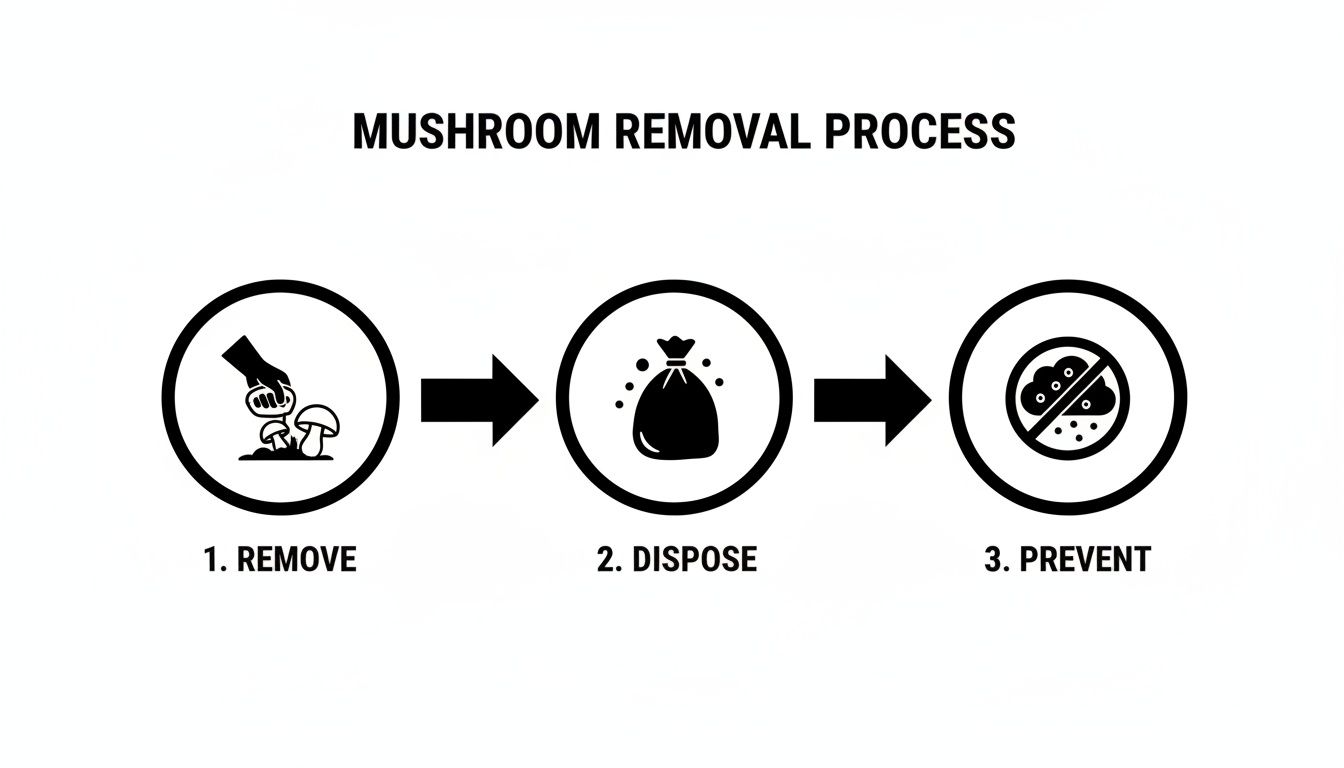
The flow is simple: deal with the immediate problem, then shift your focus to fixing the underlying cause. That’s the core of sustainable lawn care.
Aerate to Break Up Compacted Clay
If there's one game-changer for lawns in our region, it’s core aeration. Our infamous red clay soil is dense and gets compacted incredibly easily from foot traffic, mowers, and even heavy rain. This packed-down soil acts like a concrete barrier, preventing water from draining and air from reaching the roots.
When you pull small plugs of soil out of the lawn, you create thousands of tiny channels. These channels are lifelines for your turf. They let water soak deep into the ground instead of pooling on the surface, which is exactly what mushrooms love. They also get oxygen flowing to the grassroots, which is critical for a robust lawn that can outcompete fungi.
Think of it this way: a compacted lawn is like holding its breath. Aeration is taking a deep, refreshing gulp of air that revitalizes the entire system from the soil up.
For homeowners in Johns Creek or Milton dealing with perpetually soggy spots, annual aeration isn't just a suggestion—it's a necessity. It’s the single most effective way to fight the drainage issues baked into our local soil.
Rethink Your Watering Habits
So many well-intentioned homeowners accidentally create the perfect mushroom-growing conditions by watering too often. A light sprinkle every day keeps the top layer of soil and thatch consistently damp—ideal for fungal growth, but terrible for your grass. This shallow watering encourages weak, shallow roots that are less resilient to stress.
The right way to do it is deep and infrequent watering. You want to water long enough for the moisture to soak 6 to 8 inches into the soil. This encourages your grass to grow deep, strong roots as it goes searching for that water.
Here’s a practical method to get it right:
- Water Early: Always water in the early morning, between 4 a.m. and 10 a.m. This gives the grass blades all day to dry off, which helps prevent all kinds of fungal diseases.
- The Tuna Can Test: Place a few empty tuna cans (they're about 1 inch deep) around your lawn. Time how long it takes your sprinklers to fill them. Now you know how long to run your system to deliver one inch of water.
- Check the Soil: After you water, grab a screwdriver and see how deep it goes into the soil easily. If it sinks 6 inches without a fight, you’re on the right track.
By letting the soil surface dry out completely between waterings, you make the environment far less hospitable for mushrooms. For a closer look at managing water in our clay-heavy region, check out our guide on how to improve drainage in your yard.
Manage That Thatch Layer
Thatch is that spongy layer of dead grass, stems, and roots that builds up between the green blades and the soil. A thin layer is fine, but when it gets thicker than half an inch, it becomes a major problem.
A heavy thatch layer acts like a sponge, trapping moisture right at the surface and creating a permanently damp environment perfect for fungi. It also serves as a direct food source for the mycelium network underground. Dethatching, sometimes called power raking, is how you mechanically remove this excessive buildup. It’s a great way to let air and water reach the soil again while taking away a key ingredient mushrooms need to survive.
Let the Sunshine In
Mushrooms absolutely thrive in the dark, damp corners of a yard. Those areas under big trees or behind overgrown shrubs that never seem to dry out? Prime real estate for fungi.
Sometimes, one of the simplest solutions is to give those areas more sunlight and airflow.
- Trim Tree Canopies: Pruning lower branches or thinning the canopy of large trees allows more sunlight to reach the grass below.
- Prune Overgrown Shrubs: Thinning out dense shrubs gets the air moving, helping the soil and grass dry out much faster after it rains.
Making these simple landscaping adjustments can completely change the microclimate in those trouble spots, turning them from shady mushroom havens into sunny, dry areas where your grass can finally flourish.
When good lawn care habits just aren't cutting it, and those pesky mushrooms keep returning, it’s time to look at some more direct solutions. This is pretty common in North Georgia, especially in places like Cumming or Alpharetta, where a lawn might be sitting on top of an old, buried tree stump or decaying root system.
The idea here isn’t to wage war on your soil’s ecosystem—that would do more harm than good. Instead, we want to gently nudge the environment back into a state that favors lush, green grass over fungi. Let's walk through a few smart, organic strategies and discuss why reaching for a chemical fungicide is almost always the wrong move.
Speed Up the Cleanup Crew with Nitrogen
This might sound a little backward, but one of the best ways to deal with mushrooms is to apply a nitrogen-rich fertilizer. You're essentially helping the mushroom-causing fungi eat their food source faster. Think of it like giving the cleanup crew a shot of espresso—they'll break down that buried organic matter much more quickly.
The fungi and bacteria that decompose old wood and roots need nitrogen to do their job efficiently. By giving them a boost, you help them burn through their food supply. Once that buried wood is gone, the fungal network that produces the mushrooms can no longer support itself.
So, how does this work in your favor?
- Accelerated Decay: The microbes in your soil get supercharged, breaking down buried wood, roots, or thick thatch in record time.
- Eliminates the Food Source: No more food means no more mushrooms. The underlying mycelium simply runs out of fuel.
- Greener, Thicker Grass: As a fantastic side effect, the nitrogen feeds your turf, encouraging it to grow dense and strong. A thick lawn is the best defense against all sorts of issues, mushrooms included.
Pro Tip: Getting the nitrogen balance right is key. Too much can harm your lawn. A lawn care pro can analyze your soil and grass type to recommend the perfect application, giving the decomposers what they need without stressing your turf.
The Hard Truth About Chemical Fungicides
When you see a fungus, it’s only natural to think a fungicide is the answer. But for lawn mushrooms, it’s a classic case of using the wrong tool for the job. Most fungicides you can buy at a big-box store are formulated to tackle lawn diseases—things like brown patch or dollar spot—which are caused by entirely different types of fungi.
Spraying a fungicide on a mushroom is like trying to kill an oak tree by spraying a single acorn. The real action is happening underground in a vast network called mycelium, and a surface spray simply won't reach it or have any meaningful effect.
Worse yet, broad-spectrum fungicides are indiscriminate. They can wipe out the beneficial microbes that are vital for healthy soil. Killing off these good guys can create a sterile environment that invites even more problems down the line. That's why we almost never recommend fungicides for lawn mushroom control.
Don't Guess—Get a Soil Test
Before you add anything to your lawn, it’s smart to know what you’re working with. A simple soil test is one of the most powerful tools in a homeowner's arsenal. It tells you exactly what’s going on with your soil's chemistry, including its pH level.
Why does pH matter? Many mushroom-producing fungi absolutely thrive in acidic soil. If your test comes back showing a low pH (meaning it's too acidic), an application of lime can help raise it. This creates a less inviting environment for the fungi and a much better one for your grass. We often see this in areas like Johns Creek and Milton, where correcting soil pH is a game-changer for overall lawn health.
Adjusting the pH isn’t an overnight fix, but it's a critical step toward building a resilient, healthy lawn where grass wins out over mushrooms.
Comparing Mushroom Management Methods
To help you decide on the best course of action, here’s a quick look at how different strategies stack up against each other.
| Method | Effectiveness | Child & Pet Safety | Long-Term Impact |
|---|---|---|---|
| Physical Removal (Picking) | Low. A temporary cosmetic fix. Doesn't address the underground source. | High. Completely safe, but always identify mushrooms first. | Minimal. Does not prevent future growth. |
| Cultural Practices (Aeration, Drainage) | High. Addresses the root causes of moisture and compaction. | High. Natural and safe for everyone. | Excellent. Promotes a healthier, more resilient lawn overall. |
| Nitrogen Application | Moderate to High. Speeds up decomposition of the fungal food source. | High. When applied correctly, it’s just feeding the lawn. | Very Good. Improves turf density and soil health. |
| Soil pH Adjustment (Lime) | Moderate. Makes the soil less hospitable to fungi over time. | High. Lime is a natural soil amendment. | Good. A foundational step for long-term soil and turf health. |
| Chemical Fungicides | Very Low. Ineffective against deep mycelium networks. | Low to Moderate. Poses unnecessary chemical exposure risks. | Negative. Can harm beneficial soil microbes, leading to other issues. |
As you can see, the most effective and safest methods focus on improving the underlying health of your soil and turf. These strategies work with nature, not against it, to create a lawn that is naturally resistant to mushroom outbreaks.
Common Questions We Hear About Georgia Lawn Mushrooms
Even with the best game plan, you're bound to have questions. When we talk with homeowners in Cumming, Johns Creek, and our other North Georgia service areas, the same handful of concerns about getting rid of mushrooms always come up. Let's get right into them so you can feel confident tackling what's happening in your yard.
Are the Mushrooms in My Yard Poisonous?
This is, without a doubt, the first and most important question we get, especially from families with kids and pets running around in Alpharetta and Milton.
Here’s the straight answer: it's impossible to know for sure without a professional mycologist's identification. While most of the little brown or white mushrooms that pop up in lawns are harmless decomposers, some genuinely toxic ones can look shockingly similar.
Because you can't be 100% certain, the only safe and responsible path is to assume every unidentified mushroom could be dangerous. Always pop on a pair of gloves before you handle them, and make it a hard-and-fast rule that kids and pets are to never, ever touch or eat mushrooms they find outside. Removing them quickly is the best thing you can do for your peace of mind.
Does Just Picking the Mushroom Solve the Problem?
I wish it were that simple, but unfortunately, no. Plucking or mowing over the mushroom caps is a critical first step for safety and to stop them from dropping more spores, but it’s a bit like picking an apple off a tree. The mushroom you see is just the temporary "fruit" of a much larger, hidden organism—the underground mycelium network. This sprawling web of fungal threads can stretch for yards beneath the soil, quietly munching on old, decaying organic matter.
Think of the mycelium as the root system of a huge underground plant. Just removing the flower (the mushroom) does absolutely nothing to the plant itself. Real, long-term mushroom control means you have to change the underground environment that allows this network to flourish in the first place.
This means you have to shift your focus from what's on the surface to what's happening in the soil. Getting rid of the mycelium's food source—like old tree roots, buried construction debris, or excessive thatch—is how you solve the problem for good.
Should I Spray a Fungicide to Kill Them?
It's a logical thought, but for lawn mushrooms, it's generally a waste of time and money. The fungicides you find at big-box stores are formulated to treat turf diseases like brown patch or dollar spot, which are caused by entirely different types of fungi. They simply aren't designed to kill the fungi that produce mushrooms.
On top of that, these chemicals are meant for surface application. They rarely soak deep enough into the soil to make a dent in that vast mycelium network. Spraying them can also do more harm than good by wiping out the beneficial microbes your soil needs to stay healthy and resilient. It's an expensive "solution" that completely misses the root cause.
When Should I Call in a Pro?
You can absolutely handle a few mushrooms popping up here and there on your own. But there are a few tell-tale signs that it’s time to call for backup.
Consider getting professional help if:
- The problem is widespread or just won't go away. If mushrooms keep coming back in huge numbers, year after year, it’s a red flag for a significant underlying issue. This could be anything from a massive, buried tree root to severely compacted soil.
- You're worried about toxicity. When you have young children or curious pets, having a professional service manage the issue ensures it's handled safely, thoroughly, and with the right products.
- You want a real, long-term solution. A pro can do more than just get rid of mushrooms. We can perform core aeration to improve oxygen flow, analyze your soil, and create a targeted organic treatment plan that builds a healthier lawn from the ground up—one that’s naturally resistant to future outbreaks.
If you're in Cumming, Milton, Alpharetta, Johns Creek, or the surrounding North Georgia area and are tired of fighting this losing battle, let us help. The team at Barefoot Organics can figure out exactly what’s causing your mushroom problem and implement a safe, effective, and eco-friendly program to fix it. We focus on building a healthy, mushroom-resistant turf from the soil up. Get your free quote and take the first step toward a beautiful, worry-free lawn today.