

Getting rid of dollar weed for good isn't about just yanking it out or spraying it. It starts with understanding why it showed up in your lawn in the first place. You have to shift your lawn's environment from a place where this weed thrives to one that helps your turfgrass dominate.
Simply put, dollar weed absolutely loves excessive moisture and compacted soil. Tackling these two core issues is the only real long-term strategy for kicking it to the curb.
Understanding Dollar Weed In Your Georgia Lawn
Have you seen bright green, round leaves that look like tiny lily pads or umbrellas popping up in your yard in Cumming or Johns Creek? That’s almost certainly dollar weed. This annoying perennial isn’t just a random nuisance; its presence is a big, flashing sign that your lawn's underlying conditions are seriously out of whack.
Here in North Georgia, from Cumming to Dahlonega, we often find ourselves battling this weed because our local environment, especially our soil, can accidentally create the perfect home for it.
The problem usually starts with our infamous red clay soil. It’s naturally dense and compacts very easily, which leads to terrible drainage. When water can’t soak deep into the ground, it just pools near the surface, creating the constantly damp, soggy conditions that dollar weed craves. A lot of common lawn care habits just end up making this situation even worse.
Why Dollar Weed Loves Your Alpharetta Yard
Think of dollar weed as a water plant that figured out how to live on land. It flourishes in conditions that stress out most other plants, including your expensive turfgrass. For anyone with a lawn in Milton or Dahlonega, learning to spot these favorable conditions is your first big step toward getting control back.
Here are the main reasons dollar weed has made itself at home in your yard:
- Frequent, Shallow Watering: Watering your lawn for just 10-15 minutes every day is one of the worst things you can do. This habit keeps the top inch of soil constantly soggy but does nothing to encourage deep, strong root growth for your grass. It's an open invitation for dollar weed.
- Compacted Clay Soil: As I mentioned, that heavy clay soil common in the Cumming area is a major culprit. Rain and irrigation water just sit on the surface instead of soaking in, creating a perfect little swamp for dollar weed to spread.
- Mowing Too Low: Cutting your Bermuda or Zoysia grass too short is a huge mistake. It weakens the turf, thins it out, and allows more sunlight to hit the soil. This gives weeds like dollar weed all the space and light they need to take over.
- Poor Drainage: Do you have low spots in your yard that stay wet for days after a rainstorm? That’s prime real estate for this moisture-loving weed.
The real issue isn't the weed itself—it's the environment that welcomes it. If you focus on fixing the root causes like excess moisture and soil compaction, you'll create a lawn where dollar weed simply can't compete with thick, healthy grass.
To help you diagnose what's going on in your yard, here's a quick breakdown of the conditions dollar weed loves and how to start fixing them.
Quick Guide to Dollar Weed's Favorite Conditions
| Favorable Condition | Why It Helps Dollar Weed | How to Fix It |
|---|---|---|
| Daily, Light Watering | Keeps the surface soil consistently damp, which is ideal for this semi-aquatic weed. | Water deeply and infrequently (1-2 times per week) to encourage deep grass roots. |
| Compacted Soil | Prevents water from draining, causing it to pool at the surface where dollar weed thrives. | Aerate your lawn annually to break up compaction and improve water penetration. |
| Mowing Too Short | Thins out the turf, allowing sunlight to reach the soil and giving weeds room to grow. | Raise your mower blade to the recommended height for your grass type (e.g., 2-3 inches for Zoysia). |
| Low-Lying Areas | These spots naturally collect water, creating a permanently wet habitat. | Improve drainage by topdressing with a mix of sand and compost to level out the area. |
By addressing these factors, you’re not just fighting the weed; you’re building a stronger, more resilient lawn from the ground up.
The Science Behind The Invasion
Dollar weed, which also goes by the name pennywort, is an aggressive spreader. It uses both seeds and a network of underground runners, called rhizomes, to take over. This root system is what makes it so tough to control just by pulling it. If you leave even a tiny piece of a runner behind, a whole new plant will pop right back up.
This is exactly why changing your lawn care habits is so critical. Believe it or not, historical data shows that dollar weed infestations have jumped by roughly 30% in residential lawns over the past couple of decades, mostly because of how we've changed our irrigation habits.
Research has shown that lawns watered deeply just once a week, instead of daily, saw a staggering 65% reduction in dollar weed density after only three months. You can see more details in Clemson University's research, which really drives home the impact of proper watering. Understanding this proves you have more control than you think. By simply adjusting your routine, you can make a huge dent in the problem without reaching for a bottle of chemicals.
For a broader look at other common invaders in our area, check out our guide on other weeds in Georgia lawns.
Making Your Lawn an Unfriendly Place for Weeds
If you want to win the war against dollar weed, you have to stop thinking like a weed killer and start thinking like a lawn builder. Simply reacting with sprays is a temporary fix. The real, long-term solution is to change your lawn's environment from a weed paradise into a place where healthy grass can't be beat. For those of us in Cumming and Alpharetta, that means tackling the two things dollar weed loves most: too much water and our notoriously compacted clay soil.
You can create a lawn that naturally defends itself just by tweaking a few core practices—how you water, mow, and aerate. This proactive approach doesn't just choke out the dollar weed you have now; it makes it nearly impossible for it to come back. It's all about building a resilient turf from the soil up.
This little infographic perfectly sums up how a dollar weed invasion gets started on so many North Georgia lawns.
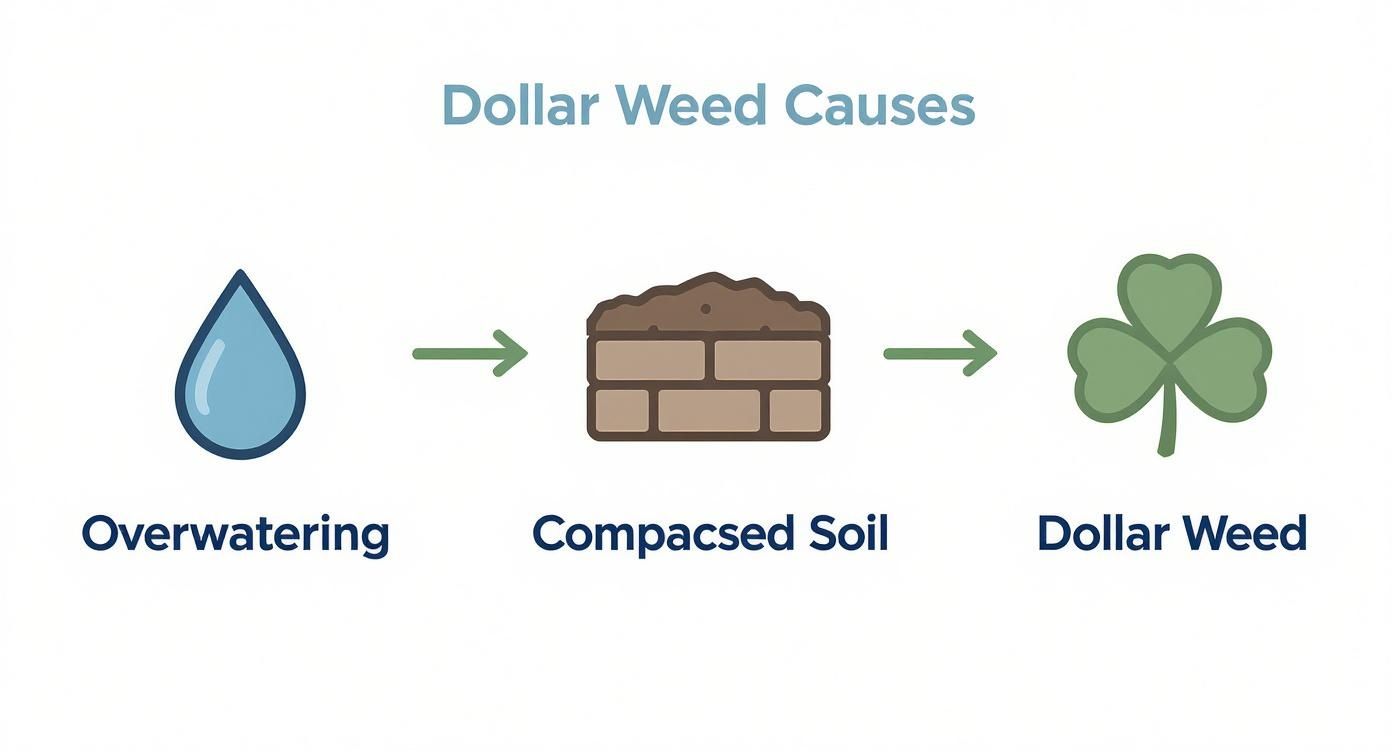
As you can see, it’s a chain reaction. One bad habit leads to another, and the end result is a yard full of those little green lily pads.
Rethink Your Watering Schedule
One of the biggest mistakes I see homeowners in Johns Creek make is watering their lawn for a few minutes every single day. This keeps the top layer of soil constantly soggy—the exact shallow, damp environment dollar weed needs to send out its runners. At the same time, this habit does nothing to encourage your Bermuda or Zoysia grass to grow the deep, strong roots it needs to thrive.
The trick is to switch to a deep and infrequent watering schedule.
- Water only 1-2 times per week. This simple change allows the soil surface to dry out between waterings, which dollar weed can't stand.
- Apply about 1 inch of water total per week. An easy way to measure this is to stick an empty tuna can in the yard; when it's full, you're done.
- Water in the early morning. This gives the grass blades all day to dry, cutting down on evaporation and the risk of fungal disease.
This watering method trains your grass to grow its roots deeper into the soil for moisture, making it far more resilient and better able to outcompete weeds.
Master Your Mowing Height
Mowing your lawn too short is like rolling out the welcome mat for weeds. When you scalp your grass, you thin out the canopy and let more sunlight hit the soil. That sunlight is exactly what dormant weed seeds need to wake up and what opportunistic weeds like dollar weed need to take over.
The fix is surprisingly simple: raise your mower blade. A taller cut creates a thicker, denser turf that literally shades out and smothers weed seedlings before they even get a chance.
A thick, healthy lawn is the best weed control there is. Proper mowing is fundamental to creating that density, robbing weeds of the light and space they need to grow.
For the most common turf types in our area, stick to these mowing heights:
- Bermuda Grass: Aim for a height of 1.5 to 2.5 inches.
- Zoysia Grass: Keep it between 2 to 3 inches.
Cutting at the right height gives you a strong, dense turf that forms a natural barrier against unwanted invaders.
Break Up Compacted Soil with Aeration
Let's face it, North Georgia's heavy clay soil is a huge part of the dollar weed problem. Over time, all that foot traffic and rain compacts the soil until it's nearly rock-hard. When that happens, water can't soak in. Instead, it pools on the surface, creating the exact swampy conditions where dollar weed flourishes.
Core aeration is your best weapon against compaction. This process pulls small plugs of soil from the lawn, breaking up the hardpan and creating channels for air, water, and nutrients to finally reach the grassroots.
For lawns here in Milton and Forsyth County, aerating once a year is a game-changer. The ideal time is during the active growing season, which for our warm-season grasses like Bermuda and Zoysia is early summer. Besides proper watering, knowing when to aerate your lawn correctly is one of the most important things you can do for long-term soil health. And if you really want to dig into improving our local soil, we've got a detailed guide on how to improve clay soil for grass.
Getting Your Hands Dirty: Effective Manual Weed Removal
When you spot a small patch of dollar weed creeping into a corner of your lawn, sometimes the best and most satisfying fix is old-fashioned elbow grease. For smaller infestations, manual removal is a fantastic first line of defense—it's immediate, totally eco-friendly, and gives you pinpoint control.
This hands-on approach is perfect for hitting those pesky spots without affecting your healthy grass. Plus, it’s the only way to go in sensitive areas like your vegetable garden or near the kids' swing set, keeping everything chemical-free.
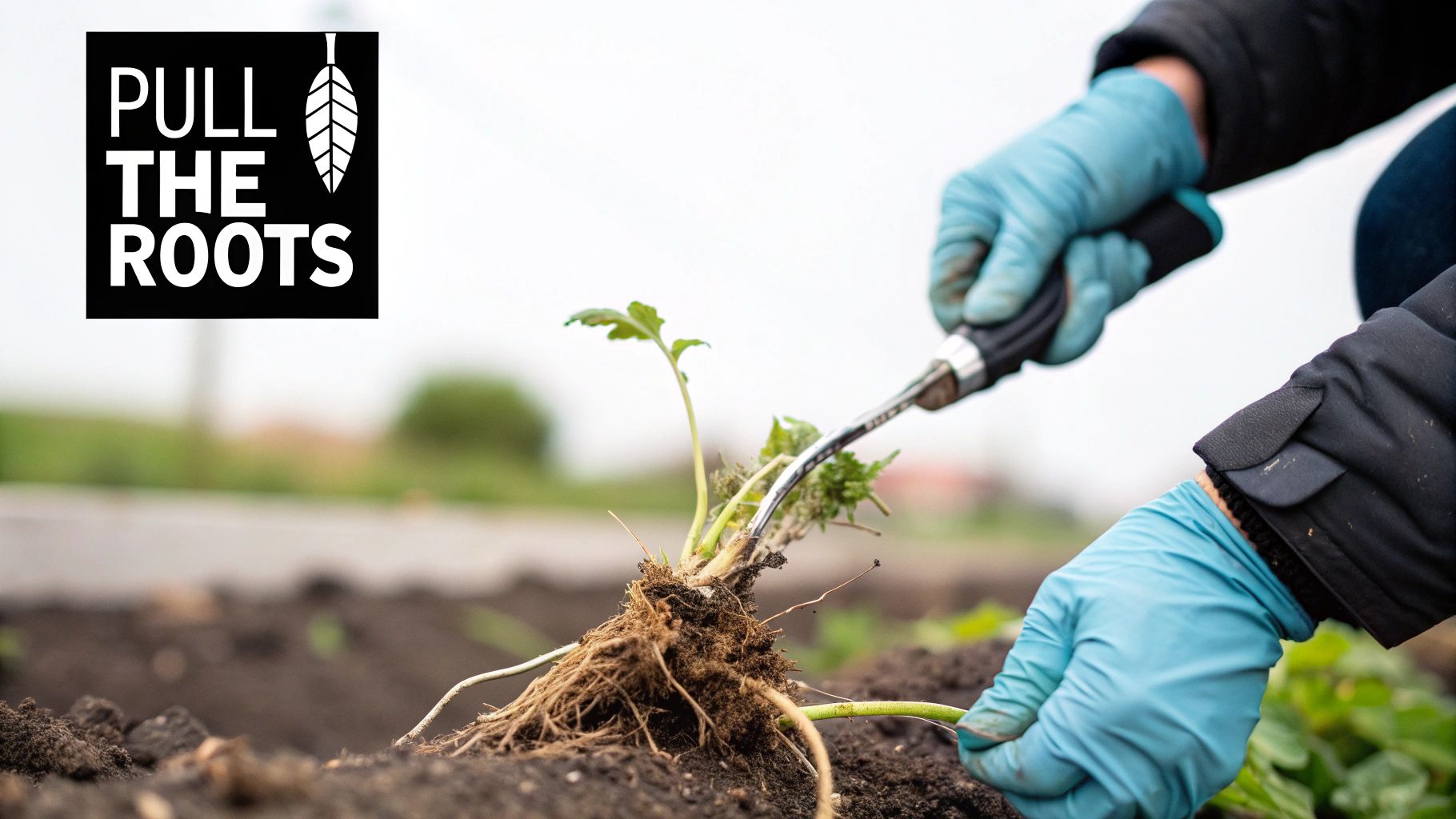
The Right Way to Pull Dollar Weed By Hand
Let's be clear: just yanking the little round leaves is a complete waste of your time. The real problem is the network of underground runners, called rhizomes, lurking just below the surface. Leave even a tiny piece behind, and you'll see a new plant pop up before you know it.
Success means getting the entire plant—leaf, stem, and the whole rhizome it's connected to.
Pro Tip: The absolute best time to pull dollar weed is the day after a good, soaking rain. Here in North Georgia, our heavy clay soil can be a real pain, but when it’s saturated, those rhizomes slide out with surprising ease. This dramatically boosts your chances of getting the whole thing.
This isn't just a gardening hack; it's a proven strategy. A 2005 study showed that lawns where dollar weed was hand-pulled every two weeks saw a 60% reduction in weed density in just one year. It's no wonder that a recent survey found 72% of lawn care professionals recommend manual removal as the first step for small-scale invasions. You can dig deeper into this approach by exploring the insights on dollar weed control in Mississippi lawns.
The Best Tools for the Job
While your hands work just fine, a few simple tools can save your back and make the process much faster, especially if that "small patch" is a bit bigger than you first thought. These tools are all about giving you the leverage to pull up those stubborn rhizomes without breaking them.
- Dandelion Weeder (Fishtail Weeder): This classic tool has a forked tip that’s perfect for getting under the main root of a dollar weed cluster and prying the whole system up.
- Hori Hori Knife: This is a versatile Japanese gardening knife with a sharp point and a serrated edge. It’s fantastic for cutting through tough soil and slicing around an entire patch to lift it out, rhizomes and all.
- Stirrup or Scuffle Hoe: If you're dealing with a concentrated patch in a garden bed, a stirrup hoe is a game-changer. You just slide it right under the soil surface to sever the weeds from their roots quickly and with minimal effort.
Your Game Plan for Manual Removal
To make sure you're not just pulling leaves, you need a methodical approach. Imagine you have a 3×3 foot patch of dollar weed trying to take over a sunny spot in your Zoysia lawn. Here's how to tackle it:
- Soak the Area: The night before you plan to weed, give the patch a really deep watering. This is the single most important step.
- Loosen the Soil: Use a garden fork or your hori hori knife to gently loosen the soil around the edges of the patch. This helps prevent the rhizomes from snapping off underground.
- Work from the Outside In: Start at the edge of the patch and find a single plant. Use your fingers to trace its runner to where it connects to the next one.
- Lift and Pull, Don't Yank: Grab the plant at its base and pull slowly and steadily. You should feel the whole runner system start to give way as it comes out of the soft soil.
- Inspect and Dispose: After you pull a section, glance back at the soil to spot any white rhizome fragments you might have missed. Toss all the weeds into a yard waste bag. And whatever you do, never put them in your compost pile—the rhizomes can easily survive and spread.
With the right timing, the right tools, and a little patience, you can make a real dent in your dollar weed problem, one patch at a time.
How to Use Herbicides Safely on Georgia Lawns
When dollar weed has really taken hold in your Cumming or Alpharetta lawn, hand-pulling just won't cut it anymore. That's when chemical controls become the next logical step. I know using herbicides can feel a bit daunting, but with the right approach, you can manage the infestation effectively and responsibly. It really boils down to three things: picking the right product for your grass, applying it at the right time, and always, always putting safety first.
The most important thing to grasp is that not all herbicides are the same. They generally fall into two categories, and knowing the difference is crucial if you want to get rid of dollar weed without accidentally nuking your North Georgia turf.
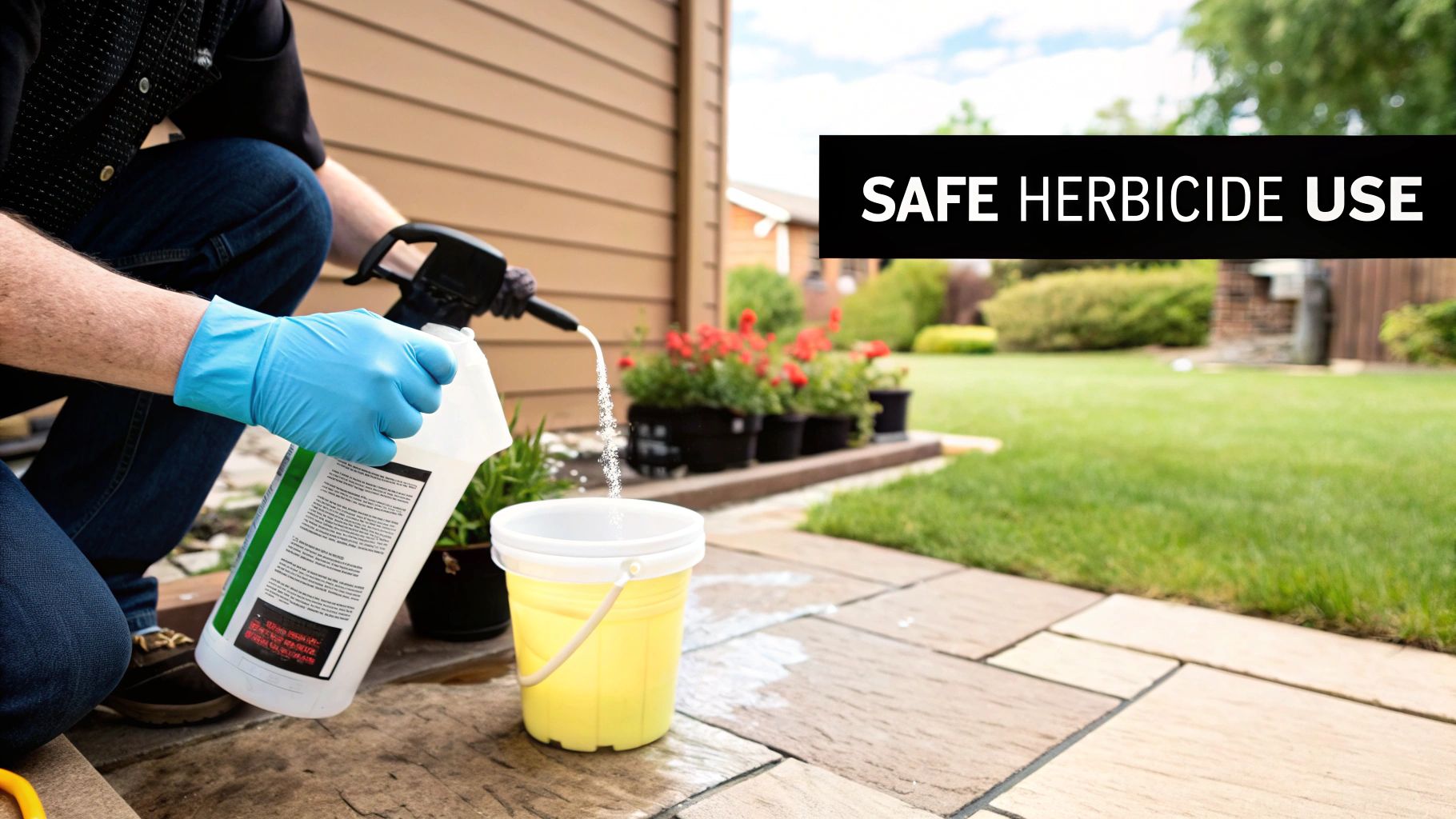
Post-Emergent vs Pre-Emergent Herbicides
I like to think of herbicides in terms of offense and defense. One is for attacking the weeds you can see right now, and the other is for preventing new ones from ever popping up.
- Post-Emergent Herbicides: This is your offensive line. These products are formulated to kill weeds that are already up and actively growing in your yard. If you're staring at a patch of dollar weed, a post-emergent is what you need.
- Pre-Emergent Herbicides: This is your defensive strategy. These create a barrier in the soil that stops weed seeds from germinating. A pre-emergent won't do a thing to existing dollar weed, but it's your best friend for preventing an invasion next season.
So, for an active infestation, you’ll start with a post-emergent. Then, later in the year, you’ll follow up with a pre-emergent as part of a long-term prevention plan.
Choosing the Right Herbicide for Your Grass
Here in North Georgia, most of us have warm-season grasses like Bermuda, Zoysia, or St. Augustine. These turf types can be a bit sensitive, so you absolutely must choose a selective herbicide labeled as safe for your specific grass. Grabbing the wrong bottle can cause major damage or even kill your entire lawn.
The single most important rule is to read the entire product label before you even think about opening the bottle. The label is your instruction manual for mixing, application rates, and all the critical safety info.
For the Bermuda and Zoysia lawns common in Milton and Johns Creek, a good "three-way" herbicide is usually very effective. These products have a cocktail of active ingredients that knock out a ton of broadleaf weeds, including dollar weed. Research backs this up, too; field trials have shown that herbicides containing 2,4-D, dicamba, and mecoprop (MCPP) achieved an 85% control rate on average when applied in late spring.
But you have to be realistic. Studies also show that recurrence can be as high as 45% within two years if you don't fix the underlying issues like watering and soil health.
Now, if you have St. Augustine grass, you need to be extra cautious. It's notoriously fussy. Products containing Atrazine are typically the go-to, as they are effective on dollar weed and won't harm this particular turf.
Safe Application and Best Practices
Once you have the right product, applying it correctly is what separates success from a costly mistake.
Timing is Everything
Hit the dollar weed with a post-emergent when it's actively growing. Here in Georgia, that sweet spot is late spring or early fall when temperatures are holding steady between 65 and 85 degrees Fahrenheit. Don't spray in the dead of summer; the heat will stress your lawn and make it more likely to get burned by the chemicals.
Mixing and Spraying
- Gear Up: Safety first. Always wear long sleeves, pants, gloves, and eye protection when handling and mixing chemicals.
- Measure, Don't Guess: Follow the mixing ratios on the label to the letter. A "little extra for good measure" is a recipe for a dead lawn, not dead weeds.
- Use a Surfactant: Dollar weed leaves have a waxy surface that makes liquids bead up and roll right off. Adding a surfactant (sometimes called a "sticker") to your tank mix helps the herbicide cling to the leaves, making it far more effective.
- Spray for Coverage, Not Drenching: Apply the herbicide in a smooth, sweeping motion for even coverage. You're aiming for a light mist, not soaking the plant. Drenching is wasteful and doesn't improve results.
Post-Application Safety
After you're done, keep kids and pets off the lawn until the spray has completely dried. This can take a few hours, so plan to spray when you know the yard will be empty for a while. This is non-negotiable, especially for pet owners. If you're wary of chemicals, our guide on https://www.barefootorganicsllc.com/dog-safe-lawn-weed-killer/ offers some great insights into less harsh options. For a deeper understanding of the different chemical controls and their proper use, you can learn more about using herbicides effectively.
Your Long-Term Plan for a Weed-Free Lawn
Getting rid of the dollar weed you see now is a great feeling, but that’s really just step one. If you don't fix the underlying problems that invited it in the first place, I can almost guarantee it’ll be back. To truly win the war against dollar weed, especially here in Cumming or Dahlonega, you need to shift from just treating the problem to proactively building a lawn that weeds can't stand.
The secret is to cultivate an environment where your grass is the undisputed champion. A thick, vibrant lawn is your best defense—it literally chokes out new weeds, starving them of sunlight and space before they ever get a chance to sprout. The goal is simple: make your lawn a terrible place for weeds but a paradise for your grass.
Build a Strong Foundation with Smart Fertilization
A starving lawn is a weak lawn, and weak lawns are a welcome mat for every weed in the neighborhood. Proper fertilization is the absolute cornerstone of building the kind of dense turf that elbows dollar weed out of the picture. This isn't about just tossing down some fertilizer a few times a year; it’s about giving your grass the right food at the right time.
For our warm-season grasses like Bermuda and Zoysia, timing is everything:
- Wait for the Green-Up: Hold off on that first spring feeding. You want to wait until your lawn is at least 50% green and the soil is consistently warmer than 65°F. Fertilizing too early just feeds the winter weeds that are still hanging around.
- Feed Through the Summer: A steady diet is key. Use a balanced, slow-release fertilizer every 6-8 weeks during the peak growing season, from late spring through the hot summer months. This keeps your grass growing strong and thick.
- Know When to Stop: As fall approaches, ease up. Whether you're in Alpharetta or Milton, you should stop using high-nitrogen fertilizer at least six weeks before the first frost. This lets your grass harden off for winter instead of pushing out new, tender growth that will just get zapped by the cold.
A well-fed lawn creates its own weed barrier. The dense canopy of grass blades shades the soil, and without sunlight, new dollar weed seeds simply can't get the energy they need to germinate. It's nature's weed prevention.
The Defensive Power of Pre-Emergent Herbicides
If post-emergent herbicides are your reactive force for killing existing weeds, think of pre-emergents as your secret weapon—your frontline defense. These products form an invisible barrier on the soil surface that stops weed seeds from ever successfully sprouting. For a stubborn invader like dollar weed, using a pre-emergent is a non-negotiable part of your yearly game plan.
But here’s the catch: timing is everything. If you're too early or too late, you’ve wasted your money. Here in North Georgia, the golden window is late winter or very early spring. The old-timers' trick is to watch for the forsythia bushes—when they start to bloom, it's time to act. That's nature's signal that the soil is warming up and weed seeds are about to wake up. Getting that barrier down before they germinate is the key to success. A second application in the fall is also a great move to tackle winter weeds and reduce the pressure for the following spring.
Commit to Core Lawn Care Habits
Ultimately, it all comes back to the fundamentals. Your best long-term defense is built on the simple, consistent habits of good lawn care. Stop thinking of watering and mowing as chores; they are your primary tools for weed control.
Here’s a final checklist to keep your lawn in fighting shape:
- Water Deeply, Not Daily: Ditch the daily sprinkle. Stick to a schedule of watering just 1-2 times per week, providing about one inch of water total. This trains the grass roots to grow deep and strong while letting the soil surface—where weeds sprout—dry out.
- Mow High and Sharp: Set your mower deck to the highest recommended setting for your grass type and make sure those blades are sharp. A clean, high cut helps the grass stay healthy and creates a taller canopy that shades out weed seedlings.
- Aerate Annually: This is one step you can't afford to skip, especially with our compacted clay soil. Core aeration breaks up the soil, improves drainage, and allows water and nutrients to get to the roots. It physically changes the soggy, compacted environment that dollar weed loves into one it can't tolerate.
Got Questions About Dollar Weed? We've Got Answers.
Even with the best plan, taking on dollar weed in your North Georgia lawn can bring up some questions. It’s a stubborn weed, and homeowners from Cumming to Alpharetta often run into the same hurdles. Let's clear up some of the most common issues we see.
Getting these details right can save you a ton of time and frustration, and it's the difference between a temporary fix and a healthy, long-term solution for your lawn.
Can I Just Spray Dollar Weed with a Vinegar Solution?
This is probably the number one question we hear, especially from folks in Johns Creek and Milton who want to go the natural route. It's an appealing idea, but the short answer is no, it’s not an effective long-term strategy.
Vinegar is a contact killer, which means it will burn the top growth of the dollar weed—and any of your good grass it touches. The real problem, however, is that dollar weed spreads through an underground root system of runners (rhizomes). The vinegar won't reach these roots, so the weed will just pop right back up in a few weeks. You'll end up with a temporarily scorched weed and a damaged patch of turf.
How Can I Be Sure It's Dollar Weed and Not Dichondra?
This is a fantastic question because they look incredibly similar. Both have those small, round, bright green leaves that creep low to the ground. Getting the ID right is crucial because what works on one might not work on the other.
Thankfully, there's one dead giveaway.
Look at where the stem meets the leaf. On dollar weed, the stem attaches right in the middle of the leaf, like a tiny umbrella. With dichondra, the stem connects at the edge, usually at a small notch in the leaf.
Take a second to check before you apply any treatment. It's a simple step that ensures you're using the right product for the job and not wasting your money.
What’s the Best Weed Killer for Dollar Weed That Won’t Hurt My St. Augustine Grass?
If you have a St. Augustine lawn in Cumming or Alpharetta, you know how sensitive it can be. This is a critical question because the wrong herbicide will do more harm than good, and many common "weed-and-feed" products can absolutely wreck this type of grass.
Your go-to active ingredient here is Atrazine. It's a selective herbicide that is specifically formulated to handle dollar weed and other broadleaf weeds while being safe for St. Augustine turf.
But—and this is a big but—you have to follow the label directions to the letter. Pay close attention to the temperature restrictions. Applying Atrazine when it's too hot (typically over 85-90°F) can still stress or damage the lawn. Always, always read the product label to confirm it is listed as safe for St. Augustine grass before you even think about spraying.
Ready to reclaim your lawn from pesky dollar weed without the guesswork? The experts at Barefoot Organics specialize in creating lush, healthy, and weed-free lawns across North Georgia using methods that are safe for your family and the environment. We understand the unique challenges of our local clay soil and create custom plans for homeowners in Cumming, Alpharetta, and beyond. Get your free online quote from Barefoot Organics today!