

It seems like one minute your Cumming lawn is clear, and the next, a fire ant mound has appeared out of nowhere. Or maybe you've noticed those persistent ant trails crisscrossing your patio again. If you're a homeowner in the Cumming, GA area, this is an all-too-familiar battle. Getting rid of ants naturally isn't just about a one-time fix. The best approach is a two-part strategy: you need to handle the ants you see now while also making your yard a place they'd rather avoid in the future.
The most effective natural strategy combines immediate treatments with long-term lawn health, creating a beautiful, resilient Cumming yard that ants just don't find appealing. For homeowners in Forsyth County, this means a lawn safe for kids and pets, without the constant worry of pests.
Ready to take back your yard from ants? Call Barefoot Organics today for a free lawn evaluation!
Why This Matters for Lawns in Cumming
If it feels like your property is a hotspot for ants, you’re right. There’s a reason yards from Johns Creek to Suwanee seem to be prime real estate for these pests—our North Georgia climate is practically a custom-built ant paradise.
Our sweltering summer heat and humidity create the warm, damp conditions that ants—especially aggressive fire ants—thrive in. When you factor in the cycle of heavy spring rains followed by dry summer spells, ants are constantly on the move, searching for stable ground. That search often leads them straight to your foundation or patio in your Cumming home.
How Our Local Landscape Contributes to Ant Problems
It's not just the weather; the ground we walk on is part of the problem. The dense, red Georgia clay so common in Forsyth County holds moisture beautifully after a storm, but it also gets rock-hard and cracks during dry spells. Ants are masters at exploiting these cracks and damp pockets to build out their sprawling, well-protected nests.
We also have a few local landscaping habits that unintentionally send ants a dinner invitation:
- Aphid-Friendly Plants: Those beautiful crepe myrtles we all love? They're magnets for aphids, which secrete a sugary goo called "honeydew." For many ant species, this is a five-star meal.
- Pine Straw Mulch: While it's fantastic for our acid-loving plants, thick layers of pine straw provide the perfect insulated, sheltered spot for ant colonies to set up camp.
- Sunny Bermuda Lawns: The big, open lawns common in Milton and Alpharetta give fire ants the sun-drenched, open territory they need to build their infamous mounds, seemingly overnight.
The good news is that you don't have to douse your yard in harsh chemicals to win this fight. Natural, sustainable ant control is a completely practical—and highly effective—solution for families in Cumming who want a safe, beautiful lawn.
At Barefoot Organics, our entire philosophy is built on one simple truth: a healthy, thriving lawn is its own best defense. A dense, well-fed turf is far less welcoming to ants than a stressed, patchy lawn. By focusing on the root causes like soil health, moisture levels, and smart planting, you build a landscape that naturally pushes pests out. This way, your yard stays safe for kids and pets to enjoy, and you get to relax all season long.
Identifying Common Ants in Your Cumming Lawn
Before you can win the war against ants in your yard, you first have to know exactly who you're fighting. Here in North Georgia, we have a whole cast of characters, from mildly annoying foragers to genuinely destructive invaders. Think of this as your boots-on-the-ground field guide for figuring out what’s marching across your lawn and patio.
Getting a positive ID is the critical first step. Are you seeing huge, angry mounds popping up in the middle of your sunny Bermuda grass? Or is it a neat little line of ants trailing from a crack in the patio right toward your kitchen? Their appearance, and just as importantly, their behavior, tells you everything you need to choose the right natural approach.
North Georgia’s Most Unwanted
Across Forsyth County, from Alpharetta to Dawsonville, a few specific ant species cause the most grief for homeowners. The good news is, learning to spot them is easier than you think.
To make it simple, here’s a quick-reference guide for identifying the ants you're most likely to encounter in your Cumming yard.
Common Ants in North Georgia Identification Guide
| Ant Species | Appearance | Nest Location | Key Behavior |
|---|---|---|---|
| Fire Ants | Small, reddish-brown | Large, fluffy soil mounds in open, sunny lawn areas | Extremely aggressive; swarms and delivers multiple painful stings. |
| Carpenter Ants | Large, typically black | Nests inside moist or rotting wood (tree stumps, decks, window sills) | Excavates wood, leaving behind coarse sawdust-like "frass." |
| Odorous House Ants | Small, dark brown or black | Shallow nests under rocks, patios; forages indoors for sweets | Trails in distinct lines; emits a rotten coconut smell when crushed. |
This table gives you a starting point, but observing these ants in their natural habitat—your yard—will confirm who you're dealing with.
This flowchart breaks down the main reasons your yard might be such an attractive place for these unwanted guests to begin with.
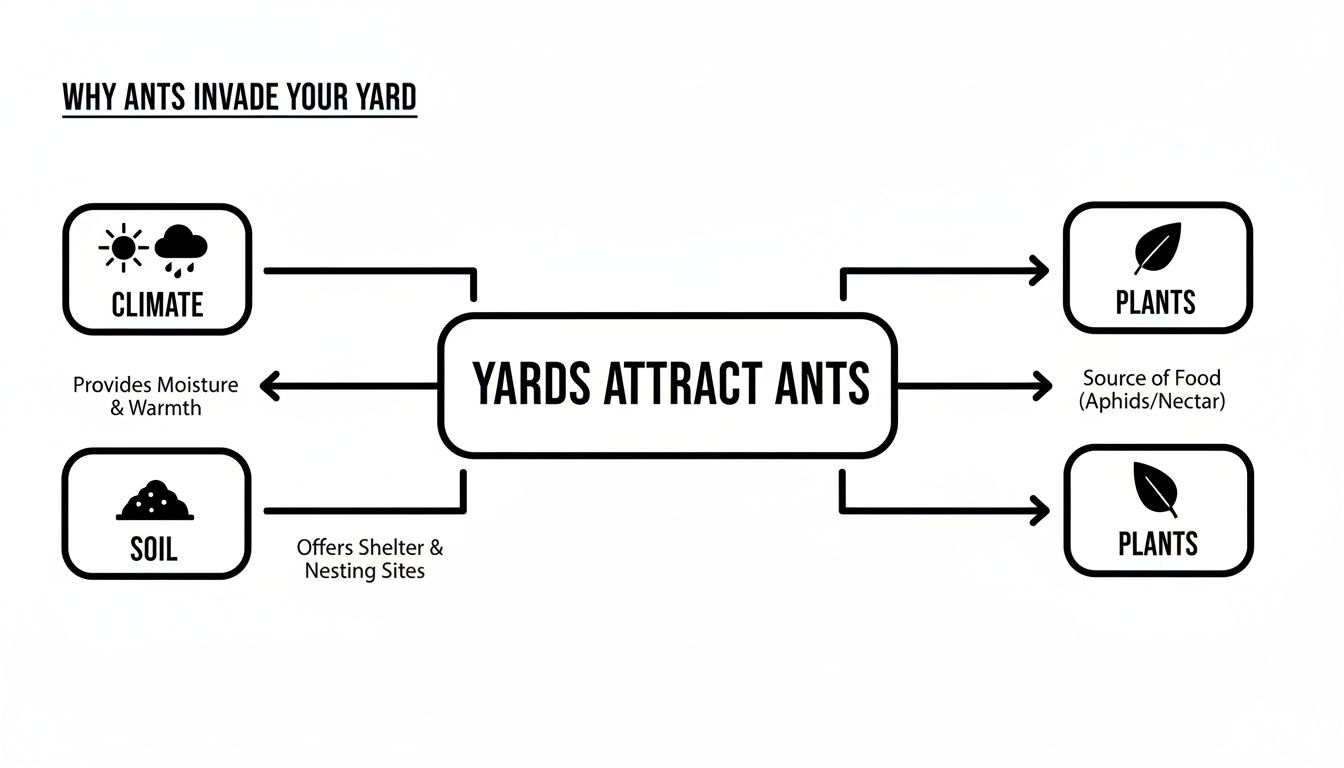
It’s no coincidence that ants thrive here. Our combination of hot, humid weather, dense clay soil, and popular landscaping choices creates a perfect storm for ant populations to explode.
What Their Behavior Tells You
Watching how the ants act is just as important as what they look like. For instance, fire ants go into overdrive after a good July rain, rapidly expanding their mounds. Carpenter ants, on the other hand, are mostly nocturnal. If you suspect you have them, grab a flashlight after dark and inspect your home's foundation, deck posts, and any old woodpiles. You'll likely spot their foraging trails.
For many homeowners in Canton and Sugar Hill, the biggest headache is the sheer number of nuisance ants that seem to materialize out of thin air. These are usually odorous house ants or pavement ants, which build shallow nests under patios, driveways, or landscaping stones. While they aren’t destructive, their endless single-file lines are a constant source of frustration.
A Pro Tip From the Field: The single biggest mistake we see is people spraying only the ants on the surface. For colony-builders like fire ants, that’s a losing battle. The only way to win is to target the queen and the entire underground nest, not just the handful of workers you can see.
Knowing whether you have aggressive fire ants or structure-damaging carpenter ants completely changes your game plan. Fire ants demand a targeted mound treatment that can get deep into their massive colony. For more on that, you can check out our detailed guide on how to kill fire ants naturally for specific techniques that work on this stubborn Georgia pest.
Spotting carpenter ants, however, is a red flag for a potential moisture issue that you’ll need to fix along with treating the ants themselves. When you correctly identify the ant, you can choose a focused, natural solution that actually solves the problem for your home.
Treatment Breakdown: Natural Methods That Work in North Georgia
Alright, you've identified the enemy. Now it's time to take back your yard. We're going to skip the myths and focus on what actually works—practical, proven methods that are safe for your family, pets, and our local Cumming landscape.
The trick is knowing which tool to use for which job. A simple ant trail requires a different approach than a deep-seated fire ant colony. We’ll cover the two most reliable natural products we use in the field: diatomaceous earth and boric acid.
Create a Barrier with Food-Grade Diatomaceous Earth
Your first line of defense should be food-grade diatomaceous earth (DE). This isn't a poison; it’s a mechanical weapon. DE is a super-fine powder made from the fossilized remains of tiny aquatic organisms called diatoms. To us, it feels like soft dust. But for an ant, it's like crawling through a field of microscopic glass shards. It physically scratches their waxy exoskeleton, which causes them to dehydrate and die.
Just be sure you're using food-grade DE. The kind used for pool filters is chemically treated and is not safe for this purpose. Food-grade DE is harmless if kids or pets encounter it on the lawn.
Our Application Process for DE
A common mistake is just shaking DE all over the yard. That's wasteful and ineffective. You want to create strategic barriers. Here’s the method we use on lawns from Alpharetta to Dawsonville:
- Foundation Guard: Puff a thin, continuous line of DE around the entire foundation of your house. An unbroken barrier is key.
- Seal Entry Points: Lightly dust the powder into cracks in your patio, along the edges of sidewalks, and around any pipes or vents where ants could sneak in.
- Disrupt the Highway: If you see a clear ant trail on your driveway or deck, dust it directly. This immediately disrupts their chemical trail and stops the procession.
In North Georgia, timing is everything. DE only works when it’s dry. Put it down right before one of our classic afternoon thunderstorms, and you've just wasted your time and money. Always check the forecast and apply it during a dry spell.
A Barefoot Organics Field Tip: Get a powder duster or even a clean, empty squeeze bottle (like a ketchup bottle). This gives you precise control for creating fine lines, rather than just dumping wasteful clumps from the bag.
Take Down the Colony with Boric Acid Baits
While DE is fantastic for defense, it won't wipe out an entire colony. For that, you need to get the treatment back to the queen. That's where boric acid baits shine.
Boric acid is a naturally occurring mineral that’s toxic to ants when they eat it. But here’s the clever part: it works slowly. Worker ants find the bait (a mix of boric acid and a sugar or protein attractant), think it's food, and carry it back to the nest. They share it with the rest of the colony, including the queen, leading to a total collapse from the inside out.
Products based on boric acid and diatomaceous earth are some of the most effective low-toxicity solutions available. In fact, studies show that consistent use of baits with about a 5.4% borax-sugar solution can eliminate entire ant colonies in just two to four weeks.
Smart Bait Placement
Success with baits is all about placement. You need to put them right in the ants' path but keep them away from children and pets.
- Place bait stations along known ant trails, not directly on top of them, which can sometimes spook the ants.
- Set them near the base of fire ant mounds, but not right on the mound itself.
- Tuck them into protected spots, like under a dense shrub or behind a planter.
For anyone in Forsyth County with dogs or curious toddlers, always use enclosed, pet-proof bait stations. Never just sprinkle boric acid powder on your lawn. The goal is a targeted strike, not a broad application.
At Barefoot Organics, we build our programs around these same safe and effective principles. You can see how we protect homes across North Atlanta with our natural pest control for lawns.
These DIY methods are a great start. But if you're dealing with a massive fire ant problem across a big Buford lawn, or the ants just keep coming back no matter what you do, you're likely up against a colony that's too large or deep to handle on your own. Don't let it become an endless, frustrating battle. At that point, calling in a professional is your best next move.
What to Do When Ants Just Won’t Quit: Advanced Natural Tactics for Cumming
So, you’ve tried the usual tricks. You’ve laid down your diatomaceous earth and set out your borax baits, but the ants are still coming back, maybe even stronger than before. It’s a frustrating feeling, and a common one here in North Georgia. When a standard approach isn't enough, it’s not about doing more of the same—it's about getting smarter.
For those really persistent ant problems, you have to think beyond what you can see on the surface. We need to go underground to disrupt the colony from within and use powerful, plant-based scents to make your favorite outdoor spots completely off-limits to them. It’s about creating a layered defense that ants simply can’t penetrate.
Go Underground with Beneficial Nematodes
When you're dealing with ant mounds that seem to pop up overnight, especially across a large lawn, surface treatments are like trimming weeds—they just grow back. You need an ally that works from the ground up, and that’s where beneficial nematodes come in.
These are microscopic worms that are already a natural part of healthy soil. They're completely safe for people, pets, and your lawn, but they’re absolute terrors for soil-dwelling pests, including ant larvae.
Once you apply them to your lawn, they get to work hunting down ant colonies from below. They find the larvae and pupae, effectively stopping the next generation of ants before they ever have a chance to hatch. It’s a brilliant, natural way to dismantle the colony's future.
- How it Works: Nematodes find their way into ant larvae and release a specific type of bacteria that deals with them quickly and safely.
- When to Apply: The best time here in Cumming is during the spring or fall. You're looking for mild soil temperatures, somewhere between 60°F and 90°F, and moist ground. Applying them right after a good rain is perfect.
This is a fantastic strategy for larger properties, like those in Milton, or even on new construction lots in Dawsonville where the soil’s natural ecosystem is still getting established. Nematodes help restore a healthy balance that keeps pests naturally under control.
Protect Your Patios and Decks with Botanical Repellents
While your nematodes are working their magic in the lawn, you still need to keep ants away from your decks, patios, and outdoor kitchens. For this, we turn to the power of scent with botanical repellents. Ants navigate using chemical signals called pheromones, leaving invisible trails for others to follow. Strongly scented essential oils, like peppermint, tea tree, or citrus, completely scramble these signals.
To the ants, it's like a thick fog of confusion. They can't find the trail, can't communicate, and quickly decide the area is not worth the trouble. The pest management industry is increasingly recognizing the power of these plant-based compounds as effective, non-toxic alternatives to harsh chemicals. Studies confirm that they work by disrupting foraging patterns, making treated areas far less appealing to entire colonies. You can read more about the science behind plant-based pest repellents and their growing role in sustainable pest control.
For a quick and easy DIY repellent, mix 10-15 drops of pure peppermint oil with a cup of water in a spray bottle. Mist it around your patio furniture, on deck railings, and near entryways. Just be sure to reapply it every couple of days, or after one of our classic North Georgia downpours.
This is a simple but effective way for homeowners in Suwanee or Johns Creek to enjoy their backyard without constantly battling ants. It’s a safe, fragrant method for drawing a line in the sand.
By combining these advanced strategies—nematodes in the soil and botanical sprays for your living areas—you’re building a truly integrated pest management (IPM) plan. This is the exact holistic philosophy we use at Barefoot Organics, targeting pests from all angles to give you lasting, natural results.
Turn Your Forsyth County Yard into an Ant-Free Zone
If you want to get rid of ants for good, you have to think beyond just treating the mounds you see. That’s only half the battle. The real, long-term solution is making your yard a place where ants simply don’t want to be. This means taking away the things that attract them in the first place, which is a core part of creating a healthy, resilient landscape here in Cumming.
Think of it as rolling up the welcome mat. When you understand what ants are looking for, you can start removing those invitations one by one. A yard that’s less appealing to pests isn’t just a nice idea—it's something any homeowner in Forsyth County can achieve with a little know-how.
Close Down Ant Superhighways
Go outside and take a good, hard look at where your house meets your landscape. See those tree branches hanging over the roof? Or the overgrown azaleas pushed right up against the siding? To an ant scout, these are basically covered bridges, protecting them from predators and leading them straight to your home.
Ants are relentless. One of the simplest and most effective things you can do is trim back all vegetation to create at least a six-inch gap between your plants and your house. This simple buffer forces them out into the open, where they're exposed to treatments or natural predators.
- Tree Limbs: Make sure no branches are touching your roof or siding. This is a classic entry point.
- Shrubs and Bushes: Prune back the plants along your foundation. This not only cuts off ant access but also improves airflow, which helps fight the fungus and mildew that thrive in our humid North Atlanta climate.
- Climbing Vines: Pay close attention to ivy and other climbers. They create a hidden, direct path for ants to crawl right up your walls.
Get a Handle on Moisture, Especially at the Foundation
Here in North Georgia, we’re constantly dealing with moisture, from high humidity to heavy downpours. Ants, especially the destructive carpenter ant variety, are drawn to damp wood and soil. A soggy foundation is a huge invitation.
It’s so important to keep the area around your home as dry as possible. This is especially true for yards from Milton to Canton, where our heavy Georgia clay soil can hold water for days after a storm.
- Check Your Gutters: Make sure they’re clear of leaves and debris so water is channeled far away from your foundation.
- Fix Leaky Spigots: Even a slow, steady drip from an outdoor faucet creates the perfect damp habitat for a new ant colony.
- Improve Your Grading: If you notice water pooling against the house, you may need to add some soil to slope the ground away from the foundation.
- Adjust Your Sprinklers: Check that your irrigation system isn't spraying the side of your house every time it runs.
By controlling moisture, you’re taking away one of the most critical resources ants need to set up shop near your home.
Cut Off the Ant Cafeteria
Ants are always on the hunt for food, and sometimes we’re serving them a buffet without even knowing it. One of their favorite meals is "honeydew," a sugary waste product from aphids. If you have plants that aphids love—like crepe myrtles, roses, or gardenias—you’re basically running a free restaurant for ants.
The secret is to manage the aphids. If you get rid of them, you cut off a major food source for the ants. You can often just knock aphids off plants with a strong spray from the hose. For a more permanent fix, you can bring in beneficial insects like ladybugs, which are fantastic natural predators of aphids.
Looking at the bigger picture, adopting eco-friendly practices for a sustainable landscape is the best way to make your yard less attractive to ants and other pests over the long haul. A balanced yard ecosystem is far less likely to let a single pest get out of control.
Let Nature's Pest Control Team Do the Work
Your yard already has its own built-in pest control crew; you just need to give them a little support. Spiders, ground beetles, and even certain types of competing ants are great at keeping the problematic ones in check. When you create a habitat that welcomes these beneficial critters, you get a powerful, hands-off way to manage pests.
It might feel a bit strange to encourage more bugs, but not all bugs are bad for your yard. In fact, a major analysis of 52 different studies confirmed that natural predators provide a huge amount of pest control. Arthropods like spiders and beetles are incredibly good at managing ant populations while also taking care of other garden pests. You can read the full research about these findings and see for yourself just how effective this strategy is.
When you combine all these preventative measures, you’re not just fighting this year’s ant problem—you’re building a healthier, more resilient landscape in Cumming that naturally keeps pests at bay.
Why Choose Barefoot Organics in Cumming
Trying to manage ants on your own can feel like a losing battle, especially here in Forsyth County. Just when you think you've won, another mound pops up. For busy families with kids and pets, it can turn into a frustrating, never-ending chore that keeps you from enjoying your own yard.
That's where we come in. At Barefoot Organics, we’re not some faceless national chain—we're your neighbors. We live and work right here in Cumming, with years of hands-on experience tackling the exact ant problems you're seeing in your subdivision, from Dawsonville all the way down to Buford.
We know how our unpredictable weather and that stubborn Georgia clay affect ant treatments. It's not just about what you use, but how and when you use it. We've built our professional, organic-based lawn programs around that local knowledge to deliver results without the guesswork, so your lawn can be the pride of the neighborhood.
This means you can finally get back to enjoying your yard without worrying. You get the peace of mind that comes from knowing your lawn is a safe place for your kids and pets to run and play. We've learned that consistency is everything, which is why our seasonal programs are designed to stay one step ahead of the ants. If you'd like to learn more, our guide on bug killers for lawns that are safe for pets is a great resource.
Stop spending your weekends fighting fire ants. Let us help you take back your yard for good. Call Barefoot Organics today for a free lawn evaluation!
Cumming, GA Ant Control FAQ
Working with homeowners across Forsyth County, we hear a lot of the same questions about tackling ants the natural way. Here are some straightforward answers based on our experience with North Georgia lawns.
Q: Are these natural treatments actually safe for my kids and dog in Cumming?
A: Yes, as long as they're used correctly. We specialize in family-safe lawn care. Methods like food-grade diatomaceous earth are harmless. When we use boric acid, it is always placed inside a sealed, pet-proof bait station. This targets the ants directly without putting your family or pets at risk, which is our top priority for every home we service.
Q: When is the best time of year to treat for ants near me?
A: For homeowners in Cumming and the surrounding North Atlanta area, preventative action is key. The best time is late winter or early spring, before soil temperatures warm up and ant activity explodes. Treatment is still effective all summer, but applying during a dry spell is critical, as our afternoon thunderstorms can wash away products.
Q: Will these methods get rid of fire ants in my Cumming lawn?
A: Absolutely. Fire ants in Forsyth County lawns require a more aggressive, targeted approach than other ant species. A simple spray won't cut it. The most effective natural method is a direct mound drench combined with strategically placed boric acid baits nearby. This combination ensures we eliminate the queen and the entire underground colony for good.
Q: Why are there so many ants around my new construction home?
A: New construction neighborhoods in Cumming and Dawsonville are often hotspots for ants. The building process disrupts the soil's natural balance, removing the beneficial insects and predators that keep pests in check. This creates a "blank slate" where opportunistic ants, especially fire ants, can quickly establish new colonies in the fresh sod and mulch.
Q: How can I stop ants from coming from my neighbor's yard?
A: Creating a defensive barrier is your best strategy. We recommend applying a perimeter of food-grade diatomaceous earth (DE) along your property line and around your home's foundation. Also, ensure any tree branches or shrubs that cross over from their yard are trimmed back. This creates a "no-man's-land" that makes it much harder for their ants to march into your yard.
Feeling overwhelmed by the constant battle with ants? If you're ready to stop fighting and start enjoying your yard again, the local experts at Barefoot Organics are here to help. We use professional, organic-based programs specifically designed for the Cumming, GA climate to keep your lawn beautiful, safe, and ant-free.