

The secret to a lush, resilient lawn here in Cumming or Alpharetta isn't about fancy gadgets or chemical quick-fixes. It’s buried right under your feet.
So many homeowners in our area, from Johns Creek to Dahlonega, are fighting the same battle: dense, acidic red clay. This guide is built to tackle that unique North Georgia challenge head-on.
Instead of constantly fighting against your soil, you'll learn how to work with it. We'll walk you through transforming that stubborn clay into a rich, living foundation for your grass. This isn’t a one-and-done project; it’s about building a sustainable ecosystem from the ground up.
Your Foundation for a Thriving North Georgia Lawn
Creating healthy soil is a process, but it’s a straightforward one. It all boils down to testing your soil’s current state, amending it with the right organic matter, and then adopting smarter long-term care practices. This approach is what turns poor, compacted soil into the kind of rich foundation a truly beautiful lawn in places like Milton or Cumming needs.
Core Principles of Soil Health
Let's break down the journey to better soil. It really comes down to three foundational pillars. Grasping these concepts is the first real step toward getting the low-maintenance, beautiful lawn you’ve been wanting.
To make this simple, here’s a quick overview of what matters most for our local soil.
| Core Principles of Healthy Soil in North Georgia |
| :— | :— | :— |
| Principle | Why It Matters in Georgia | Key Action |
| Proper Testing | Our native red clay is often acidic and nutrient-poor. Guessing just won't work. | Get a professional soil test to reveal your specific pH and nutrient levels. |
| Strategic Amending | Clay soil is dense and holds too much water. It needs help with drainage and structure. | Add high-quality compost to break up clay, improve aeration, and introduce microbial life. |
| Long-Term Maintenance | A single fix won't last. Healthy soil is a living system that needs continuous support. | Adopt sustainable habits like topdressing, core aeration, and organic fertilization. |
These principles work together to build a robust soil ecosystem that can support itself over the long haul.
The real goal here is to cultivate a soil teeming with beneficial microbes, fungi, and earthworms. This underground workforce is what truly powers a healthy lawn, breaking down organic material and making nutrients readily available to your grass. To get a better sense of how this works, you can explore the many benefits of using high-quality compost in our detailed article.
Healthy soil is more than just a local concern; it’s a global necessity. It is fundamental to agricultural productivity and ecosystem sustainability, yet 33% of the world's soils are currently classified as moderately to highly degraded due to issues like erosion and loss of organic matter. By improving your own lawn, you're contributing to a healthier local environment.
Diagnosing Your Lawn's Soil Health
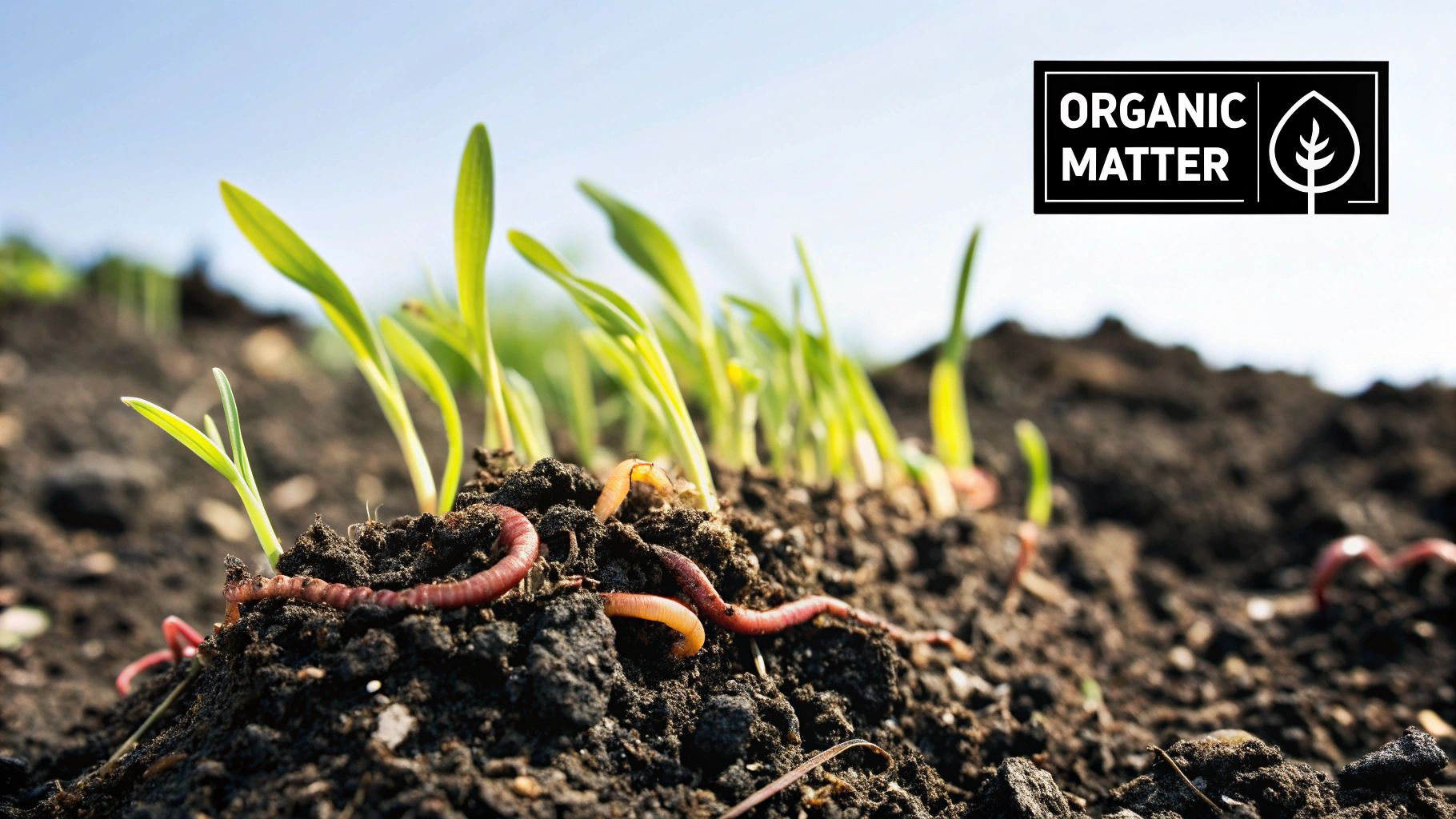
Before you can bring your lawn back to life, you have to know exactly what you’re dealing with under the surface. Trying to fix your soil without testing it first is a bit like trying to drive from Milton to Dahlonega without a map—you might get there eventually, but it's going to be a long, frustrating ride. A soil test is your roadmap. It gives you the hard data you need to make smart, effective decisions.
This one step eliminates all the expensive guesswork that sends so many North Georgia homeowners down the wrong aisle at the garden center. Instead of just grabbing a generic bag of fertilizer and hoping for the best, you’ll have a clear, scientific baseline that pinpoints your soil's specific weaknesses and strengths. Honestly, it's the single most important thing you can do to start a successful lawn care plan.
Collecting a Soil Sample That's Actually Accurate
The old saying "garbage in, garbage out" absolutely applies here. The quality of your soil test results hinges completely on the quality of the sample you send in. A rushed or poorly collected sample will give you misleading information, so taking a few extra minutes to do this right is non-negotiable.
Your goal isn't to test one random spot; you need a composite sample that represents your entire lawn. To get it, you’ll need a clean bucket, a garden trowel or soil probe, and a plan to grab about 10 to 15 small samples from all over your yard.
- Get your tools ready. Find a clean plastic bucket and a trowel. It’s important to avoid using anything made of galvanized metal, brass, or bronze. Residue from these metals can easily contaminate the sample and throw off the results.
- Map out your collection zones. Think about your yard in sections. You might have the sunny front lawn, a shady patch along the side of the house, and a sloped area in the back. Make sure you pull samples from each of these distinct areas.
- Dig for your samples. At each of your 10 to 15 spots, push aside any grass or thatch. You want to dig down about 4 to 6 inches—right into the main root zone for turfgrass—and take a nice, clean vertical slice of soil. Toss each slice into your bucket.
Once you've collected from all your spots, it's time to mix everything together thoroughly in the bucket. Break up any big clumps and pull out any rocks, roots, or other debris. Spread the mixed soil out on a piece of newspaper to air dry, then scoop about one cup into a sample bag to be sent off for analysis.
DIY Kits vs. Professional Lab Analysis
So, how do you get your sample tested? You really have two choices: a DIY kit from a big-box store or a professional lab analysis, like the one offered by our local University of Georgia (UGA) Extension offices. For anyone serious about their lawn in our area, from Cumming to Alpharetta, the choice is pretty clear.
DIY kits can give you a very rough ballpark reading of pH and maybe the "big three" nutrients: nitrogen (N), phosphorus (P), and potassium (K). But they just don't have the precision needed to tackle the unique challenges of our dense, acidic Georgia clay.
A professional lab test from the UGA Extension gives you a detailed, scientific report that blows a simple DIY kit out of the water. You get precise pH levels, exact nutrient quantities, and customized amendment recommendations based on your lawn's specific results. It takes all the guesswork out of the equation.
This detailed analysis is the foundation for everything that follows. A lab report won't just tell you that your pH is low; it will tell you exactly how many pounds of lime you need to apply per 1,000 square feet. That's a level of detail a color-changing test strip could never hope to provide.
How to Make Sense of Your Soil Test Results
When you get that report back from the lab, the sheet of numbers and charts can look a little intimidating. Don't worry. Let’s break down what a typical report for a Johns Creek lawn might show you. You’re mainly looking for two key pieces of information: soil pH and nutrient levels.
Soil pH: This number tells you how acidic or alkaline your soil is on a scale from 0 to 14. Here in Georgia, our turfgrasses are happiest when the pH is between 6.0 and 6.5. Our native red clay is naturally acidic, often coming in somewhere between 5.0 and 5.5. When the pH is that low, it essentially "locks up" available nutrients in the soil, so your grass can't absorb them—even if they're there! The report will give you a precise recommendation for lime to get that pH back into the sweet spot. For a closer look at this, check out our guide on how to test soil pH effectively.
Nutrient Levels (N-P-K): The report will also give you readings for the three most important macronutrients.
- Nitrogen (N): The powerhouse for that lush, green growth. It's tough to test for accurately since it moves through the soil so quickly, but labs provide solid recommendations based on your specific type of grass.
- Phosphorus (P): Absolutely critical for developing a strong, deep root system. Our clay soils are very often low in phosphorus.
- Potassium (K): This is the nutrient for overall plant hardiness. It helps your grass fight off disease, handle stress, and tolerate drought.
The lab will show these levels as Low, Medium, or High and suggest specific fertilizer grades (like 10-10-10 or 5-10-15) and application rates to fix any imbalances. It's a proven science that gives you a clear path forward.
Transforming Heavy Georgia Clay
You’ve got your soil test results back. Think of this as your personalized roadmap to a better lawn. Now comes the fun part—rolling up your sleeves and actually transforming that dense, stubborn North Georgia clay into something your grass will love.
It might sound like a huge job, but it really boils down to a few key moves based on what your specific lawn needs. For most of us here, from Cumming to Alpharetta, the report usually flags two big issues: the soil is too acidic and it’s packed down like concrete. Tackling these two problems head-on is what unlocks your lawn's true potential.
First Things First: Correct Your Soil pH
Before you even think about fertilizer or compost, you have to get the pH right. It's the most important step. If your soil pH is too low—a classic issue in our region—your grass can't absorb the nutrients that are already there. It’s like having a fridge full of food but the door is locked shut.
For the acidic red clay we all know and love (or hate), the solution is almost always lime. Your UGA Extension report will give you a very specific application rate, typically in pounds per 1,000 square feet. Don't guess on this one. Following that recommendation is critical, as adding too much or too little can just trade one problem for another.
Getting the lime down is easy. Just use a broadcast spreader, the same kind you’d use for fertilizer, to make sure you get even coverage. Fall is the perfect time to do this. The winter rain and snow will do the heavy lifting for you, slowly working the lime down into the soil. Just be patient; this isn't an overnight fix. It can easily take six months or more to see the full effect, but it's an absolutely essential foundation for everything else you'll do.
The Power of Organic Matter
Once your pH is headed in the right direction, the next mission is to fix your soil's structure. We need to break up that sticky, dense clay to create space for air, water, and roots to move around. And the single best way to do that? Organic matter.
Think of organic matter, like compost, as a miracle worker for clay. It improves drainage when it’s wet but also acts like a sponge, holding onto moisture during our hot, dry spells. More importantly, it feeds the microscopic life in your soil, turning it from just dirt into a living, breathing ecosystem.
Here are a few of my favorite types of compost that work wonders on our local lawns:
- Mushroom Compost: This stuff is fantastic for North Georgia. It's packed with nutrients and has a neutral pH, which is great for balancing our naturally acidic soil.
- Leaf Mold: Never underestimate the power of last fall’s leaves. Once they’re well-decomposed, leaf mold is a soil-conditioning superstar that dramatically improves structure.
- Cotton Burr Compost: This one is known for its ability to break up compacted clay. It’s a bit acidic, so it's a perfect choice after your liming program has had some time to work.
Making your own compost is easier than you think. You can turn everyday kitchen scraps and yard waste into "black gold" for your soil.
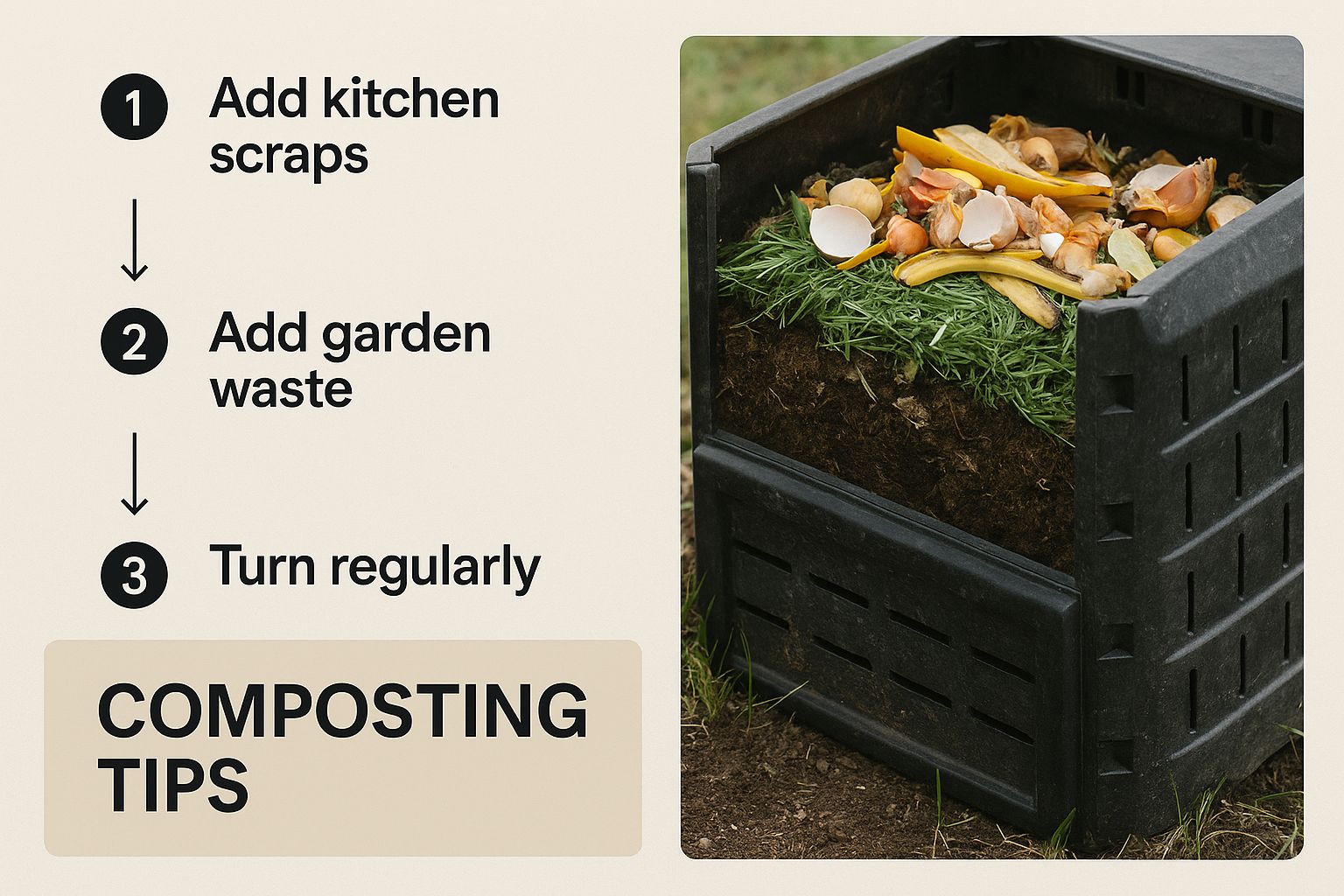
As you can see, the key is simply layering your "greens" (like vegetable scraps) with your "browns" (like dried leaves) to get the process going.
Getting Amendments Down into the Soil
Okay, so you’ve got a pile of beautiful compost. How do you get it into an established lawn without tearing everything up? The answer is a powerful one-two punch: core aeration and topdressing. This is, hands down, the most effective way to improve the soil under an existing lawn.
First, you aerate. A core aerator is a machine that pulls up thousands of small plugs of soil, which immediately relieves compaction. These new holes become superhighways for air, water, and nutrients to get down to the roots where they’re needed most. This isn't just about poking holes; it's about physically removing that compacted soil.
Think of your compacted clay lawn like a brick wall. Water and fertilizer just run off the surface. Core aeration is like drilling holes through that wall, creating pathways for essential resources to get inside.
Right after aerating is the perfect time to topdress. This is just a fancy word for spreading a thin layer—about a quarter-inch—of high-quality compost over the entire lawn. A shovel and a good rake are all you need. The compost will naturally work its way into the aeration holes, bringing that valuable organic matter right down into the root zone.
This process does more than just add good stuff to your soil; it kickstarts a whole biological cycle. Earthworms love the compost, and as they tunnel, they continue to aerate and improve your soil for you. For many homeowners, scheduling a professional aeration with overseeding service in the fall is the most efficient way to build a thick, healthy lawn from the ground up.
More Tools in the Soil-Building Toolbox
To really tackle our region's tough clay, it helps to know about a few other powerful amendments. The table below breaks down some of the most common options and how they can help.
Common Soil Amendments for North Georgia Lawns
| Amendment | Primary Purpose | Best For | Application Tip |
|---|---|---|---|
| Compost | Improving structure, adding nutrients, feeding microbes | Virtually all soil types, especially compacted clay | Apply a thin ¼-inch layer after core aeration |
| Lime | Raising soil pH (making it less acidic) | Acidic soils (pH below 6.0) common in our area | Apply in the fall based on soil test results |
| Gypsum | Loosening heavy clay, improving drainage | Clay soils with high magnesium or sodium levels | Best applied after aeration to help it work deeper |
| Expanded Shale | Permanently improving aeration and drainage | Heavily compacted clay where long-term structure is needed | Labor-intensive; best mixed into the top few inches of soil |
While compost is the all-around champion, materials like gypsum can be a game-changer if your soil test points to specific mineral imbalances.
By combining smart pH management with a steady routine of aeration and topdressing, you can systematically break down that heavy Georgia clay. You aren't just treating symptoms; you're building a healthy, living foundation that will support a beautiful, resilient lawn for years to come.
Adopting a Soil-First Fertilization Strategy
Once you’ve wrestled with your soil's pH and improved its texture, the real work of long-term nourishment begins. This is the point where most folks grab a bag of synthetic fertilizer, but that's like giving your lawn a candy bar for dinner—a quick sugar rush with no lasting benefit. A "soil-first" strategy is about feeding the entire living ecosystem beneath your feet, not just the grass blades you see.
Think of it this way: synthetic fertilizers are a direct, quick-hit meal for the grass. You get a burst of green, sure, but you've done nothing to build the health of the soil itself. In fact, you've completely bypassed the underground workforce—the beneficial microbes, fungi, and earthworms—that are the real engines of a healthy, self-sustaining lawn.
Organic fertilizers, on the other hand, play a completely different game. They're made from natural materials that break down slowly. This slow-and-steady process releases nutrients gently, feeding both your grass and the vast, complex web of life in the soil.
Why Organic Fertilizers Win in the Long Run
For those of us in Alpharetta and Milton dealing with our infamous red clay, building a robust soil ecosystem isn't just a nice idea—it's essential. Organic fertilizers are packed with the carbon-based materials that beneficial microorganisms love to eat.
When these microbes thrive, they get to work improving the soil's structure, helping it hold more water, and unlocking nutrients that were previously locked away from your grass roots. It’s a self-perpetuating cycle. Each year, your lawn becomes a little more resilient and a lot less dependent on you and a bag of chemicals.
The real win with an organic approach is that you're building a foundation. You're creating a living soil that can largely support itself, cutting down on the need for constant chemical fixes and creating a much healthier yard for your kids and pets to play in.
This isn't just about being "green." It's about being smarter. Instead of getting stuck in a cycle of chemical dependency, you're fostering a balanced ecosystem that can naturally stand up to drought, disease, and other stressors common here in North Georgia.
Easy, No-Cost Ways to Fertilize Naturally
You don't always have to buy a product to feed your soil. In fact, some of the most powerful fertilization strategies are simple tweaks to your regular lawn routine that recycle nutrients right back into your yard.
My personal favorite is a practice called grasscycling.
- What it is: It’s as simple as it sounds—just leave the grass clippings on the lawn after you mow instead of bagging them.
- Why it works: Those little green clippings are full of nitrogen, the key nutrient for lush growth. As they break down, they return that nitrogen and other nutrients right back to the soil where they came from.
- The benefit: You get a free, all-natural fertilizer that also builds organic matter and keeps yard waste out of landfills. The only trick is to keep your mower blade sharp; this creates fine clippings that disappear into the lawn quickly.
Just this one small change can slash your lawn's need for added nitrogen by up to 25% a year. It's a no-brainer.
Cover Crops for Off-Season Soil Building
If you have garden beds or even just bare patches of ground, another fantastic organic technique is planting cover crops. This means growing certain plants during the off-season, not to harvest, but purely to protect and enrich the soil.
Leaving soil bare over the winter is asking for trouble. It's vulnerable to being washed away by our winter rains or blown away by the wind. This is a bigger deal than you might think. Did you know it can take about 1,000 years to form just half a centimeter of healthy topsoil? That sobering fact really underscores why we need to protect what we have. You can learn more about why this is so critical from the UN's Food and Agriculture Organization highlights.
Here’s how cover crops come to the rescue:
- Stop Erosion: Their roots act like a net, holding the soil firmly in place.
- Build Organic Matter: Come spring, you just till the plants right back into the ground. They decompose and give the soil a massive boost of organic material.
- Smother Weeds: A thick stand of cover crops will outcompete winter weeds, leaving you with a clean slate for spring planting.
A couple of great choices for our Dahlonega-area winters are crimson clover and hairy vetch. They have the added superpower of "fixing" nitrogen from the air and storing it in the soil, ready for next year's plants to use.
Smart Watering and Mowing for Better Soil
You’ve put in the work amending your soil, and that's a massive step. But all that effort can be undone if your daily maintenance habits aren't aligned with building a healthy foundation. Think of your watering and mowing routines as powerful tools—when used correctly, they help create a lawn that can actually handle the brutal summer heat we get from Cumming to Dahlonega.
This isn't about buying more products; it’s about working smarter with what you've got. The whole idea is to encourage your grass to send its roots deep into the ground. Why? Because deep roots can find moisture and nutrients that shallow-rooted, stressed-out grass can't, making your lawn naturally tougher and less needy.
Watering for Deeper Roots, Not Just Greener Blades
If there's one mistake I see homeowners in Johns Creek and Alpharetta make over and over, it's watering too often for short little bursts. A quick sprinkle every evening might feel like you're helping, but you're actually training your grass to be lazy. The roots stay right near the surface, just waiting for their next easy drink, which creates a weak lawn that panics at the first sign of a dry spell.
The fix is a total shift in mindset: water deeply, but not often.
- What this looks like: Instead of a 15-minute daily spray, you give the lawn a good, long soak just once or twice a week. The goal is to provide a total of about one inch of water per week, including any rain we get.
- Why it works: A deep watering forces moisture far down into the soil. To get to it, your grass has no choice but to grow its roots deeper, creating a much stronger, more self-sufficient plant.
- Try this simple trick: Not sure how long to run your sprinklers? Scatter a few empty tuna cans around your lawn and turn on the water. Time how long it takes for them to fill up to the one-inch mark. That's your new watering time.
This approach is especially important for our heavy clay soil. A long, slow soak gives that dense soil time to actually absorb the water instead of letting it all just run off into the street.
Stop Scalping Your Lawn: Mowing for Health
Your mower can be your lawn's best friend or its worst enemy. It really just comes down to blade height and blade sharpness. Cutting the grass too short—what a lot of people call "scalping"—is like putting the entire plant into a state of shock.
When you chop off most of the green blade, you severely limit its ability to photosynthesize and create energy. The plant then has to burn through its root reserves just to regrow, weakening the whole system from the ground up.
Mowing tall is one of the simplest things you can do to promote a healthier root system. A taller blade of grass supports deeper roots, which in turn shades the soil, keeps it cooler, and naturally crowds out weeds. For most grass types in North Georgia, you should be aiming for a mowing height of 3 to 4 inches.
Dull mower blades are another hidden enemy. Instead of making a clean slice, they rip and tear the grass. Those ragged edges are an open invitation for diseases and also cause the plant to lose a lot more water to evaporation. Getting your blades sharpened at least twice a year is a small chore with a massive payoff.
Don’t Forget to Let Your Soil Breathe
We've talked about it before, but it's worth repeating because it’s so critical for dealing with Georgia clay. Core aeration—the process of pulling up small plugs of soil—is your single best weapon against compaction.
Foot traffic, mowing, and even heavy rain constantly press the soil particles together, squeezing out the air pockets that roots and beneficial microbes need to thrive. Aeration is the only way to mechanically reverse that damage.
- Timing is key: For warm-season grasses like Bermuda and Zoysia, the perfect time to aerate is early summer. If you have a Fescue lawn, wait until early fall.
- The benefit: Those little holes act like express lanes, allowing water, oxygen, and all those good amendments you've added to get past the compacted surface and directly down to the root zone where they're needed most.
These routines—watering deeply, mowing tall, and aerating annually—aren't just chores. They’re the follow-through that locks in all your hard work, ensuring your efforts to build healthy soil create a beautiful, sustainable North Georgia lawn for years to come.
Answering Your Top Questions About North Georgia Soil

As you start digging into the details of soil health, it's totally normal for questions to come up. From Cumming to Alpharetta, homeowners often bump into the same challenges thanks to our infamous red clay. Let's get you some clear, straightforward answers to the questions we hear most often.
How Often Should I Test My Soil in Cumming, GA?
For an established lawn in Cumming and the surrounding areas, getting your soil tested every 2-3 years is a solid rule of thumb. That's frequent enough to keep an eye on your soil's pH and major nutrient levels, letting you make smart adjustments to your lawn care plan without going overboard.
Now, if you're doing a major overhaul—like putting in a new lawn in Milton or trying to fix a stubborn problem in Johns Creek like weak growth or yellowing grass—you'll want to test annually. This gives you more immediate feedback on your efforts until things level out and your soil gets into a healthier, more stable rhythm.
Is Adding Sand a Good Way to Break Up Heavy Clay Soil?
This is a really common myth, and acting on it can backfire badly. The idea of mixing sand into our dense clay sounds logical, but it doesn't create that fluffy, loamy soil you're picturing. Instead, the sand and tiny clay particles can bind together, creating a material that's almost like concrete. You end up with even worse compaction and drainage problems than when you started.
Forget the sand. The single best way to improve the structure of North Georgia clay is by consistently adding organic matter. Materials like compost, aged pine bark fines, or leaf mold are what really build a healthy soil structure, improving aeration and letting water move freely.
Can I Improve My Soil Without Digging Up My Entire Lawn?
You absolutely can! While tilling amendments into the soil is perfect for starting a new garden bed, it's not a practical approach for an established lawn. In fact, tilling can wreck the soil's delicate ecosystem and bring a ton of dormant weed seeds to the surface, creating a whole new set of problems.
For an existing lawn, your best strategy involves a one-two punch: core aeration and topdressing.
- Core Aeration: This is the process of pulling up small plugs of compacted soil. Doing this creates little channels that allow air, water, and nutrients to get down to the roots where they're needed most.
- Topdressing: Right after you aerate is the perfect time to spread a thin layer—about 1/4 to 1/2 inch—of high-quality compost over the lawn. This rich organic material will fall into the aeration holes and slowly work its way down, improving your soil from the top down.
It’s a powerful and non-disruptive way to build healthier soil year after year. This process patiently mimics how nature builds soil, leading to sustainable, long-term results for your lawn.