

Applying lime to your lawn isn't just about tossing some pellets around. It's a calculated process that starts with testing your soil's pH, figuring out exactly how much lime you need, and then spreading it evenly. Get it right, and you’ll neutralize acidic soil, unlocking nutrients for your grass to absorb and truly thrive. For homeowners here in Cumming, Alpharetta, and the rest of North Georgia, this isn't just a "nice-to-do" task—it's often the secret to a genuinely healthy lawn.
Why North Georgia Lawns Need Lime
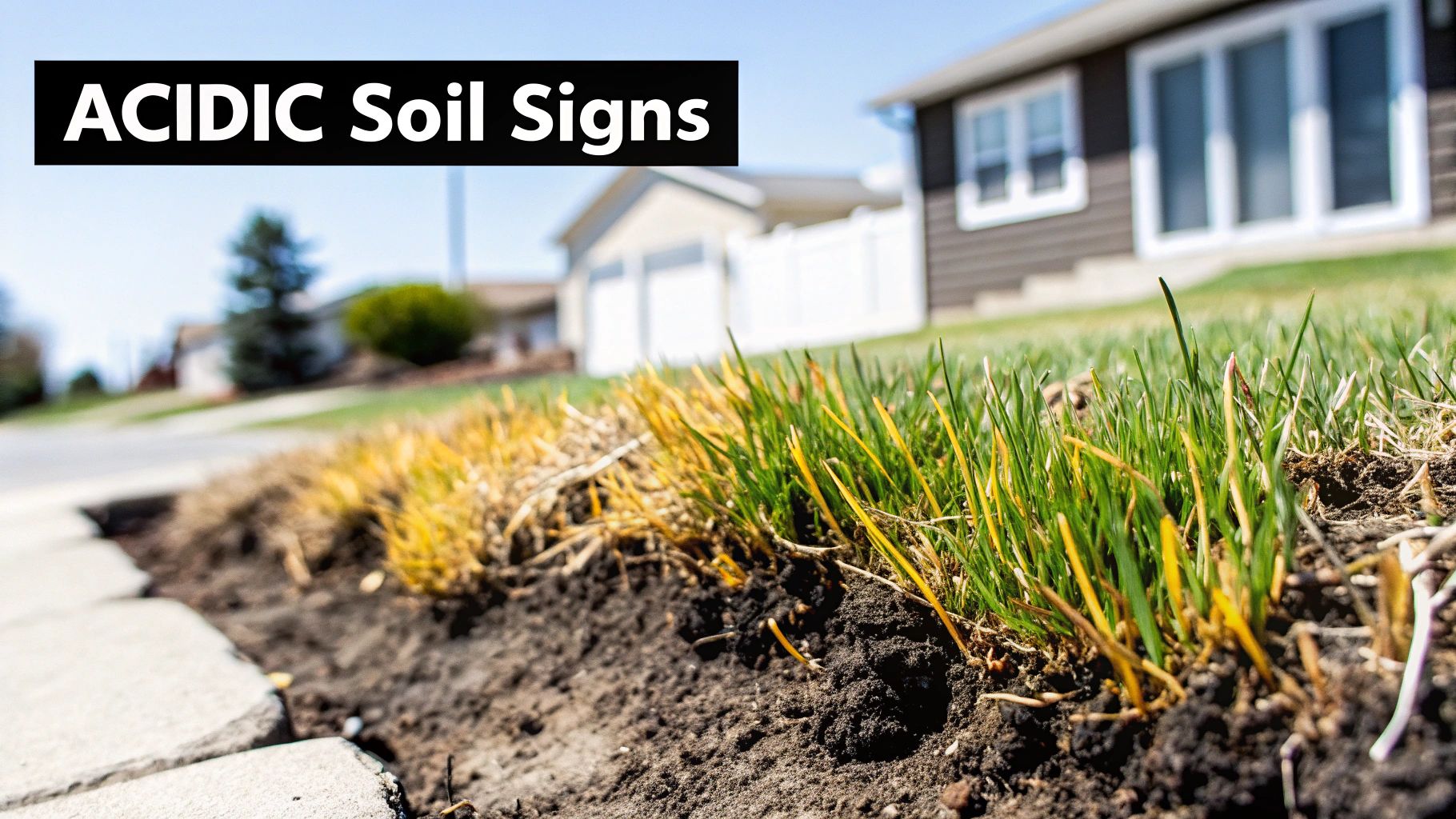
If you live anywhere from Cumming and Johns Creek across Forsyth and Gwinnett Counties, you’re dealing with a common, unseen enemy: acidic soil. Our region is famous for that heavy, red clay, which naturally has a low pH. This acidity creates a constant uphill battle for your grass, whether you have Fescue or Bermuda.
When your soil is too acidic, it's like a locked pantry. All the essential nutrients are in there, but your grass can't get to them. You could be throwing down the most expensive fertilizer, but the nitrogen, phosphorus, and potassium are essentially unavailable to the roots. This leads to those frustrating lawn problems that never seem to go away in our local climate.
Spotting the Signs of Acidic Soil
Not sure if your soil is the problem? Your lawn will tell you. When the pH is off, it sends out some pretty clear distress signals. We see these all the time in yards from Milton to Dahlonega:
- Yellowing Grass: Your lawn has a stubborn yellow or pale green tint, even after you've fertilized and watered. This is a classic sign of a nutrient deficiency common in our area.
- Stubborn Weed and Moss Growth: Certain weeds, especially moss and crabgrass, absolutely love acidic soil and will quickly take over where your turf is struggling.
- Poor Fertilizer Response: You apply fertilizer as directed, wait, and… nothing happens. If you see little to no improvement, low pH is the likely culprit.
- Increased Pest and Disease Problems: A stressed, underfed lawn is an easy target for insect damage and fungal diseases that thrive in North Georgia's humid summers.
Fixing soil acidity isn't a new concept. In fact, it's a foundational practice in agriculture. Using agricultural lime to balance soil pH has been done for centuries, and in some places like the UK, it was a massive, government-encouraged initiative in the mid-20th century to make farmland more productive.
The pH Scale and Your Lawn's Health
The pH scale is pretty straightforward. It runs from 0 to 14, where 7.0 is neutral. Anything below 7.0 is acidic, and anything above is alkaline. Most types of grass grown in our region, like Fescue and Bermuda, are happiest in a slightly acidic to neutral sweet spot, somewhere between 6.0 and 7.0.
For most North Georgia lawns, from Alpharetta to Dahlonega, the native soil pH often falls between 4.5 and 5.5—well into the acidic zone. Applying lime raises the pH, creating an environment where your grass can finally access the nutrients it needs.
This single adjustment can make a world of difference, dramatically improving your lawn's color, density, and ability to withstand stress. It’s the first real step toward building a healthy lawn from the ground up, which is at the heart of our entire approach. For more on this, take a look at our guide on how to create healthy soil.
Get Your Soil Tested Before You Start
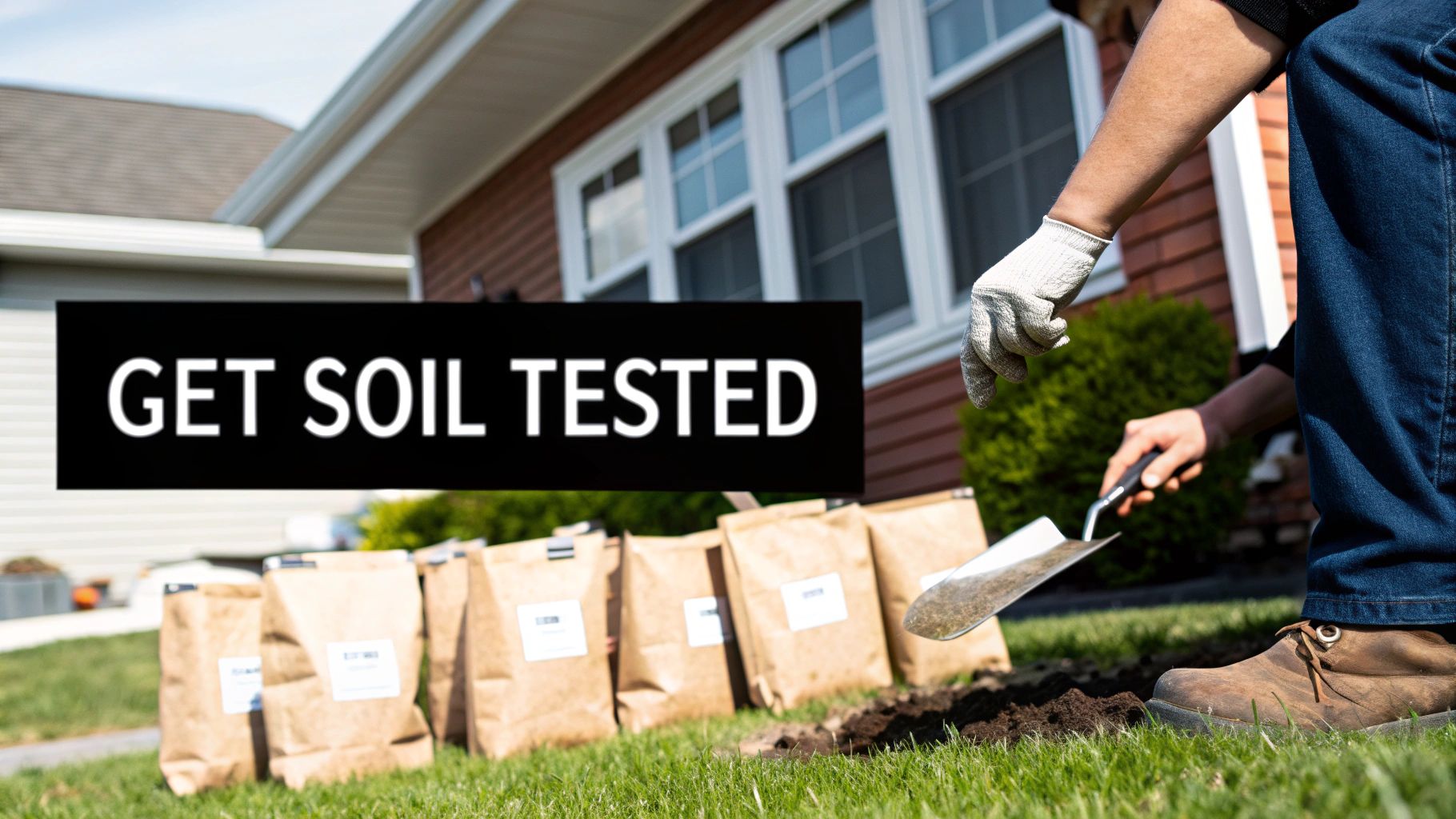
Before you even think about buying a bag of lime, you have to know what you’re working with. Applying it without testing your soil is just a shot in the dark. You could be wasting time and money, or worse, you might push your soil's pH too high and create a whole new set of problems for your lawn.
When it comes to great lawns in Cumming or Johns Creek, guesswork is the enemy. That's why a soil test is the non-negotiable first step.
Think of it as a diagnosis for your turf. A proper test gives you the hard data you need to apply lime correctly, ensuring you use the right amount to get your soil into that sweet spot for healthy grass.
The Best Way To Test Your Soil In North Georgia
For homeowners here in Milton, Dahlonega, and across Forsyth County, the most reliable and surprisingly affordable option is a professional soil analysis from your local University of Georgia (UGA) Extension office. Trust me, the results they provide blow any DIY kit from a big-box store out of the water.
Those at-home kits can give you a rough pH estimate, but they lack accuracy and miss a critical piece of the puzzle: buffer capacity. This measurement tells you how resistant your soil is to pH changes. It's especially important for the heavy clay soils we have in North Georgia, which often require a lot more lime to shift the pH than a simple test strip might suggest.
A professional soil test from a UGA Extension lab is your roadmap. It doesn't just give you a pH number; it gives you a specific recommendation in pounds of lime per 1,000 square feet, taking all the guesswork out of the equation.
Collecting An Accurate Soil Sample
To get a reading that truly represents your entire lawn, you need to collect a composite sample. It sounds technical, but it’s actually pretty simple. All you need is a clean bucket and a small trowel or soil probe.
Just walk around your lawn and gather small soil cores from 10 to 15 different spots.
Follow these tips to get it right:
- Dig to the Right Depth: You want to sample from the root zone. For most turfgrass in our area, that’s about 4 to 6 inches deep.
- Mix It All Together: Toss all your small samples into the bucket and mix them up thoroughly. This creates a single, blended sample that gives an average for your whole yard.
- Prep for the Lab: Once it's mixed, pull out any grass, roots, or rocks. You'll only need about a cup of this soil to send off for analysis.
Taking a few extra minutes to do this correctly is crucial. It ensures the lab results are a true reflection of what’s going on in your soil. For a more detailed walkthrough, you can check out our guide on how to test soil pH.
Consistent testing is a cornerstone of long-term lawn health. While the days of blindly dumping lime are gone, experts still recommend sampling your soil every few years to keep an eye on things. Once that report comes back from the lab, you'll have the exact information you need to move forward with confidence.
Picking the Right Lime and Spreader
Okay, you've got your soil test results back from the UGA Extension office, and you know exactly how much lime your lawn needs. Now for the fun part: a trip to the local garden center. But once you're there, standing in front of a wall of different lime products, it can feel a little overwhelming.
Choosing between pulverized, pelletized, or even liquid lime isn't just a matter of grabbing the first bag you see. The right choice will make the job a whole lot easier and dictate how quickly your soil pH starts to improve.
Breaking Down Your Lime Options
Let’s walk through the main types you'll find on the shelf. Each one has its pros and cons, and what works for one lawn might not be ideal for another.
-
Pulverized Lime: Think of this as limestone ground into a super-fine powder. Because the particles are so small, they have a huge amount of surface area, which means they get to work changing the soil pH relatively quickly. The big downside? It's incredibly dusty. Trying to spread this on a breezy North Georgia afternoon is a recipe for a mess—you'll end up wearing more of it than your lawn does.
-
Pelletized (or Granular) Lime: This is my go-to recommendation for most homeowners from Cumming to Milton, and for good reason. Manufacturers take that fine pulverized lime, add a binding agent, and press it into small, easy-to-handle pellets. It's virtually dust-free and flows beautifully through a standard lawn spreader, which makes getting even coverage a breeze.
-
Liquid Lime: This is the fastest-acting option of the bunch because the calcium carbonate is already dissolved in a liquid solution. You just hook it up to a hose-end sprayer and go. While it can give you a quick pH bump, the effects don't last very long. I tend to think of it more as a temporary patch than a lasting solution for correcting acidic soil.
To help you decide what's best for your lawn in Cumming or Alpharetta, here’s a quick look at how these options stack up.
Comparing Common Lawn Lime Options
| Lime Type | Form | Speed of Action | Best For |
|---|---|---|---|
| Pulverized Lime | Fine Powder | Fast | Experienced users who need quick results and don't mind the mess. |
| Pelletized Lime | Granules/Pellets | Moderate | The vast majority of homeowners in North Georgia. It's clean, easy to apply evenly, and very effective. |
| Liquid Lime | Liquid Concentrate | Very Fast | A quick, temporary pH boost or for small, targeted areas. Not ideal for long-term correction. |
Ultimately, while pulverized lime works a bit faster, the ease and accuracy you get from pellets make it the clear winner for most DIY lawn care in our area.
Honestly, after years of doing this, I point just about every homeowner in the Cumming area toward pelletized lime. The slightly longer wait for it to break down is a tiny price to pay for an application that's clean, accurate, and won't leave you covered in white dust.
Choosing the Right Tool for the Job: Your Spreader
Got your lime? Great. Now you need a way to get it on the lawn. For granular products, you’ll be choosing between two main types of spreaders: drop and broadcast.
A drop spreader is very precise. It does exactly what the name suggests—it drops the lime granules in a straight line directly between the wheels. This precision is great, but it also means you have to be meticulous with your passes, overlapping them perfectly to avoid creating stripes in your lawn.
This is why I almost always recommend a broadcast spreader (also called a rotary spreader). It uses a spinning plate to fling the granules out in a wide arc, covering a much larger area with each pass. The feathered edges of the spread pattern make it incredibly forgiving, ensuring you get nice, even coverage across your entire lawn. For the typical suburban lawns we see in Johns Creek and Milton, it’s hands-down the better tool.
Applying Lime the Right Way
You've done the prep work: you've got your soil test results, a bag of good pelletized lime, and your trusty broadcast spreader. Now comes the part where the rubber meets the road—the application. Honestly, getting the timing and technique right is what makes all the difference, especially with the unique clay soil and climate we deal with here in North Georgia.
When to Apply Lime in North Georgia
For lawns in places like Cumming, Milton, and the surrounding areas, the best times to put down lime are in the fall or early spring.
I’m a big fan of fall applications. Putting lime down then gives it the entire winter to slowly break down and work into the soil. By the time spring rolls around, your soil is primed and ready for growth. If you miss that window, early spring is your next best bet, as it preps the soil just before your lawn really starts to take off.
The one time you absolutely want to avoid is the peak heat of a Georgia summer. Applying lime to a lawn that’s bone-dry or stressed from drought is a waste of time and money. The pellets will just bake on the surface instead of getting down into the soil where they need to be.
How Much Lime Does Your Lawn Actually Need?
This is where you stop guessing and start listening to your UGA Extension soil test. That report is your playbook, telling you exactly how many pounds of lime to apply per 1,000 square feet. Flying blind here is a bad idea—too little, and you won’t fix the pH problem; too much, and you can swing the pH too far the other way, creating a whole new set of issues.
Let's look at a real-world example I see all the time in lawns around Forsyth County.
Scenario From an Alpharetta Lawn: A client has a 5,000 sq. ft. Fescue lawn. Their soil test shows a pH of 5.5. The lab report recommends applying 40 pounds of pelletized lime per 1,000 square feet to get that pH up to a much healthier 6.5.
The math is simple:
- (40 lbs / 1,000 sq. ft.) x 5,000 sq. ft. = 200 pounds of lime
- Since most pelletized lime comes in 40-pound bags, they’d need to grab five bags for the job.
It’s that easy. Just swap in the numbers from your own report and lawn size, and you'll know exactly what you need.
Calibrating Your Spreader for an Even Application
Before you start walking your lawn, you have to calibrate your spreader. If you skip this, you're just flinging lime around and hoping for the best. Check the back of the lime bag—it almost always has a chart with suggested settings for different spreader models. Find yours and set the dial.
To get that perfect, even coverage without any weird stripes, I always use a two-pass method. It’s foolproof.
- First Pass: Cut the spreader setting in half. Walk your entire lawn in a north-to-south pattern. Make sure you slightly overlap each pass, just like you would when mowing.
- Second Pass: Once you're done, go over the whole lawn again, this time walking in an east-to-west pattern.
This crisscross approach ensures every square foot gets a consistent amount of lime. Think of it like painting a wall—you wouldn’t do just one quick coat in a single direction and expect it to look good. The same logic applies here.
A couple of final tips. Even though pelletized lime is low-dust, it’s still smart to wear gloves and a basic dust mask. It just keeps you clean and safe. After you've spread the lime, give your lawn a light watering. This helps rinse the pellets off the grass blades and gets them on their way to breaking down into the soil.
You’ve spread the lime, the spreader is put away, but your work isn’t quite done yet. What you do right after application is key to making sure that lime actually starts its slow, steady work of balancing your soil's pH. These next steps are crucial for getting the results you want for your lawn, whether you're in Cumming, Alpharetta, or anywhere else with our classic North Georgia clay.
First thing's first: give the lawn a light drink. A gentle watering for about 20-30 minutes is all it takes. This quick rinse does two important things: it washes any lime dust or pellets off the grass blades and gets them down to the soil surface where they need to be. It also gives the lime the moisture it needs to start breaking down and reacting with the soil.
From measuring your yard to setting the spreader just right, getting lime down correctly is a process of careful steps.
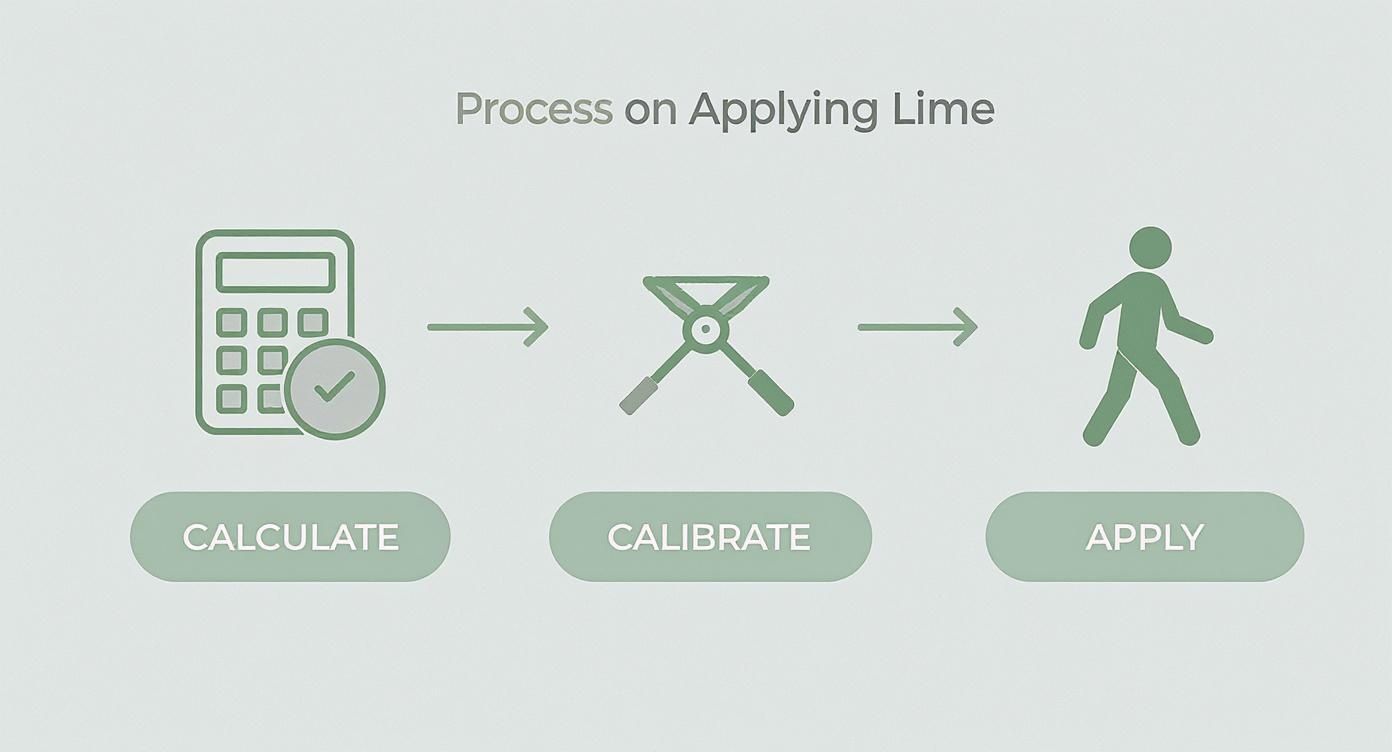
This graphic is a great reminder of the core stages: figure out how much you need, calibrate your equipment, and apply it evenly. A successful lime treatment really does depend on getting each part right, from the prep work to the final pass.
Patience is a Virtue for a Healthy Lawn
Now for the toughest part of the job: waiting. Lime is not a quick fix, and you won't see a miraculous change overnight. It can easily take several months—sometimes even a full year—for the lime to fully dissolve and bring your soil's pH up to the target level.
Don’t get discouraged if you don't see immediate results. The real payoff from liming—a thicker, greener lawn with fewer weeds—will show up next season. That's when your grass can finally absorb all the nutrients it was being starved of.
Think of liming as one important piece of the overall lawn care puzzle. It's most effective when combined with other good practices. For example, aeration is a game-changer for breaking up our dense, compacted clay soil. When you aerate, you create channels that help both water and lime work their way deeper into the root zone. You can learn more about the best time to aerate a lawn to coordinate these treatments for maximum impact.
Finally, remember that correcting soil pH is rarely a one-and-done deal. The very same things that made your soil acidic to begin with (heavy rainfall, certain fertilizers) are still at play. That’s why it’s so important to re-test your soil every few years. This simple check-up allows you to make small tweaks as needed, keeping your lawn in that sweet spot between a 6.0 and 7.0 pH and ensuring it stays healthy for the long haul.
Got Questions About Liming Your Lawn? We've Got Answers
Even after laying out a game plan, it's totally normal to have a few questions pop up before you start spreading lime. We get calls about this stuff all the time from folks in Cumming and Johns Creek, so let's clear up some of the most common uncertainties.
Can I Put Down Lime and Fertilizer at the Same Time?
This is probably the number one question we hear from homeowners in the area. The short answer is: it’s not the best idea.
Think of it this way: the lime is what preps your soil to actually use the fertilizer. If your soil pH is way off, a lot of those expensive nutrients you're spreading will just get locked up in the soil, unable to reach the grass roots.
For the best bang for your buck, put the lime down first. Water it in, then wait at least a few weeks before you fertilize. This gives the lime a head start on adjusting the pH, creating a much more welcoming environment for the fertilizer to do its job. Spreading them together is like serving dinner before setting the table—it just doesn't work as well.
Patience really is a virtue with lime. It works slowly, changing your soil chemistry over months, not days. You won't see a dramatic transformation overnight, but the long-term payoff for your lawn's health is huge.
Is Lawn Lime Safe for My Kids and Pets?
Yes, absolutely. The standard lime you buy at the garden center, whether it's calcitic or dolomitic, is simply pulverized limestone. It’s a natural, non-toxic material, so you don't have to worry about harming your family or four-legged friends in Milton or Alpharetta.
That said, the dust from powdered lime (and even some pelleted versions) can be a bit of an irritant if it's kicked up. A simple, safe approach is to keep kids and pets inside while you're applying it and until you've watered it in lightly. A quick sprinkle from the hose is usually all it takes to settle the dust and get the product down to the soil level, making the yard ready for action again.
Seriously, How Long Does Lime Take to Work?
Lime is all about the long game. It's not a quick fix; it's a slow, steady process. Because it needs moisture to break down and react with our acidic clay soil, you're looking at a gradual improvement.
You might notice your lawn looking a little greener or thicker after a few months, but the full effect on the pH can take anywhere from six months to a full year to materialize.
The speed really depends on things like the type of lime you used (finer, pulverized lime works faster than larger pellets), how much rainfall you get, and the soil temperature. This is exactly why we always recommend testing your soil again about a year after you apply lime. It’s the only way to truly know how much progress you’ve made and decide if another round is needed.
Ready to stop guessing and start getting real results for your lawn? The team at Barefoot Organics knows North Georgia soil inside and out. We create lawn care plans that work for homeowners in Cumming, Alpharetta, Johns Creek, and beyond. Get your free quote online today!