

Timing is everything when it for a truly great-looking lawn here in North Georgia. When it comes to aeration, the "how often" is a direct result of two things: what kind of grass you have and what kind of soil it's growing in.
The rule of thumb is simple. For cool-season grasses like Fescue, you'll want to aerate in the fall. If you've got a warm-season grass like Bermuda or Zoysia, late spring or early summer is the perfect time.
Your North Georgia Lawn Aeration Schedule
If your home in Cumming or Alpharetta sits on that classic red clay we all know so well, your lawn needs a bit more help. Lawns with heavy clay soil, or ones that get a lot of action from kids and pets, really benefit from being aerated annually. Think of it as an essential yearly check-up to break up that dense soil and give the grassroots room to breathe.
But not every lawn is the same. For those lucky enough to have healthier, loamy soil and less foot traffic—say, in a quiet backyard in Johns Creek—you can get away with aerating every two to three years. It’s all about reading your lawn and giving it what it needs.
This flowchart lays out the most important first step: matching the timing to your grass type.
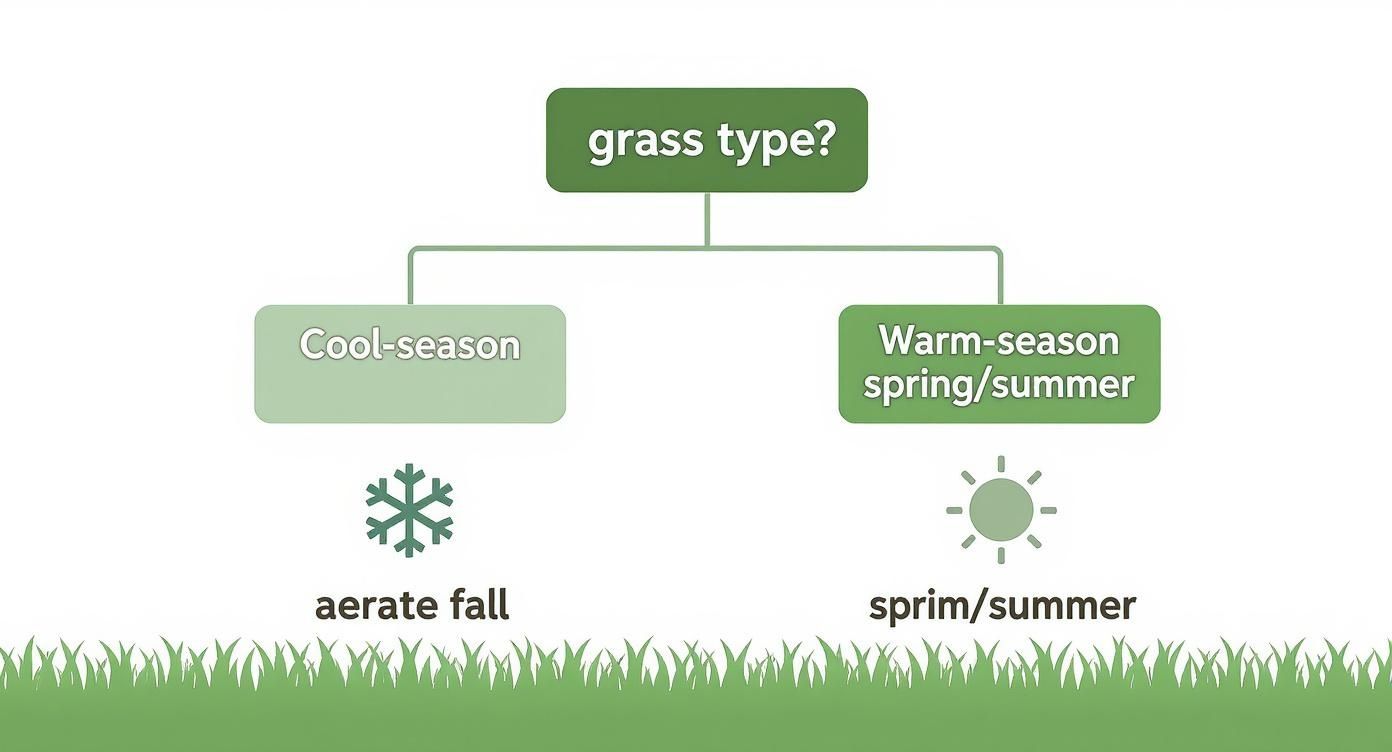
As you can see, the golden rule is to aerate when your grass is actively growing. That gives it the strength to recover quickly and take full advantage of the newly opened-up soil.
A Quick Guide for Local Grass Types
To simplify things, here’s a quick-glance guide specifically for the types of lawns we see day in and day out across Cumming and the surrounding areas. Getting this right is the foundation for a healthy turf that can handle Georgia's unique climate.
Aeration is not a one-size-fits-all solution. A lawn with heavy foot traffic in a new subdivision in Cumming will have different needs than an established, shady Fescue lawn in Milton. The key is observing your specific environment.
Here’s a simple table to serve as your starting point for scheduling aeration. It breaks down the timing based on your grass and how much wear-and-tear it gets.
North Georgia Lawn Aeration Quick Guide
This table provides a great at-a-glance reference for common local grasses and conditions.
| Grass Type | Best Season to Aerate | Recommended Frequency (High Traffic/Clay Soil) | Recommended Frequency (Low Traffic/Loam Soil) |
|---|---|---|---|
| Bermuda | Late Spring / Early Summer | Annually | Every 2 Years |
| Zoysia | Late Spring / Early Summer | Annually | Every 2 Years |
| Tall Fescue | Early Fall | Annually | Every 2-3 Years |
Once you know your schedule, you can easily plug it into a bigger plan. For a complete year-round strategy, you can integrate these recommendations into a comprehensive lawn care schedule template to keep your turf in top shape all year long.
Why Our Georgia Clay Demands Regular Aeration
Have you ever felt like you're doing everything right—watering, fertilizing—but your lawn still looks stressed and unhappy? The culprit is probably right under your feet. Here in North Georgia, from Cumming all the way up to Dahlonega, we're known for that stubborn, dense red clay. It’s beautiful in the landscape, but it can be a real headache for growing a thick, green lawn.
Think of your lawn's soil like a brand-new kitchen sponge. It's full of tiny air pockets, ready to soak up water. But with constant use and pressure, that sponge gets smashed flat. It becomes hard, and water just rolls right off. That’s exactly what’s happening in your yard every single day.
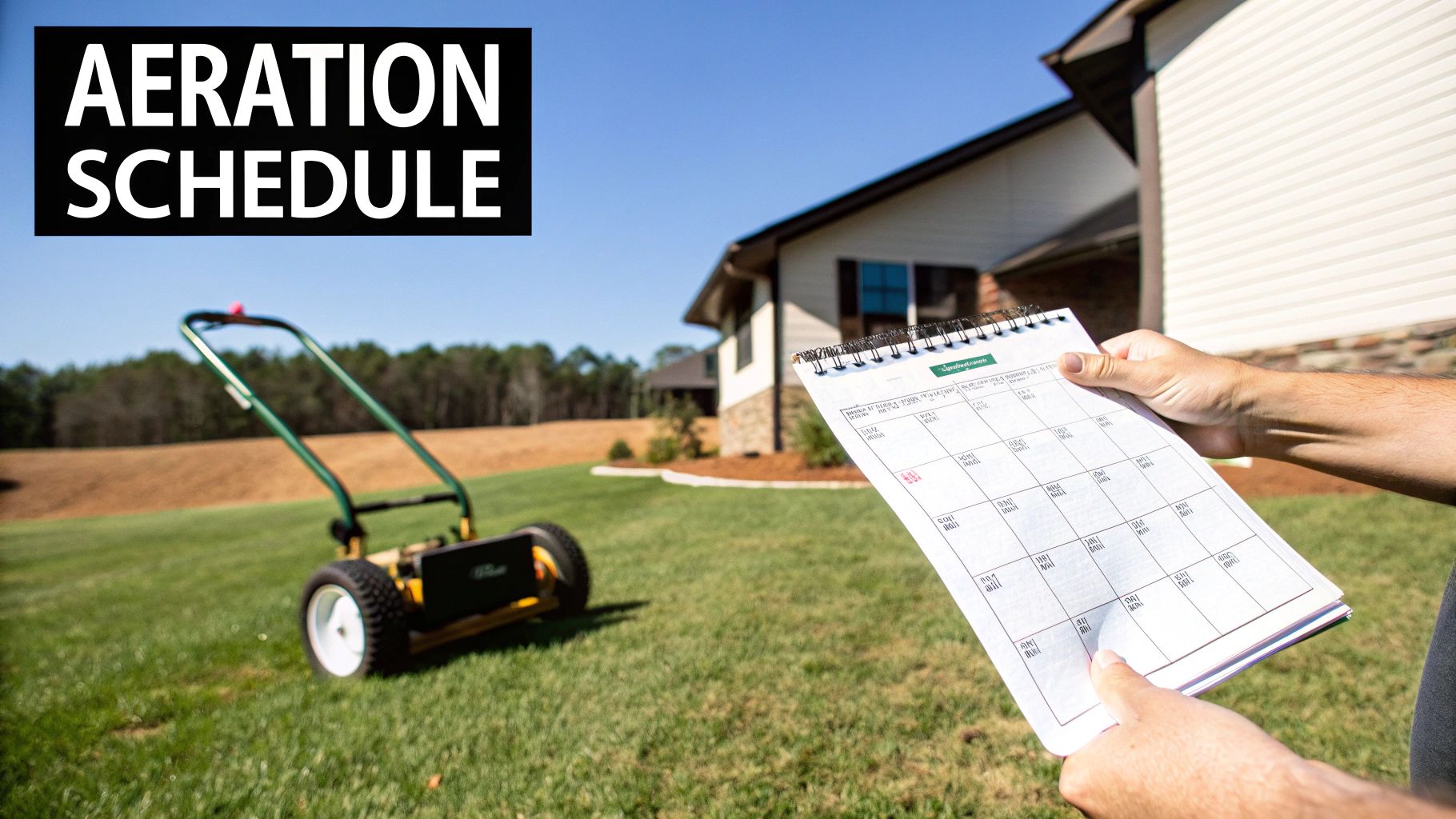
The Problem: Soil Compaction
That flattening process has a name: soil compaction. It happens slowly, almost invisibly, from everyday life. Every time the kids play soccer, the dog chases a squirrel, or you run the mower over the grass, you're squeezing those microscopic air pockets out of the soil. In busy family-focused areas like Johns Creek and Milton, this can happen surprisingly fast.
When those air pockets vanish, the soil particles get packed together like bricks. This creates a tough, almost waterproof barrier that stops the good stuff—air, water, and nutrients—from ever reaching the grassroots.
Here’s a simple way to think about it: Grass roots can't chew through concrete. Heavily compacted clay soil is basically a layer of pavement just below the surface, starving your lawn from the bottom up.
The result is a weak, struggling lawn that's an easy target for drought, disease, and every weed in the neighborhood. You can water it for hours, but if the soil can't drink, your time and money are literally washing down the drain. This is precisely why figuring out how often you should aerate your lawn is a game-changer in our part of Georgia.
Telltale Signs of a Compacted Lawn
So, how can you tell if your lawn in Alpharetta or Milton is suffocating? Thankfully, your yard will give you some pretty clear signals once you know what to look for. Your soil is likely compacted if you're seeing:
- Puddles That Won't Go Away: After a good rain, do you have little ponds on your lawn that stick around for hours? That's a classic sign water has nowhere to go.
- Thinning Grass and Bare Spots: Noticing patches where the grass looks weak and thin, especially in the areas that get the most use? Compacted soil makes it tough for grass to establish strong roots.
- The Screwdriver Test: Grab a screwdriver and try to push it into your soil (when it's moist, not bone-dry). If you have to fight to get it in a few inches, your soil is rock-hard.
- Water Running Off: When you turn on the sprinklers, does most of the water seem to run right off into the driveway? That’s another red flag.
Spotting these issues is the first step to bringing your lawn back to life. The solution isn't just more water or fertilizer—it's opening up pathways for those things to do their job. And that’s where aeration becomes your lawn's best friend.
Modern lawn care science has really doubled down on how critical this is, especially for our soil type. We've moved past one-size-fits-all advice. For lawns on heavy clay with lots of foot traffic—which perfectly describes most suburban yards around here—annual aeration is a must. In fact, data shows that roughly 60% of homeowners in the U.S. aerate their lawns at least once a year because it just plain works. You can discover more insights about these lawn care trends and see how they apply across different regions.
The Best Time to Aerate Your Bermuda, Zoysia, and Fescue Lawn
When it comes to lawn care, timing is everything. This is especially true for aeration. If you aerate at the wrong time of year, you can seriously stress your grass, slow down its recovery, and basically roll out the welcome mat for aggressive weeds. Nailing the timing is how you unlock all the benefits of aeration, particularly here in North Georgia where our seasons really dictate how different grasses behave.
The golden rule is simple: aerate your lawn when it’s actively growing. This is when your grass is at its strongest, with plenty of energy to heal quickly and fill in the spaces left by the aerator. Think of it like scheduling a minor surgery; you want the patient to be in peak health for a fast and successful recovery.
Stick to this principle, and you'll set your lawn up for a powerful rebound instead of causing it unnecessary stress.
The Best Time for Bermuda and Zoysia Lawns
For those of us in Alpharetta, Johns Creek, and Milton with warm-season grasses like Bermuda and Zoysia, your ideal window opens up right when the weather gets consistently hot. These grasses are true sun-lovers and do the vast majority of their growing from late spring all the way through summer.
The perfect time to aerate your Bermuda or Zoysia lawn is from late spring to early summer, which for us is usually between May and July. During this stretch, the grass is growing like crazy. When you pull out those soil cores, you're giving the roots immediate access to air, water, and nutrients right when the turf is hungriest.
Aerating during this peak growth period means the turf bounces back fast, sending out its runners (stolons and rhizomes) to quickly fill in the holes. This aggressive recovery naturally chokes out summer weeds trying to take hold in any bare spots. In fact, many homeowners find that knowing when to aerate a lawn in spring is the single biggest factor in having a great-looking lawn all summer.
Trying to aerate warm-season grasses when they're dormant in early spring or late fall is a big mistake. The grass has no energy to recover, leaving you with a yard full of open holes—a perfect invitation for weeds to move in before your turf even wakes up.
The Right Season for Tall Fescue Lawns
Now, if your yard in Cumming or a shady spot in Johns Creek is covered in cool-season Tall Fescue, you need to flip your calendar completely. Fescue thrives in the milder temperatures of spring and fall and absolutely hates the oppressive summer heat. Aerating Fescue in June or July would be like asking it to run a marathon in 100-degree weather—it would be a disaster.
The absolute best time to aerate a Tall Fescue lawn is in the early fall, from September through October. The ground is still warm from the summer, but the cooler air creates the perfect environment for Fescue to recover and establish deep, strong roots before going dormant for the winter.
This fall timing gives Fescue several huge advantages:
- Stress-Free Recovery: The cooler weather lets the grass put all its energy into repairing itself and strengthening its root system.
- Ideal for Overseeding: Fall aeration creates the perfect seedbed. It's the best time to overseed and thicken up any areas of your Fescue lawn that got thin and patchy over the summer.
- Fewer Weeds: By the fall, most of the aggressive annual weeds like crabgrass have finished their life cycle, so there’s much less competition for your new grass.
By lining up your aeration schedule with your grass type's natural growth cycle, you're making sure the process helps your lawn, rather than hurts it. This simple seasonal strategy is a cornerstone of great lawn care in our unique North Georgia climate.
Core Aeration Is Best for Georgia's Clay Soil
When you're dealing with the dense, stubborn red clay we have here in Cumming, Alpharetta, and across North Georgia, not all aeration methods are going to cut it. There are two main approaches you'll hear about, and choosing the right one is the difference between reviving your lawn and accidentally making your compaction problem worse.
You’ve probably seen the terms spike aeration and core aeration. They sound similar, but their results couldn't be more different.
Spike Aeration: A Quick Fix That Often Fails
Spike aeration is exactly what it sounds like: poking holes in the ground with a solid spike. Think of using a pitchfork or strapping on those cleat-like sandals and walking around your yard. The tool uses solid tines to force the soil down and sideways.
While it seems like a good idea in theory, this method is a terrible match for our heavy clay soil. Forcing a solid spike into dense earth doesn't actually relieve compaction—it just makes it worse. It increases compaction along the sides and at the bottom of each hole. Imagine jamming your finger into a block of modeling clay; you make a hole, but the clay all around it just gets packed in tighter. Any benefit is temporary at best.
Core Aeration: The Gold Standard for Georgia Lawns
Now, let's talk about the right way to do it. Core aeration uses a machine with hollow tines that function like tiny apple corers. Instead of just pushing soil around, it pulls small plugs—or "cores"—of soil and thatch completely out of the ground, leaving them on the lawn's surface.
This physical removal of soil is the game-changer. It's not about just poking holes; it's about creating real, lasting space. These new channels give air, water, and nutrients a direct path deep into the root zone, finally breaking the cycle of compaction.
Core aeration doesn't just poke holes; it performs a crucial extraction. By pulling out plugs of compacted soil, it gives the surrounding earth permission to relax and expand, creating genuine, lasting space for your grassroots to breathe and grow.
This is what makes a professional aeration service so effective. The goal isn't just to punch holes, but to fundamentally restructure the soil to support a healthier, more resilient lawn.
Why Removing Soil Cores Matters
The difference is huge, especially for homeowners in Johns Creek and Milton who are constantly fighting that packed-down clay.
Here’s exactly why pulling plugs is the only way to go:
- True Compaction Relief: Removing plugs creates voids, allowing the tightly packed soil to loosen and decompress.
- Deeper Root Growth: With the soil loosened, grass roots can finally stretch out and grow deeper, making your lawn much more resistant to our summer heat and dry spells.
- Better Water & Nutrient Access: Water, fertilizer, and oxygen can now get past the hardened surface and directly to the roots where they're needed most.
- Breaks Down Thatch: The process also pulls up and breaks apart the thatch layer, that suffocating mat of dead grass that can choke your lawn.
The science backs this up. Research shows that repeated aeration has a massive impact on lawn health. For instance, one study found that lawns aerated twice a year saw a 25% increase in water infiltration and a 15% improvement in root depth over lawns aerated just once. You can read more about these aeration findings to see how it applies to turf under heavy use.
So, for anyone in Cumming or the surrounding communities asking how often they should aerate their lawn, the answer starts with using the right technique. Always choose core aeration. It's the only way to ensure your time and money result in a genuinely healthier lawn that can handle the Georgia climate.
DIY Aeration Versus Hiring a Local Pro
So, you’re sold on aerating your lawn. You know why it needs to be done and when the best time is. The next big question is a classic weekend warrior dilemma: should you do it yourself, or is it better to call in a local pro?
For homeowners here in Cumming and Alpharetta, it’s a decision that pits your time and effort against your wallet. Both paths can get you to a healthier lawn, but they are very different journeys. Let's weigh the pros and cons to see which makes the most sense for you.

The Realities of a DIY Aeration Project
The do-it-yourself route definitely has its appeal, especially if you enjoy getting your hands dirty in the yard. The biggest draw? Saving a few bucks. But before you commit your Saturday to the cause, it’s important to understand what you're really signing up for.
First, you'll need to rent a core aerator from a local shop. The daily rental fee might look manageable, but don't forget the logistics. These machines are beasts—often weighing over 200 pounds. Just getting it home and back requires a truck and some serious muscle. It’s no small feat.
Then comes the actual work. Wrestling that heavy machine across your lawn is a workout, to put it mildly. If you have any of the hills and slopes common around here, it gets even tougher. To do it right, you need to make several passes to get a good density of holes, aiming for at least 10-20 holes per square foot. Honestly, it can take up your entire day.
The biggest oversight in DIY aeration isn't the work itself, but what comes after. Aeration creates a window of opportunity. Failing to follow up with essential steps like overseeding and fertilization is like opening a door and not walking through it.
Finally, a successful DIY job isn't over when you return the machine. The whole point of aeration is to create the perfect bed for new seed and fertilizer. Skipping these crucial follow-up steps means you did all that back-breaking work for very little gain.
The Advantages of Hiring a Local Pro
Hiring a professional lawn care service transforms aeration from a weekend-long chore into a simple phone call. Yes, the upfront cost is higher than a rental fee, but what you’re paying for is expertise, top-tier equipment, and frankly, getting your weekend back.
The pros use commercial-grade aerators that are way more powerful than the rental models. They’re built to punch cleanly and deeply into our dense Georgia clay, pulling consistent plugs and covering the ground incredibly fast. A job that would take you a solid four or five hours is often done in under an hour by an experienced crew.
Here’s a quick rundown of what you get when you hire an expert:
- Expertise and Timing: A local pro knows the soil in the Cumming area. They know exactly when to aerate your Fescue or Bermuda for the best results, taking all the guesswork out of it.
- Professional Equipment: Their machinery does a better job, period. No struggling with a heavy rental, no risking damage to your lawn (or your back).
- Efficiency: This is a big one. They save you a ton of time and hard labor.
- Comprehensive Service: Good companies like Barefoot Organics don't just aerate. They see it as one step in a complete lawn health plan. They’ll handle the crucial follow-up, like overseeding with high-quality seed and applying the right pet-safe fertilizers.
This all-in-one approach is probably the biggest benefit. A pro doesn’t just poke holes in the ground; they execute a strategy to make your lawn thicker, greener, and stronger. For many homeowners, the superior results and convenience make the investment a no-brainer for the long-term health of their lawn. It really comes down to how much you value your time, your budget, and a truly professional result.
Your Post-Aeration Lawn Care Playbook
Think of aeration as opening up a direct line of communication with your lawn's root system. You've just created thousands of tiny pathways for air, water, and nutrients to get where they're needed most. But the job isn't done yet—what you do in the hours and days that follow is what turns a good practice into a great result.
This is your game plan for capitalizing on that freshly opened ground and setting your Cumming-area lawn up for a huge win.
Making the Most of Your Freshly Aerated Lawn
First thing's first: what about all those little dirt plugs scattered across your yard? It might look a little messy, but fight the urge to rake them up. Leave them right where they are.
These cores are full of beneficial soil microbes. As you water and mow over the next week or two, they'll break down and essentially top-dress your lawn, returning valuable organic matter back into the turf.
With the soil plugs left to do their work, your next move is to give your lawn exactly what it needs to get thick and healthy.
- Overseed Right Away: Now is the perfect moment to spread new grass seed. The seeds will fall directly into the aeration holes, giving them fantastic seed-to-soil contact. This protects them from birds and the sun, creating a perfect little incubator for germination.
- Use a Starter Fertilizer: After spreading your seed, apply a starter fertilizer. This specific blend is formulated to give new grass seedlings the phosphorus and other nutrients they need for rapid, strong root development.
- Water Smart: For the next 1-2 weeks, the goal is to keep the soil surface consistently moist, but not soggy. This usually means light, frequent watering sessions—maybe once or twice a day—to help the new seeds sprout without washing them out.
Following core aeration with overseeding is the one-two punch for a truly lush lawn. You've literally created the perfect seedbed. Not taking advantage of it is like tilling a garden and then never planting anything.
Getting this follow-through right is what separates a decent lawn from a spectacular one. It ensures the effort and investment in aeration pay off with a thicker, more resilient turf that can handle our North Georgia weather. To see how a professional approach integrates these steps, you can learn more about how to properly aerate and overseed for maximum impact.
Answering Your Lawn Aeration Questions
Even with a good game plan, it's normal to have some questions before diving into a big lawn project. We get calls all the time from folks in Cumming, Johns Creek, and all over North Georgia who just want to do it right. Here are the answers to the questions we hear the most.
Can I Aerate a Brand New Lawn?
It's tempting to throw everything you've got at a new lawn to help it along, but this is one time where you need to hold back. You should wait at least one full growing season before aerating a lawn that was recently sodded or seeded.
That first year is all about root development. The grass needs time to establish a deep, strong root system without being disturbed. Aerating too soon can rip up those fragile new roots, setting your lawn back significantly. Let it mature first.
Should I Water the Lawn Before Aerating?
Yes, absolutely. This is probably the single most important prep step. Giving your lawn a good, deep watering a day or two before you plan to aerate makes a huge difference, especially with our tough Georgia clay.
Moisture softens the soil, allowing the aerator tines to sink in properly and pull out nice, deep plugs. Trying to aerate ground that's rock-hard and bone-dry is a struggle and you just won't get the results you're looking for. Just don't aerate when it’s a muddy swamp, either—aim for soil that's just slightly damp.
Think of it like trying to get a cork out of a wine bottle. When the cork is dry, it's a real fight. A little moisture helps it slide right out. Softening the soil works the same way for the aerator's tines.
Is Aeration Safe for My Kids and Pets?
The process itself is perfectly safe, but it does involve loud, heavy equipment. It’s always best to keep kids and pets inside while the work is happening, just for their own safety and comfort.
Afterward, the little soil plugs left on the lawn are completely harmless—they’re just bits of dirt and thatch that will break down and disappear back into the turf in a week or two. The only thing to be mindful of is any product applied after aeration. If you're putting down fertilizer or weed control, always read the product label to see how long you need to keep pets and children off the grass.
Ready to take the guesswork out of aeration and give your lawn the professional care it deserves? The experts at Barefoot Organics specialize in pet-safe, natural solutions perfectly suited for North Georgia's unique soil and climate. Get your free, no-obligation quote today and see how easy a beautiful lawn can be. Learn more at barefootorganicsllc.com.