

Here’s a common question I get from folks in Cumming, Alpharetta, and all over North Georgia: "How long should I actually run my sprinklers?" It's a great question because the answer isn't as simple as a single number, but there’s a rock-solid principle to start with.
Your goal is to give your lawn about one inch of water per week, and that includes whatever rain we get. The real secret, though, isn't just the amount—it's how you deliver it. You want to water deeply just two to three times per week, not a little bit every day. Light, daily sprinkles just create weak, shallow roots that can't handle our hot Georgia summer heat.
Your Quick Guide to Watering Lawns in North Georgia
Figuring out the right sprinkler runtime can feel like a guessing game. 20 minutes? An hour? It really depends on your specific yard, whether you're in Johns Creek, Milton, or even Dahlonega, but having a good starting point makes all the difference.
For the grass types we see most often around here—like Bermuda, Zoysia, and Fescue—the strategy is always deep but infrequent watering. This is how you build a resilient lawn that can actually withstand our hot, humid summers from Cumming to Alpharetta.
This approach forces the grass roots to grow deeper into the soil in search of moisture. Think about it: deeper roots mean a stronger, more drought-tolerant lawn. A shallow, daily watering routine does the exact opposite, basically training the roots to hang out near the surface where they're vulnerable to heat stress.
North Georgia Weekly Watering Quick Guide
To give you a clearer picture, here’s a simple cheat sheet for the most common turfgrasses in our area. This table breaks down that "one inch per week" rule into a practical schedule.
| Grass Type | Total Weekly Water | Sessions Per Week | Est. Duration Per Session |
|---|---|---|---|
| Bermuda | 1 inch | 1-2 | 45-60 minutes |
| Zoysia | 1 inch | 1-2 | 45-60 minutes |
| Tall Fescue | 1 to 1.5 inches | 2-3 | 30-45 minutes |
| Centipede | 1 inch | 1-2 | 45-60 minutes |
Remember, these are just starting points! Your sprinkler system's output and your soil type will require you to fine-tune these times, which we'll cover next.
Translating Inches to Minutes
So, what does "one inch of water" look like on your sprinkler timer? For most typical residential sprinkler systems, you're looking at running each zone for roughly 30 to 60 minutes, two or three times a week. This is just a baseline, but it’s a much healthier strategy than that 10-minute daily sprinkle so many people fall back on.
Understanding how often to water is a game-changer, especially in a climate like ours. Lawn watering needs change drastically depending on where you live. According to research on regional watering needs from the Cary Institute, lawns in the eastern U.S. generally need about 0.035 inches of water daily. Here in North Georgia's humid subtropical climate, where we get pretty regular rain, our needs fall right in line with that baseline.
The Expert Tip: Don't just wet the grass blades. The real goal is to deliver enough water to soak the soil several inches deep. This creates a moisture reserve in the ground that sustains your lawn between waterings and through hot afternoons in Cumming.
What we've done here is give you an immediate, actionable starting point. We've translated that abstract "one inch" rule into a real-world sprinkler time. This gives you a clear baseline before we dig into the important next steps: measuring your sprinkler's actual output and making adjustments for Georgia’s infamous red clay soil.
Find Your Sprinkler's True Output with the Tuna Can Test
It's easy to fall back on generic advice like "water for 30 minutes," but that's just a shot in the dark. Your lawn in Johns Creek isn't the same as your neighbor's in Milton. Water pressure, the types of sprinkler heads you have, and even the layout of each zone create a completely unique watering signature for your property.
To get serious about watering correctly, you have to stop guessing. You need to know exactly how much water your system puts out. This is where the simple—but incredibly effective—"tuna can test" comes into play. It's a low-tech audit that gives you high-impact results, revealing your system's true precipitation rate.
How to Run a Sprinkler Audit
Don't worry, this isn't complicated. In less than 30 minutes, you can get the exact data you need for your lawn, whether you're in Cumming, Alpharetta, or Dahlonega. All it takes is 5 to 10 empty, flat-bottomed containers. Tuna cans or cat food cans are perfect for the job.
Here’s what you do:
- Set the stage: Scatter your empty cans randomly across a single sprinkler zone. Make sure you get good coverage—place some near sprinkler heads, a few in the middle of the zone, and others at the furthest edge of the spray.
- Start the clock: Run that specific zone for exactly 15 minutes. Use a timer on your phone to be precise.
- Measure your results: Once the time is up, turn off the water. Grab a ruler and measure the depth of the water inside each can.
- Do the math: Add up all the measurements, then divide that total by the number of cans you used. The result is the average amount of water that zone puts out in 15 minutes.
For example, let's say you used five cans and measured 0.25", 0.3", 0.2", 0.25", and 0.3". Your total is 1.3 inches. Divide that by 5, and your average output is 0.26 inches in 15 minutes.
This whole process is designed to help you achieve the goal of deep, infrequent watering, which is what builds a resilient lawn.

The idea is simple: deliver about an inch of water over two or three sessions per week. This encourages the grass roots to chase water deep into the soil, making your lawn much stronger.
Turning Data into a Schedule
Now for the best part. With your specific output rate, you can create a precise watering schedule.
Using our example, if your system puts out 0.26 inches in 15 minutes, you'd need to run it for about 30 minutes to deliver a little over half an inch of water. That's your target for a single watering session.
Remember to repeat this test for every zone in your yard. You'll often find that they have surprisingly different outputs. Once you have this baseline, you can make smarter seasonal adjustments. For a closer look at that, check out our guide on how often to water your lawn in the summer. This simple audit takes all the guesswork out of the equation, saving water and promoting the deep, healthy roots your lawn needs to thrive.
Adapting Your Watering for Georgia Clay and Climate

Alright, so you've figured out your sprinkler system's output. That's a huge step. But here in North Georgia, knowing your gallons per minute is only half the battle. The real challenge comes from two local quirks: our dense red clay soil and our wildly unpredictable climate.
If you live anywhere from Cumming to Dahlonega, you know exactly what I'm talking about. Our heavy clay soil is nothing like the sandy loam you might see elsewhere. It’s made of incredibly fine particles packed tightly together, which means it absorbs water at a snail's pace.
Ever run your sprinklers for 30 minutes straight, only to see half of it running down the driveway? That’s classic Georgia clay. On any kind of slope—a common feature in places like Milton and Johns Creek—the water simply can't soak in fast enough, leading to wasteful runoff.
Mastering the Cycle and Soak Method
So, how do you get water to the roots without it ending up in the storm drain? The answer is a technique we live by in the lawn care world: the "cycle and soak" method. It's simple, but it makes a world of difference.
Instead of one long, continuous watering session, you break it up.
- First, run your sprinklers for a shorter burst—say, 15 minutes per zone. This is just enough to saturate the very top layer of soil.
- Then, let it rest. Shut the system off for at least 30-60 minutes. This pause is critical; it gives that initial water a chance to slowly seep down into the compacted clay.
- Finally, run the sprinklers again for another 15 minutes to deliver the rest of the water your lawn needs.
By splitting the watering time, you allow the softened topsoil to absorb the second round much more effectively. The water goes deep where the roots are, instead of pooling and running off. For a deeper dive into managing our local soil, we've put together a guide on how to create healthy soil.
Matching Water to Grass Type and Season
Of course, your watering schedule also needs to adapt to the specific grass you have and the time of year. A sunny Bermuda lawn in Johns Creek has completely different needs than a shaded Fescue lawn over in Milton.
- Warm-Season Grasses (Bermuda, Zoysia): These are our summer workhorses. They're built for the heat and are quite drought-tolerant. While they may need a full inch of water per week during the peak of summer in Alpharetta, they require far less in the milder spring and fall months.
- Cool-Season Grasses (Fescue): Fescue, which we often see in shadier spots, is a bit thirstier. As temperatures rise, it gets stressed and may need up to 1.5 inches of water per week just to stay green and healthy.
Smart watering isn't just about saving your lawn; it's about conserving a vital resource. Outdoor irrigation accounts for nearly a third of all residential water use in the U.S., with up to 60 percent often wasted due to poor methods.
It’s amazing what a little knowledge can do. One study showed that when homeowners understood local rainfall and their lawn's actual needs, they slashed their water usage by an incredible 61%. Thinking bigger, these small adjustments are part of a larger trend toward creating beautiful and sustainable water-smart yards that can handle whatever our climate throws at them.
Reading the Signs of an Overwatered or Thirsty Lawn
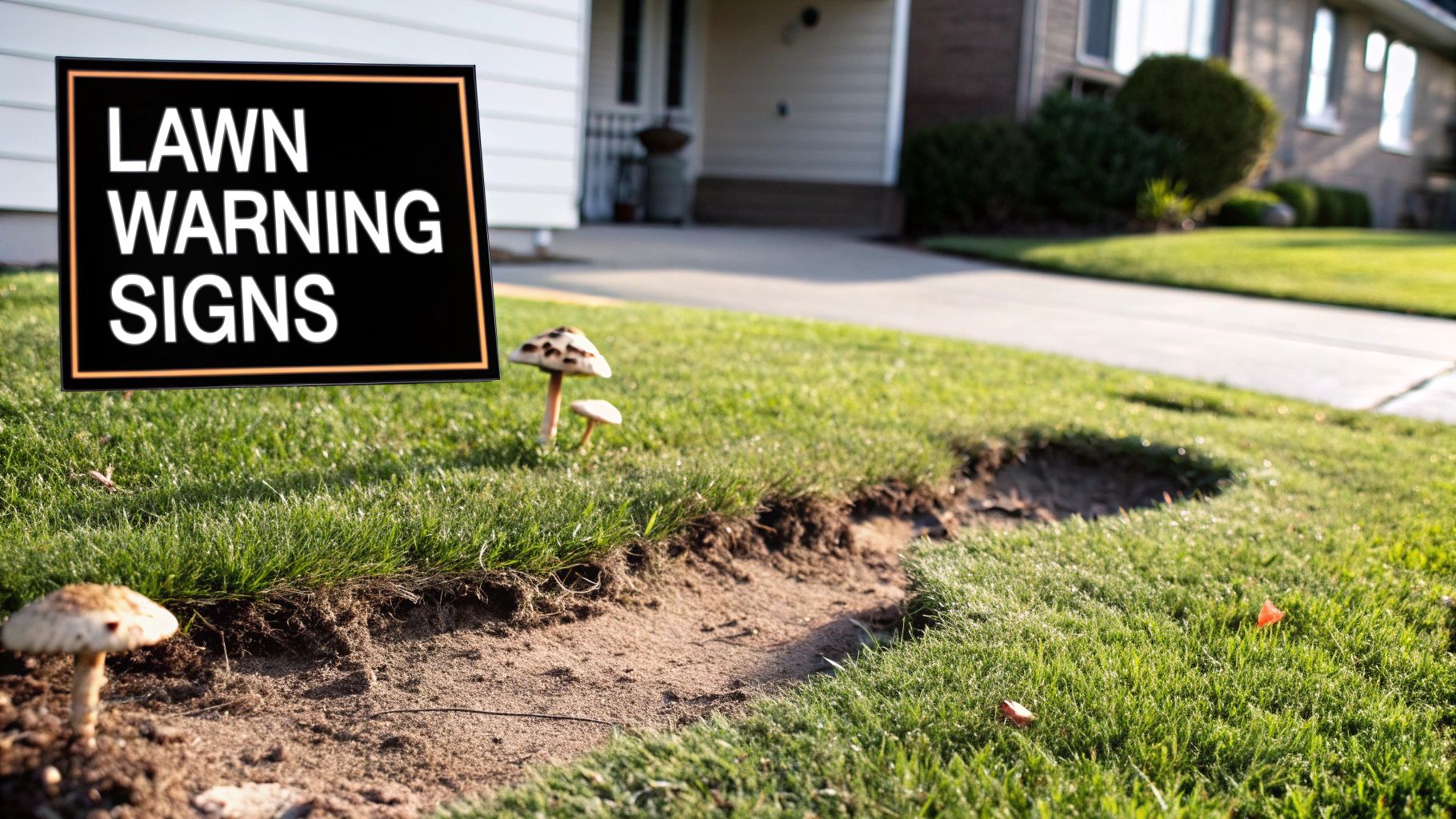
Your lawn is constantly communicating its needs; the trick is learning its language. Instead of sticking to a rigid, arbitrary schedule, you can grow a much healthier and more resilient lawn simply by paying attention to what it's telling you.
By learning to read these signs, homeowners from Johns Creek to Cumming can catch problems early, long before they turn into widespread damage. It saves water, money, and a lot of headaches.
Is Your Lawn Thirsty?
Spotting a thirsty lawn is pretty straightforward once you know what to look for. One of the oldest tricks in the book is the footprint test. Just walk across your grass and look back. If you can still see your footprints clearly after a minute or two, the grass blades don’t have enough moisture to spring back up. It’s a sure sign they need a drink.
Beyond the footprint test, here are a few other clues that it's time to run the sprinklers:
- A Color Shift: Healthy grass has a vibrant green color. When it gets thirsty, that color fades to a dull, almost bluish-gray tint. This is often the very first sign of stress.
- Curling Blades: To conserve water, individual grass blades will start to fold or roll inward. This can make the entire lawn look thin and less dense.
- Hard Soil: Try pushing a screwdriver or a small trowel into the ground. If it’s a struggle to get it in, the soil is likely too dry for roots to easily absorb water and nutrients.
The Takeaway: These symptoms mean your lawn is already stressed. The real goal is to learn your yard’s unique rhythm so you can water deeply just before these signs appear.
The Dangers of Too Much Water
While we often worry about our lawns drying out during a hot Georgia summer, overwatering is frequently the more destructive problem, especially with our humid climate. Constant moisture is an open invitation for disease and weak, shallow roots.
A key indicator is how the lawn feels. If the ground is constantly squishy or spongy under your feet, even hours after it has rained or you've irrigated, you're almost certainly overwatering. That excess moisture suffocates the roots, literally drowning them by cutting off the oxygen they need to thrive.
Another dead giveaway is the sudden appearance of mushrooms or fungal growth. Diseases like brown patch absolutely love overly damp conditions, creating those ugly, expanding circles in your turf. If you’re seeing these issues, it’s a clear signal to dial back the watering time and let the soil dry out a bit between sessions.
Overwatering vs. Underwatering Symptoms
It can be tricky to tell the difference between too much and too little water, as some symptoms can overlap. This quick-glance table helps break down the most common signs you'll see in your North Georgia lawn.
| Symptom | Underwatering (Too Dry) | Overwatering (Too Wet) |
|---|---|---|
| Color | Dull, bluish-gray tint | Vibrant green, but with yellowing patches |
| Feel | Hard, compacted soil | Spongy, squishy turf |
| Growth | Slow, thin growth | Rampant weed and mushroom growth |
| Blades | Folded or curled blades | Rotted or slimy at the base |
Becoming a good lawn detective is the key. Regularly checking these simple visual and physical cues will help you fine-tune your watering routine, ensuring your grass gets exactly what it needs to flourish.
If you want to cut down on how long you water your lawn, you have to start thinking from the ground up. Seriously. The real secret to a water-wise lawn in North Georgia isn't just about tweaking your sprinkler timer; it's about cultivating healthy, living soil.
When your soil is packed with beneficial microbes and rich organic matter, it completely changes. That hard, compacted Georgia clay starts acting more like a sponge. This transformation gives your grass roots the space and air they need to dig deep, well below the surface, where they can find and absorb moisture more effectively.
Creating a Lawn That Can Handle the Heat
A lawn with a deep, strong root system is naturally more resilient against the summer droughts we inevitably get here in places like Cumming and Alpharetta. It can tap into moisture reserves that a shallow-rooted lawn can't even touch, which means it stays greener, longer, without you having to constantly run the sprinklers.
One of the best ways to kickstart this process is with core aeration. This is non-negotiable for our dense red clay. Aeration physically pulls out plugs of soil, creating pathways for water and oxygen to get down where they're needed most—the root zone. When you do water, it soaks in deep instead of just running off into the gutter. We get into the nitty-gritty of this in our guide on how to create healthy soil.
Taking a soil-first approach does more than just save water. You're building a self-sufficient ecosystem in your yard that holds moisture better, needs fewer chemical treatments, and supports a stronger, greener lawn with a lot less work.
This focus on soil health also means you can step away from a heavy reliance on synthetic products. It’s a shocking fact, but homeowners often apply 10 times more pesticides and fertilizers per acre than farmers do. A huge portion of that ends up as runoff, polluting our local waterways. For a deeper dive into this, the Columbia Climate School offers great insights on the problem of lawns.
At the end of the day, a lawn built on a healthy foundation just needs less from you. It requires far less supplemental watering, saving you money and helping protect our beautiful North Georgia environment.
Your Top North Georgia Lawn Watering Questions, Answered
As lawn care pros working across Cumming, Johns Creek, Alpharetta, Milton, and the surrounding areas, we hear a lot of the same questions from homeowners. When it comes to watering, everyone seems to wonder about the same things. Let's clear up the confusion with some straight answers.
What’s the Best Time of Day to Water My Lawn in Georgia?
Hands down, the best time to water is in the early morning, somewhere between 4 a.m. and 10 a.m. Think of this as your lawn's "golden hour" for hydration. The air is cool, the sun is low, and the winds are calm, which means less water is lost to evaporation. More of that precious water actually makes it down to the grassroots where it belongs.
Watering in the middle of a blazing hot Alpharetta afternoon is like throwing money away—a huge chunk of it will simply vanish into the air before it ever soaks in.
But even more important is what time to avoid: the evening. Letting your grass sit wet all night in our humid climate is an open invitation for fungal diseases. Pesky problems like brown patch absolutely thrive in those damp, dark conditions and can wreck a beautiful lawn fast.
Should I Still Water My Lawn if It Rains?
You should absolutely let Mother Nature do the work for you. Your irrigation system is there to supplement rainfall, not compete with it. A quick five-minute downpour might not do much, but a good, soaking rain can easily take care of your lawn's needs for several days.
A cheap rain gauge is one of the most valuable tools you can own. It completely takes the guesswork out of the equation.
If your lawn in Milton or Johns Creek gets a solid half-inch of rain on a Tuesday, go ahead and skip your next scheduled watering day. Sticking to a rigid, automated schedule no matter the weather is one of the biggest mistakes we see—it leads to overwatering, disease, and a high water bill.
Are There Watering Restrictions in Forsyth or Gwinnett County?
Yes, and this is a big one. Most of North Georgia, including areas like Cumming and Johns Creek, falls under state-mandated water restrictions. The Georgia Environmental Protection Division generally prohibits most outdoor watering between 10 a.m. and 4 p.m. every day.
Keep in mind, though, that individual counties like Forsyth, Gwinnett, or Cobb can and do implement their own, stricter rules, especially when we're facing a drought. These local ordinances can change from year to year, so it's always a smart move to check your local county water authority's website before you set your sprinkler timer for the season. A quick search for "Forsyth County water restrictions" or "City of Alpharetta water rules" can save you from a potential fine.
How Should I Water New Sod or Seed?
Watering new grass is a completely different ballgame. Forget everything about deep, infrequent watering for the first few weeks. Here, the goal is to keep the soil surface consistently moist to help those new roots get established.
- For New Seed: This means you'll be watering lightly but frequently, maybe even several times a day. You're just trying to keep those tiny seeds from drying out while they're trying to sprout.
- For New Sod: For the first week or so, you’ll probably need to give it a good soaking every single day. You want to make sure the soil underneath the sod stays damp, which encourages the new roots to reach down and take hold.
As the new turf starts to establish over a few weeks, you can slowly back off, watering less often but for longer periods. This gradual transition helps the lawn get used to the deep watering schedule that builds a tough, resilient root system for the long haul.
A healthy, smartly watered lawn is the bedrock of a beautiful landscape. At Barefoot Organics, we take that foundation and build on it with our natural, soil-first approach. We create lawns in Cumming, Johns Creek, Milton, Alpharetta, and beyond that aren't just green, but are genuinely healthier, more resilient, and less dependent on constant watering. Ready for a lawn that truly thrives? Get your free quote today at https://barefootorganicsllc.com.