

Are you fighting a losing battle with your lawn under those beautiful, mature trees in Cumming? If you have thin, patchy grass beneath your oaks and pines, you're not alone. It's a classic Forsyth County problem. Most turfgrasses we love here in North Georgia—especially popular Bermuda and Zoysia—are sun worshippers. They need at least 6-7 hours of direct, unfiltered sunlight to thrive. Anything less, and they start to get weak and spindly, leaving bare spots that become a welcome mat for weeds.
At Barefoot Organics, we solve this exact problem for homeowners across Cumming. We use proven, organic-based lawn treatments to help shade-tolerant grass not just survive, but thrive in our local conditions.
Ready to fix your thin, shaded lawn for good? Get a free lawn evaluation today!
Why Shady Lawns Matter in Cumming, GA
Trying to grow a great-looking lawn in the shade is probably the biggest headache for homeowners from Cumming to Johns Creek. It’s more than just a lack of sunlight. Underneath that dense tree canopy, a fierce competition is happening, and your grass is usually on the losing end.
Think about what's going on in those shady spots. It's a perfect storm of local lawn challenges all hitting at once:
- Red Georgia Clay Soil in Cumming: Our infamous clay soil gets packed down hard by tree roots and foot traffic. It becomes incredibly difficult for delicate grass roots to push through and find the water and nutrients they need to survive.
- A Battle for Resources: Those big, beautiful trees have massive root systems that are greedy. They soak up a huge amount of the available water and nutrients in the soil, leaving your turf with the scraps.
- High Summer Humidity: A thick tree canopy doesn't just block sun; it blocks airflow. This traps moisture right at the soil level during our muggy Georgia summers, creating the perfect breeding ground for fungal diseases like brown patch.
- Acidic Soil from Debris: As leaves and pine needles fall and decompose, they gradually lower the soil's pH. This makes the soil more acidic, which "locks up" key nutrients and prevents your grass from absorbing the fertilizer you apply.
The Frustration for Cumming Homeowners
For many of us living in Cumming communities with strict HOAs, a weak, patchy lawn isn't just a personal frustration—it can be a real problem. You look across the street and see your neighbor's full-sun Bermuda lawn looking like a golf course, while your yard under the trees looks tired and thin. It’s a familiar story in wooded neighborhoods from Alpharetta to Dawsonville.
The secret isn't to keep trying to force a sun-loving grass to grow where it can't. Success comes from choosing a grass variety that is naturally built for lower light and then giving it the specific support it needs to win that battle for resources. You can learn more about this in our comprehensive guide on how to grow grass in shade.
Simply put, the game plan that works for a sunny lawn in Suwanee will fail in a shaded backyard in Milton. You need a completely different approach, and it all starts with picking the right player for the team—your grass.
Top Shade Grasses for Cumming GA at a Glance
To make it easier, we've put together a quick comparison of the best shade-tolerant grasses that do well in our Forsyth County climate. Use this table to find the best starting point for your specific yard.
| Grass Type | Minimum Sunlight | Best Use Case in Cumming | Summer Stress Tolerance |
|---|---|---|---|
| Tall Fescue | 4-6 hours | Under large deciduous trees | Moderate (with proper care) |
| Fine Fescue | 3-4 hours | Deeply shaded, low-traffic areas | Low to Moderate |
| Shade-Tolerant Zoysia | 5-6 hours | Mixed sun/shade transitional zones | High |
| Bermuda Grass | 7+ hours | Not recommended for Cumming shade | Very High |
As you can see, you do have options! The key is matching the grass type not only to the amount of sun it gets but also to how you use your lawn. Tall Fescue is often the go-to for moderately shady areas in Cumming, while a specialized Zoysia can work in those tricky transitional zones.
Treatment Breakdown: Choosing the Right Shade Grass for Cumming
If you have a lawn in Cumming surrounded by our area's beautiful, mature trees, you know the struggle is real. The conversation about what grass to plant almost always leads to cool-season varieties. Our beloved warm-season grasses, like Bermuda, just can't hang on without a full day of sun. For shady yards in North Georgia, the true champions are specific types of Fescue and, in some unique situations, Zoysia.
The key is to match the grass to your property's specific conditions, from the amount of dappled sunlight filtering through the leaves to how well your red Georgia clay soil drains.
Fescue: The Go-To Choice for Cumming, GA Shade
Here in Forsyth County, fescue is hands-down the king of shade-tolerant turf. These grasses are just built differently, genetically better suited to handle the lower light under the dense canopies of oaks and pines you see everywhere from Milton to Sugar Hill and Canton.
We primarily work with two types of fescue in this area:
Tall Fescue: Think of this as the workhorse for most moderately shaded Cumming lawns. It has a wider blade and a surprisingly deep root system, which helps it fight tree roots for water in our notorious Georgia clay. It needs at least 4-6 hours of sunlight—even if it's filtered—making it perfect for the dappled light under big leafy trees.
Fine Fescue Blends: For those really stubborn, deeply shaded spots that get less than four hours of sun, fine fescues are the only answer. These grasses have a delicate, almost wispy look and are the most shade-tolerant cool-season grasses you can find.
Figuring out what your lawn needs can feel like detective work. This chart can help you trace the symptoms back to the root cause, whether it's shade, soil issues, or something else entirely.
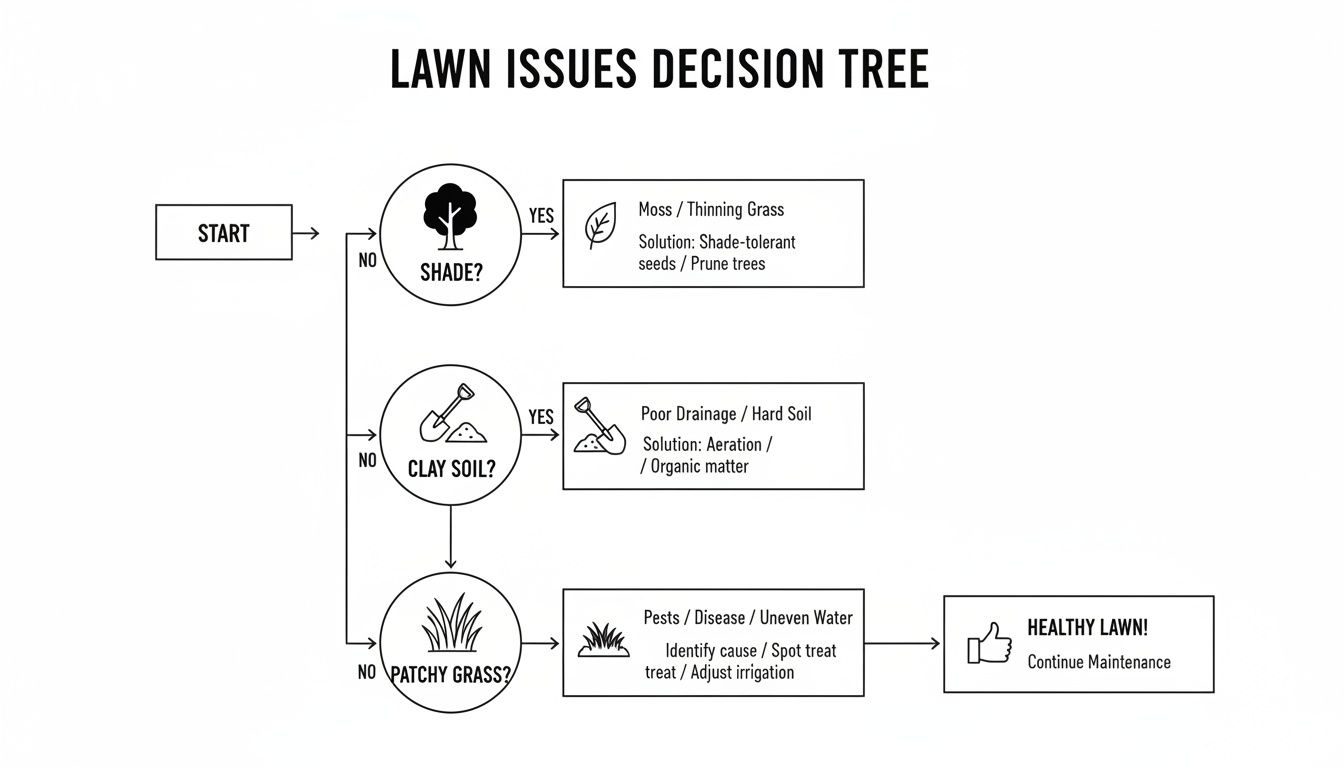
As the decision tree shows, correctly identifying the problem—like too much shade—is the critical first step. Once you know what you’re up against, you can choose the right solution instead of wasting time and money on treatments that won’t work.
In the tree-lined neighborhoods of North Atlanta, from Cumming and Alpharetta to Buford, planting the right grass can completely change the game. Shade-tolerant fine fescues can turn those patchy, sad-looking areas under trees into lush, green turf. Turfgrass experts confirm that these grasses are at the top of the list for shade tolerance, thriving on as little as 4 hours of filtered sunlight per day. This makes them a perfect fit for yards with the dense tree cover common across Forsyth County.
What About Zoysia Grass in Shaded Cumming Areas?
While most warm-season grasses give up in the shade, some Zoysia varieties are tougher than others. Cultivars like ‘El Toro’ or ‘Zeon’ can often get by on 5-6 hours of sun, which makes them a possibility for lawns in Johns Creek or Suwanee that have a mix of sunny and shady spots.
The big advantage of Zoysia is its incredible tolerance for heat and drought, a huge plus during our blistering Georgia summers. Keep in mind, though, it will still get thin and patchy in heavier shade where a good fescue would be perfectly happy. For any Cumming lawn with significant tree cover, a high-quality fescue blend is almost always the more reliable pick.
If you want to dive deeper, we have a whole article dedicated to exploring the best shade-tolerant grass varieties for our area.
Beyond Grass: Groundcovers and Alternatives
Let's be honest—sometimes, the shade in a Cumming yard is just too dense for any grass to grow well. In those spots, trying to force a lawn to grow is a losing battle. The best move is to stop fighting and embrace plants that actually love the shade.
For the darkest corners of your yard, like right under a dense magnolia or a tight grouping of pine trees, even fine fescue will struggle. This is the perfect place for groundcovers like Mondo Grass, Liriope, or Ajuga. These plants are designed by nature to thrive in low light, giving you a beautiful green carpet without the constant headache.
As you plan out these challenging areas, you might find some great ideas in this guide to the Top 10 Shade Tolerant Plants. It can help you create a beautiful, cohesive landscape that works with your yard's natural light instead of against it.
Application Process: Our Proven Plan for Shaded Lawns in Cumming
Getting grass to grow well under the beautiful, mature trees in Cumming isn't about luck. It's about having a smart, locally-tuned plan. You can't just toss out some seed and cross your fingers; the unique challenges of tree canopies, competitive roots, and filtered sunlight demand a more deliberate approach.
At Barefoot Organics, we've spent years refining our process to give shaded Forsyth County lawns a real fighting chance. We know the local landscape—from the stubborn red clay in new construction subdivisions to the acidic soil under old-growth pines—and we’ve built our strategy around what actually works here.
Step 1: We Start with a Soil Analysis
Everything we do begins with understanding your soil. Before we even think about seed or fertilizer, we conduct a professional soil test. This is non-negotiable for shaded areas in Cumming, where the soil under oaks and pines often becomes too acidic for grass like Fescue to properly pull in nutrients.
That simple test tells us a powerful story. It gives us the exact recipe needed to balance your soil's pH with our organic-based amendments, effectively unlocking the food that’s already there. This first step is often the single most impactful thing we can do.
Step 2: We Relieve Soil Compaction
Between heavy foot traffic, thirsty tree roots, and our notorious Georgia clay, the soil in shaded areas can get packed down as hard as concrete. Grass roots simply can't muscle their way through it. Our solution is core aeration.
By pulling up small plugs of soil, we create thousands of small channels that let air, water, and nutrients finally get down to the root zone. It's like opening a window in a stuffy room. This step is absolutely critical for giving new grass seed a welcoming place to germinate and establish strong roots. You can learn more about how we aerate and overseed a lawn in Cumming.
Step 3: We Use the Right Seed and Fertilizer
We don’t grab a generic bag of seed from the big-box store. We use premium, certified Tall and Fine Fescue blends specifically selected for their proven track record in the low-light yards across North Atlanta. Our application process is meticulous, ensuring that seed makes direct contact with the soil where it needs to be.
After seeding, we apply a slow-release starter fertilizer that’s packed with organic goodness. The formula is designed to build a deep, robust root system without forcing a lot of weak, flimsy top growth—a common problem in shade. It provides the foundation your new grass needs to withstand the stress of a Georgia summer.
In areas from Milton to Buford where trees can shade over 50% of a yard, the grass has to work smarter. Research on how grass adapts shows that in low light, the blades physically widen to create more surface area for catching sunlight. The Fescue varieties we choose are champs at this, boosting their photosynthesis ability by 20-30% in shade, which is key to staying healthy and green.
Step 4: We Guide You on Proper Care
Our partnership doesn't end once the seed is down. We arm you with simple, straightforward advice on two of the most important things you can do to maintain a healthy shaded lawn:
- Mow High: We'll show you why setting your mower deck to 3.5–4 inches is a game-changer. Taller grass blades mean more surface area to soak up every last bit of available sunlight.
- Water Smart: Shaded spots hold moisture longer, which can invite fungal diseases. We'll guide you on a deep, infrequent watering schedule that encourages roots to grow down deep while keeping problems like brown patch at bay.
Solving Common Shade Problems in Forsyth County
If you live in Cumming, Alpharetta, or Johns Creek, you know our beautiful, mature trees are a double-edged sword. They provide welcome relief from the Georgia sun, but they can wreak havoc on your lawn. Getting grass to thrive under a dense canopy isn't just about finding a shade-tolerant seed; it's about tackling a whole different set of local problems.
These shady spots become damp, still microclimates that invite trouble. At Barefoot Organics, we've spent years in Forsyth County yards diagnosing and fixing these exact issues. We know what works because we deal with it every single day.
Battling Moss and Fungal Disease
Take a look under your big oak trees. See that green, velvety carpet? That’s moss, and it’s a classic sign of a shady Cumming lawn. Moss absolutely loves the damp, acidic soil that’s so common here. With limited sun and barely any airflow, it can quickly choke out your fescue.
It gets worse in the summer. Our thick humidity gets trapped under the tree canopy, turning your lawn into a perfect breeding ground for fungal diseases like brown patch. One day your grass looks fine, and the next you have ugly, dying circles. It’s a frustrating cycle for homeowners from Cumming to Canton.
Here's how we fight back:
- Fixing the Soil: We start by testing your soil's pH. Our organic-based treatments help raise the pH, making the soil less acidic and far less friendly to moss.
- Preventing Fungus: We apply targeted, safe treatments that act like a shield for your grass, stopping fungal diseases before they can even get started during those hot, sticky months.
Managing Tree Root Competition
Your trees aren't just blocking the sun; they're also fighting your grass for survival underground. Those massive, sprawling root systems are incredibly thirsty, and they will always win the battle for water and nutrients against tiny grass roots. You can often see them right at the surface, making it nearly impossible for turf to get a foothold.
We see a lot of homeowners make the mistake of piling on surface fertilizer, thinking it will help the struggling grass. In reality, you're mostly just feeding the tree. Our solution is to go deeper with a deep-root fertilization program that injects nutrients right into your lawn's root zone, bypassing the greedy tree roots.
Smart tree care makes a huge difference, too. Thinning the canopy lets more light and air through. While it's best to consult a local arborist, this expert guide to tree pruning offers a solid overview of the principles, which are the same no matter where you live.
The Critical Role of Fall Overseeding
After a brutal Georgia summer, fescue lawns in the shade are often looking thin, tired, and patchy. The fall isn't just a good time for recovery—it's the only time. For a lush, dense lawn in a shady Cumming spot, overseeding is not optional. It's an absolute must.
In places like Johns Creek and Milton, the go-to choice is a quality, shade-tolerant tall fescue. This grass is the key to maintaining green year-round. It's no surprise that tall fescue covers over 30 million acres nationwide, with a huge concentration right here in the Southeast where it’s perfectly suited for the shady conditions under our beautiful tree canopies.
Why Choose Barefoot Organics in Cumming, GA
Let's be honest. When you search for "lawn treatment near me," you don't want a 1-800 number for a national chain. You want to talk to someone who actually knows what it's like to grow grass under a giant Georgia oak tree in Forsyth County.
You deserve an answer from a local who gets it. We’re not some faceless franchise; we’re your neighbors, right here in Cumming, focused on solving the exact lawn problems you're facing.
Local Experts Who Know Your Neighborhood
Advice that works for a lawn in Ohio is useless when you're staring at a patch of struggling fescue baked into our local red clay. Our team is on the roads in Cumming, Alpharetta, Milton, and Johns Creek every single day.
We see firsthand what works and what doesn't. We know all about the unique challenges here, like:
- Getting turf to take in a new construction neighborhood over in Dawsonville.
- Making sure your lawn meets the standards of your Cumming HOA.
- Fighting back the nonstop crabgrass and weeds that thrive in our long, humid summers.
This boots-on-the-ground experience means we skip the generic, one-size-fits-all treatments. We build a plan for your lawn, whether that means tackling brown patch in a shady Suwanee backyard or helping a heat-stressed lawn in Buford recover.
A Commitment to Family-Safe, Effective Treatments
We believe you shouldn’t have to fence off your yard after a lawn treatment. As a local, family-focused company, we specialize in organic-based lawn care programs that are as responsible as they are effective.
Our whole philosophy is about building a healthier lawn from the ground up. By improving your soil, we grow stronger, more resilient turf that can naturally fend off weeds and disease. It's the perfect approach for families with kids and pets who want to actually live on their lawn, not just look at it.
You don't just get a service with us; you get a local partner. We're here to give you honest advice and deliver a lawn your family can truly enjoy—barefoot and worry-free.
Ready to see what a local expert can do for your yard? Call Barefoot Organics today for a free lawn evaluation and let’s get your Cumming home the beautiful, healthy lawn it deserves.
FAQs: Your Shade Grass Questions for Cumming, GA
If you're a homeowner in Cumming or anywhere in Forsyth County, you're not alone in struggling with those tricky, shaded spots. Getting straight answers that work for our local Georgia climate is the key. Here are the most common questions we hear from your North Georgia neighbors.
Q: When is the best time to plant shade grass in Cumming, GA?
A: In Cumming, the ideal time to plant shade-tolerant fescue grass is in the fall, from September through mid-October. Our Georgia clay soil is still warm enough for quick germination, but the brutal summer heat has passed. This gives the new grass the entire cool season to establish deep roots before facing its first hot Forsyth County summer.
Q: Will Bermuda grass grow in the shade in my Alpharetta yard?
A: The honest answer is almost always no. Bermuda grass is a sun-lover and needs at least 6-7 hours of direct, unfiltered sunlight daily. In the dappled light under the mature trees common in Alpharetta and Milton, Bermuda gets thin, weak, and overrun by weeds. For any shady part of your lawn, a quality Tall Fescue blend is a much smarter choice.
Q: How should I mow my shaded fescue lawn in Cumming?
A: For any shaded fescue lawn in Cumming or nearby cities like Sugar Hill, you must mow higher. We recommend setting your mower deck between 3.5 and 4 inches. Taller grass blades act like bigger solar panels, capturing more of the limited sunlight that filters through the trees. This extra energy is essential for survival during our long growing season.
Q: Does shaded grass in Cumming need to be watered differently?
A: Yes, absolutely. Shady spots in your Johns Creek yard hold moisture longer, and poor airflow under trees creates a perfect environment for fungal diseases like brown patch, especially with our high humidity. Water deeply but infrequently, only when the top inch of soil feels dry. This encourages deep roots and helps keep fungus at bay.
Q: Can I grow grass under pine trees in my Dawsonville lawn?
A: Growing grass under pines is a double challenge: deep shade and acidic soil from fallen needles. It's tough, but not impossible. The key is starting with a highly shade-tolerant Fine Fescue blend and first correcting the soil's pH. A soil test is critical. You'll also need to commit to overseeding every fall to keep the area thick and healthy.
Ready to finally win the battle with your shady lawn? Let the local experts at Barefoot Organics create a customized plan that works for your Cumming home. We understand North Georgia soil and have the proven, family-safe solutions to help your lawn thrive.