

Keeping a lawn green and healthy through a North Georgia summer is a special kind of battle. It’s a far cry from the generic advice you see on national websites. For our warm-season grasses like Bermuda and Zoysia, true success hinges on a specific trifecta: smart watering, adjusted mowing, and strategic fertilization. This is how you fight back against the relentless sun and humidity, from Cumming all the way to Alpharetta.
Your Resilient Summer Lawn Plan for North Georgia
That Georgia heat is no joke. Anyone living from Forsyth County to Milton knows the drill: a gorgeous, vibrant lawn in June can become a sad, brown, stressed-out mess by August if you don't have a solid game plan.
A common mistake is just throwing more water at the problem. But that often does more harm than good, leading to weak, shallow roots and creating a perfect breeding ground for fungal diseases.
Real summer lawn care is about working with our climate, not against it. It’s about knowing that a Zoysia lawn in Johns Creek has completely different needs than a fescue lawn up north. This guide is your local roadmap, a clear and actionable plan built for the very specific challenges we face right here in areas like Cumming, Milton, Alpharetta, and Dahlonega.
What Makes a North Georgia Summer So Tough on Lawns?
It's the combination of temperatures soaring into the 90s and that thick, soupy humidity that creates a perfect storm for lawn stress. This environment is practically an incubator for fungal diseases like brown patch and dollar spot. At the same time, pests like armyworms and grubs are having the time of their lives, ready to cause massive damage in what feels like an instant.
To win this fight, your strategy has to focus on building resilience from the soil up.
Here’s what that looks like in practice:
- Go for Deep Roots: You need to encourage the roots to dig deep into the soil. This gives them access to moisture long after the surface has dried out in the afternoon sun.
- Cut Down on Turf Stress: Simple changes, like raising your mowing height and never, ever mowing in the midday heat, can drastically reduce the strain on your grass.
- Manage Nutrients Wisely: Feeding your lawn the right things at the right time is crucial. It prevents burnout and supports steady, healthy growth instead of weak, rapid bursts.
The goal here isn't just about survival—it's about helping your lawn actually thrive. A proactive approach that puts soil health and proper cultural practices first will always beat reactive, chemical-heavy treatments for long-term vitality in our region.
Here's a quick cheat sheet to keep you on track.
North Georgia Summer Lawn Care At a Glance
This table breaks down the essential tasks for keeping your warm-season turf healthy during the hottest months of the year.
| Task | Frequency | Goal for Bermuda/Zoysia Grass |
|---|---|---|
| Watering | 1-2 times per week, deeply | Encourage deep root growth; provide 1-1.5 inches of water total |
| Mowing | Every 5-7 days | Maintain a higher cut (2-2.5 inches) to reduce stress and shade soil |
| Fertilizing | 1-2 applications over the summer | Provide slow-release nutrients; avoid promoting weak growth |
| Pest/Disease Check | Weekly | Early detection of issues like brown patch, dollar spot, or grubs |
| Weed Management | As needed (spot treat) | Address weeds before they spread, avoiding broadcast herbicides in high heat |
Following these guidelines will put you well on your way to a lawn that not only survives the summer but looks great doing it.
Ultimately, you can trace almost any lawn problem back to the soil. Building a strong, healthy foundation is the single most important thing you can do to help your grass withstand summer pressures. For a deeper dive, you can learn how to improve soil in our detailed guide, which lays out the key steps to creating the perfect environment for your turf. By focusing on these core principles, you'll have a lawn that's a beautiful, resilient asset all summer long.
Smart Watering Strategies for Georgia's Climate
When it comes to keeping your grass green through a North Georgia summer, nothing is more important than how you water. From the heat in Cumming to the humidity in Johns Creek, our climate is tough on turf. The real goal isn't just to keep things from turning brown; it’s to encourage deep, tough roots that can handle those inevitable dry spells.
Forget the old advice about watering a little bit every day. That’s a surefire way to get shallow roots that bake in the afternoon sun. What you want is to water deeply and infrequently. This simple shift in strategy forces the roots to dig deeper for moisture, creating a much stronger, more resilient lawn from the ground up.
Timing is Everything in the Georgia Humidity
I can't stress this enough: you have to water in the early morning. Your sweet spot is between 5 AM and 9 AM. If you water in the middle of the day, you're just losing a huge amount of it to evaporation before it even hits the soil.
Watering at night might seem like a decent alternative, but it’s a recipe for disaster. Letting the grass blades sit wet all night creates a perfect, humid breeding ground for fungal diseases like brown patch. Morning watering gets the water deep into the soil and lets the sun dry the leaves, which is exactly what you want.
This infographic breaks down why that morning window is so critical for a healthy lawn.
By watering early, you give your lawn the hydration it needs to face the day's heat without inviting disease to the party.
Knowing When and How Much to Water
So, how do you know when your lawn is actually thirsty? Don't wait until it looks stressed and brown. Look for the subtle clues. The grass might get a slight bluish-gray tint, or you might notice your footprints lingering long after you've walked by. Those are the early warning signs of dehydration.
As a rule of thumb, your lawn needs about 1 to 1.5 inches of water per week, and that includes whatever rain we get. A dead-simple way to measure this is the "tuna can test."
- Scatter a few empty tuna cans (or any small, straight-sided container) around your lawn.
- Turn on your sprinklers and time how long it takes for the cans to collect one inch of water.
- That’s it. Now you know precisely how long to run your system each time.
This little trick takes all the guesswork out of watering. You'll stop wasting money by overwatering and avoid stressing your grass by underwatering. It’s a small effort for a big payoff in lawn health.
This focus on smarter home and garden care is part of a bigger picture. The global lawn and garden market is expected to hit $360.60 billion in 2025, growing at 2.87% annually. People are investing more in their outdoor spaces, and that includes sustainable practices. Here in the U.S., the number of landscaping businesses grew by 4.3% from 2024 to 2025, which really shows the demand for expert lawn care, especially during summer. You can see more on the global lawn and garden market on Statista.com.
Adapting to Our Unpredictable Weather
Anyone who lives here knows North Georgia weather is anything but predictable. We can get a gully washer in Dahlonega one day and a week of bone-dry heat in Milton the next. You can't just set your sprinkler timer and forget it.
Before you water, always check the soil. An old-timer's trick is to just shove a long screwdriver into the ground. If it slides in easily, the soil is probably moist enough. If you have to fight it, it's time to water. For a more detailed breakdown on building a flexible plan, take a look at our guide for creating a proper lawn watering schedule.
For those with larger properties or even small farms, understanding how large plastic storage tanks for farm use can play a role in water management is a game-changer. Collecting rainwater is a fantastic way to supplement your irrigation during dry spells. Ultimately, paying close attention to what your lawn and the local weather are telling you is the key to helping your grass do more than just survive—it'll actually thrive.
Don’t Stress Your Lawn: Master Your Mowing Technique
In a North Georgia summer, how you mow your lawn is just as important as when you water it. It’s no longer just a chore; it’s one of the most critical things you can do to keep your grass healthy. The blistering heat from Cumming to Alpharetta means a single bad cut can send your entire lawn into a tailspin.
The most common mistake I see is cutting the grass way too short, a classic case of “scalping.” When you scalp your Bermuda or Zoysia, you're not just giving it a tight haircut. You’re literally ripping away its natural defense system—the canopy of blades that shades the soil, keeps moisture locked in, and crowds out weeds like crabgrass. Once that soil is exposed, the sun bakes the roots, and your lawn goes into survival mode.
Raise the Mower Deck for Summer Survival
If you do only one thing differently this summer, make it this: raise your mower deck. That super-short, manicured look works great in the spring, but it’s a recipe for disaster in July and August. Why? Taller grass grows deeper roots, and deep roots are exactly what your lawn needs to find water when the ground is dry and cracked.
For our warm-season grasses like Bermuda and Zoysia, a summer mowing height of 2 to 2.5 inches is the sweet spot. This isn't just a random number; that extra height gives you some serious advantages:
- It’s a natural insulator. Taller grass acts like a living mulch, keeping the soil cooler and slashing water evaporation by as much as 30%.
- It chokes out weeds. A thick, tall turf creates a canopy that blocks sunlight, preventing pesky weed seeds from ever getting a foothold.
- It’s a solar panel for your lawn. Longer blades have more surface area to absorb sunlight, creating the energy your grass needs to power through the heat stress.
It’s a simple adjustment, but it makes a world of difference in helping your lawn conserve energy and stay green through the hottest days of the year.
Follow the One-Third Rule (and Mow More Often)
Here’s a rule of thumb every homeowner should live by: the "one-third rule." Never, ever remove more than one-third of the grass blade’s height in a single mow. Hacking off more than that sends the plant into shock. It panics, stops growing roots, and becomes an easy target for every pest and disease in the neighborhood.
So, if you’re aiming for a 2-inch lawn, you need to get the mower out when the grass hits 3 inches. In our climate, that often means mowing every 5 to 7 days, especially if we’ve had a bit of rain. It feels like more work, I know, but these frequent, lighter trims are far less stressful than letting it get shaggy and then whacking it all down at once.
Cutting off too much of the grass blade at once is like forcing it to run a marathon right after a major surgery. The plant has to expend a massive amount of energy to recover, energy it desperately needs to fight off summer heat and drought.
Don't Forget to Sharpen Your Mower Blades
Mowing with dull blades is another big no-no, and it’s a mistake I see all the time. A dull blade doesn’t slice the grass cleanly; it tears and shreds it. Those jagged, torn ends are open wounds, creating the perfect entry point for fungal diseases that thrive in the heat and humidity around Johns Creek and Milton.
A sharp blade, on the other hand, makes a clean cut that heals fast. You can easily spot the difference. A day or two after you mow, look closely at the tips of the grass. If you see frayed, brown, or whitish ends, your blades are tearing, not cutting. Taking the time to sharpen your blades two or three times a season is a small effort that pays off in a big way.
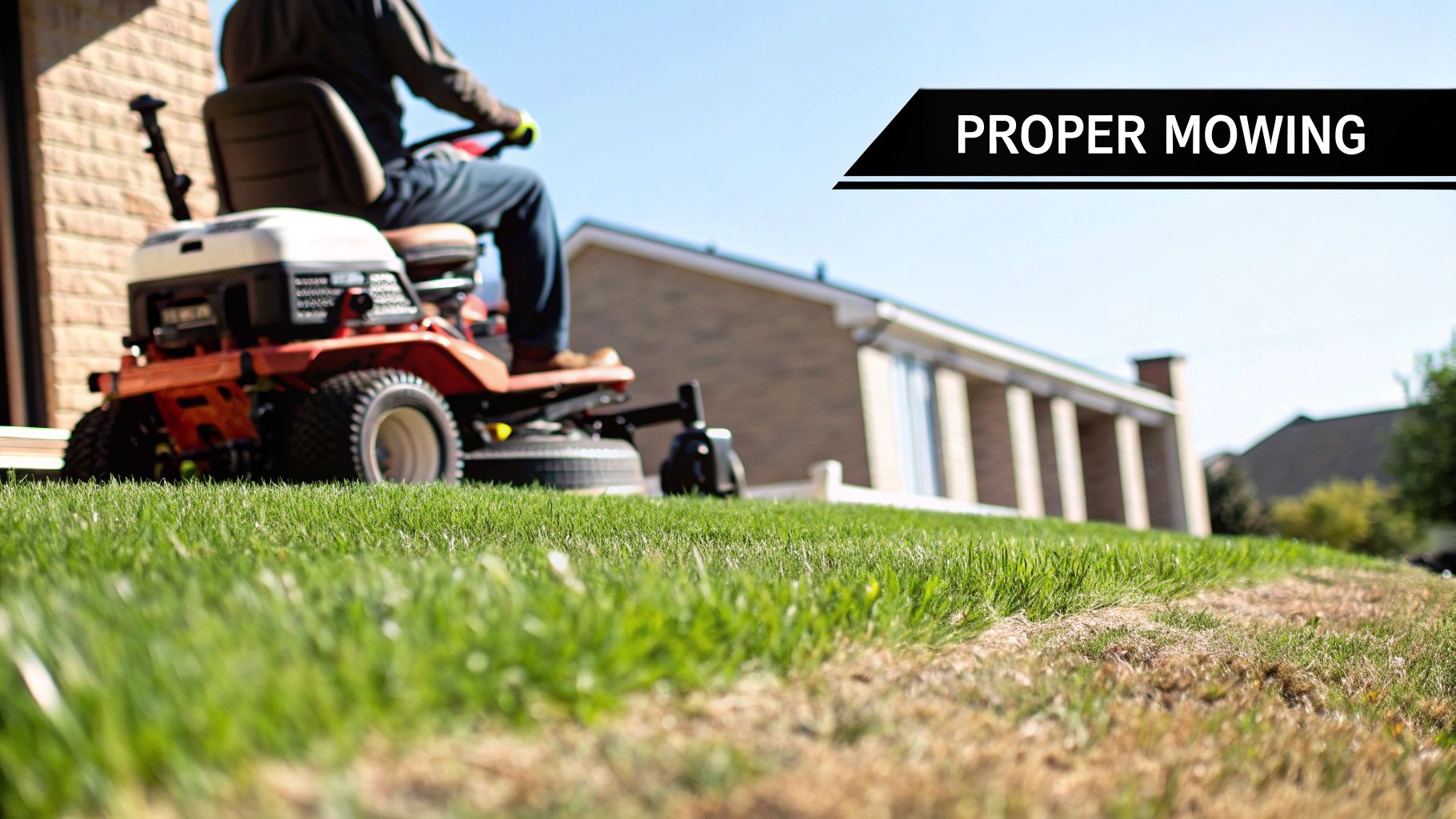
The right tools are everything. Think about it: the global market for lawn and garden equipment was estimated at $41 billion in 2024 and is expected to hit $77.7 billion by 2034. That’s because homeowners are realizing that having quality mowers, trimmers, and irrigation systems is essential, especially during tough seasons like summer. As you can find out more, the demand for better equipment just keeps growing, proving just how vital the right tools are for keeping your grass in top shape.
Navigating Summer Fertilization and Weed Control
Feeding your lawn during a North Georgia summer is a delicate balancing act. From Cumming to Alpharetta, the intense heat puts incredible stress on your grass. The absolute last thing you want to do is force-feed it with a heavy, fast-acting fertilizer. That just encourages weak, unsustainable growth that can't handle the pressure. This is a time for a delicate touch, not a heavy hand.
So many homeowners make the same mistake. They see a struggling lawn, assume it's starving, and hit it with a big dose of fertilizer. In reality, applying the wrong product or applying it at the wrong time can easily scorch your lawn, leaving you with more brown patches than you started with. What your lawn actually needs is a steady, light diet to get through the stressful season.
Feeding Your Lawn Without the Burn
The secret to successful summer fertilization? A slow-release, low-nitrogen fertilizer.
Think of it like this: a fast-release fertilizer is like giving your lawn a sugary energy drink. You get a quick, vibrant burst of green, but it’s followed by a hard crash. This leaves the grass weak and far more vulnerable to disease and pests.
A slow-release formula, on the other hand, is like a balanced, healthy meal. It provides a steady drip of nutrients over several weeks, supporting consistent health without promoting that tender, rapid growth that the Georgia heat will just bake.
For your Bermuda or Zoysia lawn in areas like Milton and Johns Creek, here’s what to look for on the bag:
- Low Nitrogen: The first number in the N-P-K ratio (N for nitrogen) should be relatively low.
- Slow-Release Sources: Look for ingredients like sulfur-coated or polymer-coated urea, which break down gradually.
- Iron for Greening: A fertilizer with iron is a great bonus. It helps give your lawn a deep green color without forcing excessive top growth.
The goal here is to sustain, not to stimulate. A light application in early summer (June) is often all you need to carry your lawn through the hottest months. Pushing for aggressive growth in July or August is just asking for trouble.
Tackling Those Stubborn Summer Weeds
Just as your grass is feeling the heat, summer weeds are hitting their peak. Pesky invaders like crabgrass, nutsedge, and dallisgrass absolutely thrive in the hot, often compacted soil of our region. While a healthy, thick lawn is always your best defense, sometimes these weeds still find a way in.
This is where post-emergent herbicides come into play—products designed to kill weeds that have already sprouted. But you have to be extremely careful when applying them in high heat. Many herbicides can damage or even kill your warm-season grass when temperatures climb above 85-90°F.
Always, always read the label carefully. Make sure you choose a product specifically rated as safe for Bermuda or Zoysia grass in summer conditions. Applying these treatments in the cooler parts of the day, like early morning, can also significantly reduce the risk of damaging your turf.
Here’s a quick guide to some of the common culprits you'll likely find in your Forsyth County lawn:
| Weed | How to Identify It | Best Control Strategy |
|---|---|---|
| Crabgrass | Sprawls out from a central point with wide, light-green blades. It looks like a crab's legs. | Spot-treat with a selective post-emergent herbicide that's safe for your grass type. Hand-pulling small patches is surprisingly effective, especially after a good rain. |
| Nutsedge | Has a distinct triangular stem (roll it between your fingers to feel it). It grows faster and taller than your grass, sticking out like a sore thumb. | Requires a specific nutsedge-control product. Whatever you do, don't pull it! This often leaves tubers in the soil that will just sprout new plants. |
| Dallisgrass | Grows in ugly, coarse clumps with a deep root system. It produces tall, spiky seed heads just a day or two after mowing. | This one is tough. Spot-treating with a targeted herbicide is the best approach, but you'll likely need multiple applications to knock it out for good. |
Ultimately, the most effective weed control is a thick, healthy lawn. By following smart mowing and watering practices, you naturally create an environment where weeds just can't compete. Your fertilization strategy is a huge part of this, helping build a dense turf that leaves no room for unwanted guests to sprout. The one-two punch of targeted treatments and healthy lawn practices will give you the upper hand in the summer-long battle against weeds.
Dealing With Pests and Diseases in High Humidity
Anyone who’s lived through a North Georgia summer knows that the intense heat and soupy humidity are a recipe for lawn problems. From Cumming to Johns Creek, I’ve seen beautiful lawns develop strange spots almost overnight. This isn't just a string of bad luck; it’s the perfect storm for pests and fungal diseases that thrive in these conditions.
Your best defense is a good offense—and that means knowing what to look for. A small, discolored patch can balloon into a major headache in just a few days. If you can spot trouble early and know what you're dealing with, you can stop a small issue from becoming a summer-long battle.
Identifying Common Fungal Diseases
That classic Georgia humidity is practically an incubator for lawn fungus. These diseases pop up as discolored patches that homeowners often mistake for drought stress. They start watering more, which, unfortunately, is like throwing gasoline on a fire.
Here are the two biggest culprits I see year after year in the Milton and Alpharetta areas:
- Brown Patch: This one looks just like it sounds. You’ll see roughly circular patches of brown or yellow grass, anywhere from a few inches to several feet across. A tell-tale sign is a grayish, smoky-looking ring around the edge of the patch, especially when there's morning dew. Brown patch absolutely loves hot, humid weather and lawns that have been hit with too much nitrogen fertilizer.
- Dollar Spot: If you're seeing small, bleached-out spots about the size of a silver dollar, you’ve probably got dollar spot. These little circles can quickly merge into large, ugly patches. It tends to show up when days are warm but nights are cool and dewy, and it’s often a hint that your soil is running low on key nutrients.
Honestly, the best way to handle fungus is to prevent it from ever starting. Make sure you have good air circulation, water deep in the early morning so the grass blades can dry, and use a slow-release fertilizer. If you do get an outbreak, you'll need a targeted fungicide to stop it in its tracks.
Spotting Destructive Lawn Pests
Fungus isn't the only thing out to get your lawn. Several insect pests can tear through a beautiful Bermuda or Zoysia lawn before you even know what's happening.
The two heavy hitters in our region are armyworms and grubs. They work differently—one above ground, one below—but they're both incredibly destructive. Knowing their calling cards is crucial.
The Voracious Armyworm
Armyworms are the stuff of lawn nightmares. These caterpillars travel in large groups, literally marching across your turf and chewing the grass blades down to the nub. The damage is fast and dramatic.
You might be dealing with armyworms if you notice:
- Large patches of your lawn look like they were scalped overnight.
- A sudden increase in birds on your lawn—they’re there for the buffet.
- You can see the small green or brown caterpillars if you get down and look, especially in the early morning or late evening.
The Hidden Threat of Grubs
While armyworms are obvious, grubs are sneaky. These C-shaped beetle larvae live in the soil and chew on the roots of your grass, silently cutting off its supply of water and nutrients. You often don't see the damage until it’s pretty bad.
Look for these signs of a grub problem:
- The ground feels spongy or bouncy under your feet.
- You have irregular brown patches that just won't green up, no matter how much you water.
- You can easily pull up sections of turf like a piece of carpet, revealing that the roots have been chewed off.
Treating these pests is all about timing and using the right product. An active armyworm invasion requires an immediate insecticide application. For grubs, you have both preventative and curative options. If you prefer a gentler approach, you can look into natural pest control for lawns for less harsh solutions. And don't forget that general lawn health plays a role; for instance, effective pet waste disposal is a simple step that improves overall hygiene and can help prevent other issues.
Keeping lawns healthy is a big deal, part of a landscaping industry valued at $153 billion in 2024 in the U.S. alone. Homeowners, on average, spend about $300 per month on landscaping, and a good chunk of that goes toward vital summer maintenance like keeping these very pests and diseases in check. You can see more details in the latest lawn and landscaping industry statistics.
Answering Your Toughest North Georgia Summer Lawn Questions
Even with the best game plan, a Georgia summer is going to throw you a few curveballs. You might see strange brown spots pop up in your Cumming lawn despite your best watering efforts, or maybe you're getting conflicting advice about grass clippings from your neighbor in Alpharetta. These specific, nagging questions are exactly what we're going to tackle here.
Consider this your go-to troubleshooting guide for those moments when you're standing in your yard, scratching your head. Let’s cut through the noise and get you some practical answers for your Bermuda or Zoysia turf.
Should I Bag My Grass Clippings in the Summer?
This is easily one of the most common questions I get, and the honest answer is, it really depends on the situation. For most of your weekly mows, mulching your clippings is absolutely the best thing to do. Those little bits of grass break down quickly, feeding your soil with valuable nutrients and moisture—it’s like a free, natural fertilizer treatment every time you mow. This is a simple but powerful way to help your lawn handle the summer stress.
That said, there are a couple of times when you absolutely should bag them. If you’re battling a fungal disease like brown patch, you have to bag those clippings. Mulching will just spray those fungal spores all over the healthy parts of your lawn, spreading the problem. The other exception is when heavy rains in Forsyth County have kept you off the lawn for a week and the grass is just too long. Trying to mulch thick, wet clumps of grass will just smother the turf underneath, blocking sunlight and causing even more issues.
My Bermuda Lawn Has Brown Spots, But I’m Watering it… What Gives?
It’s incredibly frustrating to see brown spots appear in a well-watered lawn during a Milton summer. When this happens, it almost always points to one of two culprits: fungus or insects. Your first instinct might be to water more, but hold off—that can actually make the problem worse.
Your prime suspect should be brown patch fungus, which just loves our heat and humidity. Look for roughly circular patches, and if you look closely, you might see a darker, grayish "smoke ring" around the edge. If that's not what you're seeing, it's time to check for grubs.
The "Tug Test" is a lawn pro's secret weapon for diagnosing grubs. Get down on your hands and knees, grab a handful of the brown turf, and give it a gentle but firm pull. If the grass pulls up like a piece of old carpet with no roots attached, you've got grubs. They've been chewing through the root system, completely cutting the grass off from the water you've been giving it. Getting the diagnosis right is everything before you start treating it.
Is It Okay to Aerate My Lawn in Cumming During the Summer?
This is a hard no. Core aeration is one of the best things you can do for your soil, but the timing is critical. You should never, ever aerate during the peak stress of a Georgia summer, which is typically July and August. Aerating punches holes into the soil, which is great for breaking up compaction, but it's a disaster when the sun is blazing down.
When you aerate in that kind of intense heat, you're exposing the root zone directly to the sun and wind. This causes the soil to dry out incredibly fast and puts a massive amount of stress on an already struggling lawn. The ideal window to aerate warm-season grasses like Bermuda and Zoysia is in late spring or early summer (May to June) when the turf is growing at its peak and can recover quickly from the process.
How Do I Know if My Lawn is Just Dormant or Actually Dead?
Knowing the difference between a dormant lawn and a dead one is crucial for your fall recovery plan. Dormancy is just a survival tactic. The grass turns brown to save water and energy, but the crown of the plant—right at the soil level—and the roots are still alive, just waiting for better conditions to green up again.
The easiest way to check is with that same tug test we talked about for grubs. Pull on a patch of brown grass. If it holds on tight, it's very likely just dormant and will bounce back with cooler temperatures and some rain. If it pulls right out with zero resistance, that spot is probably dead and will need to be reseeded or replaced with new sod in the fall. You can also get down close and look at the very base of the brown blades; if you see even a tiny speck of green, that’s a great sign of life.
Trying to figure all this out on your own can be a real challenge, but you don't have to go it alone. If you want a professionally managed, beautiful lawn that's also safe for your family and pets, it's time to trust the local experts. Barefoot Organics provides specialized, natural lawn care programs designed from the ground up for North Georgia's unique climate. Get your free online quote today!