

So, you're ready to declare war on crabgrass? Good. Getting rid of it for good means playing both offense and defense. You need to kill the weeds you see now (post-emergent control) while also stopping new seeds from ever starting (pre-emergent prevention). For us here in North Georgia, winning this battle is all about timing and building a lawn so thick and healthy that crabgrass simply can't find a place to grow.
Your North Georgia Game Plan for a Crabgrass-Free Lawn
If you've got a lawn anywhere from Cumming to Alpharetta, you know the routine. The moment that Georgia heat really kicks in, those ugly, pale-green crabgrass patches start creeping in from the edges of your driveway, taking over any spot where your turf is a little thin. It's an annual frustration, but it's a fight you can definitely win if you have a strategy designed for our area.
This guide isn't about generic advice you could find anywhere. It's built specifically for North Georgia homeowners. We're cutting through the noise to focus on what actually works for our local turf types—like Bermuda, Zoysia, and Fescue—and the unique climate we deal with in places like Johns Creek and Milton.
Why Crabgrass Loves North Georgia
Our hot, sticky summers are basically a dream vacation for crabgrass. It thrives in the exact conditions that stress out our lawns. It adores the heat that can weaken Fescue and quickly pounces on any bare spot in a Bermuda or Zoysia lawn. And here’s the kicker: a single one of those ugly plants can drop up to 150,000 seeds, setting you up for an even bigger headache next year.
The real secret to kicking crabgrass to the curb for good isn't just about spraying the weeds you can see. It's about making your lawn so incredibly dense that crabgrass seeds are left in the shade, never getting the sunlight they need to sprout.
What We'll Cover
Forget just being told to grab a bottle of weed killer. We’re going to walk through a practical, season-by-season playbook that puts you in control. You’ll learn exactly how to:
- Spot crabgrass like a pro so you don't end up hurting the grass you actually want to keep.
- Nail the timing for both preventative treatments and spot-spraying, tailored specifically for the climate in areas like Dahlonega and Forsyth County.
- Use natural, hands-on methods to clear out existing patches without resorting to harsh chemicals.
- Build an ironclad, resilient lawn that becomes your best defense against future invasions.
Consider this your go-to local resource for taking back your yard. By focusing on proven techniques that work right here in our backyards, you can finally break the frustrating cycle and get the beautiful, lush lawn you’ve been working for.
How to Spot Crabgrass in Your Lawn
Before you wage war on a weed, you’ve got to be certain you’re fighting the right enemy. A simple case of mistaken identity can lead you down a path of ineffective treatments, costing you time, money, and potentially harming the beautiful Bermuda, Zoysia, or Fescue you've been nurturing. Catching crabgrass early—especially in spring and early summer—is the secret to stopping a small problem from becoming a lawn-wide disaster.
So, what should you look for? Crabgrass has a very distinct growth habit. It sprouts from a single point in the soil and sprawls outward in every direction, low to the ground. The whole plant really does look like a crab, with its coarse, light-green blades spreading out like legs from a central body. This is a world away from the tidy, upright growth of your desirable turf.
The color and texture are other dead giveaways. Crabgrass blades are much wider and feel rougher than the delicate blades of Fescue or the dense, carpet-like feel of Zoysia. The color is often a tell-tale pale, almost yellowish-green that clashes horribly with the deep, rich green of a healthy lawn. You'll notice the patches immediately, especially when they're glistening with morning dew.
Telling It Apart From Your Turf
Here in North Georgia, it’s easy to get confused, particularly when crabgrass is young and just starting to pop up. Let's break down how to distinguish it from the grasses we actually want.
- Versus Fescue: Fescue grows in well-defined upright bunches with fine, dark green blades. Crabgrass is the opposite—it grows low and spreads wide with much broader, lighter-colored leaves.
- Versus Bermuda: Bermuda grass is also a spreader, but it uses delicate runners (stolons) to weave a dense, tight mat. Crabgrass looks clumsy in comparison, forming a distinct, ugly clump with much wider blades instead of blending in.
- Versus Zoysia: A healthy Zoysia lawn is famous for its thick, almost impenetrable density and sharp, pointed blades. An invading crabgrass plant will stick out like a sore thumb—a coarse, messy patch that grows much faster in the summer heat.
Getting a handle on the differences between crabgrass and other common weeds in our area is the first step to a successful treatment plan. To sharpen your identification skills, take a look at our guide to the most common weeds in Georgia.
Know the Enemy’s Lifecycle
Crabgrass is a summer annual, meaning it lives and dies in a single year. But what a year it is. Understanding its predictable lifecycle is your biggest advantage in controlling it. Why? Because a single, unchecked crabgrass plant is a seed-producing machine, turning a few weeds this summer into a full-blown infestation next year.
A lone crabgrass plant can drop an unbelievable 150,000 seeds in just one season. Those seeds then lie dormant all winter, just waiting for the right conditions to explode into life.
This incredible seed production is what makes it so persistent. The seeds patiently wait for the soil temperature to consistently hit 50-55°F for several days in a row, a benchmark we often see around Cumming and Milton by mid-March. That’s their signal to germinate. As you can find in deep-dives on the evolution of crabgrass control on extension.wvu.edu, this lifecycle proves that timing is everything. Your best weapon is stopping those seeds before they ever get a chance to sprout.
Mastering the North Georgia Lawn Care Calendar
In the constant battle against crabgrass, timing isn't just a factor—it's everything. I've seen countless North Georgia homeowners struggle, and the difference between a lush, green lawn and a patchy, weed-infested one almost always comes down to a well-timed strategy.
Getting rid of crabgrass for good is less about a single, magic-bullet treatment and more about aligning your efforts with the seasons. From Milton to Dahlonega, understanding our local lawn care calendar is the secret weapon. There are two critical windows: prevention in the spring and damage control in the summer. Miss that first one, and you'll be playing defense all season long.
The Spring Pre-Emergent Window
This is your first, best, and honestly, easiest line of defense. A good pre-emergent herbicide creates a barrier in the soil that stops crabgrass seeds from ever germinating. But for it to work, it has to be on the ground before those seeds decide to sprout.
So, when is the right time for those of us in Cumming or Alpharetta? Forget circling a date on the calendar. Let nature give you the clues.
- Watch the Forsythia: You know those brilliant yellow bushes that pop up everywhere in early spring? They are one of nature's most reliable timers. When the forsythia is in full bloom and you see the petals just start to drop, that's your cue. It's go-time.
- Check the Soil Temperature: If you prefer a more scientific approach, a simple soil thermometer is your best friend. Crabgrass germinates when the soil temperature consistently hits 55°F for a few days straight. This is your absolute last call to get that pre-emergent down.
This infographic breaks down the lifecycle of crabgrass, which really drives home why that early spring timing is so vital.
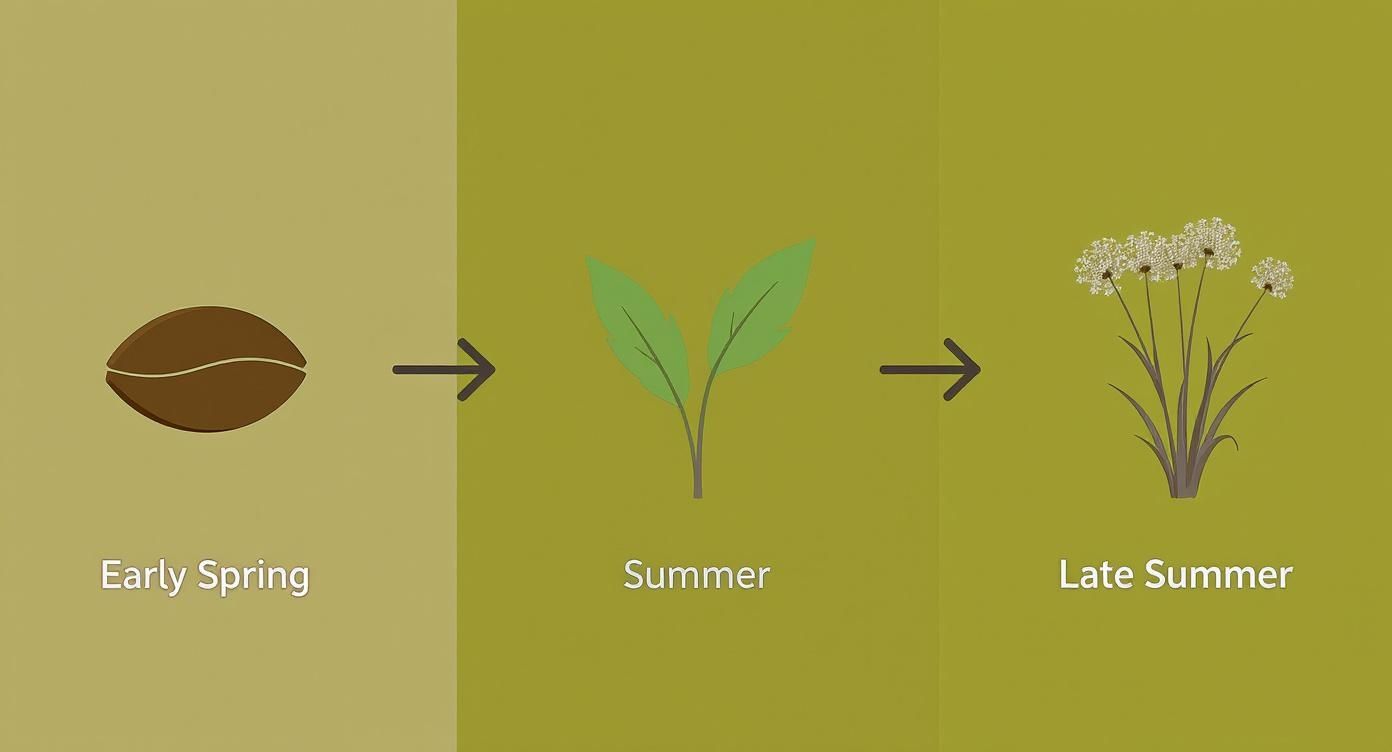
As you can see, stopping the seeds before they sprout is a molehill. Trying to kill a fully grown, seed-producing monster in August is a mountain.
The Summer Post-Emergent Strategy
So what happens if a few stubborn crabgrass plants poke through your defenses? Or maybe life got in the way and you missed the pre-emergent window entirely. It happens. Now, we shift gears to post-emergent control, which means treating the weeds after they’ve sprouted.
The absolute key here is to act fast. Young, tender crabgrass plants are far more vulnerable to herbicides than mature, established ones. Once a plant develops tillers—those side shoots that help it spread out like a mat—it becomes exponentially harder to kill.
A classic mistake I see homeowners make is waiting until the crabgrass is big, ugly, and obvious in mid-July. By that point, it has already choked out your good grass, developed a tough root system, and is getting ready to drop thousands of new seeds to start the whole nightmare over again next year.
Thankfully, the tools for this fight have improved dramatically. Modern selective herbicides are much more effective than what was available decades ago. You can even read about the evolution of crabgrass control on extension.wvu.edu to see how far the science has come.
Your North Georgia Seasonal Checklist
Following a simple, structured timeline can make all the difference between a chore and a victory. To help you stay on track, we've put together a high-level calendar specifically for our local climate.
For a more detailed, month-by-month guide, you can always download our free lawn care schedule template.
North Georgia Crabgrass Control Calendar
This seasonal timeline breaks down the key moments for crabgrass prevention and treatment here in the Cumming, GA area.
| Time of Year | Key Indicator | Primary Action | Goal |
|---|---|---|---|
| Late Winter / Early Spring (Feb-March) | Forsythia petals drop; soil hits 55°F | Apply pre-emergent herbicide | Create a barrier to stop seed germination. |
| Late Spring / Early Summer (May-June) | Small, young crabgrass appears | Spot-treat with post-emergent | Eliminate any breakthrough weeds before they mature. |
| Mid-Summer (July-August) | Crabgrass grows aggressively | Continue spot-treating; hand-pull small clumps | Prevent plants from producing and dropping seeds. |
| Fall (September-October) | First frost is approaching | Aerate and overseed bare patches | Thicken the turf to crowd out new weeds next year. |
By sticking to a calendar like this, you shift from constantly reacting to weeds to proactively preventing them. You'll spend a lot less time sweating in the summer heat and a lot more time enjoying the beautiful, healthy lawn you deserve.
Natural Ways to Get Rid of Crabgrass
Even with the best pre-emergent plan, a few stubborn crabgrass plants always seem to find their way into North Georgia lawns. When they pop up, don't feel like you have to reach for a chemical spray right away. For homeowners in places like Johns Creek and Milton who prefer a more hands-on, family-safe approach, tackling crabgrass naturally is surprisingly effective, especially if you catch it early.
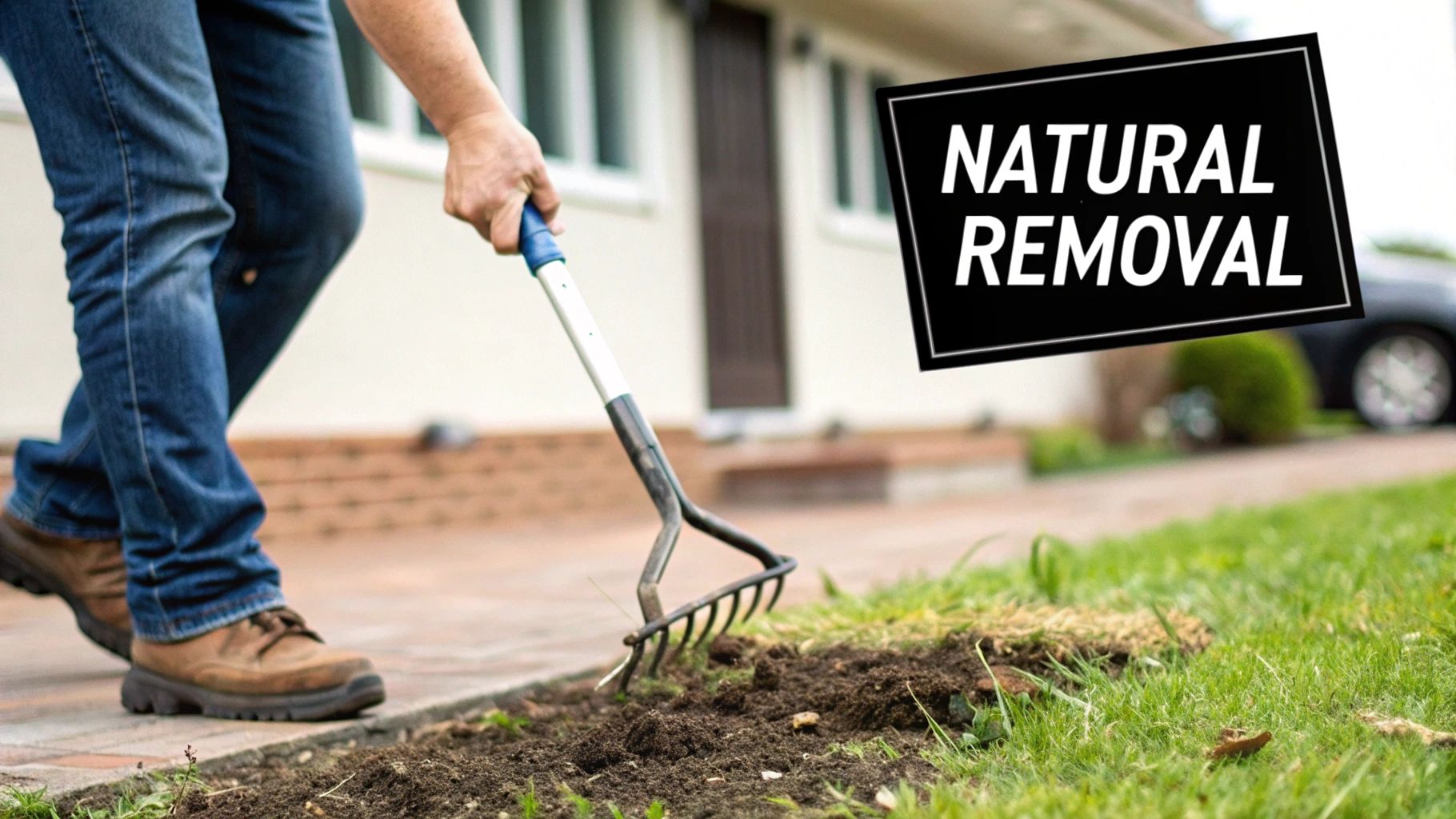
These methods are all about protecting your soil's long-term health, keeping your lawn a safe playground for kids and pets. It's about taking control of any existing weeds without relying on harsh treatments.
When to Just Hand-Pull It
Sometimes, the old-fashioned way really is the best. Manually pulling crabgrass is incredibly effective, but your success comes down to two things: timing and technique. We’ve all made the mistake of trying to yank weeds from dry, compacted Georgia clay—you just snap the leaves off, and the root is left behind to happily regrow.
The absolute best time to pull crabgrass is after a good summer rain. When the soil is soft and moist, the entire plant, taproot and all, slides out with very little fight.
To get it right, grab the weed as low as you can, right at its base where it meets the soil. Instead of a quick jerk, pull slowly and steadily, giving it a little wiggle to loosen the surrounding dirt. The goal is to get the whole root system out, especially that central crown. If you leave any of that behind, you'll be seeing that weed again. For a few scattered weeds, this is easily the fastest and most satisfying fix.
Using the Right Tools for the Job
Hand-pulling is great for a few stragglers, but it's hardly practical for the larger patches that often pop up in a Dahlonega backyard. This is where having a little mechanical help can save your back and a ton of time.
- Stand-Up Weeders: These long-handled tools are a game-changer. You just position the claws over the center of the crabgrass, step on the foot pedal, and pull back. The tool uses leverage to pop the entire weed and its roots right out of the ground—no bending required.
- Hori-Hori Knives or Weed Poppers: For really stubborn, established clumps, a simple garden knife or a forked weeder is your best friend. Use it to slice into the soil around the weed's base to break up the roots before you give it a final pull.
Having the right tool on hand turns what feels like a major chore into a much more manageable task.
Remember, the key is to get these weeds out before they have a chance to go to seed. Every single crabgrass plant you pull in June or July is preventing thousands of new weeds from sprouting next spring.
How to Smother Large Patches
But what if you have a big area, like that strip along your Alpharetta driveway, that's completely overrun? Pulling hundreds of individual plants just isn't going to happen. For situations like this, a technique called smothering is a fantastic organic solution.
This method works by completely blocking the sunlight crabgrass needs to live. It’s an incredibly effective way to clear out an entire section of lawn before you reseed with healthy turf in the fall.
Here’s how it works:
- Start by mowing the infested area as low as you can.
- Cover the whole patch with a thick, light-blocking material. Overlapping pieces of cardboard or several layers of newspaper are perfect for this.
- Soak the cardboard or newspaper with water. This helps it mold to the ground and starts the decomposition process.
- Top it all off with a 2 to 3-inch layer of mulch, compost, or even pine straw. This not only holds the light-blocking layer down but also feeds the soil as it breaks down.
Give it a few weeks, and the crabgrass underneath will be completely gone, starved of sunlight. You’ll be left with a clean slate and richer soil, creating the perfect bed for overseeding with a tough Fescue or Zoysia blend.
Building a Crabgrass-Resistant Lawn
The best way to get rid of crabgrass for good has nothing to do with what you spray or pull. The real secret is building a lawn so thick, healthy, and dominant that crabgrass simply can't find the space or sunlight it needs to take hold. If you can shift your mindset from "killing weeds" to "growing grass," you'll have the only sustainable solution that works for homeowners from Cumming to Johns Creek.
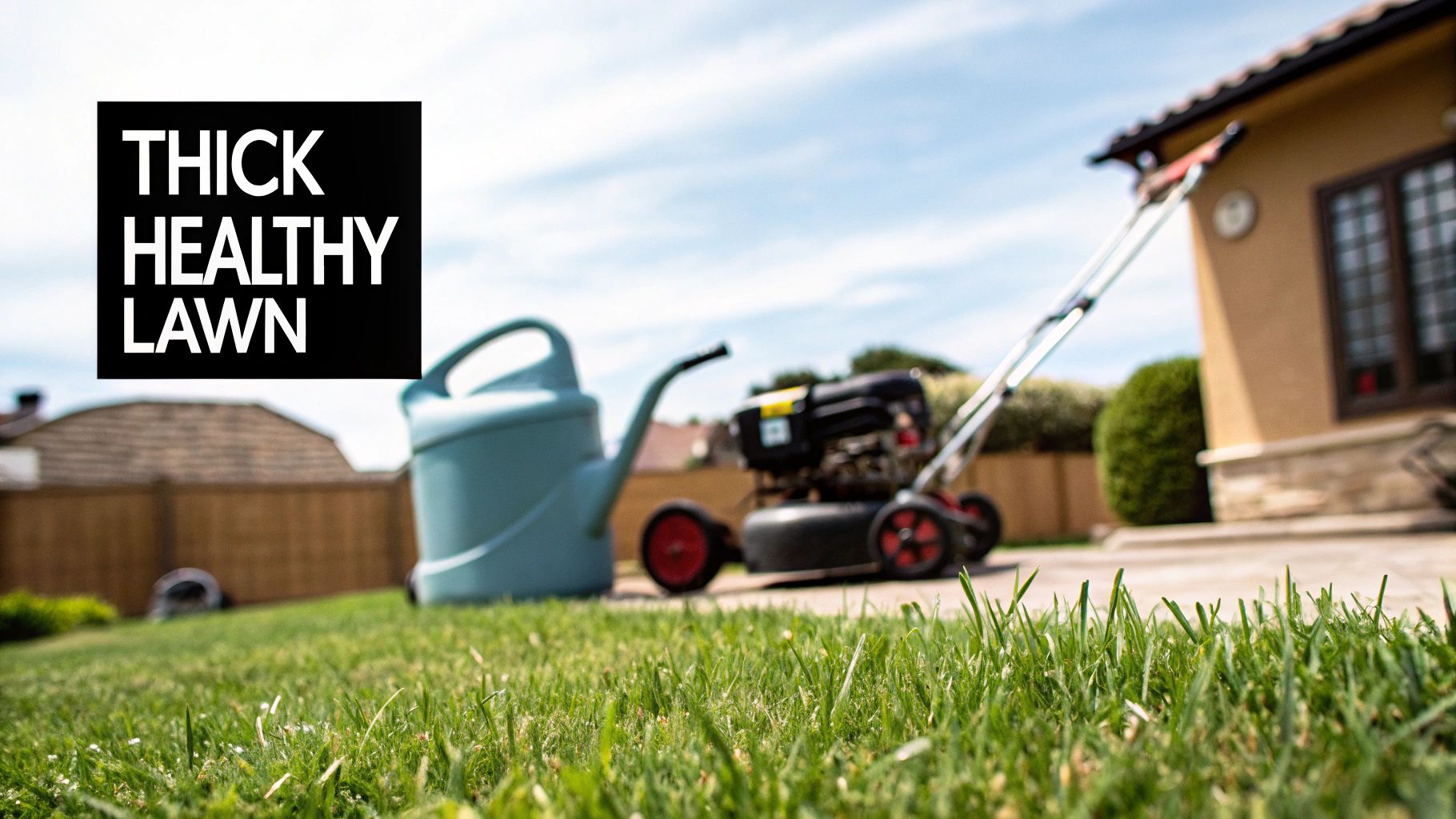
Think of your lawn as a living fortress. A dense, thriving turf is the most effective weed barrier there is. This proactive approach is all about creating an environment where your grass—whether it's Fescue or Bermuda—outcompetes any potential invaders, making crabgrass a problem of the past.
Raise Your Mowing Height
One of the easiest and most powerful changes you can make is to simply mow your lawn higher. I see it all the time with homeowners in Alpharetta and Milton—they cut their grass way too short, thinking it creates a tidier look. But what they're actually doing is scalping the lawn, which weakens the turf and rolls out the red carpet for crabgrass.
When you mow higher, the longer grass blades form a dense canopy that shades the soil. That shade is critical because it blocks the direct sunlight crabgrass seeds desperately need to germinate. For cool-season grasses like Tall Fescue, which are incredibly popular in North Georgia, you should aim for a mowing height of 3 to 4 inches. It’s a small change that helps your lawn grow deeper, more drought-resistant roots while simultaneously starving out those weed seeds.
Water Deeply and Infrequently
How you water is just as important as how you mow. Crabgrass has a shallow, fibrous root system that absolutely loves frequent, light watering. So when you sprinkle your lawn for a few minutes every day, you're basically creating the perfect shallow-moisture playground for it to flourish while your desirable turf struggles.
The key is to train your lawn’s roots to grow deep into the soil. Water your lawn deeply but less often—about one inch of water, once or twice a week, is a great rule of thumb. This forces the roots of your Fescue or Zoysia to chase moisture downward, building a strong, resilient foundation that can easily outcompete that shallow-rooted crabgrass.
A lawn with deep roots is a lawn that wins. By watering deeply, you're building an underground advantage, creating turf that is not only more drought-tolerant but also better equipped to choke out opportunistic weeds like crabgrass.
Focus on Superior Soil Health
At the end of the day, a great lawn starts with great soil. That compacted red clay common throughout Forsyth and Cherokee County makes it tough for grass roots to thrive, leaving thin patches where weeds can move right in. Improving your soil isn't just a suggestion; it's the foundational step to building a truly crabgrass-resistant lawn.
To really get your soil in shape with rich, organic matter, using an ultimate guide to setting up a compost bin can be a game-changer. Making your own compost gives you a steady supply of black gold to feed your soil and, in turn, your lawn.
- Fall Aeration is Key: Core aeration in the fall is non-negotiable. It pulls small plugs of soil from your lawn, relieving compaction and allowing water, air, and nutrients to finally reach the root zone.
- Overseed After Aerating: The perfect time to overseed is right after aerating. Spreading high-quality grass seed over your lawn fills in any thin spots, beefing up turf density and leaving no room for crabgrass to get a foothold next spring.
- Amend with Organic Matter: After you aerate, topdress your lawn with a thin layer of compost. This adds vital nutrients back into the soil, improves its structure, and helps it hold onto water. For more ideas on getting your soil right, check out our detailed article on how to improve soil.
Use Mulch as a Natural Barrier
Don't forget about your garden beds and landscaping areas! Mulch is a powerful ally in the fight against crabgrass. Research has shown that applying a mulch layer of 2 inches or more can slash crabgrass populations by over 90%. It acts as a physical barrier, blocking the light that seeds need to sprout. It's a simple, highly effective way to prevent weeds from creeping in along the edges of your lawn.
By embracing these core principles—mowing high, watering deep, and building healthy soil—you transform your lawn from a passive victim into an active defender. It’s a long-term strategy that delivers lasting results, giving you a beautiful, dense lawn that naturally resists crabgrass year after year.
Answering Your Crabgrass Questions
Even the most dedicated homeowners in North Georgia run into head-scratchers when tackling crabgrass. From pre-emergent treatments that seem to fail to picking the right grass seed, plenty of questions come up. We've pulled together some of the most common ones we hear from our clients in Cumming, Alpharetta, and across the area to give you some clear, straightforward answers.
"My Pre-Emergent Failed! What Now?"
It’s a gut-punch moment for any lawn enthusiast. You felt like you timed your pre-emergent application just right, but come June, you're seeing those telltale, scraggly blades of crabgrass popping up anyway. It happens more often than you'd think, and a few common culprits are usually to blame.
Heavy spring rains right after you apply can literally wash the product away or dilute it so much that it never properly bonds with the soil—a classic issue here in Georgia. Another possibility is applying it just a little too late. If soil temperatures in your Forsyth County yard jumped to 55°F a week earlier than you expected, some seeds might have already germinated. And finally, a big one we see is breaking the barrier yourself. If you aerate or dethatch your lawn after applying a pre-emergent, you're essentially punching holes in that protective shield, giving crabgrass a perfect invitation.
If you’re seeing this kind of breakthrough, it’s time to pivot to a post-emergent strategy. Get out there and spot-treat the young crabgrass plants as soon as you notice them. The smaller they are, the less of a fight they'll put up.
"What's the Best Grass Seed to Fight Crabgrass?"
Honestly, the best defense against crabgrass is a lawn so thick and healthy that weed seeds never see the sunlight they need to sprout. For homeowners in Milton and Johns Creek, choosing the right type of turf is the foundation of a good long-term strategy. You want a grass that loves our heat and humidity and naturally outcompetes the bad stuff.
Here are two fantastic choices for our region:
- Tall Fescue Blends: The modern Tall Fescue varieties aren't what your grandpa planted. They're bred for our climate, growing in dense clumps and keeping a deep green color through the summer. Their upright growth and tolerance for a higher mowing height (think 3-4 inches) create a shady canopy that smothers crabgrass seedlings.
- Zoysia Grass: A healthy Zoysia lawn is like an impenetrable carpet. It's known for its incredible density. Because it spreads with runners, it actively fills in bare spots and creates a tight, thick mat that leaves absolutely no room for crabgrass to get a foothold.
By choosing a grass type that is naturally aggressive and well-suited for the Georgia climate, you are fundamentally changing the battlefield. Instead of constantly fighting weeds, you’re empowering your lawn to win the war on its own.
"Why Can't I Just Use a Generic Weed Killer?"
Grabbing an all-in-one weed killer from the big-box store might seem like a quick fix, but it can easily become a lawn disaster. The most important thing to understand is the difference between selective and non-selective herbicides.
A non-selective herbicide is the nuclear option—it’s made to kill any plant it touches. If you spray this on a patch of crabgrass in your Fescue lawn, you’ll kill the crabgrass, but you'll also kill the Fescue, leaving a lovely dead spot. These products have their place for clearing out gravel driveways or patio cracks, but they’re destructive on turf.
Selective herbicides, on the other hand, are formulated to target certain weeds (like crabgrass) while leaving your desirable grass alone. But even then, you have to read the fine print. A product that’s perfectly safe for a Bermuda lawn might seriously injure Zoysia. This is why reading the label is non-negotiable, and it’s also why focusing on overall lawn health—mowing high, watering deeply, and feeding the soil—is always a better long-term plan than just reaching for a spray bottle.
Are you tired of playing defense against crabgrass year after year? Let Barefoot Organics build a thick, healthy, and resilient lawn that naturally chokes out weeds for good. We specialize in lawn care solutions designed specifically for North Georgia's unique climate. Get your free, no-obligation quote today and discover how our natural approach can transform your yard. Learn more and get your free quote from Barefoot Organics!