

If you want a truly lush, green lawn, the secret isn't just in the seed or sod—it's in the first meal you give it. A quality starter fertilizer, loaded with phosphorus, is the key to building the deep, strong root systems your new grass needs to establish itself quickly and thrive from day one.
Giving Your New North Georgia Lawn the Best Start
Dreaming of that perfect, vibrant green lawn in Cumming or Alpharetta? It all starts the moment you put down new seed or sod. But let's be honest, new grass is incredibly delicate, especially here in North Georgia with our notorious heavy red clay soil. It needs a very specific blend of nutrients to build a solid foundation.
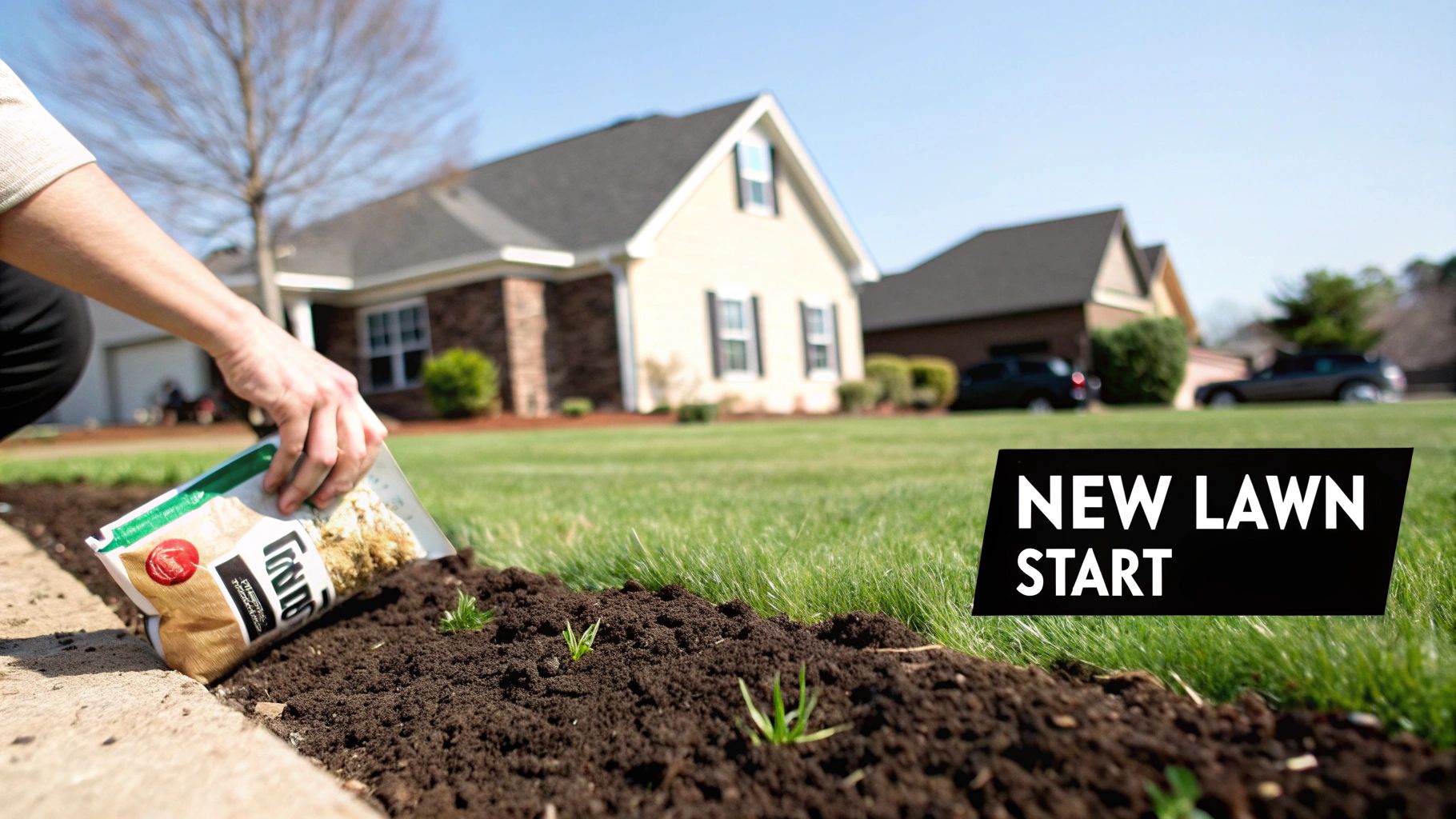
This is where a high-quality fertilizer for new grass—often called a "starter fertilizer"—makes a world of difference. It's not the same as the regular lawn food you'd use on established turf. A starter formula is packed with phosphorus, the single most important nutrient for driving deep, robust root development. That root system is the secret to a resilient lawn that can handle the hot Georgia summer.
Why Your New Lawn Needs a Specialized Diet
Think of it like this: you wouldn't feed a newborn baby a steak dinner. New grass seedlings and sod rolls have their own unique nutritional needs. Right now, their entire focus is on establishing a root system before they can even think about producing that lush, green top growth you want to see.
Using a dedicated starter fertilizer delivers some huge advantages:
- Accelerated Root Growth: It gives new roots an immediate, accessible source of phosphorus right where they need it.
- Improved Germination: The right nutrients give seeds the energy required to sprout successfully and uniformly.
- Enhanced Resilience: A strong root system is what helps new turf survive the stresses of heat, drought, and foot traffic—all common challenges for lawns from Johns Creek to Milton.
For homeowners in Forsyth and Cherokee Counties, we've seen that opting for natural, organic alternatives can boost root establishment by up to 30% compared to synthetics. This approach also improves the long-term health of your soil, creating a thriving lawn that's safe for kids and pets to play on.
It’s no surprise the global fertilizer market is projected to hit US$279.52 billion by 2033. Everyone, everywhere, understands the need for essential nutrients like nitrogen, phosphorus, and potassium (NPK) to get new grass growing strong. You can read more about the fertilizer industry's growth on renub.com.
Of course, feeding your new lawn is only half the battle. Proper watering is just as critical for success. Be sure to check out our expert guide on how to water new sod to make sure your investment pays off.
Getting to Know What Your New Grass is Hungry For
Walking down the fertilizer aisle can feel overwhelming, with all those bags and numbers staring back at you. But it's actually pretty simple once you know the language. The secret is the N-P-K ratio—those three bold numbers on the front of every bag. They stand for Nitrogen (N), Phosphorus (P), and Potassium (K).
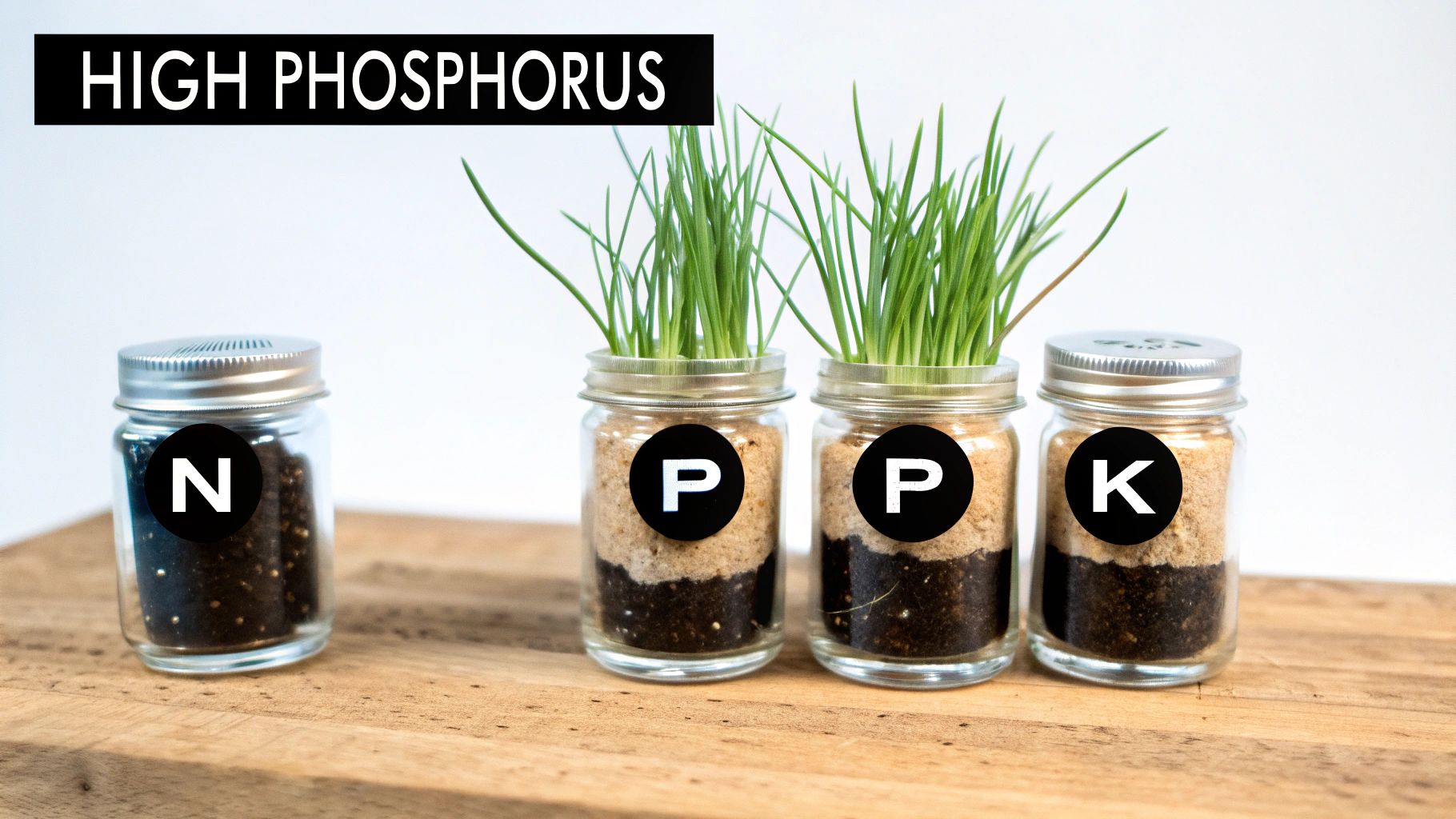
Here’s a simple way I always remember it: "Up, Down, and All-Around."
- Nitrogen (N) is for "up" growth. It’s what gives you those vibrant, green blades of grass.
- Phosphorus (P) focuses on "down" growth, building a deep and powerful root system.
- Potassium (K) is for "all-around" health. Think of it as the immune system, helping with stress, disease, and water absorption.
For a new lawn, whether you're in Alpharetta or Dahlonega, that middle number—Phosphorus—is the undisputed MVP. Before it can become a lush, green carpet, your new grass has to establish a strong foundation of roots. Phosphorus is the primary nutrient that fuels that critical underground growth.
Starter Fertilizer vs. Regular Lawn Food
This is where a lot of people make a crucial mistake. Grabbing your regular lawn food won't work for new grass. It’s designed for established turf and is packed with nitrogen to keep things green.
A starter fertilizer, on the other hand, has a completely different job. Its high phosphorus content provides immediate, accessible energy for root development. This is absolutely essential for helping your new lawn survive its first hot and humid summer in North Georgia.
To put it in perspective, the right starter fertilizer can increase germination rates by 25-50% and boost root mass by as much as 40% in that first season alone. It’s no wonder that globally, dry fertilizers hold an 82.50% market share—they give you the precision application new turf desperately needs.
Let's break down the key differences.
Starter Fertilizer vs. Regular Lawn Food: A Quick Comparison
| Attribute | Starter Fertilizer (For New Grass) | Regular Fertilizer (For Established Lawns) |
|---|---|---|
| Primary Goal | Encourage strong, deep root development | Promote lush, green top growth and maintenance |
| Nutrient Focus | High in Phosphorus (P), moderate N & K | High in Nitrogen (N), lower P & K |
| Release Speed | Often slow-release to avoid burning seedlings | Can be fast or slow-release |
| When to Use | At or just before seeding/sodding | On a mature, established lawn |
As you can see, using the right tool for the job makes all the difference in getting your lawn off to a healthy start.
From my experience working with lawns across Cumming and Milton, choosing a slow-release, natural starter fertilizer is a game-changer. It feeds the new grass gently over weeks, which drastically reduces the risk of "fertilizer burn" that can easily scorch those delicate seedlings. Plus, it actually helps improve the structure of our challenging red clay soil.
But before you spread anything, you need a baseline. Knowing what your soil already has is just as important as knowing what it needs. A simple soil analysis is your roadmap to success, and you can learn more about this in our guide on how to test your soil's pH. A test reveals your soil's current nutrient levels, ensuring you only add what’s necessary to create the perfect growing environment from day one.
Getting the Timing and Technique Just Right
You've picked out the perfect high-phosphorus fertilizer for your new grass, but that's only half the job. Now, we have to talk about the "when" and the "how." For homeowners all over North Georgia, from Dahlonega to Cumming, getting the timing and application technique spot-on is what separates a struggling new lawn from one that takes off.
We see two main scenarios: starting a lawn from scratch with seed or laying down fresh sod. Each has its own best practice, and nailing this step really sets the stage for a lawn that establishes itself quickly and healthily.
Applying Fertilizer When Seeding a New Lawn
If you're starting with grass seed, the timing is pretty simple: apply your starter fertilizer the same day you sow the seed. Think of it like packing a lunch for the seed’s first day. You're giving it an immediate advantage by placing those essential nutrients right there in the soil where germination happens.
The moment a seed sprouts, its first tender roots need to find phosphorus to develop. By fertilizing on seeding day, you ensure that food source is waiting for them.
Here are a few tips I've picked up over the years for seeding success in the Cumming area:
- Fertilize First, Then Seed: The ideal method is to spread your fertilizer and then lightly rake it into the top inch or so of soil. After that, spread your seed. This mixes the nutrients right into the germination zone.
- Same-Day is Okay: If you can't do it in that order, don't sweat it. Applying the fertilizer right after you spread the seed works just fine. The important thing is getting both done together.
- Water Gently, but Consistently: Once everything is down, a light and steady watering routine is key. It activates the fertilizer and helps the seeds germinate without washing away all your hard work.
How to Fertilize a New Sod Lawn
With sod, there's a bit of a debate: fertilize before you lay the sod or after? I'm here to tell you, applying the starter fertilizer directly onto the prepared soil before you lay the sod is the way to go.
This puts that phosphorus-rich food right where the new roots will be reaching in just a few days. You’re basically creating a nutrient-packed bed that encourages the sod’s roots to dive deep into your soil. That quick rooting is absolutely critical for helping the sod survive its first hot Georgia summer. If you just toss the fertilizer on top of the sod, it has to travel a lot further to get to where it's needed most.
Having laid sod on countless lawns in places like Alpharetta and Johns Creek, I can tell you that sod put down on pre-fertilized soil establishes faster and shows far less stress. You're giving the roots a clear reason to dig in, which is exactly what you want.
Using Your Spreader and Watering It All In
Whether you're seeding or sodding, you have to get even coverage. A sloppy application leads to a patchy, uneven lawn and can even burn the new grass. Always calibrate your spreader based on the settings listed on the fertilizer bag. For most lawns in our area, a broadcast (or rotary) spreader is your best bet for getting that nice, uniform application. Just walk at a steady pace and make sure to slightly overlap each pass to avoid leaving green and yellow stripes in your yard.
And finally, the most important step: water the fertilizer in. As soon as you're done spreading, give the area a good watering for about 10-15 minutes. This does two crucial things:
- It washes the fertilizer granules off the grass blades and down into the soil.
- It activates the nutrients, starting the process of breaking them down so the new roots can actually use them.
A word of caution: try to avoid fertilizing in the blistering heat of a Georgia summer afternoon. The best time is always early in the morning or later in the evening when things have cooled down. This prevents the fertilizer from scorching those delicate new grass blades before the water has a chance to do its job.
Your First-Year Lawn Feeding Schedule
Putting down a new lawn is a real investment, and that first year is absolutely critical. Think of it as a year-long project. That initial dose of starter fertilizer for your new grass is the first step, but it's just the beginning. To get that thick, resilient turf that can handle everything from a humid Cumming summer to a chilly Dahlonega winter, you need a smart, consistent feeding plan.
This timeline gives you a bird's-eye view of what that first year looks like, from the day you seed all the way to your follow-up feedings.
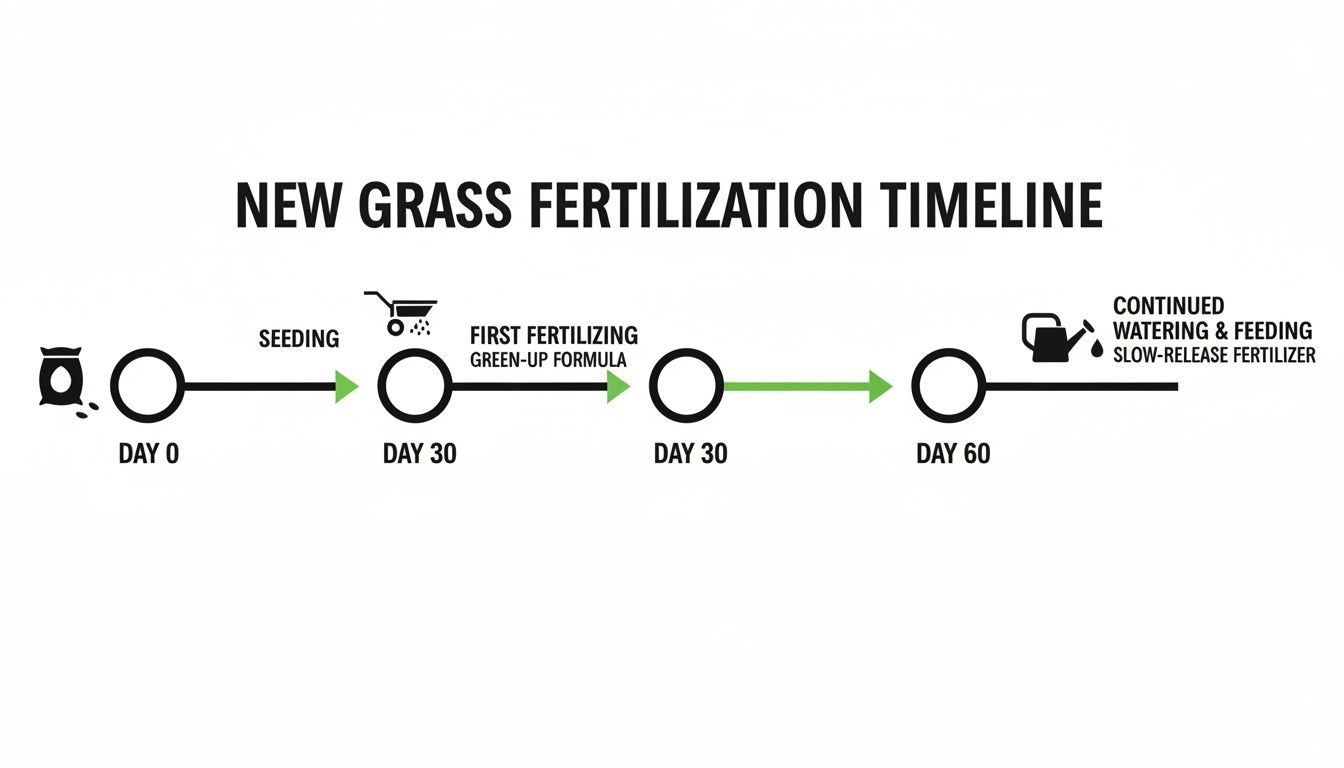
As you can see, that first feeding is all about phosphorus to get the roots digging deep and establishing a strong foundation. But once that network is in place, your lawn’s nutritional needs shift. You'll move away from a high-phosphorus starter formula and onto a more balanced, slow-release natural fertilizer that builds overall health from the soil up.
The All-Important Follow-Up Feeding
Your new grass is hungry, and it will tear through that starter fertilizer in no time. You should be planning for a second application roughly four to six weeks after you first put down seed or sod. At this stage, you should be seeing good, uniform growth, and the young roots are ready for their next course.
Don't skip this one. This second feeding is the bridge that carries your lawn from its fragile infancy into a mature, regular maintenance routine. You have two good options here: you can either apply another round of starter fertilizer or start making the switch to a well-rounded, slow-release organic blend.
A Seasonal Game Plan for North Georgia Lawns
After that initial six-week push, your lawn care schedule can settle into a more predictable seasonal rhythm. The key is tailoring it to our local climate here in Forsyth and surrounding counties.
- Spring (March-May): As your young lawn comes out of its first winter, you want to encourage steady, resilient growth. A balanced, slow-release natural fertilizer is perfect for this. It provides a consistent stream of nutrients without forcing a sudden, weak burst of top growth, helping the grass build strength before the summer heat hits.
- Summer (June-August): Let's be honest, Georgia summers are brutal on young turf. We always recommend a gentle, organic fertilizer that's rich in potassium. Potassium is the key to stress tolerance—it helps your new lawn handle the heat, fight off drought, and resist disease.
- Fall (September-November): In my experience, this is the most important feeding of the entire year, especially for lawns in Milton and Alpharetta. A good fall application helps the grass bounce back from summer stress and, more importantly, store up energy in its roots for the winter. This "winterizer" feeding is what ensures your lawn comes back greener and stronger next spring.
Don't skip the fall feeding! I've seen countless young lawns struggle in their second year simply because they went into winter dormancy on an empty stomach. A proper fall application is like giving your lawn a warm coat for the cold months ahead.
It's interesting to see how this approach lines up with broader trends. Globally, fertilizer use is at an all-time high. Potash demand, which provides that crucial potassium for stress tolerance, is projected to jump by 10% by 2028. At the same time, safety-conscious homeowners are driving a massive shift toward natural solutions. Organic fertilizers hold a staggering 94% market share in some segments because they can reduce chemical runoff by up to 50%—a huge win for protecting kids and pets playing on the lawn. For a deeper dive, you can check out market analysis from firms like Precedence Research.
Building the perfect schedule can feel a little overwhelming at first. That's why our guide on when to fertilize your new lawn breaks it down with even more detail to keep you on track all year long.
Building a Healthy Foundation Beyond Fertilizer
Putting down the right fertilizer is a great start, but if your soil isn't ready, it’s like trying to bake a cake in a cold oven. Here in Forsyth County and the surrounding areas, our biggest challenge is almost always the heavy, compacted red clay. That's why getting the soil right isn't just a suggestion—it's the absolute foundation for a beautiful lawn.
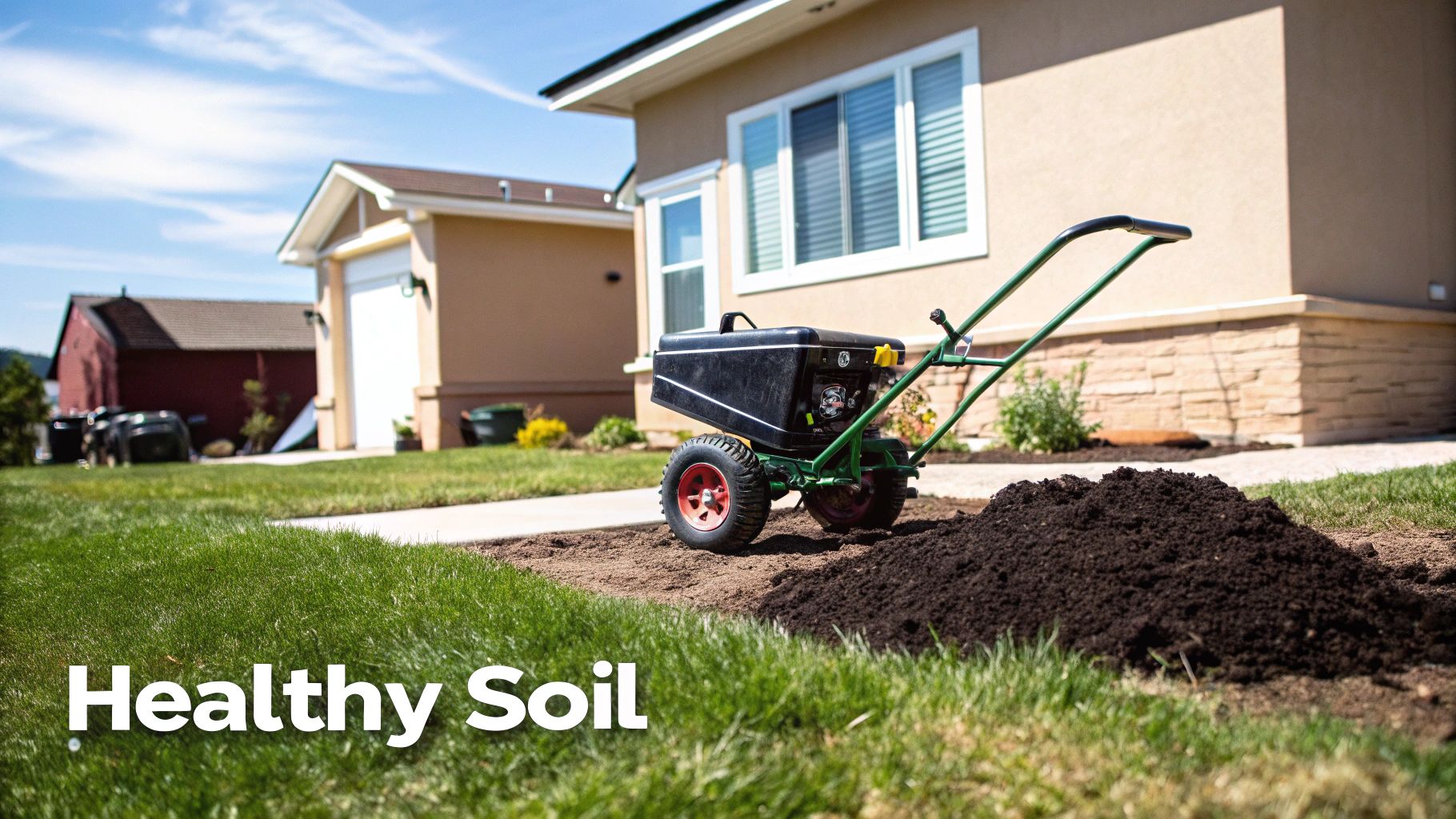
Before you even open a bag of fertilizer, you need to know what you’re working with. A simple soil test is the single most important first move. Think of it as a report card for your lawn; it tells you the pH and exactly which nutrients are missing or in excess. Guessing just leads to wasting time and money on the wrong products, and you could even damage your fragile new grass.
Unlocking Your Soil's Potential
Once you have your soil test results, you can start improving the ground itself. In neighborhoods from Cumming to Johns Creek, years of foot traffic, mowers, and even the original construction can leave the soil feeling like concrete. Tender new grass roots just can't push through that.
This is where core aeration becomes a total game-changer. A core aerator pulls up small plugs of soil, opening up channels that relieve that rock-hard compaction. Suddenly, three critical things can get down to the root zone:
- Air: Roots need to breathe, and compacted soil suffocates them.
- Water: Rain and irrigation can soak in deep instead of just running off into the street.
- Nutrients: Your fertilizer can actually reach the new roots where it’s needed most.
Essentially, aeration gives your new turf’s roots the breathing room they need to stretch out and establish a strong foothold.
From our experience working on lawns from Milton to Dahlonega, the most dramatic transformations happen when we aerate and top-dress before seeding. It turns that dense clay into a crumbly, welcoming bed where new grass doesn't just survive—it absolutely thrives.
The Finishing Touch: Top Dressing with Compost
After you’ve opened up the soil with aeration, top dressing with a high-quality organic compost is the final piece of the puzzle. Spreading a thin layer of compost over the aerated ground works wonders.
This rich organic matter improves the soil's structure, helps it hold onto moisture during our scorching Georgia summers, and provides a slow, steady diet of essential micronutrients. It acts like a sponge, keeping water and fertilizer right where the new roots can find them. By pairing aeration with top dressing, you're creating a rich foundation that makes your starter fertilizer work so much better, giving your new Alpharetta lawn the best possible shot at long-term success.
Common Questions About Fertilizing New Grass
Even with the best game plan, questions always come up when you're trying to get a new lawn off the ground. Getting the right answers is the difference between a lush, thriving lawn and a frustrating, patchy mess. Here are a few of the most common questions we hear from homeowners we work with across North Georgia, from Cumming to Johns Creek.
Can I Use My Regular Lawn Fertilizer on New Grass Seed?
I get this question all the time, and the answer is a hard no. You really want to avoid using your standard lawn food on brand new grass.
Think of it this way: your regular fertilizer is packed with nitrogen, which is all about pushing that deep green, leafy growth you see in an established lawn. But brand new seedlings and freshly laid sod have a completely different job to do. Their number one priority is building a deep, robust root system, and for that, they need a high dose of phosphorus.
If you hit them with a high-nitrogen product, you're essentially forcing weak, flimsy top growth before the roots can actually support it. You'll end up with a shallow-rooted lawn that's incredibly vulnerable to drought, disease, and the brutal summer heat we get here in Alpharetta and Cumming.
The rule of thumb I always tell people is simple: Starter fertilizer is for new roots; regular fertilizer is for established leaves. Sticking to this gives your new grass exactly what it needs, right when it needs it.
How Soon Can Kids and Pets Play on the New Lawn?
This is, understandably, a huge concern for families. The answer really comes down to what kind of fertilizer you put down.
If you're using most of the common synthetic granular fertilizers, you absolutely must keep kids and pets off the lawn for 24 to 48 hours after you've applied it and watered it in. Those chemicals need time to dissolve and settle, and you don't want your loved ones rolling around in them.
This waiting period is a major reason why so many families in communities like Johns Creek and Milton are making the switch to natural, organic products. With a truly organic fertilizer, that waiting game is over. You can feed your lawn and let the kids and dogs run out to play on the very same day, all without having to worry about harsh chemical residues. It's a huge peace-of-mind thing.
What Are the Signs of Over-Fertilizing a New Lawn?
It's so easy to get a little too excited and go heavy on the fertilizer, but it can do some serious damage to your delicate new grass. The most obvious red flag is "fertilizer burn," which looks like yellow or brown scorch marks right on the grass blades. Sometimes, you'll also just see stunted growth or a lawn that looks patchy and generally unhealthy.
If you think you might have overdone it, the best course of action is to water the area deeply and frequently for the next several days. This helps to flush all those excess salts and nutrients down past the root zone. My best advice is to prevent it in the first place—always read the bag, measure your lawn's square footage, and stick to the recommended application rates.
My New Grass Is Patchy. Should I Add More Fertilizer?
Hold on a second—resist that urge to just dump more fertilizer on it. Patchiness in a new lawn is almost never caused by a lack of nutrients, especially if you've already applied a good starter fertilizer.
The real culprits are usually something else entirely:
- Poor seed-to-soil contact in those spots.
- Uneven watering that’s leaving some areas too dry.
- A heavy downpour that washed some of the seed away.
- Birds and other critters snacking on your seed.
Throwing more fertilizer on those bare spots won't fix the problem and will likely just burn the young grass that has managed to sprout nearby. A much better approach is to gently rake the patchy areas to loosen the soil, put down a little more seed, and then cover it with a very thin layer of quality compost or topsoil to protect it.
Ready to give your new lawn the expert, natural care it deserves without all the guesswork? The team at Barefoot Organics specializes in creating lush, healthy lawns across North Georgia using methods that are safe, effective, and good for the environment. Get your free online quote and discover the difference a natural approach can make by visiting https://barefootorganicsllc.com.