

Starting a new lawn here in North Georgia is one of the most rewarding things you can do for your property, but getting it right from the very beginning is everything. The real secret isn't just the seed or sod you choose; it's feeding it properly before you even plant.
A good starter fertilizer is non-negotiable. You want to apply it before planting to give those new seeds or sod rolls a heavy dose of phosphorus, which is the key nutrient for kickstarting strong root growth. Honestly, this one step is the most critical thing you can do to help your new lawn take hold in our infamous red clay soil.
Why Fertilizing New Grass is a Game Changer in North Georgia
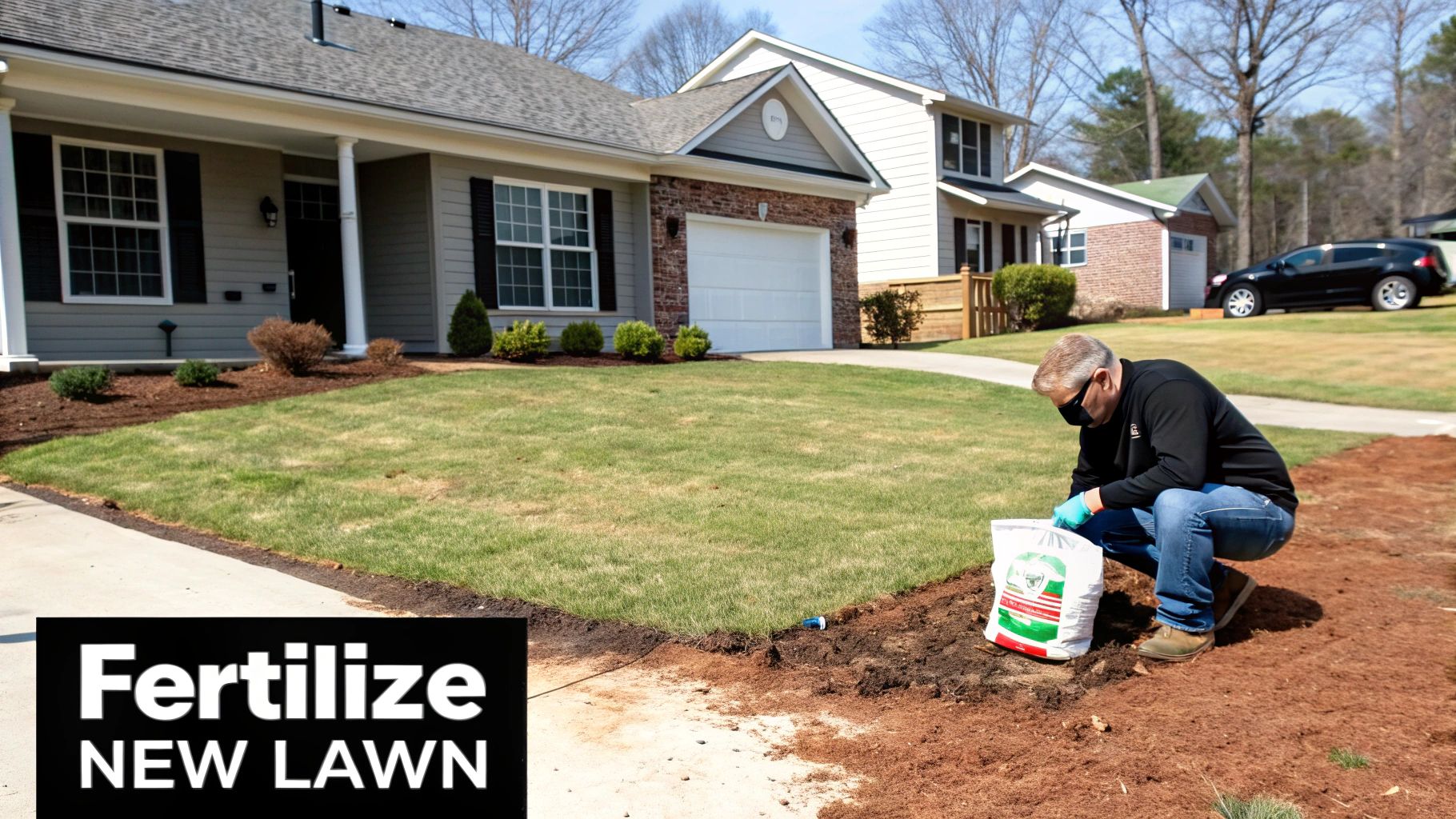
Anyone trying to grow a lawn in places like Cumming, Alpharetta, or Johns Creek knows it’s a battle. You're not just tossing seed and hoping for a miracle. We're up against some unique challenges, from that dense, nutrient-starved clay to our sweltering summer humidity that just invites fungal problems. Having a smart plan to fertilize new grass is your best weapon for building a lawn that lasts.
Feeding a new lawn correctly from day one is about more than just a pop of green color. You're actually building a resilient, healthy ecosystem from the soil up.
- Strong Root Development: New grass is starving for phosphorus to establish deep, tough roots. This is absolutely essential for anchoring the turf so it can hunt for water and nutrients, especially in our compacted soil.
- Natural Weed Control: Here’s a pro tip: the best weed defense is a thick lawn. When new grass fills in quickly and densely, it literally chokes out common weeds like crabgrass and clover, giving them no room to get started.
- Disease and Stress Resistance: A well-fed lawn can handle the stress of a brutal Milton summer or a surprise dry spell. Healthy turf is far less likely to fall victim to the common fungal diseases that thrive in our humid climate.
First Steps for New Grass Fertilization: Seed vs. Sod
When it comes to that initial nutritional boost, the path for new seed and new sod diverges just a little. I hear homeowners in Milton and Cumming debating which installation method is better all the time, but the success of either one comes down to how you support it in those first few critical weeks.
We'll get into the specific timing and products in a bit, but for now, let’s look at the different goals for each.
| Action | Newly Seeded Lawn | Newly Laid Sod |
|---|---|---|
| Primary Goal | Encourage fast, even germination and deep root penetration. | Promote rapid root "knitting" into the native soil to prevent shock. |
| Fertilizer Timing | Apply before or during seeding, raking it lightly into the top inch of soil. | Apply to the prepared soil just before laying the sod strips. |
| Key Nutrient | High Phosphorus (the "P" in N-P-K) to fuel root and shoot growth. | High Phosphorus to help roots anchor quickly and absorb water. |
The key takeaway is that both methods need that starter fertilizer up front, but the application is tailored to the unique needs of seed versus sod.
For a newly seeded lawn, the goal is rapid germination and root growth. For new sod, the focus is on encouraging the roots to knit quickly into the soil below to prevent it from drying out. Both goals are achieved with a proper starter fertilizer.
The data backs this up, too. Recent studies show that properly fertilized new lawns, especially with organic options, can establish 30-50% faster than lawns that are left to fend for themselves. This quick establishment helps reduce weed invasions by up to 40% in those crucial first 90 days.
It’s been incredible to see the shift in our local communities. In suburban areas like Johns Creek and Milton, the use of natural fertilizers has jumped from just 15% in 2010 to nearly 35% by 2023. This change is driven by families who want beautiful lawns that are also safe for their children and pets. You can actually explore the market trends for natural fertilizers yourself to see this growing demand. It proves more and more people understand that a healthy lawn starts with living soil, not just a quick chemical fix.
Choosing the Right Nutrients for Georgia's Clay Soil
Before you can even think about spreading fertilizer, you have to get inside the mind of your new grass. What is it really hungry for? This is non-negotiable here in North Georgia, where our infamous red clay can be incredibly stubborn, locking up nutrients and making it tough for anything new to thrive. It’s like trying to grow a garden in a brick—you’ve got to give your lawn a serious head start.
The foundation of any good lawn food is its N-P-K ratio, which stands for Nitrogen (N), Phosphorus (P), and Potassium (K). Each one has a specific job to do for your lawn.
- Nitrogen (N): This is all about lush, green, leafy growth. Nitrogen is what gives your lawn that vibrant color and helps the blades grow tall and strong.
- Phosphorus (P): Think of this as the root-builder. For new grass, it’s arguably the single most important nutrient, fueling the development of a deep, healthy root system.
- Potassium (K): This is your lawn’s bodyguard. Potassium helps your grass handle stress, from scorching summer droughts to the occasional cold snap we see from Dahlonega down to Alpharetta.
When you’re starting a lawn from scratch, the nutrient balance is completely different from what an established lawn needs. A mature lawn is a nitrogen fiend, but new grass is absolutely desperate for phosphorus to anchor itself into the ground.
The Secret Weapon for Clay: Starter Fertilizers
That heavy, compacted clay soil we have all over Forsyth County is a physical barrier. It makes it incredibly difficult for tiny, new grass roots to push through and find the food and water they need. This is where a starter fertilizer becomes your lawn’s best friend.
Unlike regular lawn food, starter fertilizers are specifically formulated with a much higher concentration of phosphorus. This phosphorus boost is a complete game-changer. It doesn’t really move through the soil, so by applying it right at seeding or just before laying sod, you place this crucial nutrient exactly where the new roots can find it immediately. This gives them the energy to power through that tough clay and get established fast.
In North Georgia's tricky red clay, a starter fertilizer high in phosphorus (like a 10-20-10 NPK) is non-negotiable. It can jumpstart root growth by an impressive 25-35%, giving your new lawn the fighting chance it needs.
This kind of strategic lawn care is a big reason why residential use accounts for 55% of the entire lawn consumables market. Homeowners in Milton and Alpharetta are increasingly focused on both results and safety. And with some synthetic residues known to linger for 6-12 months, the push toward smarter, safer lawn care is undeniable. You can discover more insights into these market trends to see where the industry is heading.
Granular vs. Liquid: Which Is Better for New Turf?
When you head to the store, you'll generally find two forms of starter fertilizer: slow-release granular and fast-acting liquid. Both are useful, but for a new lawn in our region, they play slightly different roles.
Slow-Release Granular Fertilizer
These are the little pellets you spread across the soil. For a pre-planting application, they are fantastic. They break down slowly over several weeks, providing a steady, gentle supply of nutrients. This "spoon-feeding" approach is perfect for new seedlings, as it prevents the shock of too many nutrients hitting them all at once.
Liquid Fertilizer
Liquid options are absorbed almost instantly by the soil and the plant. They provide a quick boost, but they just don't have the staying power of a good granular product. I find they are best used for a gentle follow-up feeding a few weeks after the grass has germinated, especially if you notice any spots that look like they need a little pick-me-up.
For that critical first application, a high-quality organic granular fertilizer is almost always the way to go. It builds the foundation for long-term soil health, not just a temporary green-up. The reality is, our clay soil needs more than a quick chemical fix; it needs to be conditioned and improved over time. You can dig deeper into that process with our guide on how to improve clay soil for grass.
By using natural, organic products, you're not just feeding the grass blades—you're feeding the entire soil ecosystem. This improves water retention and helps prevent chemical runoff into local waterways, a growing concern for families in Cumming and Johns Creek.
Your First-Year Fertilization Calendar for North Georgia Lawns
Let’s be honest, trying to fertilize a lawn in North Georgia by following a generic calendar is a recipe for frustration. A surprise heatwave in Johns Creek or a cool, damp fall in Dahlonega can throw any rigid schedule right out the window. The real art is learning to read the cues from your specific grass and our local weather.
One of the biggest mistakes I see homeowners make is feeding their lawn just because the calendar says it's time. The whole point is to give your grass nutrients when it's actively growing and can actually use them. Dumping fertilizer on dormant summer grass or right before a classic Forsyth County downpour is just a waste of money and can seriously stress your new turf.
Nailing That Second Feeding
We already covered applying a starter fertilizer right when you plant, but the next step is just as critical for building a lawn that can handle its first year. This second feeding is the first real meal your young grass gets after it has sprouted and started to put down roots. It’s what fuels the deep root development needed for a thick, resilient lawn.
Pro Tip: Plan on giving your new lawn its second feeding about 4 to 6 weeks after the seedlings have clearly sprouted, or after your new sod has tacked down and started rooting firmly into the soil. This timing is crucial—it ensures the young grass is mature enough to absorb the nutrients without getting burned.
Different Grass, Different Schedules
Around here, we primarily deal with two types of grass: warm-season grasses like Bermuda and Zoysia, and cool-season grasses like Fescue. Their growth cycles are polar opposites, which means their feeding schedules are, too. You can't feed a Fescue lawn on a Bermuda schedule and expect good results.
H3: For Warm-Season Lawns (Bermuda, Zoysia)
If you planted in late spring or early summer, your new lawn is hitting its stride during our hottest months.
- First Feeding: At planting, typically May or June.
- Second Feeding: About 4-6 weeks later, usually in July or August.
- What's Next: Give it one last light meal in late summer to help it store up energy before it goes dormant for the winter. You'll want to stop all fertilizing by early September.
H3: For Cool-Season Lawns (Fescue)
If you planted in the fall (the best time for Fescue here), your grass does its best growing when temperatures are mild.
- First Feeding: At planting, which is usually September or October.
- Second Feeding: Around 4-6 weeks later, putting you in October or November.
- What's Next: The next major feeding won't be until early spring (think March-April) as the lawn wakes up and starts growing vigorously again.
To make it even clearer, here’s a simple schedule to follow for that all-important first year.
Fertilizer Schedule for New North Georgia Lawns
This table breaks down the ideal first-year timeline for the most common grasses planted in our area.
| Season Planted | Grass Type | First Application | Second Application | Follow-Up Plan |
|---|---|---|---|---|
| Late Spring | Bermuda / Zoysia | May / June | July / August | Light feeding in early Sept |
| Early Fall | Fescue | Sept / Oct | Oct / Nov | Main feeding in early spring |
Remember, your best tool is your own observation. Is that new Fescue in your Alpharetta yard looking a bit pale? You might want to feed it closer to the 4-week mark. Is your new Zoysia in Milton struggling during a dry spell? Hold off on the fertilizer until we get some rain; feeding stressed grass only makes things worse.
For a more detailed look into the year-round process, our complete guide on when to fertilize your lawn digs even deeper into the seasonal needs of established North Georgia turf. Learning to listen to what your lawn is telling you is what truly separates a decent lawn from a great one.
How to Properly Apply Fertilizer to New Grass
Getting your hands on the right starter fertilizer is a great start, but how you put it down is what really makes or breaks a new lawn. A careful, even application is the only way to ensure every single new blade of grass gets the nutrients it needs to sink its roots deep into our tough North Georgia clay. This is where a little bit of technique goes a long, long way.
Your goal here is simple: avoid the rookie mistakes. We're talking about fertilizer burn—those awful yellow or brown patches—and the kind of uneven, striped growth that screams "DIY job gone wrong." Nailing the application in your Cumming or Johns Creek yard from day one sets the stage for a thick, uniform carpet of green that your neighbors will envy.
Calculate Your Needs and Calibrate Your Spreader
Before you even think about tearing open that bag of fertilizer, you've got to do a tiny bit of math. It's painless, I promise, but absolutely critical.
First, figure out the square footage of your new lawn area (just multiply the length by the width). Every fertilizer bag lists application rates, usually in pounds per 1,000 square feet. For new grass, a good rule of thumb is to aim for a rate that delivers about 0.5 to 1 pound of actual nitrogen per 1,000 square feet.
Once you know how much fertilizer you need for your space, you absolutely must calibrate your spreader. This isn't an optional step. Every spreader is a little different, and every bag of fertilizer has a unique particle size.
- Check the Bag: The label will suggest a spreader setting. Think of this as a starting point, not the final word.
- Run a Quick Test: Find a driveway or lay down a small tarp. Run your spreader over it for a short, measured distance, maybe 10 feet or so.
- Weigh and Adjust: Sweep up the fertilizer you just spread, weigh it, and see how it lines up with your target rate. Tweak the spreader setting up or down until it's dropping the right amount.
Taking just five minutes to do this will save you from over-applying, which is a waste of money and can easily scorch your brand-new, delicate grass seedlings.
This infographic gives you a great visual breakdown of your new lawn's feeding schedule, from the initial planting to those all-important follow-up applications.
Seeing the process laid out like this really helps clarify the timeline so you don’t miss a critical feeding window.
The Foolproof Crisscross Application Method
Alright, it's time to actually spread the fertilizer. If you want perfectly even coverage without any stripes, you have to use the crisscross method. It's the technique the pros use, and it's surprisingly easy for any homeowner in Alpharetta or Milton to master.
Here’s how it works:
- Divide and Conquer: Put exactly half of the fertilizer you calculated into your spreader.
- Make the First Pass: Walk your entire lawn area in straight, parallel lines. Make sure you slightly overlap each pass to avoid gaps. The key is to walk at a steady, consistent pace.
- Make the Second Pass: Pour the remaining half of the fertilizer into the spreader. This time, walk the lawn again, but in a pattern that's perpendicular to your first one—think of it like making a giant tic-tac-toe board on your lawn.
This two-direction approach guarantees that every square foot of soil gets hit with fertilizer, smoothing out any little inconsistencies from your walking speed or spreader pattern. It's a game-changer whether you're using pellets or another form. If you're curious about the different product types, you can dig into the pros and cons in our guide on liquid vs. granular fertilizer.
A split application approach—applying half the recommended nitrogen at seeding and the other half about four weeks later—has been shown to drastically cut new lawn failure rates from a staggering 30% down to under 10%.
This method does more than just grow grass; it builds healthier soil for the long haul. Research shows this feeding strategy can improve soil organic matter by 15-20% in a single season. That's a huge win for managing the 50 inches of rain we typically get. Spreading 0.5-1 pound of nitrogen per 1,000 sq ft each month can lead to 40% denser turf in just 60 days.
The Final, Crucial Step: Water It In
Once the fertilizer is down, you have one last thing to do. You need to give the area a light watering.
This quick sprinkle does two very important things. First, it washes any stray granules off the tender new grass blades, preventing them from getting burned. Second, it starts to dissolve the fertilizer, activating the nutrients and helping them seep down into the root zone where they're needed most. You're not looking to flood the area—just aim for about a quarter-inch of water to moisten the top layer of soil without creating puddles or runoff.
What to Do When Your New Lawn Isn't Cooperating
Even with the best-laid plans, a new lawn in North Georgia can sometimes test your patience. Our notoriously humid summers in Alpharetta and dense clay soil in Forsyth County can team up to create some real challenges. But don't worry—most of these early-stage problems are common and, more importantly, completely fixable.
The biggest mistake I see homeowners make is jumping to conclusions. They spot a yellow patch and immediately grab the fertilizer bag, thinking more food is the answer. In reality, the problem might be too much water or the beginnings of a fungal disease. Learning to read what your new lawn is telling you is half the battle.
Why Is My New Grass Turning Yellow?
It’s a gut-punch to see your beautiful new green lawn start to fade to yellow or a pale lime green. Fortunately, this is usually a straightforward issue. The color is a clear distress signal that something's off, typically with nutrition or water.
Down here in our neck of the woods, it almost always boils down to one of two things:
- It's hungry. New lawns need a ton of water, and that frequent irrigation can wash nitrogen right through the topsoil before the shallow new roots can grab it. If the yellowing is pretty consistent across the lawn, it's a good bet it just needs a gentle feeding.
- It's drowning. People in Milton and Johns Creek are often so excited about their new lawn that they water it to death. When the soil is waterlogged, the roots can't breathe, let alone absorb nutrients. That suffocation leads to—you guessed it—yellowing grass.
The solution is right at your fingertips. Go out and feel the soil. If it’s soggy or you see standing water, you know you need to dial back the watering schedule. If the soil is just moist but not a swamp, your lawn is probably ready for a light, balanced meal to get its nitrogen levels back up.
Dealing with Annoying Bare or Thin Patches
Patchy growth is probably the number one complaint I hear about new lawns. You’ll have one spot that looks like a golf course fairway right next to a bare patch of clay. This checkerboard effect almost always points back to a misstep during the prep or application phase.
Let's rewind to installation day. Does any of this sound familiar?
- Uneven Spreading: If you didn't overlap your passes with the spreader, you can easily end up with stripes or patches—some areas got plenty of starter fertilizer, and others got nothing.
- Poor Seed-to-Soil Contact: Grass seed can't just sit on top of the ground; it has to be pressed into the soil to germinate. Any spots where seed was just scattered over hard, unraked clay were doomed from the start.
- Washouts: One of those classic Georgia downpours or a sprinkler aimed a little too aggressively can wash all your seed into little piles, leaving the higher ground completely bare.
For small spots, the fix is simple. Just lightly scuff up the bare soil with a rake, scatter some more seed, and gently press it in with your foot. If you have larger bare areas, you'll get much better results by spreading a thin layer of quality compost before you re-seed. It gives the new seeds a much better place to call home.
A quick but important note: Don't mistake patchy growth for fertilizer burn. Burn looks like scorched, dead grass, often in streaks. Patchiness is just an absence of healthy grass.
Weeds Are Taking Over!
It’s maddening to see weeds pop up before your new grass even has a chance. But remember, those weed seeds were already in the soil, just waiting for the same water and sun you're giving your new lawn.
Whatever you do, do not use a "weed and feed" product on your new lawn. This is a critical rule. The chemicals in those products are designed to stop seeds from sprouting, and they don't know the difference between a crabgrass seed and your expensive fescue seed.
Your best weapons, for now, are patience and a strong back. For the first month or so, just hand-pull the obvious weeds. It’s not fun, but it works. After you’ve mowed the new lawn at least three or four times, it will be mature enough to handle a gentle, targeted liquid weed killer if you still have problems. Ultimately, the best defense is a thick, healthy lawn that chokes out the weeds before they can even get started.
Your Top Questions About New Lawn Care Answered
When you're nurturing a new lawn, it feels like every little thing matters. And it does! Here in the Cumming area, we get a lot of the same questions from folks trying to give their new grass the best possible start. Let's tackle some of the most common ones I hear.
Can I Use a "Weed and Feed" Product on My New Grass?
I see this all the time. You’ve put in all the work to get your new Fescue or Bermuda growing, and then a few pesky weeds pop up. The first instinct is often to grab a bag of "weed and feed," but please, hold off! This is one of the quickest ways to sabotage your new lawn.
Those combination products contain herbicides that are great at stopping weed seeds from sprouting. The problem is, they have no idea how to distinguish between a crabgrass seed and your precious new grass seedlings. Applying a weed and feed too soon puts immense stress on your tender new grass, often stunting its root growth and undoing all your effort.
For the first month or two, the best approach is old-fashioned hand-pulling. It's a bit of work, but it's safe. Once you've mowed your new lawn at least three or four times, the grass will be strong enough to handle a gentle, spot-applied liquid herbicide if you absolutely need it.
How Long Before My Kids and Pets Can Play on the Lawn After Fertilizing?
This is probably the number one question I get from families in Alpharetta, Milton, and Johns Creek. The answer really boils down to what kind of fertilizer you're putting down.
If you opt for synthetic chemical fertilizers, you have to be really diligent about reading the label. Most of them require a strict waiting period—usually somewhere between 24 to 72 hours—after you've applied and watered them in. This gives the chemical pellets time to dissolve and soak into the soil, minimizing the risk of your kids or pets getting it on their skin or paws.
Frankly, this waiting game is a huge reason so many local homeowners are making the switch to organic lawn care.
When you use a high-quality, natural organic fertilizer, there's no waiting period. As soon as it's watered in, the lawn is completely safe for your kids and pets to get right back out there and play. That kind of peace of mind is priceless.
What are the Signs of an Over-Fertilized Lawn?
It’s easy to fall into the "more is better" trap, but with fertilizer, that can lead to some serious trouble. Over-applying can literally scorch your new grass, a problem we call fertilizer burn. Your lawn will let you know pretty quickly if you've gone too heavy with the spreader.
Keep an eye out for these classic signs:
- Yellow or brown stripes: You might notice distinct discolored streaks that trace the exact path you walked with your spreader.
- Crispy, burnt grass blades: The grass will look and feel dry and brittle, almost like straw, even if you know the ground is damp.
- A white crust on the soil: In really bad cases, you can actually see a crusty layer of fertilizer salts forming on the surface.
If you see this happening, you need to act fast. Your best bet is to flush the area with a lot of water. Water it deeply every day for several days to wash those excess salts down below the root zone. Give your lawn a break from mowing or any other treatments until you start to see fresh, healthy green shoots coming back.
A vibrant, beautiful lawn shouldn't mean compromising your family's safety. At Barefoot Organics, we build natural lawn care programs specifically for our unique North Georgia climate. We're all about creating a yard that’s both stunning and a safe place for everyone to enjoy.
Ready for a personalized plan for your new lawn? Get a free quote from Barefoot Organics today!