

When you hear about concentrated liquid fertilizer for your lawn, what you're really talking about is a powerhouse nutrient blend that you mix with water and spray right onto the grass. It's a method designed for speed, giving your lawn a fast-acting dose of nutrients like nitrogen and iron. For homeowners in places like Cumming and Alpharetta, this means a quick green-up and that vibrant, healthy look everyone's after. Think of it as an express lane for feeding your lawn.
The Secret to a Lush Lawn in North Georgia

If you live anywhere across North Georgia, from Milton to Dahlonega, you know a great lawn is more than just curb appeal. It's a point of pride and the backdrop for family life. But getting that barefoot-soft grass can feel like an uphill battle, especially with our infamous red clay soil and weather that keeps us guessing. This is where a smarter fertilization strategy completely changes the game.
Concentrated liquid fertilizers are fast becoming the go-to for savvy homeowners who demand fantastic results without putting their kids or pets at risk. Unlike the granular pellets of yesterday that just sit on the soil's surface, liquids get to work right away. They're absorbed through both the grass blades and the soil, delivering nutrition exactly where it’s needed most—and fast.
Why Liquids Are Gaining Popularity
It's no surprise that the demand for lawn care products that are both effective and easy to use has exploded. The global market for lawn and garden consumables, which includes concentrated liquid fertilizer for lawns, has seen massive growth and shows no signs of slowing down. Here in North Georgia, we're at the heart of this trend, reflecting a deep-seated desire for top-notch lawn care in our communities. You can dive into the full research on lawn and garden consumables market trends to see the numbers for yourself.
But this shift is about more than just convenience; it’s about tangible results. It’s the difference between giving your lawn a slow-to-digest meal and a nutrient-packed smoothie. The liquid nutrients are immediately available, which leads to quicker greening and a healthier, more robust turf. That rapid uptake is a lifesaver for reviving a lawn that's looking stressed and tired after a long, hot Georgia summer.
For many folks I talk to in Forsyth and Dawson County, the biggest win is the precision. A liquid application gives you perfectly uniform coverage. You can say goodbye to those patchy spots or striped patterns you often get when spreading granules unevenly. Every single blade of grass gets the same balanced diet.
A Modern Approach to Lawn Health
Switching to a liquid-based program is about more than just getting fast results. It fits perfectly with a more natural, holistic approach to yard care. When you feed the lawn directly, you cut down on nutrient runoff and waste, which is a big deal for protecting our local environment and waterways.
A well-fed lawn is a strong lawn, and that strength starts at the roots. A deep, robust root system makes your turf far more resilient against common local challenges, such as:
- Summer Drought: Stronger roots reach deeper for water, helping your grass push through those punishing dry spells we see in Alpharetta and Johns Creek.
- Weed Invasion: A thick, healthy canopy of grass is the best defense against weeds—it simply crowds them out, reducing the need for harsh herbicides.
- Disease and Pests: Healthy grass is naturally better at fending off the fungal diseases and pest problems that can pop up in North Georgia lawns.
By opting for a concentrated liquid fertilizer, you're not just creating a lawn that looks great for the weekend. You're making a long-term investment in its health and creating a safer, more enjoyable outdoor space for your family to live on.
Why Liquid Feed Beats Granular for Georgia Clay Soil
If you’re tending to a lawn anywhere in North Georgia, from Johns Creek to Dahlonega, you know the struggle with our dense, stubborn clay soil. It's a unique challenge. This is where traditional granular fertilizers often fall short, sitting on the surface and fighting to get nutrients down to the roots where they're actually needed.
This is exactly why we've found that a concentrated liquid fertilizer for lawns isn't just another option—it's a smarter, more effective one for our specific conditions.
Think of granular pellets. They have to slowly dissolve to release their nutrients, a process that’s at the mercy of our unpredictable rainfall and compacted clay. A liquid feed is completely different. It’s like giving your lawn a direct IV of nutrients. The solution soaks into the ground immediately, bypassing that slow breakdown and making vital nutrition instantly available to the grass roots.
This rapid absorption is a game-changer, especially for the Bermuda and Zoysia grasses so common in our area. When your lawn looks pale and stressed after a hot Milton summer, a liquid application delivers a fast, visible boost. You can often see the difference in just a few days, a speed that granules simply can't match.
Consistent Coverage for Flawless Results
One of the biggest headaches we see with homeowners in Alpharetta using granular products is uneven coverage. It's incredibly easy to miss spots or accidentally overlap rows with a spreader, which is what causes that patchy, striped look. You end up with one section that’s brilliant green right next to a patch that’s lagging behind.
Liquid fertilizers, applied with a simple hose-end sprayer, solve this problem beautifully. The spray ensures a uniform blanket of nutrition covers your entire lawn. Every square inch gets the same balanced meal, which is the key to promoting that consistent, deep green color and even growth.
The real advantage here is a professional, uniform finish. You're not just feeding your lawn; you're ensuring that every single blade of grass gets an equal share, which is the secret to that seamless, carpet-like look we all want.
Working With Georgia’s Clay, Not Against It
Let’s be honest, our heavy clay soil can be tough for root systems to push through. Granular fertilizers can sometimes make this worse by sitting on the surface. Liquid applications do the opposite—they help improve the soil's structure by delivering nutrients that encourage beneficial microbial activity.
Healthy soil microbes are crucial for breaking down organic matter and aerating the soil naturally. When you feed that microbial population, you're helping create a healthier, more porous soil environment. This allows grass roots in your Forsyth County lawn to grow deeper and stronger, making the turf much more resilient to drought and disease over the long haul.
It all comes down to the delivery system. A liquid feed is just a more direct and efficient way to get your lawn the nutrition it needs to thrive in our region.
Liquid vs Granular Fertilizer for Georgia Lawns
To make it even clearer, let's put them side-by-side. Here’s a straightforward comparison of how liquid and granular fertilizers stack up for the typical North Georgia lawn.
| Feature | Concentrated Liquid Fertilizer | Traditional Granular Fertilizer |
|---|---|---|
| Nutrient Speed | Nutrients are available almost instantly, leading to rapid green-up. | Nutrients are released slowly as pellets dissolve, delaying results. |
| Application | Sprayed for perfectly even, consistent coverage across the entire lawn. | Applied with a spreader, making it easy to create stripes or miss spots. |
| Soil Impact | Soaks directly into the soil, feeding both the plant and microbes. | Sits on the surface and can struggle to penetrate dense clay soil. |
| Customization | Can be easily mixed with other natural products for a tailored treatment. | Formulas are pre-set and offer little flexibility for specific needs. |
| Staining Risk | Can stain hardscapes if oversprayed, requires careful application. | Pellets can be swept off driveways and walkways easily after application. |
While it's true that liquid fertilizers might require more frequent applications than some slow-release granular products, the trade-off is worth it. You get far superior control, much faster results, and a more effective feeding method tailored to our unique soil type. For any homeowner in Cumming or Milton who wants a reliably beautiful lawn, the benefits are clear.
Getting the Perfect Mix for Your Lawn
The real magic of a concentrated liquid fertilizer for lawns happens when you get the dilution and application just right. It might sound a bit technical, but honestly, it’s more like following a simple recipe for a gorgeous lawn than doing a complex chemistry experiment. It puts you in complete control.
For anyone with a lawn from Cumming to Johns Creek, getting this part right means your grass gets precisely what it needs—no waste, no risk. Forget trying to decipher tiny print on a bottle; let's walk through this with some practical advice that actually works.
Calculating the Right Amount for Your Lawn
Before you even think about mixing, you need to know the size of your lawn. This is, without a doubt, the most critical piece of the puzzle. Guessing is a recipe for disaster; you could either underfeed your turf or, even worse, scorch it with fertilizer burn.
So, grab a tape measure and figure out your lawn's square footage (just multiply length by width). If your yard has some funky shapes, no problem. Just break it down into smaller, manageable rectangles, measure each one, and add the totals together.
Here's a pro tip we share with clients in places like Milton or Cumming who often have larger, sprawling properties: use a free online mapping tool. You can literally trace the outline of your lawn on a satellite image, and it will spit out a surprisingly accurate square footage. It takes just a few seconds.
Once you have that number, look at the fertilizer label. It will clearly state how many ounces of concentrate to use per 1,000 square feet.
Let's say you have a 5,000 sq ft lawn in Alpharetta, and the product calls for 6 ounces of concentrate per 1,000 sq ft. The math is simple: you’ll need 30 ounces of fertilizer total (5 x 6 = 30). Doing this quick calculation ensures you're on target every single time.
Choosing Your Application Tool
Next up, you need to decide how you're going to apply the mixture. For most homeowners, the choice comes down to two main tools: a hose-end sprayer or a pump sprayer. Each one has its place.
- Hose-End Sprayers: These are great for convenience. You screw them right onto your garden hose, and they automatically mix the concentrate and water as you spray. They make quick work of large lawns, but the trade-off is precision. You have to be mindful around your flower beds and walkways.
- Pump Sprayers: With these, you do the mixing yourself in a tank and use a hand pump to build pressure. They offer way more control, making them perfect for smaller yards or for spot-treating specific areas that need a little extra love.
For most of our clients in suburban spots like Johns Creek or Milton, a good 2- or 3-gallon pump sprayer is a fantastic investment. It gives you that precise, even application you’re looking for.
The Art of Dilution and Application
The whole process, from mixing the fertilizer to seeing a greener lawn, is pretty straightforward.
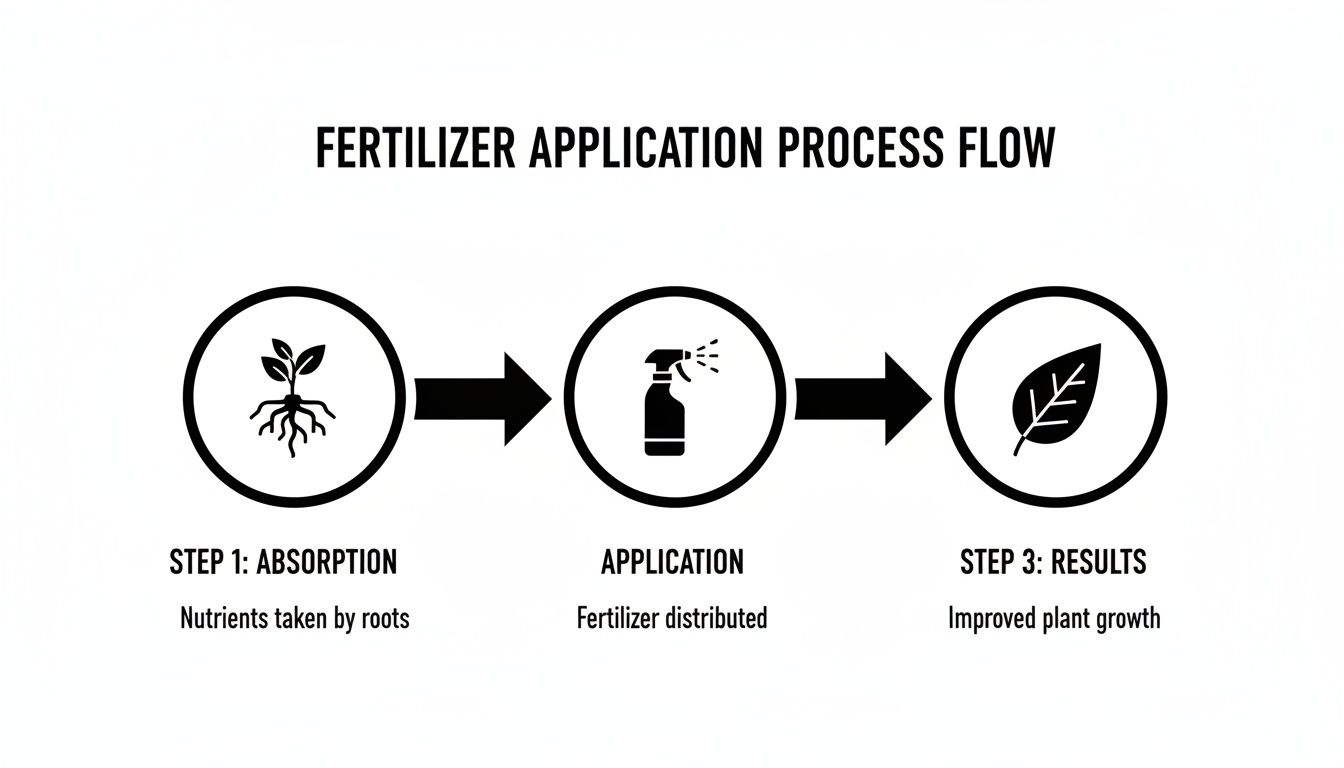
This visual really nails it: a proper application is what connects the product's potential (absorption) to the beautiful results you want.
So, let's put it all together. You've already figured out how much concentrate you need. Now, you’ll mix it with water. The amount of water is less about a rigid formula and more about being a carrier for the fertilizer.
A good rule of thumb is to use one gallon of water for every 1,000 sq ft. For that same 5,000 sq ft lawn, you’d mix your 30 ounces of concentrate into 5 gallons of water. For best results, it's always wise to know what's going on with your soil first. If you're curious, you can learn more about how to test soil pH in our guide, which can make your fertilizer work even better.
When it's time to spray, walk at a steady, even pace. Go back and forth across your lawn, slightly overlapping each pass to avoid stripes. The goal is to evenly coat the grass blades until they are wet, but not to the point where you have puddles forming. If you really want to geek out on the science, this piece on understanding fertilizer NPK ratios and liquid formulas is a great read.
And remember, safety first. Always wear gloves and eye protection when you're handling the concentrate. A little splash in the eye is no fun. By following these simple steps, you'll be applying liquid fertilizer with the confidence of a pro, well on your way to that lush, green lawn you've been dreaming of.
Getting the Timing Right in the Atlanta Metro
Here in North Georgia, a truly great lawn comes down to one thing: feeding your grass exactly when it's hungry. Our unique climate, with its blazing hot summers and fairly mild winters, means our lawns have a rhythm all their own. Applying a concentrated liquid fertilizer for lawns at the right time works with that natural cycle, not against it, giving you a vibrant lawn from the first hints of spring all the way to winter dormancy.
Timing really is everything. Spreading fertilizer on a dormant lawn in January is just throwing money away. On the other hand, skipping that crucial fall feeding can leave your turf weak and unprepared for the cold. When you sync up your applications with the seasons, you're giving your grass the right fuel to tackle the specific challenges of the year, whether it's the brutal summer sun in Alpharetta or the first frost up in Cumming.
The Early Spring Kickstart
Once the soil starts to warm up, usually around March and April, our warm-season grasses like Bermuda and Zoysia begin to stir. This is your first—and maybe most important—chance to feed the lawn for the year. A well-timed application now gives the turf a much-needed jolt of nitrogen, which is what fuels that beautiful deep green color and vigorous growth.
This initial feeding helps the grass shake off any winter stress and quickly build a thick, dense canopy. Why does that matter? A dense lawn is its own best defense, literally choking out early-season weeds like crabgrass before they ever get a chance to sprout.
You can think of this first application like a strong cup of coffee for your lawn after a long winter's nap. It jumpstarts everything, giving your lawn in Alpharetta or Johns Creek a head start on the season so it looks amazing by the time you're ready to fire up the grill.
Summer Feedings to Beat the Heat
Let's be honest: summer in the Atlanta metro is tough. The combination of intense heat and often sporadic rain puts a ton of stress on our lawns. A common mistake is to stop fertilizing altogether, but the right kind of summer application is actually key to building resilience.
The goal isn't to force a lot of new growth. Instead, summer liquid feedings should focus on balanced nutrients that strengthen the root system and improve stress tolerance. This helps your lawn manage water more efficiently during dry spells and makes it better at fighting off common summer diseases. A well-fed lawn will bounce back much faster once the cooler, wetter weather of late summer finally rolls in.
A Fall Application for Winter Prep
Your last big feeding of the year, which typically happens around September or October, is all about getting your lawn ready for the months ahead. As the top growth naturally slows down, the grass puts its energy into its roots. A fall fertilizer application supports this vital process, encouraging deep, strong root growth that will sustain the plant through its dormant period.
This feeding is really an investment in next year’s lawn. Strong roots developed in the fall mean your grass will be healthier and green up much quicker come spring. We're also seeing more homeowners embrace modern fertilizer options that make this process easier. For example, slow-release formulas are a fantastic choice, offering convenience and safety. They require fewer applications, significantly reduce the risk of fertilizer burn, and minimize nutrient runoff—a big plus for environmentally-conscious homeowners in Milton and Forsyth County.
Getting the timing right is a cornerstone of any effective lawn care plan. You can dive deeper into this topic by reading our complete guide on the best times to fertilize lawns.
Creating a Safe Lawn for Kids and Pets

For families here in Cumming, Alpharetta, and all over North Georgia, a lawn is never just grass. It's the backdrop for family photos, the field for a game of catch, and the best place for barefoot summer afternoons. The biggest question we always get is, "How can I have a gorgeous lawn that’s also truly safe for my kids and pets?" This is exactly where choosing the right concentrated liquid fertilizer for lawns becomes so important.
Your peace of mind is everything, and that begins with knowing what you’re putting on your yard. So many lawn treatments come with strict warnings to keep everyone off the grass, but the move toward natural and organic-based solutions is changing that conversation. These products help build a non-toxic environment, so you can feel good about letting your kids and pets play freely.
This isn’t just a local trend, either. It’s a huge shift we're seeing everywhere. The market for natural and organic lawn fertilizers is exploding and is projected to reach USD 10.2 billion by 2032. That number really shows a powerful change in what people want, especially in family-centric communities like Milton and Forsyth County, where health and safety are a big deal. You can read more about this growing demand for natural lawn care solutions to see how it’s reshaping the entire industry.
Re-Entry Times and Keeping Your Family Safe
One of the first questions parents and pet owners ask is about "re-entry time"—how long they have to keep everyone off the lawn after we treat it. With traditional chemical fertilizers, that waiting period is a must to prevent skin irritation or accidental ingestion.
But when you choose a natural, organic-based liquid fertilizer, the rules are much more relaxed. The main thing is to just wait until the product has completely dried on the grass blades. On a warm, sunny Georgia day, this can be as quick as a few hours.
Here's a pro tip we always share: To be extra cautious, wait until the lawn has been watered (either by rain or your sprinkler) and has dried again. This washes any remaining product off the grass blades and into the soil where it belongs, creating the safest possible playground.
Why Proper Dilution is the Key to Safety
With any concentrated product, getting the dilution right is your single most important safety step. Mixing it too strong can be harsh on your grass and could irritate sensitive paws or skin. Following the label directions isn't just about getting a greener lawn; it’s about making sure the final spray is gentle and safe.
Think about it this way:
- Correct Dilution: You get a perfectly balanced nutrient mix that feeds the soil and grass without being aggressive.
- Incorrect Dilution: You risk "fertilizer burn" on your lawn and end up with a mixture that’s much stronger than it needs to be.
This is why we always stress the importance of measuring your lawn's square footage and the fertilizer concentrate with care. It takes the guesswork out of the process, ensuring you’re applying a product that is both incredibly effective and completely family-friendly. By focusing on natural ingredients and proper techniques, you can have a lawn that’s not just beautiful, but a genuine safe space for everyone you love. To dive deeper, take a look at our complete guide on creating a pet-safe lawn treatment plan.
Got Questions About Liquid Fertilizer? We've Got Answers.
We've walked through the what, why, and how of liquid lawn fertilizers, but I know you probably still have a few questions rolling around. That’s completely normal. Let's tackle some of the most common things we hear from homeowners right here in North Georgia, from Cumming to Alpharetta. These aren't textbook answers; this is advice straight from years of dealing with our local clay soil and unpredictable weather.
My goal here is to give you clear, confident answers for the real situations you’ll run into. This way, you can feel good about the choices you're making for your lawn.
Can I Use Liquid Fertilizer During a Georgia Drought?
This is a big one, especially with our notoriously hot and dry summers in Forsyth and Fulton counties. As a general rule, you really want to avoid pushing a dormant, heat-stressed lawn to grow. It's like asking someone to run a marathon when they're already exhausted—it just causes more stress.
That said, a light, properly diluted application of a natural liquid fertilizer can be beneficial. Think of it less as a heavy meal and more as giving your lawn some essential electrolytes. It provides key nutrients without forcing a bunch of new growth the grass can't support. The trick is to water it in deeply, always following any local watering restrictions. Applying it in the cool of the early morning is best, as it cuts down on evaporation and lets the roots soak it all in.
If your lawn is completely brown and crunchy underfoot, your best bet is to just wait. Hold off on fertilizing until the weather breaks and we get some rain.
How Long Until My Kids and Pets Can Play on the Lawn?
This is usually the very first question I get from families, especially in neighborhoods across Milton and Johns Creek. With most natural liquid fertilizers, the simple answer is to wait until the product has completely dried on the grass. On a warm, sunny day, this might only take a couple of hours.
For total peace of mind, we always tell our clients to wait a full 24 hours, or at least until after the next watering cycle (and the lawn has dried again). This ensures any lingering residue is washed down into the soil, leaving the safest possible surface for bare feet and curious paws.
Always take a quick glance at the product label for its specific re-entry instructions, as they can differ. When you work with a pro service like Barefoot Organics, we make sure to give you crystal-clear guidance so your family’s safety is never a question.
Will Liquid Fertilizer Stain My Driveway in Alpharetta?
Yes, it absolutely can. Many liquid fertilizers, particularly those with iron to give you that deep, rich green color, will leave rust-colored stains on concrete, pavers, and stone. It’s a common headache, but thankfully, it's also completely avoidable.
Prevention is everything here. Be mindful during application and try not to overspray onto your hardscapes. If you do get some on your driveway or patio, rinse it off with a hose immediately. Don't let it sit and dry. A quick spray of water right then and there will save you from a whole lot of scrubbing later on. Our technicians are trained to use specific techniques, like spraying inward from the edges, to protect your property from any staining.
What Is the Best Sprayer for Applying Liquid Fertilizer?
Having the right tool for the job makes a world of difference in your results. You're basically looking at two main options: a hose-end sprayer or a pump sprayer.
- Hose-End Sprayer: This is the kind you screw right onto your garden hose. It mixes the concentrate with water automatically as you spray. It’s a real time-saver for big, wide-open lawns, but you sacrifice a lot of control.
- Pump Sprayer: This is a tank (often a backpack you can wear) that you pre-mix your fertilizer solution in. You pump a handle to build pressure and then spray. This method gives you far more precision, making it perfect for smaller yards, hitting specific problem areas, and carefully edging around garden beds and walkways.
For most homeowners in our area with typical suburban lawns, a good-quality pump sprayer is the way to go. It gives you the accuracy you need to get even, consistent coverage that looks like a pro did it.
Ready to get a lush, healthy lawn without all the guesswork and harsh chemicals? The team at Barefoot Organics provides expert, natural lawn care designed specifically for our unique North Georgia climate. Get your free online quote today and let us help you create a beautiful, safe outdoor space your whole family can enjoy.