

If you’ve ever bagged up grass clippings after mowing your Cumming lawn or raked fall leaves to the curb, you’re throwing away one of the best resources for your grass. This guide is all about showing you how to build your own compost bin, turning that yard "waste" into the nutrient-rich black gold your lawn is craving. With our compost bin designs plans, you can transform your yard maintenance routine and finally get the lush, healthy grass you want, even on tough Forsyth County soil.
Tired of thin, weak grass? Let Barefoot Organics help. Call today for a free lawn evaluation in Cumming!
Why Composting Matters for Lawns in Cumming, GA
As a homeowner in Cumming, you're familiar with the yearly struggle. Our lawns get scorched by the intense Georgia sun, and the grass struggles to pull a drop of moisture from our dense, red Georgia clay soil. It’s a challenge we see every single day across Forsyth County, from older neighborhoods in Milton to brand-new lawns in Dawsonville.
Composting isn't just about being eco-friendly; it's your most effective strategy for building a resilient lawn that can handle our local climate. You're not just getting rid of waste—you're fundamentally changing the ground your turf grows in for the better.
Breaking Up That Stubborn Georgia Clay in Cumming
Let's be honest, the biggest hurdle for any lawn around here, from Alpharetta to Suwanee, is soil compaction. That heavy red clay packs down like a brick, choking out grassroots and preventing water from getting where it needs to go.
When you topdress your lawn with finished compost, you're mixing rich organic material directly into the soil. This physically breaks up the compacted clay, creating crucial air pockets that improve drainage and give roots the space they need to grow deep and strong.
Surviving Cumming's Summer Heat and Drought
A healthy lawn is one that can handle stress. The brutal combination of 90+ degree heat and high humidity in a Cumming summer can cook a weak lawn in a hurry, especially our popular fescue varieties.
Think of compost as a natural sponge for your soil. It dramatically increases how much water the ground can hold. A lawn treated with compost will retain moisture far longer, making it tougher during those dry spells that always seem to follow our heavy spring rains. For you, this means less watering and a lawn that stays green right through the hottest part of the year.
A Natural Defense Against Local Lawn Problems in Cumming
Healthy, living soil gives your turf the strength to fight back against common North Georgia problems. We see the proof in our work across Johns Creek, Buford, and the surrounding North Atlanta areas all the time.
A robust soil ecosystem, fueled by compost, helps suppress common issues:
- Brown Patch Fungus: This disease loves stressed, overly wet turf. The improved drainage you get from compost is a great preventative measure.
- Armyworm Infestations: Pests tend to do the most damage to weak, struggling grass. Healthy turf is simply less vulnerable.
- Weed Pressure: Thick, dense grass, fed by healthy soil, naturally crowds out weeds like crabgrass before they can take hold.
Knowing what to put in your pile is just as important. Learning the benefits of using mulch for compost can take your soil-building game to the next level. In the next section, we’ll dive into the step-by-step compost bin designs, but it's crucial to first understand why this is the foundation of a true 'Barefoot' lawn.
What Compost Bin is Right for My Cumming Home?
Before you pick up a hammer, the most important decision is choosing the right kind of compost bin for your North Georgia yard. The perfect setup for a big, leafy property out in Dawsonville won’t work for a brand-new home with a smaller yard in a Suwanee subdivision. People get excited, build a bin, and then realize it’s totally wrong for their space or lifestyle.
Let's skip the generic advice. We're going to focus on what actually works for homeowners right here in Forsyth County and the surrounding areas.
What to Consider for Your Cumming Home
Answering these questions honestly will save you headaches and help you avoid building a bin that’s too small for all your grass clippings or an eyesore your HOA will shut down.
How big is your yard, and how much "green stuff" do you have? Think realistically about the volume. A half-acre lot in Canton with mature oak trees will generate a mountain of leaves every fall, which calls for a high-capacity system. On the other hand, a smaller fescue lawn in a Johns Creek subdivision will produce far less.
What will the neighbors (and the HOA) think? Many of our subdivisions in Cumming and Alpharetta have strict rules about what you can have in your yard. A rustic, open-air pallet bin might be a no-go. A tidy, enclosed tumbler, however, usually gets a pass because it keeps things contained and out of sight.
How much work are you willing to put in? Your level of commitment matters. Some designs, especially hot-composting methods, need regular turning and attention to produce finished compost quickly. Others are a "set it and forget it" approach, but you'll be waiting a lot longer for that black gold.
Are pests and pets a concern? Our warm, humid Georgia climate can be an open invitation for critters. If you're near a wooded area in Buford or Sugar Hill, a secure, critter-proof design with a locking lid is non-negotiable. This is doubly true if you have curious dogs or small children.
A Quick Tip from Experience: Don't ever underestimate how many grass clippings a healthy Bermuda lawn churns out during a Forsyth County summer. It’s always better to build your bin a little bigger than you think you need. For most local yards, a bin that’s at least 3x3x3 feet is a solid starting point.
Compost Bin Designs Compared for North Georgia Yards
To make the choice a bit easier, we've laid out the most common DIY compost bin designs and how they stack up for local homeowners.
| Bin Design | Estimated Cost | Ideal Yard Size | Compost Speed | Best For… |
|---|---|---|---|---|
| Simple Pallet Bin | $0 – $50 | Medium to Large | Slow to Medium (4-12 months) | Large volumes of leaves and grass clippings; homeowners on a budget in areas like Dawsonville. |
| Wire Mesh Bin | $20 – $40 | Small to Medium | Medium (3-9 months) | A quick and easy setup in smaller yards or new construction lots in Cumming with limited space. |
| Enclosed Tumbler | $100 – $300+ | Any size | Fast (1-3 months) | HOA communities in Johns Creek or Alpharetta; folks who want a tidy look with less manual turning. |
| High-Speed (Berkeley) Bin | $50 – $100 | Medium | Very Fast (18-30 days) | Serious gardeners who want compost now and are willing to manage the process closely. |
Each of these compost bin designs serves a specific purpose. The humble pallet bin is a workhorse for big properties, while a simple wire mesh bin is a fantastic, low-cost option for smaller spaces. If you need fast results or have to keep the neighbors happy, a tumbler or a more intensive system like the Berkeley method is probably your best bet.
Building The Simple Pallet Compost Bin In Cumming
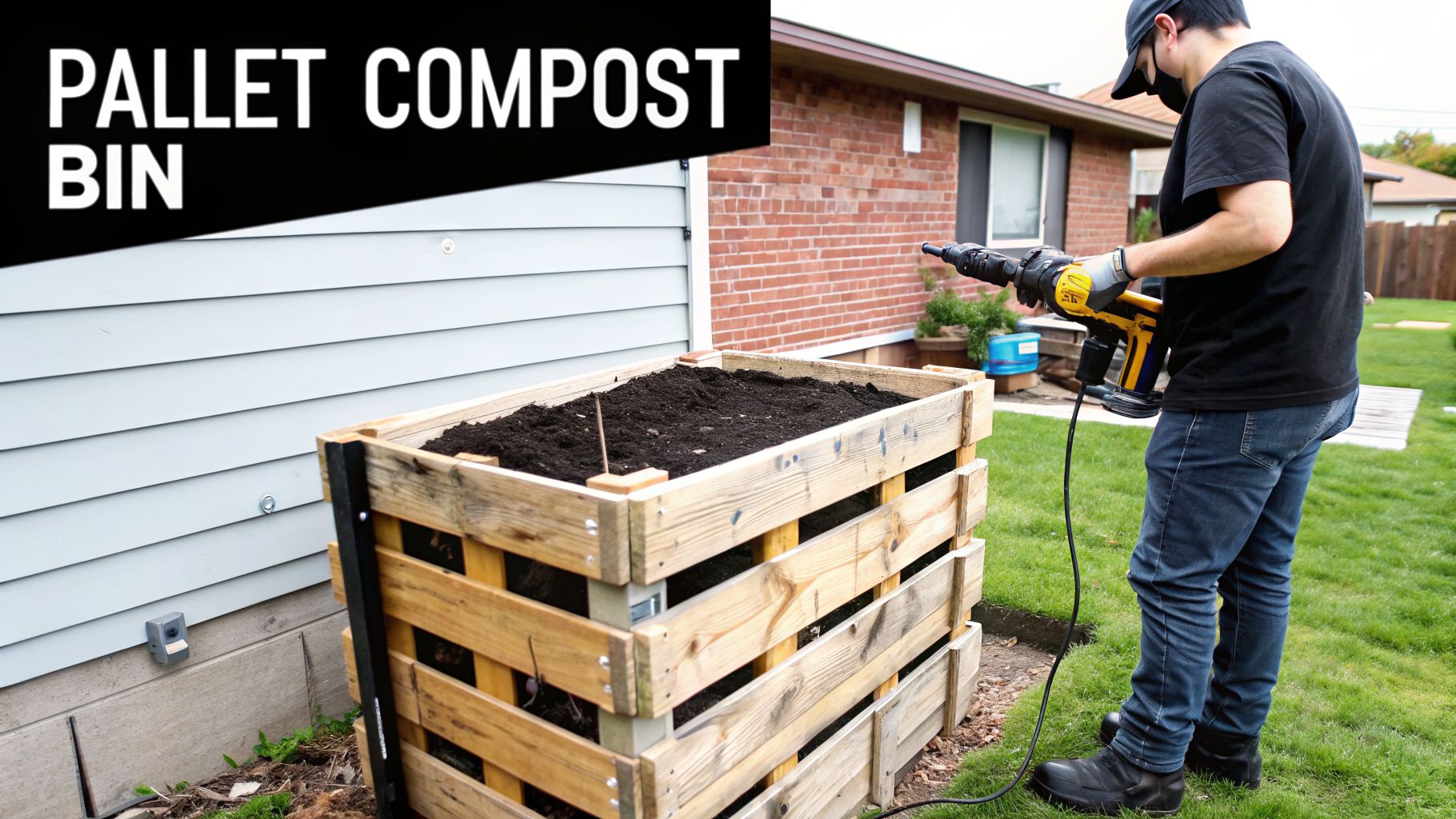
If you need a workhorse compost bin that costs next to nothing and can swallow a mountain of leaves and grass clippings, the pallet bin is your best friend. There's a reason it’s the most popular choice here in Forsyth County—it’s big, tough, and you can have it built and ready to go in a single afternoon.
This is the perfect project for homeowners in Cumming with larger lots, especially if you have mature oak trees dropping tons of leaves every fall. The generous size is ideal for managing the sheer volume of yard waste that a healthy Bermuda or fescue lawn produces.
Materials and Tools You'll Need
The real beauty of this design is its simplicity. You won't need a complicated cut list or a special trip to the hardware store; most of us have what we need already sitting in the garage.
Materials List:
- 4-5 identical wood pallets: Make sure you find ones stamped with "HT" for heat-treated. Avoid any marked with "MB" (methyl bromide).
- Fasteners: A box of 3-inch deck screws will give you the sturdiest build. For a lightning-fast assembly, heavy-duty outdoor zip ties work surprisingly well.
- Optional: A couple of fence U-posts can add extra stability, which is handy if your yard has a bit of a slope.
Tool List:
- Work gloves
- Power drill (if you're using screws)
- Tape measure
- Level
Sourcing Free Pallets in the Cumming Area
Finding free pallets around Cumming, Suwanee, or Buford is much easier than you might think. Lots of local businesses are just happy to see them go. Your best bets are garden centers, small hardware stores, and businesses in local industrial parks. Just be sure to always ask for permission before you take them.
Local Pro Tip: Try driving through the industrial areas off GA-400 in Cumming on a weekday afternoon. Politely ask a manager if they have any spare, untreated pallets you could take. More often than not, they’re glad to give them away.
Putting Your Pallet Bin Together
This isn't fine woodworking; you're just building a simple, sturdy box.
Find the Right Spot
First, pick a level spot in your yard. In our Georgia climate, this next part is crucial: find a place with partial shade. Full sun will bake your compost pile bone-dry during the summer, stalling everything. Also, make sure it has good drainage. You don't want a heavy rain turning your bin into a swamp on our dense clay soil.
Build the Walls
Start by standing one pallet on its edge—this is your back wall. Next, position two more pallets at 90-degree angles against the ends of the back one to form the sides.
Secure the Corners
Now, connect the corners. If you're using screws, drive at least three into each corner joint for a solid hold. If you're using zip ties, loop several at the top, middle, and bottom of each corner to keep it from wobbling.
Add a Front Gate
Your fourth pallet serves as a removable front gate. You can attach it loosely with zip ties or bungee cords, which makes it easy to open when you need to turn the pile. For a fancier setup, you can attach it with a pair of gate hinges.
And just like that, your compost bin is ready for action.
Starting Your First Pile
With the bin built, it's time to start layering. Kick things off with a thick layer of "browns" on the very bottom—think shredded leaves, twigs, or torn-up cardboard. This creates airflow. On top of that, add a layer of "greens," like grass clippings from your lawn or kitchen scraps.
Keep alternating layers, aiming for a rough 2:1 ratio of browns to greens.
Backyard composting is more than just a hobby; it’s a huge part of modern waste management. The amount of yard trimmings composted by homeowners has jumped from 12% in 1990 to over 63% by 2026. That year alone, Americans composted 22.3 million tons of yard trimmings, turning what was once landfill-bound waste into black gold for our gardens. You can read more about these composting trends from the EPA.
Building the Super-Efficient Wire Mesh Composter
For a lot of folks with smaller yards in Cumming or those new-build lots in a Suwanee subdivision, finding the right compost bin can feel like a challenge. That’s where the wire mesh design comes in—it’s probably the most practical, no-fuss option you can find. It goes up in minutes, takes up very little space, and barely costs anything to make.
I especially recommend this style for anyone with fescue lawns in Canton. You’ll have less yard waste than the Bermuda grass folks, so a huge, bulky bin is just overkill.
What makes this simple cylinder so effective is the incredible airflow. The open mesh lets oxygen get to every part of the pile, which is the single most important factor for fast decomposition. That constant circulation also keeps things from getting soggy and smelly, a real lifesaver during our humid Georgia summers. If you're in Alpharetta and want to compost without it becoming an eyesore, this little bin can be tucked away in a corner and practically disappear.
Materials and Tools for Your Wire Mesh Bin
The beauty of this project is its simplicity, and that goes for the shopping list, too. You only need a couple of things, making this a perfect project you can knock out in under an hour.
Materials List:
- A roll of 1/2-inch hardware cloth that’s about 3-4 feet tall. A 10-12 foot length is a great starting point, giving you a bin that’s roughly 3-4 feet in diameter.
- A handful of carabiner clips or heavy-duty zip ties to hold it all together.
Tool List:
- Heavy-duty work gloves (seriously, the cut wire is sharp!)
- Wire cutters or a pair of tin snips
- Tape measure
That’s it. No saws, no drills, no lumber. It doesn't get much more straightforward than this.
Putting Your Cumming-Ready Composter Together
You’ll have this bin built in less time than it takes to drink a cup of coffee. Just be sure to handle that hardware cloth with care.
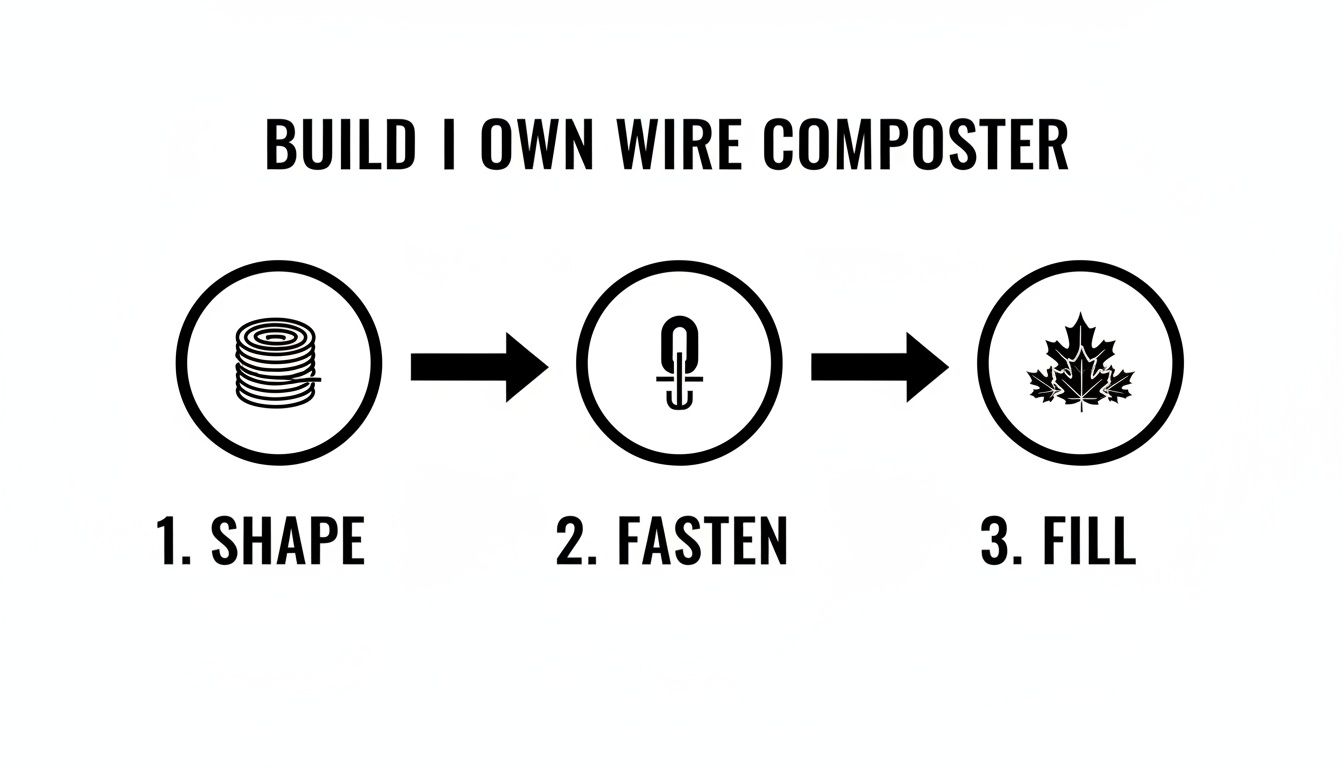
First, figure out how wide you want your bin. For a typical yard here in Cumming, a diameter of about 3 feet is perfect. That’s big enough to build up some good heat but still small enough to handle without a struggle. To get that size, unroll and cut a piece of the hardware cloth that’s about 9.5 feet long.
With your gloves on, gently bend the wire into a cylinder. You’ll want to overlap the two ends by a few inches to make it sturdy.
Now, just fasten the ends together. Use three or four carabiners or zip ties, spacing them out from top to bottom, to lock the cylinder in place. I’m a big fan of using carabiners—they make turning the pile, which we'll get to next, incredibly simple.
Local Pro Tip: Always set up your new bin on bare earth, never on concrete or a deck. This direct contact with the ground lets all the beneficial microbes and earthworms from our native Georgia soil migrate up into your pile and kickstart the composting process.
The Easiest Way to Turn Your Compost Pile
"Turning" compost is just mixing it up to get oxygen in, but let's be honest, it can be a back-breaking job. This wire mesh setup has a brilliant shortcut that our clients in Forsyth County absolutely love.
Forget about the tedious work of forking everything out and back into the same bin.
Instead, when it's time to turn the pile, you just:
- Unclip the carabiners or snip the zip ties holding the cylinder together.
- Lift the entire wire mesh cage off the pile and set it down right next to it.
- Then, simply use a pitchfork or shovel to move the compost materials from the old pile back into the empty cylinder.
This quick flip automatically puts the less-decomposed outer layers into the hot center of the new pile. It’s an incredibly effective way to aerate and mix everything without the usual sweat and strain, making compost maintenance far less of a chore. Because it's so lightweight and easy to manage, it's also a perfectly safe choice for yards where kids and pets in places like Milton and Johns Creek are always running around.
Want Compost Fast? The Berkeley Method Bin Delivers
If you're serious about your garden here in Cumming and can't stand the thought of waiting months for compost, this is the system for you. We’re talking about the Berkeley method, the gold standard for getting rich, finished compost on an incredibly tight timeline.
This isn't your lazy, "set-it-and-forget-it" pile. It's a high-speed, active approach designed for folks in Forsyth County who need a large volume of top-tier soil amendment, and need it now. While most methods drag on for months, the Berkeley hot composting technique can give you beautiful, usable compost in as little as 18 to 21 days. That’s fast enough to prep your beds for spring planting or give your fall garden a powerful late-season boost.
Building the bin itself is surprisingly simple. You're essentially just creating a container to hold the magic.
The real key to success with the Berkeley method isn't the bin, though—it's what you do with it.
The Secret Sauce: Getting Your Pile Hot
The magic behind this rapid composting is heat. The entire goal is to build a pile that cooks at a consistent 130°F to 160°F. This intense heat is what supercharges the decomposition process while handily killing off pesky weed seeds and pathogens. Think of it less like a trash pile and more like a managed biological furnace.
To hit those temperatures in our local climate, whether you're in Alpharetta or Dawsonville, you absolutely need three things: size, the right ingredients, and a commitment to turning the pile.
- Size is Everything: Your pile must be at least 3 feet wide, 3 feet long, and 3 feet tall. Anything smaller just won't have the mass to generate and hold onto the heat it needs.
- The Perfect Recipe: You’re aiming for a carbon-to-nitrogen (C:N) ratio of about 30:1. In simple terms, that means a lot more "browns" (like dried leaves and shredded cardboard) than "greens" (fresh grass clippings and kitchen scraps).
- Get Ready to Work: This is an active system. You'll need to stick to a strict turning schedule to keep the pile aerated and cooking all the way through.
Assembling Your High-Speed Berkeley Bin
The bin is the easy part. You can use old wood pallets or a roll of wire mesh to create a simple cube. The most important rule is to meet that minimum one-cubic-yard (3x3x3 feet) size.
A lot of seasoned gardeners I know in Johns Creek and Milton actually build two or three bins right next to each other. This makes turning a breeze—you just use a pitchfork to move the material from one bin into the empty one next to it.
My Biggest Piece of Advice: Shred all your materials before they go in the pile. I can't stress this enough. Running your leaves and small twigs through a shredder (or even just going over them a few times with a lawnmower) massively increases the surface area. This gives the microbes more to feast on and dramatically speeds everything up.
The All-Important Turning Schedule
Here’s where your dedication really pays off. You can't just build this pile and walk away. Once you've gathered all your materials and built your pile, the clock starts ticking.
First, let the brand-new pile sit undisturbed for about four days. This initial phase is crucial for letting the core temperature climb to its peak.
Then comes the active part. Starting around day five, you need to turn the pile every two days without fail. This is the non-negotiable step. Turning injects fresh oxygen for the aerobic bacteria and cycles the cooler outer layers into the hot center, ensuring everything breaks down evenly.
After your final turn around day 18, the pile will naturally start to cool down. Let it sit and "cure" for another week or so. When your compost is dark, crumbly, and has a rich, earthy smell, you've done it.
This method, first developed back in the 1950s, was a true game-changer, cutting compost production time from months to under three weeks. It's the same principle property managers use to divert huge amounts of organic waste from landfills. As a bonus, amending soil with good compost can also slash landscape water needs by up to 30%. If you're curious about the science, you can learn more about the history and science of composting methods online.
Why Choose Barefoot Organics in Cumming?
Building your own compost bin is a brilliant move, but the real payoff comes when you combine that amazing homemade compost with a professional lawn care program. Think of it this way: your compost is building incredible, living soil from the ground up, while our Barefoot Organics treatments are delivering the precise, targeted weed control and fertilization your lawn needs to flourish here in Cumming.
When you put the two together, the results are more than just doubled. They amplify each other, creating the kind of healthy, resilient turf that can handle our hot Georgia summers and tough clay soil.
The Ultimate Follow-Up to Core Aeration
One of the absolute best uses for your finished compost is topdressing—spreading a thin, even layer across your lawn. The perfect time to do this? Right after we've performed a core aeration service.
When our aerator pulls up thousands of small soil plugs, it opens up direct channels to your lawn's root system. Shoveling your fresh compost across the lawn right then and there lets all that rich organic matter fall directly into those holes. For the dense, red Georgia clay we see all over Forsyth County, from Cumming to Alpharetta, this is a game-changer.
- It physically breaks up compacted soil, improving its structure permanently.
- It creates lasting pathways for air, water, and vital nutrients to get to the roots.
- It gives the turf's root system a nutrient-rich, looser environment to expand into.
Honestly, a post-aeration topdressing is one of the fastest ways to transform that packed clay into the healthy, living soil you need for a truly lush lawn.
Giving Your Fertilizer a Helping Hand
While your homemade compost is a goldmine of organic matter, it’s not a complete fertilizer on its own. The best way to think of it is as a powerful supplement that makes our custom-blended fertilizer and weed control treatments work even better.
The organic matter in your compost acts like a natural sponge. It grabs onto the nutrients we apply and holds them in the root zone, preventing them from just washing away in the next downpour.
This means your grass gets more mileage out of every single treatment. With better soil structure, the turf can absorb nutrients far more efficiently, leading to that deep green color, better thickness, and stronger defenses against local headaches like brown patch fungus and crabgrass.
Your compost pile is the long-term investment in your soil's future. Our program provides the balanced nutrition and weed control that delivers immediate health and fantastic curb appeal. You can learn more about the specifics of this process in our guide on using compost for lawns in North Georgia.
While your compost works its magic from below, let our team handle the rest. Call Barefoot Organics in Cumming today for a free lawn evaluation and see how our programs can work hand-in-hand with your composting efforts.
FAQ: Top Composting Questions in Cumming, GA
Getting started with composting in Forsyth County always brings up a few common questions. From our sticky summer humidity to dealing with stubborn local weeds, here are the straightforward, practical answers we give homeowners every day.
Q: What should I never put in my Georgia compost bin?
A: In Cumming, you should never add meat, bones, dairy, or oily foods to your bin. Our warm, humid climate makes these an open invitation for pests and bad odors. Also, avoid adding diseased plants, like those with brown patch fungus, or invasive weeds like nutsedge, as your pile may not get hot enough to kill them completely.
Q: My compost pile stinks! How do I fix it in this humidity?
A: A smelly pile in our North Georgia humidity usually means it's too wet and needs air. The fix is to turn it thoroughly with a pitchfork and mix in plenty of "browns" like shredded leaves, torn cardboard, or wood chips. These dry, carbon-rich materials will absorb excess moisture and restore balance, eliminating the odor.
Q: When is the best time to start a compost pile in Cumming, GA?
A: While you can start anytime, fall is the ideal season in Cumming. You'll have an abundance of fallen leaves ("browns") to balance out grass clippings and kitchen scraps. Starting in fall allows the pile to break down over winter, giving you rich, finished compost by spring, just in time for your lawn and garden.
Q: Is compost safe for my Bermuda or Fescue lawn near me?
A: Yes, compost is one of the best things you can do for Bermuda and fescue lawns in North Georgia. Spreading a thin 1/4 to 1/2 inch layer after a core aeration service adds vital organic matter to our clay soil. This improves water retention, helping your lawn better survive the summer heat and drought stress common in Cumming.
Q: I live in a strict HOA in Cumming. What's the best compost bin?
A: For homeowners in Cumming, Johns Creek, or Alpharetta with strict HOA rules, an enclosed compost tumbler is your best choice. They are neat, fully contained, and don't attract pests or create odors. Their tidy appearance almost never violates subdivision rules, allowing you to compost without any issues with your neighbors or HOA.
For more in-depth educational resources on soil health, check out more articles in our composting knowledge center.
Ready to pair your home composting efforts with a professional lawn care program that truly gets North Georgia’s soil? The team at Barefoot Organics is here to help you build the healthy, beautiful lawn you've always wanted.