

When you're searching for the best slow-release fertilizer, you're really looking for something that feeds your lawn steadily over several months. The best options prevent chemical burns and stop valuable nutrients from washing away. For families in Cumming and the surrounding areas with kids and pets, natural organic options are a fantastic choice, as they build up the soil while providing the consistent nourishment your grass needs to handle Georgia's tough climate.
Your Guide to a Lush North Georgia Lawn

Keeping a lawn green and vibrant in places like Cumming, Alpharetta, or Johns Creek can feel like a constant struggle. We’re not just dealing with weeds. We're up against Georgia's stubborn red clay soil, sudden downpours, and blistering summer heat that can cook even the hardiest turf.
It’s tempting to grab a bag of quick-fix, high-nitrogen fertilizer for a fast green-up. But that’s like giving your lawn a shot of caffeine and sugar—you get a jolt of energy, followed by a hard crash that leaves the grass weak and vulnerable. This approach often leads to chemical burns on the blades and nutrient runoff, which means your money literally goes down the drain with the next storm.
A Smarter Approach for Local Lawns
There’s a much better way, and it’s tailored for our unique North Georgia environment: slow-release fertilizers. Think of it less like a quick snack and more like a wholesome, balanced diet for your turf. Instead of one overwhelming dump of nutrients, these products deliver them gradually over weeks, or even months.
This "spoon-feeding" approach builds a stronger, more resilient lawn from the roots up. It promotes deep root growth, which is absolutely essential for surviving the dry spells we see in Milton and Dahlonega. The benefits directly address the challenges we face here:
- Consistent Growth: You get steady, even growth instead of the wild surges caused by fast-release products.
- Reduced Risk of Burn: Your grass is protected from the harsh chemical damage that causes those ugly brown spots.
- Less Nutrient Runoff: More fertilizer stays in your soil and out of our local waterways, like Lake Lanier.
- Stronger Roots: A deep root system helps your lawn stand up to drought and heat stress.
For local families in Cumming, especially those with kids and pets playing in the yard, choosing the best slow-release fertilizer is about more than just looks. It’s about creating a beautiful, safe outdoor space without all the guesswork.
This guide is designed to tackle the problem head-on, showing you why slow-release fertilizer is the key to a healthy lawn that truly thrives. It's your roadmap to building a resilient yard that can handle Georgia’s demanding climate and become the envy of the neighborhood.
How Do Slow-Release Fertilizers Actually Work?
So, what really sets a great slow-release fertilizer apart from the fast-acting stuff you see everywhere? I like to think of it like this: feeding your lawn a quick-release fertilizer is like giving it a candy bar. Sure, you get a sudden, sugary burst of energy—and your lawn gets a quick, often weak, surge of green—but it’s not built to last, especially in Georgia's brutal summer heat.
Slow-release fertilizers, on the other hand, are the balanced, high-fiber meal. They deliver a steady, controlled supply of nutrients over weeks or even months. For homeowners here in Johns Creek and Milton, that means your lawn gets a consistent diet, which is exactly what it needs to build the deep, strong roots and resilient blades to handle our heavy clay soil and humid climate.
The Science Behind That Sustained Meal
Slow-release products don't just dump all their nutrients at once. They rely on some clever mechanisms to meter them out over time, ensuring your grass gets what it needs, right when it needs it. There are two main ways they pull off this "timed-release" feeding.
The first method involves coated synthetic nutrients. Picture each tiny fertilizer granule being wrapped in a special shell.
-
Polymer-Coated Fertilizers: These granules have a thin, semi-permeable plastic resin coating. Soil moisture gradually seeps through this shell, dissolving the nutrient inside, which then slowly diffuses back out to feed your lawn's roots. The release rate is often tied to temperature—warmer soil speeds it up, which perfectly aligns with your grass's most active growing period in Alpharetta.
-
Sulfur-Coated Fertilizers: With these, a layer of sulfur (often with a wax sealant) encases the nutrient pellet. Before water can even get in, microbes in the soil have to break down that sulfur coating. This creates a naturally paced feeding schedule that follows the biological activity in your yard.
This controlled delivery is a huge advantage. It helps prevent the nutrient runoff and chemical burns that are all too common with conventional, fast-release products.
Nature's Own Slow-Release Method
The other major type of slow-release fertilizer relies on a completely natural process. Organic fertilizers—think high-quality compost, bone meal, or poultry litter—don't have any artificial coatings. Instead, their nutrients are naturally locked up inside complex organic molecules.
These nutrients aren't immediately available for your grass to slurp up. First, the vast community of beneficial microbes, fungi, and bacteria living in your soil has to get to work. They slowly break down, or "digest," the organic matter, converting it into simple nutrient forms that the plant roots can finally absorb.
This microbial digestion process is nature’s perfect slow-release system. It does more than just feed the grass; it actively improves the structure of our dense North Georgia clay soil, enhancing its ability to hold onto water and nutrients for the long haul.
This steady, microbe-driven feeding is why organic options are a cornerstone of building a truly healthy, sustainable lawn. And it’s not just a local trend. The global market for controlled and slow-release fertilizers was valued at USD 2.5 billion in 2023 and is expected to nearly double to USD 4.8 billion by 2032, with North America leading the charge in residential use. You can explore more data on this market trend to see just how quickly it's growing.
In the end, whether it’s through a clever engineered coating or a natural microbial process, the goal is identical. The best slow-release fertilizer provides your lawn in Cumming or Dahlonega with a dependable, long-term food source, building a foundation of strong roots and healthy soil instead of just forcing weak, vulnerable top-growth.
Choosing The Right Fertilizer For Georgia's Clay Soil
Picking the best slow-release fertilizer for your lawn in Cumming or Alpharetta isn't about grabbing the biggest, most colorful bag off the shelf. If you want a truly healthy lawn, especially with North Georgia’s infamous red clay, you need to be a bit more strategic. It all starts with figuring out what your lawn is actually hungry for.
Guessing what nutrients your soil is missing is a surefire way to waste time and money. That’s why the single most important first step is a simple soil test. Think of it as a report card for your yard; it reveals the soil's pH level and pinpoints which key nutrients—nitrogen, phosphorus, and potassium—are in short supply.
Here in our region, from Milton to Dahlonega, acidic clay is the default setting. A soil test will tell you if you need to add lime to balance the pH, which unlocks the nutrients already in the soil so your grass can actually use them. Without this critical piece of information, even the world's best fertilizer will fall flat.
This decision-making guide really nails the difference between a quick, temporary green-up and a long-term, sustainable feeding plan for your turf.
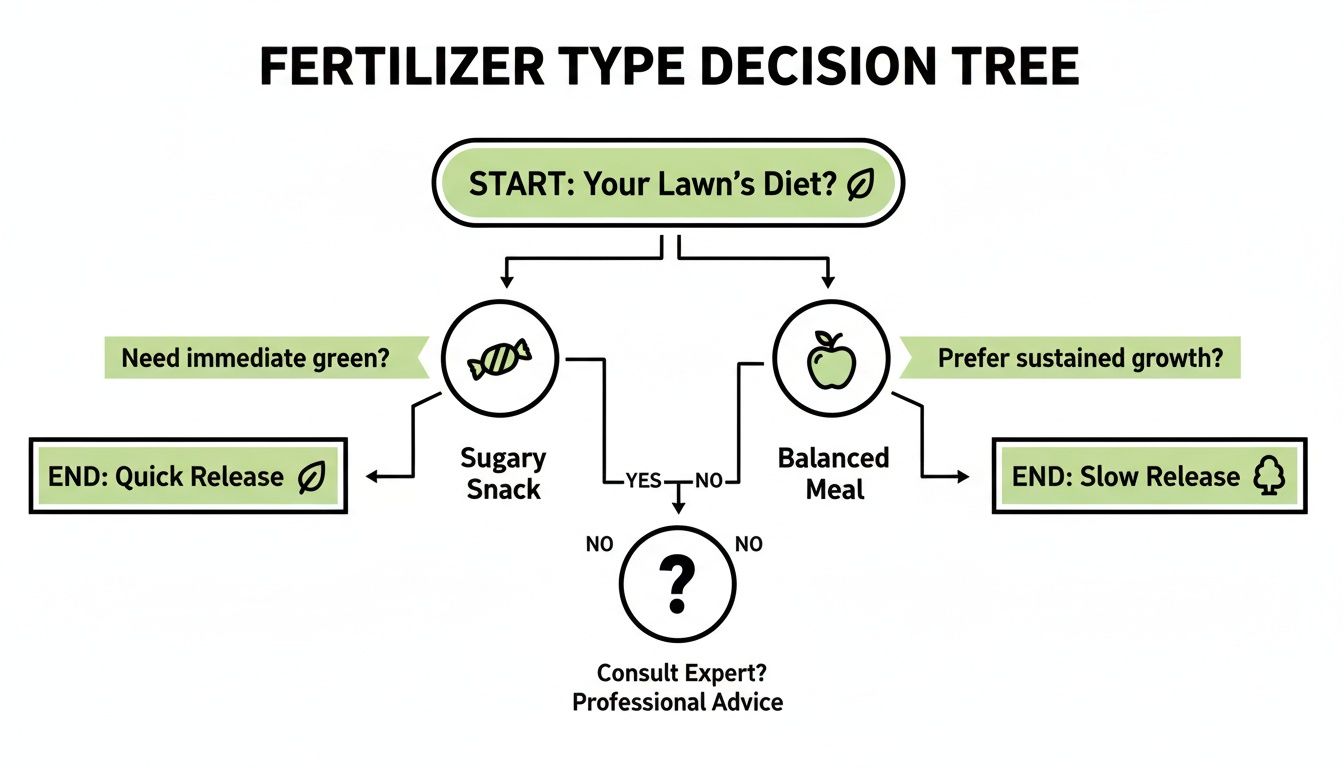
As you can see, quick-release products are like a sugary snack—a fast jolt of energy that quickly fades. Slow-release options, on the other hand, are a balanced meal that provides lasting health and strength.
Reading The N-P-K Ratio Like A Pro
Once you have your soil test results, you can finally crack the code on those three numbers printed on every fertilizer bag: the N-P-K ratio. These numbers simply tell you the percentage of Nitrogen (N), Phosphorus (P), and Potassium (K) inside.
- Nitrogen (N): This is the gas pedal for lush, green growth. For warm-season grasses common in Alpharetta and Cumming, like Bermuda and Zoysia, a steady stream of nitrogen is essential during the hot summer months.
- Phosphorus (P): Think of this as the foundation builder. Phosphorus is all about creating strong, deep roots, which helps your lawn establish itself and power through periods of drought.
- Potassium (K): This is your lawn’s personal trainer and bodyguard. Potassium helps grass handle stress from heat, cold, and disease—an absolute must for surviving Georgia’s wild weather swings.
So, a bag with 10-5-15 on the label contains 10% nitrogen, 5% phosphorus, and 15% potassium by weight. If your soil test shows plenty of phosphorus but a serious need for potassium, you'll know to look for a fertilizer with a higher third number.
Organic Vs. Synthetic Slow Release Options
With your soil report in hand, you’ve arrived at the next major crossroad: do you go with a natural organic fertilizer or a coated synthetic product? Both provide slow-release benefits, but they get there in very different ways, especially when dealing with our local clay.
Deciding between them comes down to your priorities—are you focused on feeding the plant directly, or are you looking to build healthier soil for the long haul?
Comparing Organic vs. Synthetic Slow Release Fertilizers
| Feature | Organic Slow Release (e.g., Compost, Bone Meal) | Synthetic Coated Slow Release (e.g., Polymer-Coated Urea) |
|---|---|---|
| Nutrient Source | Derived from natural plant and animal materials. | Manufactured chemicals, often urea or ammonium nitrate. |
| Release Mechanism | Relies on soil microbes to break down materials and release nutrients. | A physical coating (polymer, sulfur) breaks down over time due to moisture and temperature. |
| Soil Health Impact | Improves soil structure, adds organic matter, and boosts microbial life. A huge plus for clay. | Feeds the plant directly but does not improve the underlying soil structure or health. |
| Nutrient Consistency | Nutrient release can be less precise and varies with soil temperature and moisture. | Highly predictable and consistent nutrient release over a specified period. |
| Risk of Burn | Very low risk of burning the lawn, even with over-application. | Can burn turf if over-applied or if the coating is damaged. |
| Best For | Homeowners focused on long-term soil health, improving clay, and sustainable practices. | Those wanting precise, predictable results and rapid correction of specific nutrient deficiencies. |
While synthetics get the job done efficiently, natural organic fertilizers do more than just feed the grass; they feed the soil itself. Made from things like compost, bone meal, or feather meal, these products require soil microbes to break them down to release nutrients. This biological process is a game-changer for our dense clay, as it naturally improves soil structure over time. If you're tired of fighting compacted soil, our guide on how to improve clay soil for grass dives deeper into building a foundation for a truly resilient lawn.
The real magic of organic options is that they build a more self-sufficient soil ecosystem. It's about creating lasting health from the ground up, not just a temporary green appearance.
Synthetic coated fertilizers, on the other hand, are all about engineering. A special polymer or sulfur coating around each nutrient pellet slowly dissolves, releasing a specific dose of food over a set period. They are incredibly predictable and effective at delivering exact N-P-K ratios.
Matching Release Duration To Georgia Grasses
The last piece of the puzzle is the release duration. Slow-release fertilizers are formulated to last anywhere from 8 weeks to 6 months or even longer. The right one for you depends entirely on your grass type and how hands-on you want to be.
- Warm-Season Grasses (Bermuda, Zoysia): These are the workhorses across Cumming and Alpharetta, growing like crazy from late spring through summer. A 3-month release formula applied in May can carry them perfectly through their peak growing season.
- Cool-Season Grasses (Fescue): For those shady spots in Milton or Johns Creek with Fescue lawns, the main growing seasons are spring and fall. Applying a longer-lasting 6-month formula in the fall can feed the lawn through the winter and give it a powerful head start the following spring.
By aligning the fertilizer's release rate with your grass’s natural growth cycle, you ensure it gets exactly what it needs, right when it needs it. That’s the secret to a thick, healthy, and beautiful lawn all year long.
Applying Fertilizer for a Safe and Healthy Lawn
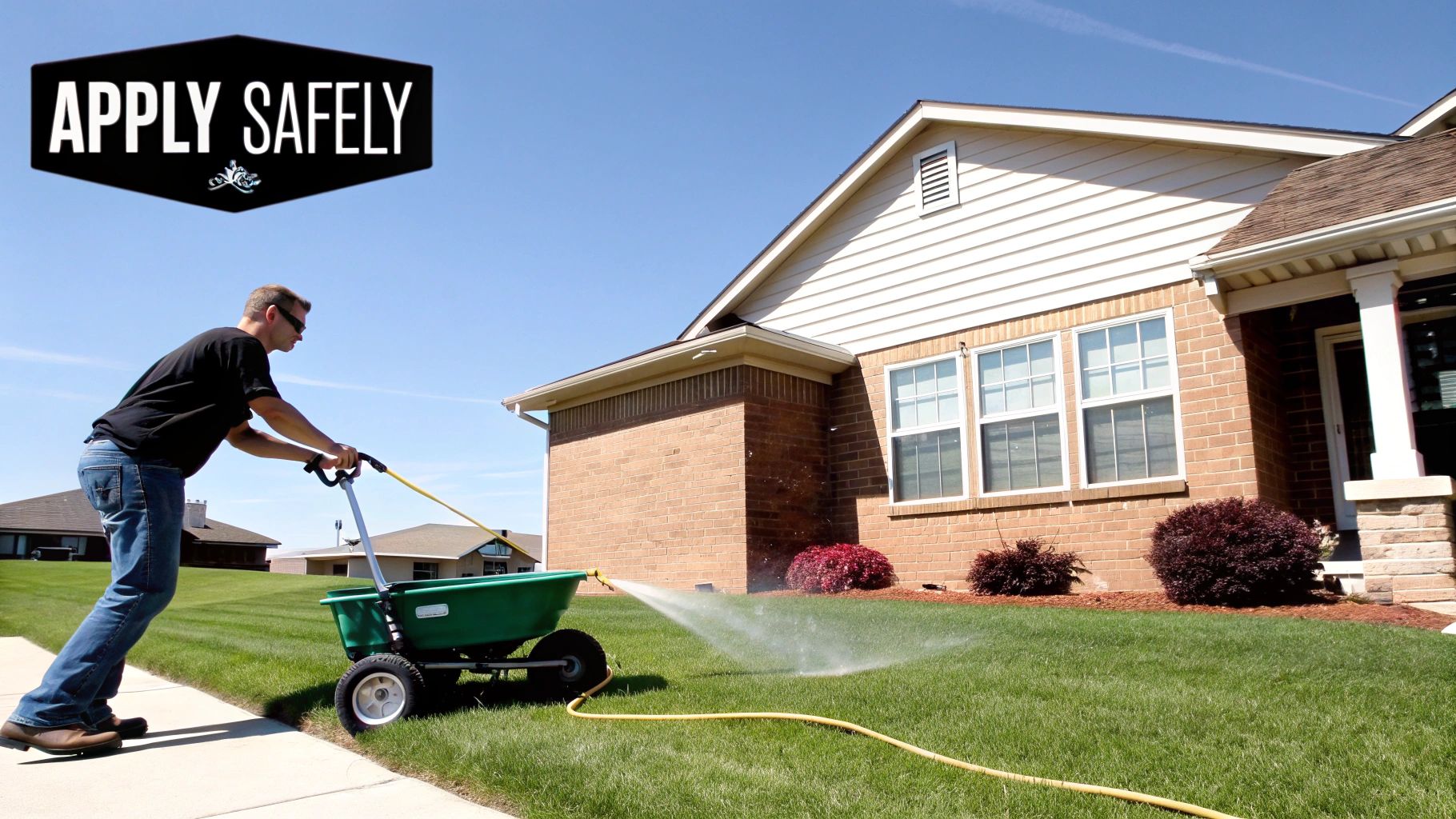
Picking out the best slow-release fertilizer is a fantastic start, but even the perfect product won't do much good if it’s not applied correctly. Getting the application right is about more than just a green lawn; it’s about making your investment count, preventing waste, and keeping your yard safe for your family and pets.
For homeowners all the way from Cumming to Dahlonega, this boils down to two things: timing and technique. Nail these, and you’ll unlock the full potential of that slow-release formula, giving you the lush, vibrant turf you've been picturing.
Timing Your Application for Georgia Grasses
Here in North Georgia, we deal with two main types of turf, and each one operates on its own schedule. Tossing fertilizer on dormant grass is like talking to a sleeping plant—it's just not listening. You need to feed your lawn when it's actively growing and ready for a meal.
- Warm-Season Grasses (Bermuda, Zoysia): These are the stars of a Georgia summer, growing like crazy from late spring through the hottest days. For these lawns, plan on applying your slow-release fertilizer in late spring (May) right as they’re greening up. A second round in mid-summer (July) will give them the stamina to power through the intense heat.
- Cool-Season Grasses (Fescue): Fescue is happiest in milder weather. Its biggest growth spurts happen in the spring and fall. The most important feeding of the year is in the fall (September/October), as this helps it build a robust root system for the year ahead. A follow-up application in early spring (March) will support that initial burst of green.
This targeted approach ensures nutrients are ready and waiting the moment your grass gets hungry, leading to a much stronger and more resilient lawn.
Choosing Your Spreader: Broadcast vs. Drop
The spreader is your tool for the job, and you’ve got two main choices. Each has its own strengths, making one a better fit depending on your yard’s layout.
A broadcast spreader, sometimes called a rotary spreader, is what most homeowners in places like Alpharetta and Johns Creek use. It flings the granules out in a wide arc, making it a fast and efficient way to cover large, open lawns. The trick is to overlap your passes just right to get even coverage without creating stripes or dumping too much along the edges.
On the other hand, a drop spreader does exactly what its name implies: it drops the granules straight down between the wheels. This gives you incredible precision, which is perfect for smaller yards or tricky lawns with lots of flower beds and winding paths. It takes a bit more time and more walking, but it virtually guarantees you won’t accidentally feed your driveway or prized petunias.
No matter which spreader you use, here’s a pro tip: set it to apply half the recommended rate and go over your lawn twice—once in one direction (say, north to south) and the second time in a perpendicular pattern (east to west). This crisscross method is the secret to getting that flawless, uniform green. We dive even deeper into different application methods in our guide on liquid vs. granular fertilizer.
Calibrating your spreader based on the fertilizer bag's instructions is non-negotiable. If your setting is off, you could end up starving your lawn or, even worse, burning it with way too much product.
Simple Steps for a Safe and Effective Application
With your timing down and your tool ready, the last piece of the puzzle is applying the fertilizer safely and cleanly. This is especially crucial for families in Cumming and Milton with kids and pets running around.
- Read the Label: The manufacturer's directions are your best friend. Follow their instructions for application rates and safety measures.
- Clear the Lawn: Before you start, do a quick sweep to pick up any toys, patio furniture, or other obstacles.
- Apply Evenly: Grab your spreader and use that crisscross pattern to get a nice, even distribution.
- Clean Up Spills: If any granules land on your sidewalk, driveway, or patio, sweep them up right away. Fertilizer on hardscapes can easily wash into storm drains and pollute local creeks and rivers.
- Water It In: Give the lawn a light watering after you’re done. This helps activate the slow-release coating and washes the nutrients down into the soil, moving them away from the surface where tiny hands and paws play.
By sticking to these simple but vital practices, you’ll make sure every granule gets to work building a healthier lawn while protecting your family and our beautiful North Georgia environment.
Protecting Your Family and North Georgia Waterways
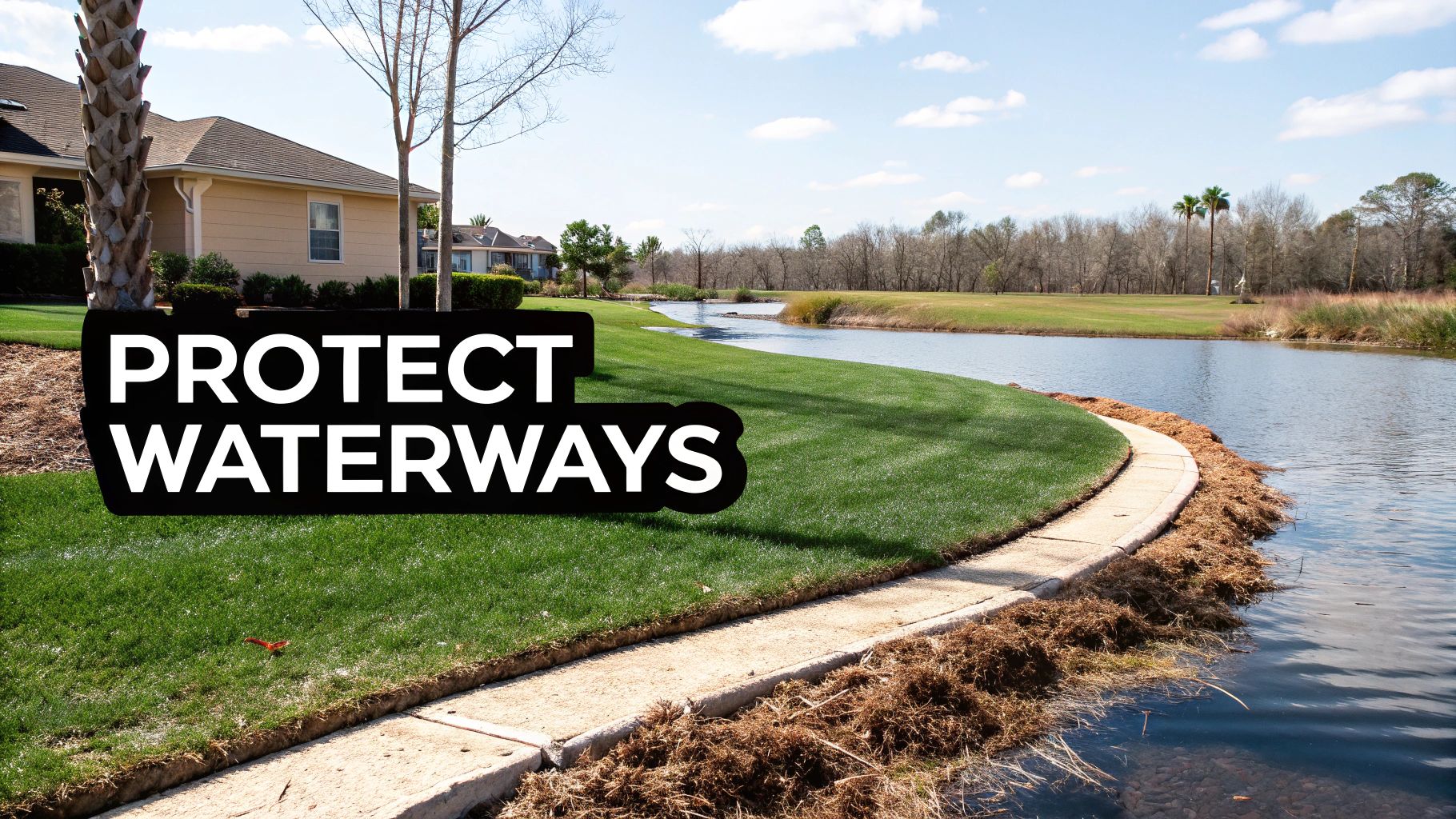
For homeowners all across North Georgia, a truly great lawn is about more than just a deep green color. Families in Cumming, Dahlonega, and Milton are increasingly defining 'best' as safe, sustainable, and responsible. It's about the peace of mind you get when the kids and pets are tumbling around on the grass, and it's about being a good steward of our beautiful local environment.
This is where the right slow-release fertilizer becomes more than just a lawn care choice—it's a commitment to the health of our community. These advanced formulas are one of the most powerful tools we have for protecting the delicate ecosystems of waterways like Lake Lanier and the Chattahoochee River.
Reducing Nutrient Runoff in Our Waterways
Think about what happens when a traditional, fast-acting fertilizer is applied. It dumps a flood of nutrients onto your lawn all at once. The next time a heavy Georgia downpour hits, any nutrients the grass couldn't immediately soak up get washed away, heading straight for storm drains and, ultimately, our local streams and rivers.
This process, called nutrient runoff, can fuel harmful algal blooms that throw the natural balance of aquatic life completely out of whack.
Slow-release fertilizers provide a smart solution. By metering out nutrients over time, they ensure a much higher percentage gets absorbed by the grass roots instead of being carried away by rainwater. This targeted delivery is especially crucial for the sloped yards and dense clay soils so common in Alpharetta and Johns Creek, which are notoriously prone to runoff. In fact, slow-release formulas can improve nutrient use efficiency by 20–40%—a significant reduction in the nitrogen and phosphorus polluting our cherished waterways. More information on the sustainable farming practices driving this trend is available for those curious.
Choosing a slow-release product isn't just a lawn care decision; it's a direct action to help preserve the health and beauty of North Georgia's natural resources for future generations.
Identifying Truly Child-Safe and Pet-Safe Options
Real peace of mind comes from knowing exactly what’s going on your lawn. While plenty of products claim to be "safe," the most reliable way to protect your family is by choosing high-quality, natural organic options.
Here’s a quick guide to what to look for—and what to steer clear of—when you're at the garden center:
- Look For: Ingredients you can actually pronounce, like compost, bone meal, feather meal, and kelp meal. These come from natural sources and work by feeding the soil's microbial life, which then releases nutrients biologically.
- Avoid: Products with vague labels or those that mix in synthetic pesticides or herbicides. While these "weed and feed" products can be effective, the added chemicals can pose unnecessary risks to pets and children.
Organic slow-release fertilizers work with nature, not against it. They build up healthy soil biology, and that healthy soil, in turn, grows a stronger, more resilient lawn. This approach gives you a safe play area for your family without ever having to compromise on that lush, green look.
For a deeper dive into this philosophy, you can explore our complete guide to using natural fertilizer for grass. By prioritizing these responsible products, you can cultivate a beautiful lawn that you and your family can enjoy, worry-free.
Why Expert Lawn Care Makes All the Difference
You can absolutely get a decent lawn with some weekend effort and the right DIY approach. But if you’re after that truly thick, resilient, deep-green turf that stands up to North Georgia's heat, it takes a level of expertise that goes beyond what’s written on the back of a fertilizer bag. All the advice on soil tests, N-P-K ratios, and application timing is the playbook. A professional knows how to call the right plays for your specific yard, all season long.
Think about it: a lawn in Cumming deals with different microclimate pressures than one up in Dahlonega. The compacted red clay in a new Alpharetta subdivision needs a completely different strategy than the established soil in a Johns Creek neighborhood. That’s the gap an experienced pro fills. Real success isn't just about using the best slow release fertilizer; it's about making it part of a complete system that works together.
It's a Comprehensive Approach to Lawn Health
At Barefoot Organics, that’s the core of our philosophy. We build our programs around high-quality, natural slow-release fertilizers because they create healthy soil and deliver steady, reliable nutrition. But that’s just step one. We pair that solid foundation with other essential services that amplify the results.
What does that look like in practice?
- Core Aeration: This is non-negotiable for breaking up North Georgia's dense clay. Punching those cores allows water, oxygen, and all the good stuff from your fertilizer to get down where it matters most—the root zone.
- Top Dressing: After we aerate, we apply a thin layer of rich compost or organic matter. It's like giving your lawn an instant infusion of the soil-building magic that organic fertilizers provide over the long haul.
When you combine these services, you ensure every single granule of fertilizer you pay for is put to work effectively.
Let Your Local Experts Handle the Hard Work
A truly exceptional lawn requires a dynamic plan that adapts to your property’s specific needs throughout the year—from the spring green-up in Johns Creek to fall preparation in Milton. It’s a science that demands time, the right equipment, and deep local knowledge.
Instead of spending your weekends trying to decode soil reports and fiddling with spreader settings, why not let us handle it? The team at Barefoot Organics lives and breathes Georgia lawns. We create plans tailored to deliver the beautiful, healthy, and safe yard your family deserves, without you having to do the guesswork.
If you’re ready for a lawn that’s the envy of the neighborhood, it’s time to call in the pros. We proudly serve homeowners throughout Cumming, Alpharetta, Johns Creek, Milton, Dahlonega, and the surrounding areas. Get your free, no-obligation quote from Barefoot Organics today!
Common Questions About Slow-Release Fertilizer
Even the best-laid plans can bring up a few questions, especially when you're trying a new way of caring for your lawn. Getting straight answers is the best way to feel good about your approach and get the lush, green results you’re after. Let's tackle some of the most common questions we hear from homeowners in Cumming, Alpharetta, and all over North Georgia.
How Often Should I Fertilize My North Georgia Lawn?
The right answer really comes down to two things: your type of grass and the specific fertilizer you're using. You want to time the meals to match your lawn's natural rhythm of growth.
If you have a warm-season grass like Bermuda or Zoysia, you're looking at two main applications. These grasses are most active in the summer heat, so you'll want to feed them once in late spring as they're really waking up, and then again in mid-summer to power them through the hottest days.
For Fescue, a cool-season grass you'll often find in the shadier spots around Milton and Johns Creek, the schedule flips. A spring feeding gives it a good start, but the most critical application is in the fall. That's when it's storing up energy and building deep roots to get through winter and emerge strong next year. A good 3-to-6-month slow-release fertilizer lines up perfectly with these cycles, which means less work for you.
Is Organic Slow-Release Fertilizer As Strong As Synthetic?
That's a great question, and it really gets to the core of different lawn care philosophies. A synthetic fertilizer might give you a slightly faster pop of green right out of the gate, but high-quality organic slow-release fertilizers are every bit as effective for the long-term health of your lawn—and I'd argue they're even better.
Their strength isn't just about the N-P-K numbers on the bag. Instead of just force-feeding the grass, organic options work on building up your soil. They feed the beneficial microbes that create a healthy foundation, making your lawn more resilient to drought and disease on its own. It’s the difference between a quick fix and building a lawn that truly thrives from the ground up.
Can I Use This Fertilizer On My Garden and Shrubs?
Most of the time, yes! A good all-purpose, natural slow-release lawn fertilizer is generally safe and beneficial for your flower beds, vegetable gardens, and shrubs. That same steady, balanced delivery of nutrients that helps your grass is great for promoting strong growth in other plants, too.
But here’s a pro tip: always check the label. Certain plants, like the azaleas and blueberries so many people love in their Dahlonega gardens, need acidic soil. They’ll be much happier with a fertilizer made specifically for acid-loving plants. For everything else, though, your organic lawn fertilizer is a fantastic, versatile choice.
Getting that truly head-turning lawn is about more than just spreading fertilizer; it's about creating a healthy ecosystem from the soil up. If you're ready to see what a professional, customized plan can do for your yard, the team at Barefoot Organics is here to help. Get your free, no-obligation quote today and let us build the beautiful, safe lawn your family deserves.