

If you're a homeowner in Cumming, Alpharetta, or Johns Creek, the war against weeds like crabgrass can feel like a losing battle. But here's the secret: winning isn't about fighting the weeds you can see. It's about stopping them from ever showing up in the first place. This guide will show you that the best pre emergent strategy isn’t a single product, but a smart, precisely timed plan built for our unique North Georgia climate.
Your Guide to a Flawless North Georgia Lawn

Think about it this way: you wouldn't try to keep your kitchen clean by only wiping up spills after they happen. That's a reactive, never-ending chore. A pre-emergent herbicide is the lawn care version of putting down a protective mat by the door—it stops the mess before it ever starts. This proactive mindset is the foundation of a truly healthy, weed-free lawn here in North Georgia.
Instead of waiting for stubborn invaders like crabgrass, nutsedge, or poa annua to muscle their way into your turf, a pre-emergent creates an invisible barrier just below the soil surface. As weed seeds start to germinate, they hit this barrier and are stopped dead in their tracks, long before they can sprout and steal vital resources from your grass.
Why Prevention Is Key in Our Climate
Let's face it, our climate in North Georgia—from Milton all the way up to Dahlonega—is a perfect breeding ground for aggressive weeds. The combination of warmth and humidity means we need a two-pronged attack to stay ahead.
- Spring Application: This is your non-negotiable step to shut down summer annuals like crabgrass and goosegrass before they can even get started.
- Fall Application: This application is all about targeting winter weeds, especially the ever-present Poa annua (annual bluegrass) that can turn a dormant lawn into a patchy green mess.
If you skip this crucial preventative step, you’re signing yourself up for a season-long, uphill battle with post-emergent chemicals. Not only is that more work, but those treatments can be harsher on your lawn and often less effective.
Think of pre-emergent not as a one-time fix, but as a seasonal vaccine for your lawn. It protects your grass from predictable threats, giving it the space to grow thicker and healthier. A dense lawn is its own best defense, naturally choking out future weeds.
The True Meaning of "Best"
At the end of the day, the best pre emergent for your lawn in the Cumming area isn't about the specific brand in the bag. It's about a complete strategy that gets everything right.
- Timing: Applying it based on soil temperature, not a random date on the calendar.
- Application: Spreading it evenly to create that seamless, unbroken protective barrier.
- Overall Lawn Health: Pairing it with a solid routine of proper mowing, watering, and fertilization.
This guide will walk you through each of these critical pieces, giving you a clear roadmap to the lush, beautiful lawn you've been wanting. Whether you're using a traditional approach or looking for natural, organic solutions that are safe for kids and pets, understanding how to use pre-emergents is your first and most important step.
How Pre-Emergents Create a Shield for Your Soil
Think of a pre-emergent herbicide as a silent, invisible gatekeeper for your lawn. It stands guard just beneath the surface of the soil, not to kill existing weeds, but to stop new ones from ever getting a foothold. It's a powerful preventative shield that keeps weed seeds from becoming a problem in your lawn, whether you’re in Cumming, Alpharetta, or Milton.
Once you apply the product and water it in, this protective layer forms in the top inch or so of soil. It’s smart stuff—it doesn’t harm your established grass, whose roots are already deep and mature. Instead, it zeros in on the most vulnerable moment in a weed’s life: right as the seed begins to germinate.
When a weed seed sprouts and sends out its first tiny root, it hits the pre-emergent barrier. That's where the journey ends. The herbicide stops the cell division needed for the root to grow, and the weed dies before it ever breaks through the soil to see the sun.
Pre-Emergent vs. Post-Emergent: A Tale of Two Strategies
For any homeowner in North Georgia, getting the difference between pre-emergents and post-emergents is key. It really boils down to being proactive versus reactive.
- Pre-Emergent: This is your preventative shield. It stops weed seeds from germinating in the first place. You put it down before you ever see the weeds.
- Post-Emergent: This is your spot treatment. It’s for killing weeds that have already popped up and are actively growing. You use this after the weeds are visible.
Here's an easy way to think about it: a pre-emergent is like the security system you install to keep intruders out of your house. A post-emergent is what you grab when you realize someone has already broken in. Both have their place, but a solid security system is always your best first line of defense.
For lawns in places like Johns Creek and Alpharetta, a preventative approach is just so much more effective and a lot less stressful on your turf. Constantly spraying visible weeds is a frustrating, never-ending battle. A well-timed pre-emergent application tackles the problem at its source.
An Invisible "No-Entry" Zone for Lawn Invaders
This invisible barrier is a game-changer against some of our area's most stubborn annual weeds. For homeowners battling weeds around Cumming, this means you can finally get a leg up on the pests that love our warm climate.
What are we stopping? Usually, it's these common culprits:
- Crabgrass: This is the absolute king of summer lawn invaders. It loves the heat and will spread like wildfire if you let it.
- Poa Annua (Annual Bluegrass): A sneaky cool-season weed that sprouts in the fall and leaves ugly, light-green patches in your dormant winter lawn.
- Goosegrass: Another summer weed that often shows up in compacted soil or areas with a lot of foot traffic.
- Spurge: A low-growing, mat-forming broadleaf weed that can quickly smother patches of your good grass.
By getting this protective layer down at the right time, you’re basically putting up a "no-entry" sign for these weeds. The best pre-emergent strategy is about more than just killing weeds—it’s about preventing a full-blown invasion. This gives your grass the room, water, and nutrients it needs to grow thick and healthy, which in turn helps it crowd out any future weeds all on its own.
The Perfect Timing for Your Pre Emergent Application
In North Georgia, a few weeks can make all the difference between a flawless, green lawn and a summer-long, frustrating battle with crabgrass. Unlike fertilizing, where your timing can be a bit more flexible, applying a pre-emergent is all about precision. Success hinges on one crucial factor: soil temperature. Think of it as the natural alarm clock that tells weed seeds it's time to wake up.
Forget what the calendar says. A surprisingly warm February in Cumming or a late cold snap in Milton can shift the ideal application window by weeks. Your goal is to get that protective barrier down before the soil consistently hits the magic number that triggers germination.
This is all about getting ahead of the problem. You apply the product, water it in to activate it, and create an invisible shield in the soil before those pesky weeds even think about sprouting.
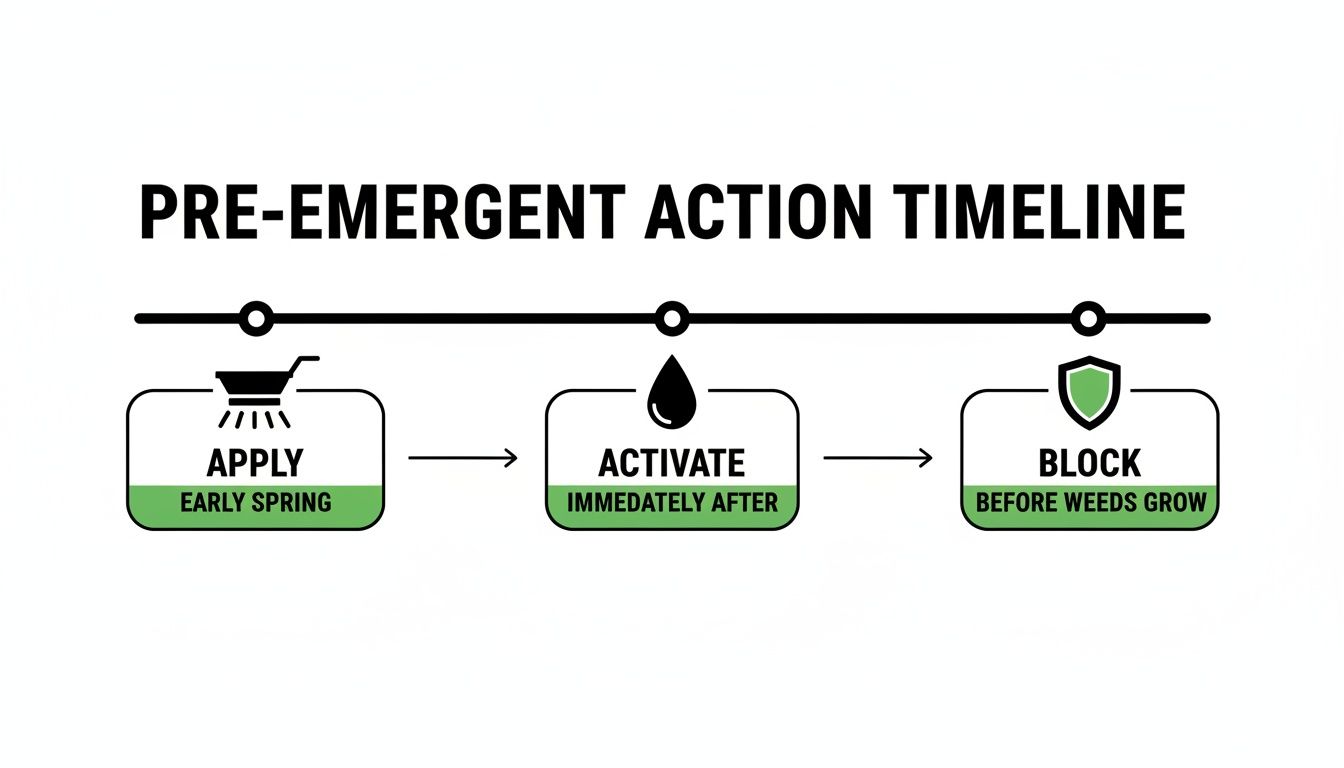
As you can see, the sequence is what matters. The shield must be in place and ready before the weed seeds awaken.
The Two Critical Seasons for North Georgia Lawns
Our unique climate from Alpharetta to Dahlonega really calls for a two-part strategy. You'll need one application in the early spring and another in the fall, with each one targeting a different set of aggressive weeds that thrive here.
-
Spring Application (For Summer Weeds): This is your main defense against crabgrass, plain and simple. The key is to apply your pre-emergent when soil temperatures are consistently reaching 55°F. If you go too early, the barrier might break down before the last of the crabgrass seeds sprout. Go too late, and you’ve missed your chance entirely.
-
Fall Application (For Winter Weeds): This round is absolutely essential for stopping winter annuals like Poa annua (annual bluegrass) and henbit. The trigger for this application is when soil temperatures are consistently dropping to 70°F after the summer heat. This prevents those bright green, clumpy weeds from popping up and ruining the look of your dormant lawn.
How To Track Soil Temperatures Like A Pro
You don't need a meteorology degree to get this right. For those of us in the Cumming area and surrounding communities, there are a couple of easy ways to keep an eye on soil conditions.
The most direct method is a simple soil thermometer from any garden center. Just push it a few inches into the ground and check it around the same time for several days in a row to spot the trend.
You can also lean on technology. Many university extension programs (like the UGA Extension) and weather websites publish daily soil temperature maps for our region. It's a fantastic way to see the bigger picture and anticipate when it's time to act.
One of my favorite old-school tricks? Watch for the forsythia bushes in your neighborhood to burst into bloom. Those brilliant yellow flowers are nature's way of saying the soil is warming up and has likely hit that critical 55°F mark.
The global market for pre-emergent herbicides hit about USD 2.5 billion in 2023 and is expected to climb to USD 4.0 billion by 2032. That growth reflects what we see right here in North Georgia, where our warm-season grasses are under constant threat from invasive weeds. In fact, University of Georgia Extension studies show that getting pre-emergent timing right in our climate can boost overall turf health by 40% and drastically cut the need for other herbicides later on.
North Georgia Pre Emergent Application Calendar
To make it even simpler, here’s a quick-glance calendar for homeowners in the Cumming, Alpharetta, Milton, and surrounding areas. This guide outlines the ideal windows and target weeds for our specific region.
| Season | Ideal Application Window (North GA) | Target Soil Temperature | Primary Weeds Controlled | Notes |
|---|---|---|---|---|
| Spring | Late February to Mid-March | Rising to 55°F | Crabgrass, Goosegrass, Foxtail | Apply before dogwoods bloom. This is the most crucial application of the year for summer lawn health. |
| Fall | September to Early October | Dropping to 70°F | Poa Annua (Annual Bluegrass), Henbit, Chickweed | This application protects your dormant lawn and prevents a messy spring green-up. |
Remember, this calendar is a guideline. A strange weather year can shift these dates, so always let the soil temperature be your ultimate guide.
Ultimately, the goal is to create that seamless shield at the exact moment weed seeds start their growth cycle. Nailing the timing is far more important than the specific brand you choose. While the process is similar for different products, you can learn more about how this fits into your larger lawn care plan in our guide to the best time to weed and feed your lawn.
How to Apply Pre-Emergent for Maximum Effect
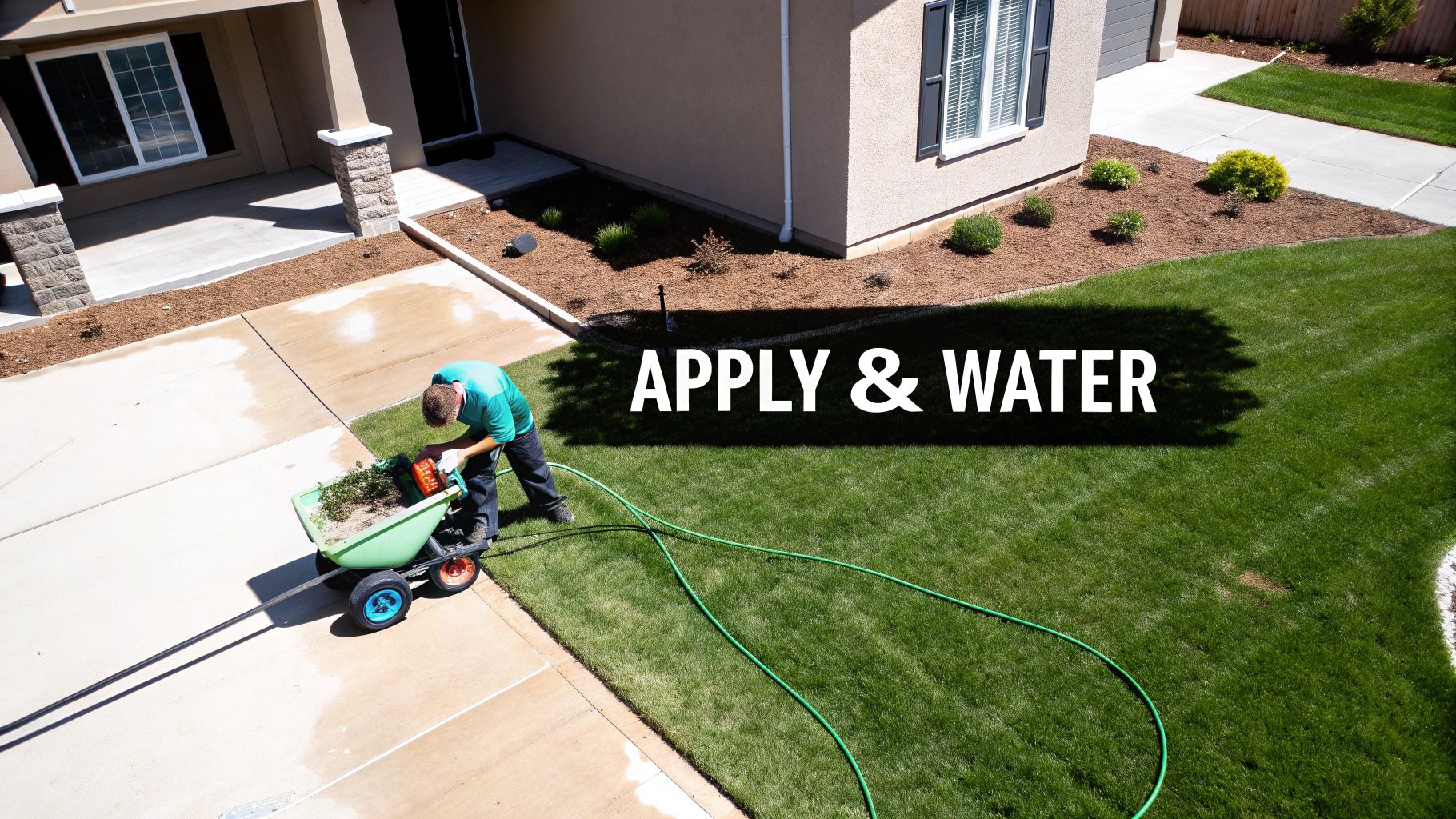
Knowing when to put down your pre-emergent is half the battle. The other half is getting the application just right. Proper technique is what creates that complete, unbroken shield across your soil, leaving absolutely no room for stubborn weeds to push through. Think of it like painting a wall—one tiny missed spot can compromise the whole job.
Whether you're in Cumming, Johns Creek, or anywhere else in North Georgia, this step-by-step guide will walk you through the process. Let’s make sure your hard work pays off with a thick, green, and weed-free lawn.
Step 1: Prepare Your Lawn Canvas
Before you even think about opening that bag or bottle, a little prep work can make a world of difference. The entire goal is to make sure the pre-emergent—whether it's granular or liquid—can make direct contact with the soil. If it gets stuck on a thick layer of leaves or thatch, it simply can't do its job.
Here's your quick pre-application checklist:
- Mow Your Lawn: A day or two before you plan to apply, give the grass a fresh cut to its normal height. This tidies things up and helps you get an even spread.
- Light Raking: Grab a rake and gently clear away any lingering leaves, pine straw, or other debris. You're just clearing the path so the product can get down to the soil level.
This isn’t just busywork. It’s a crucial first step in building that uniform barrier that stops weeds cold. For a deeper look at getting your lawn's foundation right, check out our guide on how to improve your soil.
Step 2: Choose Your Application Method
Pre-emergents generally come in two forms: granular and liquid. Both are effective, but they require different tools and techniques to get that all-important even coverage.
For Granular Pre-Emergents:
A broadcast or rotary spreader is your best friend for applying granules. These tools are designed to fling the tiny pellets in a wide, consistent arc, making it much easier to cover your entire lawn without missing spots. Please, don't try to apply it by hand—that’s a recipe for patchy coverage and a weak weed shield.
- Calibrate Your Spreader: This is critical. The product label will tell you the correct setting for your specific spreader model. This step ensures you're not putting down too much or, worse, too little.
- Create Your Pattern: I find it best to start by making a "header strip" pass around the perimeter of your lawn. Then, walk back and forth in straight lines, slightly overlapping each pass, just like you would when mowing.
For Liquid Pre-Emergents:
Liquid products are usually applied with a backpack sprayer or a hose-end sprayer. They can provide fantastic coverage, but the key is to maintain a steady walking pace and a consistent spray pattern to avoid over-applying in some areas and under-applying in others.
No matter which type you choose, uniform coverage is the most important goal. Weeds are opportunistic. They will find and exploit any tiny gap you leave in the pre-emergent barrier.
Step 3: Activate the Barrier with Water
This is the final, non-negotiable step. A pre-emergent just sits on the surface until it's watered into the soil. Water is what "activates" it and unlocks its protective power.
After you've finished the application, you need to water it in with about a half-inch of water. Ideally, this should happen within 24-48 hours. This can come from a light, steady rain or your sprinkler system. Watering does two important things:
- It washes the product off the grass blades and down to the soil.
- It moves the herbicide into the top inch or so of soil, where it forms that invisible shield that blocks weed seeds from sprouting.
A gentle rain after you apply is perfect. The only thing to be wary of is a predicted torrential downpour, as it could wash the product away on sloped areas before it has a chance to set in.
Step 4: Prioritize Safety for Family and Pets
While you’re making your lawn a safe space for grass to thrive, you also want to keep it safe for your family and pets. Always read and follow the safety instructions printed on the product label—they are there for a reason.
As a general rule, it’s best to keep children and pets off the lawn during the application and right afterward. The lawn is typically considered safe for everyone to enjoy again once a liquid product has completely dried or after a granular product has been thoroughly watered in and the grass is dry to the touch. This simple precaution lets everyone enjoy your beautiful, protected lawn without any worries.
Exploring Safe and Natural Pre Emergent Alternatives
For a lot of families here in Cumming, Alpharetta, and Johns Creek, the best pre emergent isn't just the strongest one—it's the one that's safe for their kids, pets, and the local environment. The great news is you don't have to sacrifice a beautiful lawn to live a greener lifestyle. There are powerful, natural alternatives that work by building a healthier lawn from the ground up.
This is a different way of thinking. Instead of relying on a synthetic chemical barrier, this approach uses organic solutions that work with nature. It's a long-term strategy that focuses on creating a turf so thick and healthy that weeds simply get crowded out. This method is a perfect fit for homeowners in Milton and Dahlonega who want a gorgeous lawn that doubles as a safe playground.
The Power of Corn Gluten Meal
At the top of the list for natural weed prevention is corn gluten meal. It's a simple byproduct of the corn milling process, but it's a powerhouse for your lawn. It pulls double duty as both a natural pre-emergent herbicide and a slow-release nitrogen fertilizer. Think of it as a one-two punch: it stops weed seeds from growing while feeding your turf.
So, how does it actually work? Corn gluten meal releases proteins into the soil that stop tiny seeds from forming roots right after they germinate. A weed seedling might sprout, but without roots, it can't draw up water or nutrients, so it quickly withers away. The best part is that it doesn't affect your established grass, which already has a deep, strong root system.
The benefits of going organic with corn gluten meal are huge:
- Safety First: It’s completely safe for kids and pets. They can run out and play on the lawn the moment it's applied, no waiting required.
- Soil Enrichment: As it breaks down, it slowly feeds your lawn with nitrogen. This encourages the kind of lush, dense growth that is your best natural defense against weeds.
- Eco-Friendly: You're using a natural, biodegradable product that actually improves your soil's ecosystem instead of harming it.
Corn gluten meal is all about building a self-sustaining lawn. Instead of just creating a temporary chemical barrier, you're investing in the long-term health and resilience of your soil and turf, a core principle we follow at Barefoot Organics.
Understanding the Trade-Offs
While corn gluten meal is a fantastic organic choice, it's important to set the right expectations. It works differently than synthetic products. The weed suppression rate is often lower, especially in the first year or two, and getting the timing and application just right is critical for it to be effective.
You have to think of it as a gradual process. The real goal is to improve your soil health and turf density over several seasons until your lawn can naturally outcompete most weeds on its own. For homeowners looking to expand their organic approach, another great strategy is using effective ground cover plants to smother weeds in garden beds.
To dive deeper into how this specific product works, you can check out our detailed guide on using corn gluten for weed control. This long-term, ecosystem-first approach is what we specialize in, helping North Georgia homeowners get beautiful results they can feel great about.
Why North Georgia Homeowners Trust the Experts
Tackling lawn care on your own can be satisfying, but when it comes to pre-emergents, the stakes are high—especially here in North Georgia. Our unpredictable climate can make timing everything. A small miscalculation in application can mean you're fighting a losing battle with weeds all season long.
This is exactly why so many homeowners in Cumming, Johns Creek, and Alpharetta eventually decide that bringing in an expert is the smartest, most effective path to a beautiful lawn.
Calling a professional becomes the best pre emergent strategy when the DIY route feels like a gamble. Is your lawn already a sea of weeds from last year? An expert can build a comprehensive plan to get it back on track. Are you second-guessing when soil temperatures are just right? We take the guesswork out of the equation.
The Professional Advantage in Our Climate
Lawn care in North Georgia is its own unique challenge. The heavy clay soil, the wild temperature swings, and the stubborn local weeds from Milton to Dahlonega all demand a strategy that's anything but generic.
- Pinpoint Local Timing: We live and breathe North Georgia turf. We know the specific microclimates and soil quirks in the Cumming area. That means we know exactly when the ground is hitting that crucial 55°F for crabgrass or dropping to 70°F for pesky Poa annua.
- Superior Products and Equipment: Professionals have access to highly effective, commercial-grade products and precisely calibrated spreaders. This gear ensures every single inch of your lawn gets protected—an evenness that's nearly impossible to get with a push spreader from the big box store.
- Guaranteed Peace of Mind: When you work with a service like Barefoot Organics, you're not just hoping for the best. Your pre-emergent strategy is executed flawlessly, protecting your investment and letting you simply enjoy a gorgeous, weed-free lawn.
When you hire an expert, you’re not just paying for someone to spread granules. You’re investing in years of hands-on, local experience and a process that’s proven to work right here in Georgia.
Ultimately, bringing in a pro saves you precious time, prevents frustrating and expensive mistakes, and delivers the kind of lush, healthy lawn you've been aiming for. To see what this kind of dedication looks like, you can learn more about the Outdoorbrite experts, who share our commitment to deep regional knowledge. It’s that expertise that turns a good lawn into a truly great one.
Answering Your Top Questions About Pre-Emergents
Even with the best game plan, you're bound to have questions. When you're dealing with something as timing-sensitive as a pre-emergent application for your lawn in Cumming or Alpharetta, getting straight answers is the key to feeling confident. We get these questions all the time from homeowners across North Georgia, so let's clear them up.
Think of this as your go-to guide for navigating the finer points of weed prevention.
Can I Put Down Grass Seed After Applying A Pre-Emergent?
This is a big one, especially for fescue lawns in our area, and the short answer is no. A pre-emergent’s entire job is to stop seeds from sprouting, and it's not smart enough to tell the difference between a weed seed and a desirable grass seed. It will stop them both, cold.
Most of these products create a chemical barrier that stays active in the soil for a solid 6 to 12 weeks. If you throw down expensive grass seed during that window, you're unfortunately just wasting your time and money.
The best approach here in North Georgia is to think in seasons:
- Spring: Focus on your pre-emergent application. This is your chance to get ahead of crabgrass and all those other annoying summer weeds.
- Fall: This is the prime time to overseed your fescue lawn, long after the spring pre-emergent has done its job and faded away.
Of course, always double-check the product label, as a few newer formulas might have different rules. But for a perfectly timed strategy where your weed control and seeding efforts actually work together, having an expert map it out is your safest bet.
What Happens If I Apply Pre-Emergent Too Late?
Timing is everything. If you apply your pre-emergent after the weed seeds have already started to germinate, it simply won't work. The product is designed to be a preventative shield, and once the weeds are already growing, its power is gone.
Imagine you're targeting crabgrass in your Johns Creek yard. The moment the soil temperature stays above 55°F for a few days in a row, that's the starting gun. If you apply after that point, the battle has already begun beneath the surface, and your pre-emergent barrier is useless against a weed that has already sprouted.
At that point, you have to switch gears from prevention to damage control. You'll be forced to use a post-emergent herbicide to tackle the weeds you can now see, which is often a tougher, more frustrating fight. This is exactly why hitting that application window is the single most critical factor for success.
Are Organic Pre-Emergents As Effective As Chemical Ones?
This is a great question. Organic options like corn gluten meal are definitely effective, but they work a bit differently and set different expectations. When applied correctly, corn gluten can give you about 60-80% weed suppression by stopping the tiny roots from forming on newly sprouted seeds.
In comparison, a traditional chemical pre-emergent will often hit a 90-95% effectiveness rate. The real trade-off isn't just about the numbers, though. The huge advantage of an organic approach is the peace of mind it offers for your family, pets, and the local ecosystem in places like Milton and Johns Creek.
The "best" choice really comes down to what you value most. If your priority is building incredible long-term soil health and ensuring absolute safety, an organic strategy is the clear winner. It's about creating a lawn so healthy and resilient that it naturally squeezes weeds out over time.
Will Rain Wash Away My Pre-Emergent?
Actually, it’s the opposite—rain is exactly what you want after you apply! A pre-emergent needs about a half-inch of water, either from rainfall or your sprinkler system, to truly get to work. Water is the key that activates its protective power.
That moisture is what carries the product off the grass blades and down into the first inch of soil, which is where it needs to be to form that weed-blocking barrier. A nice, steady rain a day or so after you apply is the perfect scenario.
The only time you’d need to worry is if a massive thunderstorm is in the forecast for a sloped yard. A torrential downpour could cause heavy runoff and potentially wash the product away before it has a chance to soak in. Just remember, the goal is for water to wash it "in," not "away."
Ready to take the guesswork out of your lawn care and guarantee a beautiful, weed-free yard? The team at Barefoot Organics has the local expertise to create a customized pre-emergent plan perfect for your North Georgia lawn. Get your free quote today!