

Want a beautiful, thick Bermuda lawn that’s the envy of your Cumming, GA neighborhood? It’s not about luck—it’s all about timing. A proactive, locally-tuned Bermuda grass calendar is the true secret to getting that dense, green turf that naturally crowds out weeds and keeps the HOA happy. Here in Cumming and across Forsyth County, Bermuda grass is the turf of choice, but it needs a specific care schedule to handle our Georgia red clay, high humidity, and intense summer heat.
This guide is your year-round playbook, built from our daily experience treating lawns just like yours. Let Barefoot Organics show you how to stop struggling with thin spots and weeds. Call us today for a free lawn evaluation and start your journey to a healthier lawn.
Why This Matters in Cumming: Your Seasonal Game Plan
A thriving Bermuda lawn in North Georgia needs a specific sequence of care, timed perfectly to our unique climate. From the sticky, 90-degree days in July to the unpredictable frosts of late winter, every season demands a different approach. Ignoring this natural rhythm is the number one reason we see so many lawns in Cumming, Alpharetta, and Johns Creek struggling with weeds, thin spots, and disease.
Your Bermuda grass operates on a pretty clear schedule. It goes dormant and brown through the cold months, explodes with growth in the spring, hits peak performance in the summer heat, and then gets ready for a long winter's nap in the fall. The key is to align your lawn care—mowing, watering, fertilization, and weed control—with this cycle.
This visual timeline gives you a great snapshot of the core phases, showing the shift from spring green-up to summer maintenance and fall prep.
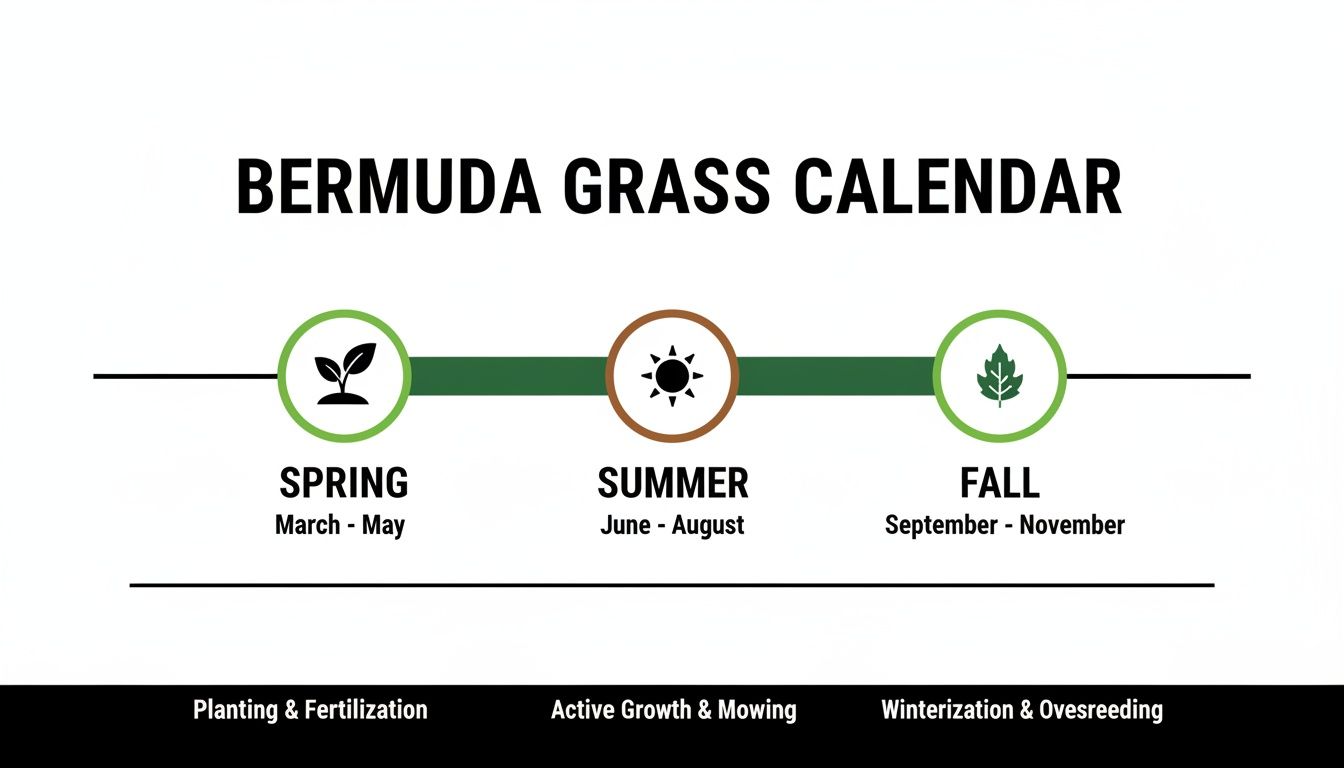
As you can see, the heavy lifting happens during spring and summer. That’s the active growing season for Bermuda here in Forsyth County, and it's when your lawn needs the most attention. Trying to fertilize dormant, brown grass in January is just a waste of time and money. On the other hand, failing to apply pre-emergent on time in late winter is basically rolling out the welcome mat for a crabgrass invasion come May.
Bermuda Grass Care at a Glance for Cumming, GA Lawns
| Season | Key Focus | Primary Tasks in Cumming, GA |
|---|---|---|
| Late Winter (Jan-Feb) | Prevention & Prep | Apply pre-emergent for crabgrass control; sharpen mower blades. |
| Spring (Mar-May) | Growth & Strength | First mow ("scalping"), core aeration, initial fertilization. |
| Summer (Jun-Aug) | Maintenance & Stress Mgt. | Consistent mowing, deep and infrequent watering, targeted feeding. |
| Fall (Sep-Oct) | Winter Preparation | Final fertilizer application, raise mowing height, monitor for fall weeds. |
Following this seasonal rhythm is the single most important thing you can do for your lawn. You're working with your Bermuda grass, not against it, giving it the strength to choke out weeds and handle the stress of our local climate.
Late Winter (Jan-Feb): This is all about preparation. The main event is applying pre-emergent weed control to stop crabgrass before it ever gets a chance to sprout in our red clay soil.
Spring (Mar-May): As your lawn starts to “green up,” the focus shifts. It’s time to encourage healthy, dense growth with the first short mow (scalping), core aeration, and the right starter fertilizer.
Summer (Jun-Aug): During the peak heat of a Georgia summer, your job is all about stress management. This means consistent mowing, deep watering to build drought resistance, and smart, targeted feeding.
Fall (Sep-Oct): As the temperatures finally start to cool off, you’ll want to get the lawn ready for dormancy. This involves a final fertilizer application and raising your mowing height one last time.
Whether you're in a new construction neighborhood in Dawsonville or an established community in Suwanee, sticking to this calendar will save you a lot of headaches and money down the road. You can get into even more detail by using a customizable lawn care schedule template to break these steps down further.
Treatment Breakdown: A Seasonal Guide for Your Cumming Lawn
Let's walk through what each season looks like in more detail for a homeowner in Forsyth County.
Late Winter & Early Spring: Your Most Important Season in Cumming
What you do for your Bermuda lawn from January through March sets the tone for the entire year. This is the crucial window for preventing a summer-long headache with crabgrass and all the other weeds we fight here in North Georgia. Getting a jump on them now is everything.
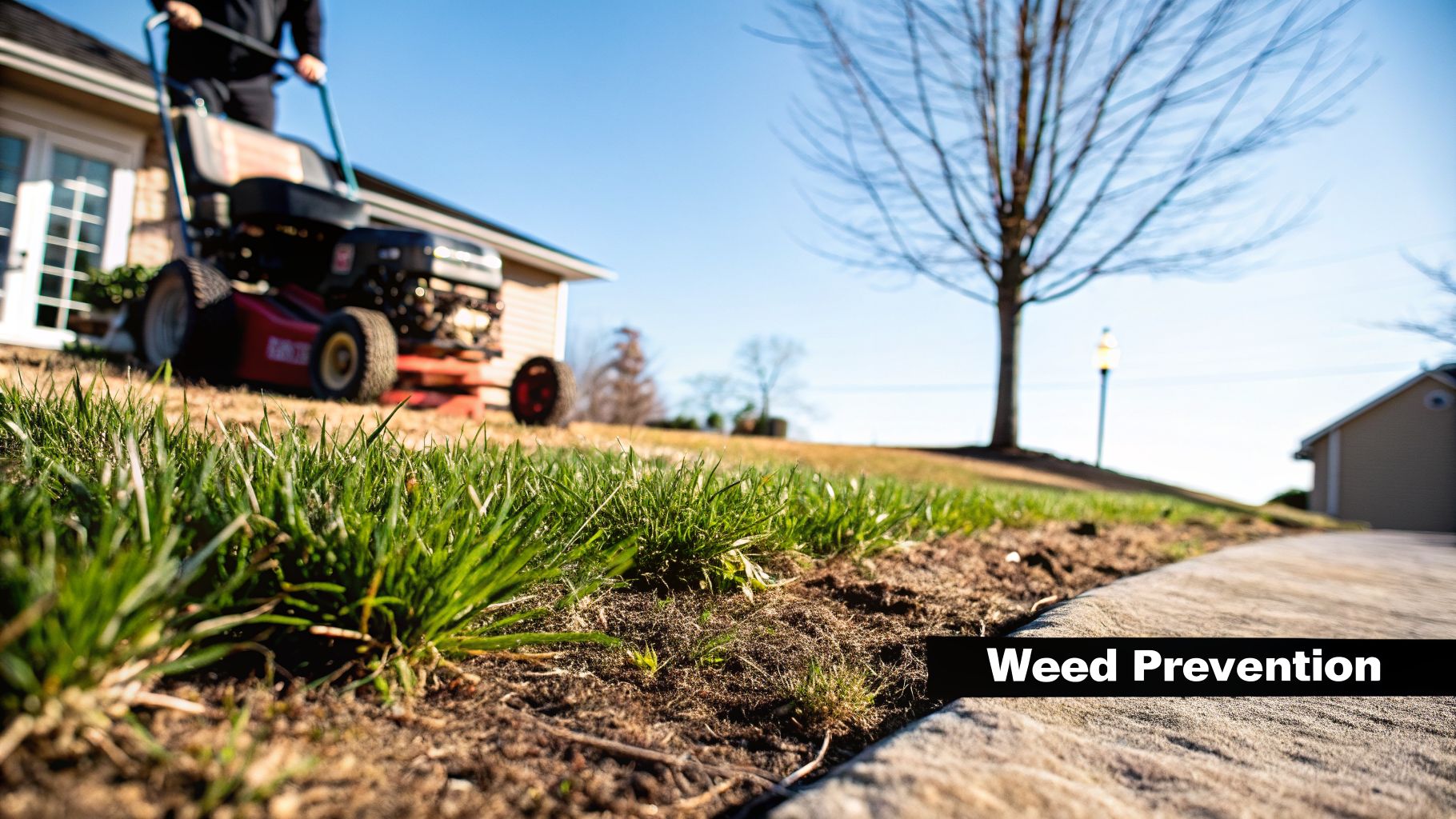
While your Bermuda is brown and dormant, the soil is far from asleep. Winter annuals like henbit and Poa annua are taking hold, and worse, crabgrass seeds are just waiting for a little warmth to erupt. This is your chance to stop them before they even start.
The Make-or-Break Application
If you only do one thing for your lawn all year, this is it: apply a pre-emergent herbicide. For homeowners across Forsyth County, this single task is the key to a cleaner lawn. Pre-emergents work by creating a barrier in the soil that prevents weed seeds from successfully germinating. It won’t kill existing weeds, but it stops new ones in their tracks.
Pro Tip: The magic number for timing your pre-emergent in Cumming is a consistent soil temperature of 55°F. Once the ground hits that mark, crabgrass starts to germinate. If you apply it after that, you've missed your shot. Don’t let your lawn fall behind your neighbors'.
Spring Cleaning for Your Lawn
As we move toward spring, there are a couple more things you can do to give your Bermuda a strong start.
Clear Winter Debris: Grab a rake and clear off any leftover leaves, twigs, and gumballs. Getting this layer of junk off the dormant turf lets sunlight hit the soil, warming it up faster and encouraging a more uniform green-up later.
Tune-Up Your Mower: Now is the perfect time for mower maintenance. Sharpen the blades, change the oil, and clean the filter. A dull blade rips the grass instead of making a clean cut, which stresses the lawn and opens the door for disease.
The "Spring Scalp": Your First Mow of the Season
Once we’re safely past the last hard frost—typically mid-to-late March in the Cumming, Johns Creek, and Suwanee areas—it’s time to scalp the lawn. This is the only time of year you should ever mow your Bermuda this low, cutting it down to about 1 inch.
This might feel a little harsh, but it's a vital reset for the grass. Scalping removes all the dead, brown grass from winter and exposes the soil to that all-important direct sunlight. This warmth is the signal your Bermuda needs to wake up and start growing. A timely pre-emergent application can prevent up to 90% of potential crabgrass, giving your lawn the clean slate it needs to thrive.
Ultimately, winning this battle requires a few different tactics. Combining a well-timed pre-emergent with good cultural practices like the spring scalp is a cornerstone of effective weed control for lawns. It’s how you set the stage for a thick, healthy lawn that can naturally choke out weeds all season.
From Spring to Summer: Fueling Your Forsyth County Bermuda Lawn
Once spring finally settles in across North Georgia, from April through June, your Bermuda grass starts to wake up from its winter slumber, and it is hungry. This is the time when our focus shifts from preventing winter weeds to actively fueling the dense, healthy green turf you want for your yard in Cumming or Johns Creek.
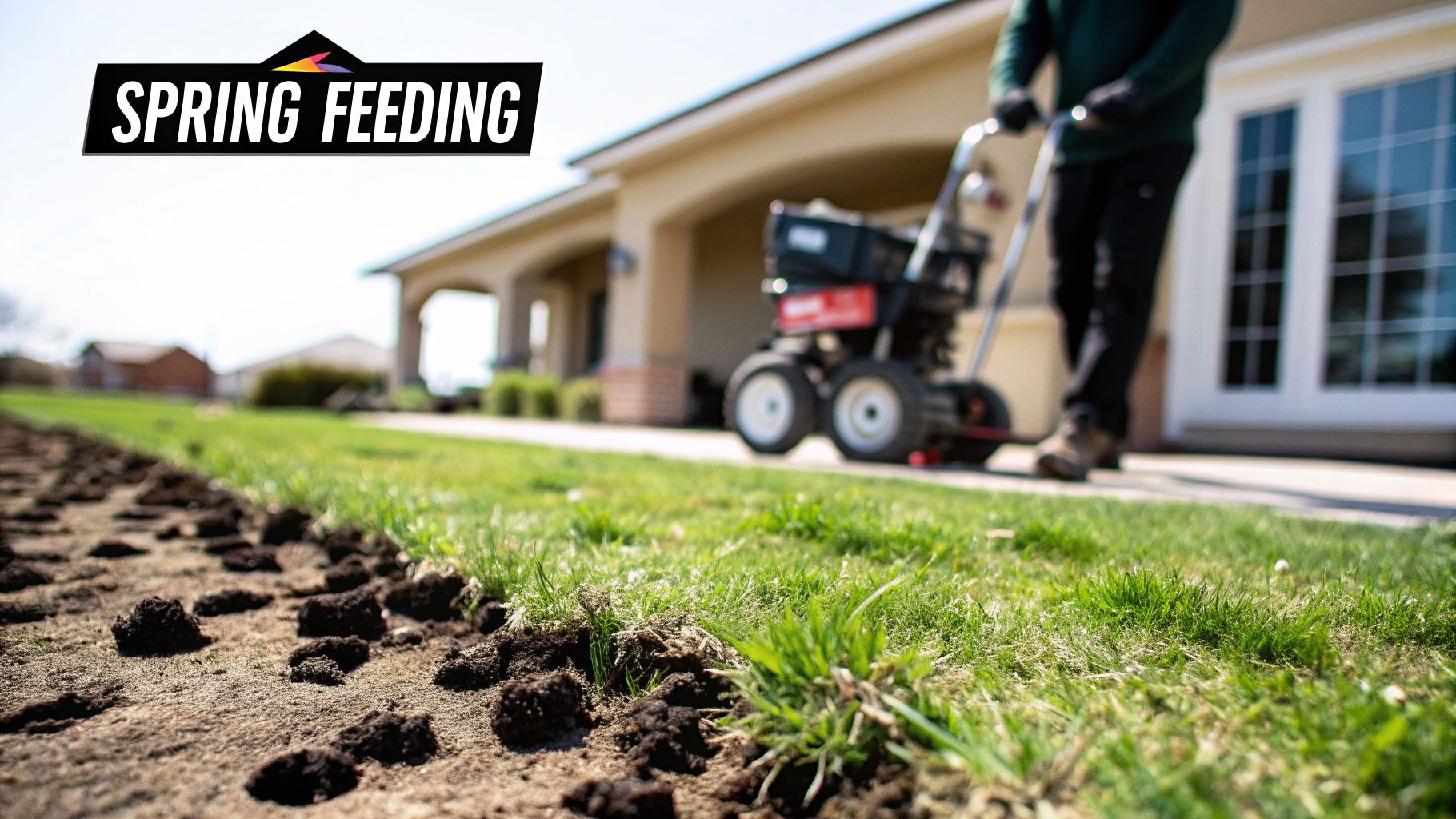
The real secret during this window isn't just to make the grass grow up, but to encourage it to spread out. A thick, matted turf is your best defense against the coming summer weeds and is what creates that uniform, carpet-like appearance so many HOAs in Forsyth County love to see.
Master Your Mowing in Cumming
When you see that your lawn is about 75-80% green, it’s go-time. This is your cue to lock in a consistent mowing routine for the rest of the season. Your target height for Bermuda grass should stay between 1 and 2 inches. I know, that sounds short. But Bermuda is a unique turf that thrives on low, frequent cuts. This low height encourages the stolons (those above-ground runners) to spread sideways, thickening the lawn naturally.
Just stick to the one-third rule: never chop off more than one-third of the grass blade at a time. For Bermuda in peak season, that means you’ll likely be mowing at least once a week.
Why Core Aeration is a Must in North Georgia
If you’ve ever tried to dig a hole anywhere from Alpharetta to Suwanee, you know exactly what we’re up against: heavy, compacted Georgia red clay. That dense soil suffocates grass roots, making it incredibly difficult for them to access the air, water, and nutrients they need. This is precisely why we consider core aeration a non-negotiable part of our spring Bermuda care calendar.
What exactly is core aeration? We run a machine over your lawn that pulls up small plugs of soil. Think of it as creating hundreds of tiny pathways that break up compaction. This allows air, water, and fertilizer to get down deep where they matter most—the root zone. It’s like letting your lawn finally take a deep breath.
For homeowners in areas like Johns Creek and Milton, the perfect time for this is late spring (April-May) when the Bermuda is growing vigorously. The grass recovers quickly, sending roots and runners into the newly opened space and building a much stronger foundation before the summer heat kicks in.
Fertilizing Your Cumming Lawn the Smart Way
The moment you see that first hint of green, it’s tempting to grab the fertilizer. But hold off. Fertilizing too early, while your lawn is still groggy and waking up, does more to feed opportunistic weeds than your actual turf. Even worse, it can trigger a weak surge of growth that makes your lawn a magnet for brown patch fungus, a disease that absolutely loves our humid spring weather.
Our rule of thumb is simple: wait to fertilize until the lawn is fully green and you've mowed it at least twice at its low summer height. This ensures the grass is awake, active, and ready to put those nutrients to good use. Bermuda grass hits its peak growth when soil temperatures stay consistently above 65°F. When you pair a late-spring aeration with a well-timed fertilizer application, you can see 20-30% thicker turf by the time summer arrives. You can even read more about how these lawn care practices influence market trends.
Navigating Summer Heat Stress in Cumming and North Atlanta
When July and August roll into North Georgia, they bring a brand of heat that puts your Bermuda grass to the test. As temperatures climb past 90 degrees and the humidity feels thick enough to swim through, your lawn’s focus shifts from rapid growth to pure survival. Staying green through this stretch isn't about luck; it's about having a smart game plan to protect your lawn before summer heat stress sets in.
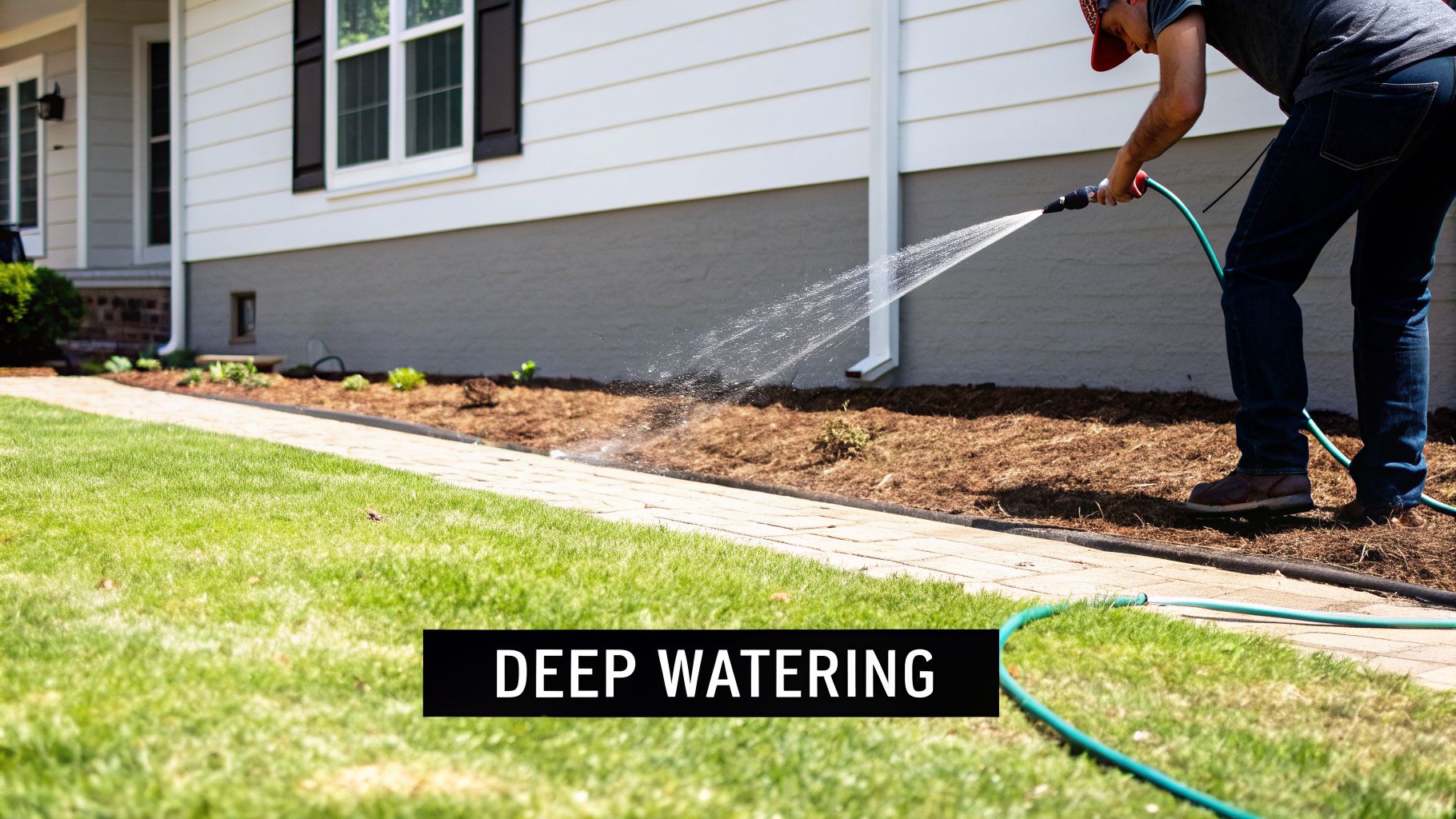
We've seen it all across Canton, Buford, and Cumming—the lawns that look great all summer are the ones whose owners nail their watering, mowing, and pest monitoring strategy.
The Right Way to Water Bermuda Grass in Cumming
Hands down, the biggest mistake we see homeowners make during a hot Forsyth County summer is watering too frequently and far too lightly. The real secret is to water deeply, but infrequently. Aim to deliver about 1 inch of water per week, ideally in a single, long watering session. This gives the water time to soak deep into our dense Georgia clay, forcing the roots to chase it downward and build drought tolerance.
Local Insight: The best time to water is always early in the morning, ideally between 4 AM and 9 AM. This minimizes evaporation and gives the grass blades plenty of time to dry before nightfall. This is critical for preventing common fungal diseases like brown patch, which absolutely loves our humid North Atlanta nights.
Consistent Mowing for a Healthy Summer Lawn
During the summer peak, a consistent mowing schedule—at least once a week—becomes non-negotiable. Keep your mower blade sharp and set the height between 1 and 2 inches. Mowing regularly at this low height forces the grass to spread out sideways, creating that thick, carpet-like turf. A dense lawn is also your best natural defense against opportunistic summer weeds like dallisgrass and nutsedge. Homeowners from Dawsonville to Sugar Hill who stick to this routine have healthier and far more resilient lawns.
Summer Feeding and Pest Watch in Forsyth County
Summer is also high season for destructive pests that can wreck a lawn in days. You need to be on the lookout for:
- Armyworms: These caterpillars can materialize almost overnight, mowing through a lawn in just a few days. Watch for patches of grass that look like they’ve been scalped.
- Grubs: The adult beetles are laying their eggs right now. Proactive care is key.
- Brown Patch: This fungal disease thrives in high heat and humidity. It appears as expanding, brownish-yellow circles.
If you're seeing signs of trouble on your Cumming lawn or just want a "lawn treatment near me" expert to take a look, don't wait for the problem to get worse. Request service from Barefoot Organics today.
Preparing Your Bermuda Lawn for Winter Dormancy
As the summer heat finally starts to fade from September through December, your Bermuda lawn’s job description changes. It’s no longer about pushing aggressive, green growth. Instead, the focus shifts to smartly preparing for its winter rest. This is a vital part of our North Georgia Bermuda grass calendar, and getting it right sets the stage for a thick, healthy lawn next spring.
A Final Meal Before Winter
Sometime in early fall, your Bermuda grass needs one last "winterizer" fertilizer application. This is all about the roots. We use a fertilizer low in nitrogen but high in potassium to help the grass store carbohydrates in its root system. That stored energy is precisely what the lawn will live on through winter and use for a quick green-up next spring. For a deep dive, check out our guide on when to apply winterizer fertilizer.
Raising the Mowing Height for Insulation
Gradually bring the mowing height up with each cut throughout the fall until you land at a final height of about 2 to 2.5 inches. That extra height acts like a blanket, helping to insulate the crown of the plant and its roots from harsh winter temps and shading out winter weeds.
The Importance of Leaf Management in Cumming
One of the most important fall chores in neighborhoods from Dawsonville to Sugar Hill is managing the leaves. A thick, wet blanket of leaves smothers dormant grass and creates a perfect environment for fungal diseases. Keep the lawn clear to protect your Bermuda investment through its dormant season.
Don't panic when your lawn turns that familiar straw-brown color. That’s a good thing! It’s a natural and healthy sign of dormancy. Your Bermuda isn't dead—it's just resting.
Application Process
At Barefoot Organics, we make following the Bermuda grass calendar effortless for homeowners. Our seasonal lawn program is designed specifically for the challenges of Cumming and Forsyth County.
- Free Lawn Evaluation: It starts with a phone call. We'll come to your property to assess your lawn's specific needs, identify problem areas, and discuss your goals.
- Custom Program: We'll build a year-round treatment plan based on your lawn's condition, our local climate, and your family's needs, using our effective organic-based products.
- Scheduled Treatments: Our licensed technicians will visit your home at precisely the right time for each seasonal application, from pre-emergent weed prevention in late winter to winterizer fertilization in the fall.
- Ongoing Monitoring: We don't just "spray and pray." We monitor your lawn's progress, communicate with you after each visit, and provide guidance on mowing and watering.
Why Choose Barefoot Organics in Cumming, GA
Trying to keep up with a Bermuda grass care calendar can feel like a full-time job. At Barefoot Organics, we handle the science and scheduling so you can just enjoy a beautiful, healthy lawn. Unlike the big national chains, our programs are built from the ground up for North Georgia lawns. We spend our days working in the unique conditions of Forsyth County—from our stubborn red clay soil to the oppressive summer humidity.
Local Expertise You Can Count On
We’re boots on the ground, right here in your community. We know from experience the exact week soil temperatures in local neighborhoods are about to hit 55 degrees, which is the crucial window for pre-emergent. We're the ones watching for the first signs of armyworms in Alpharetta and Johns Creek, and we're constantly tweaking our organic-based treatments for lawns in Milton and Suwanee. This is a hands-on, local know-how you simply can't find by calling a 1-800 number.
Safe for Your Family, Tough on Weeds
We hear it from homeowners all the time: "What are you spraying on my lawn, and is it safe for my kids and dog?" It’s a concern we share deeply. That's precisely why we've built our business around effective, organic-based lawn care options that are a much better choice for your family and our local ecosystem. You get the peace of mind that comes from responsible lawn care without giving up the results you want.
Ready to see the difference? Call Barefoot Organics today for a free lawn evaluation, and we’ll create the perfect plan for your Cumming-area home.
FAQ: Your Bermuda Grass Calendar Questions Answered for Cumming, GA
Working on lawns from Cumming to Johns Creek, we hear the same great questions over and over. Here are answers to the most common questions about the Bermuda grass calendar in our area.
Q: When should I apply pre-emergent in Cumming, GA?
A: In Cumming, pre-emergent weed control should be applied in late winter or very early spring before soil temperatures consistently reach 55 degrees. This is when crabgrass begins to germinate in Forsyth County lawns. We target late February to early March to create that crucial barrier before the spring pollen arrives, giving your Bermuda lawn a clean start.
Q: What is the best mowing height for Bermuda grass in Cumming?
A: For a healthy lawn in Cumming, maintain a mowing height between 1 and 2 inches during the spring and summer. This low height encourages the dense, sideways growth that chokes out weeds. In the fall, gradually raise the height to 2.5 inches to help insulate the turf from cold and protect it during winter dormancy.
Q: Why is my Forsyth County Bermuda lawn still weedy after treatments?
A: A comprehensive Bermuda care calendar is key. While post-emergent treatments handle existing weeds, true success comes from a dense, healthy turf that outcompetes them naturally. This requires proper mowing, deep watering, core aeration in our Georgia clay soil, and correctly timed fertilization. A single treatment can't fix a lawn that's fighting underlying health issues.
Q: Should I water my dormant Bermuda lawn in the winter?
A: Generally, no. Your dormant Bermuda lawn in Cumming needs very little water during the winter. Our typical North Georgia winter precipitation is usually more than enough. Overwatering a dormant lawn can actually promote fungal diseases and winter weed growth. It's best to leave it alone and let it rest until spring green-up begins.
Q: Is it okay to use weed killer on Bermuda grass in the summer heat?
A: You must be very careful. Applying many common weed killers when temperatures are over 85-90 degrees can severely damage or discolor your Bermuda grass. The best approach is to spot-treat individual weeds with a product labeled safe for Bermuda in the heat. A healthier strategy is building a dense turf that prevents summer weeds from establishing in the first place.
Q: Why is core aeration so important for lawns in Cumming?
A: Our heavy Georgia red clay soil compacts easily, suffocating grass roots. Core aeration is critical in Cumming and Forsyth County because it pulls up plugs of soil, breaking up that compaction. This allows essential air, water, and nutrients to finally reach the root zone, leading to a much healthier, more drought-resistant lawn.
Q: Should I overseed my Bermuda grass lawn in Cumming, GA?
A: For most Bermuda lawns in the Cumming area, the answer is no. Bermuda is an aggressive grass that spreads and self-repairs very effectively. Overseeding is usually unnecessary and can sometimes create competition with the existing turf. We only recommend it in cases of severe, widespread damage where the lawn cannot recover on its own.
Ready to hand over your lawn care calendar to a local expert? The team at Barefoot Organics knows exactly what your Cumming lawn needs to thrive in every season.
Get your free lawn evaluation and start your custom lawn program today!