

When it's time to aerate your lawn in the spring, you're essentially pulling small plugs of soil out to give it some breathing room. The best time to do this is usually after the grass is actively growing and you've had to mow it at least twice. For us here in the Cumming, GA area, this single task is a game-changer because it allows precious water, air, and nutrients to break through our dense clay soil, encouraging deeper roots for a much healthier and tougher lawn.
Why Spring Aeration Is a Must-Do for Georgia Lawns
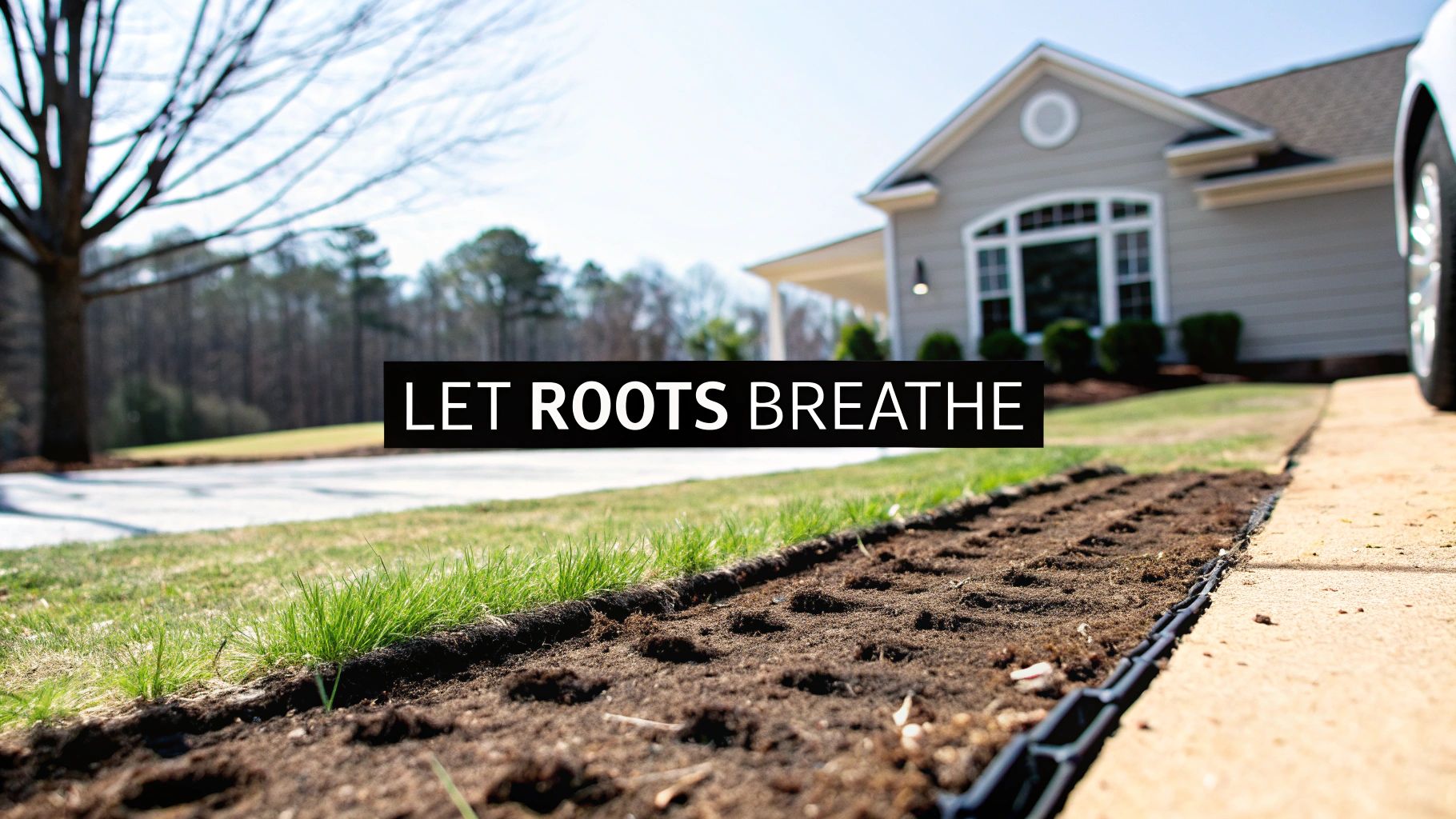
If you live anywhere from Cumming and Johns Creek to Alpharetta, you know our infamous red clay all too well. After a long, wet winter, that soil gets packed down so tightly it might as well be a layer of concrete right under your grass. This compaction literally suffocates your lawn’s root system, cutting off the essentials it needs to thrive.
Imagine trying to grow a plant in a pot with zero drainage holes. It's a recipe for disaster because the roots can't breathe or find space to expand. That's exactly what's happening to your lawn. When the roots can't grow deep, the grass becomes weak, thin, and an easy victim for the brutal summer heat and drought we know is coming to places like Milton and Dahlonega.
Unlocking Your Lawn's True Potential
This is why core aeration isn't just a good idea—it's a non-negotiable part of local lawn care in communities like Cumming and the surrounding areas. The process uses a machine to methodically pull up small plugs, or "cores," of soil and thatch from your lawn. We just leave these cores right on the surface, and they'll break down over a week or two, recycling valuable nutrients back into the ground.
But the real magic is in the holes the aerator leaves behind. These little channels create pathways that fundamentally improve your lawn’s health.
- Oxygen Finally Reaches the Roots: Grass roots need oxygen just like we do. Compacted soil cuts off that supply, but aeration reintroduces critical airflow right where it's needed.
- Water Soaks In, Not Runs Off: Instead of puddling on the surface or running down the curb, rainwater and sprinklers can now soak deep into the soil, hydrating the roots where it matters most.
- Nutrients Get to Work Faster: Any fertilizer or organic treatments you apply can now penetrate the soil much more easily, feeding your lawn for greener, thicker growth.
For the warm-season grasses common across North Georgia, like Bermuda and Zoysia, spring aeration is the perfect kickstart to their growing season. It sets them up to build the strong, deep root systems they’ll need to not just survive our hot summers, but actually flourish. Honestly, it’s one of the most effective things you can do to get that lush, green yard you're after in Cumming.
Understanding How Compaction Harms Your Clay Soil
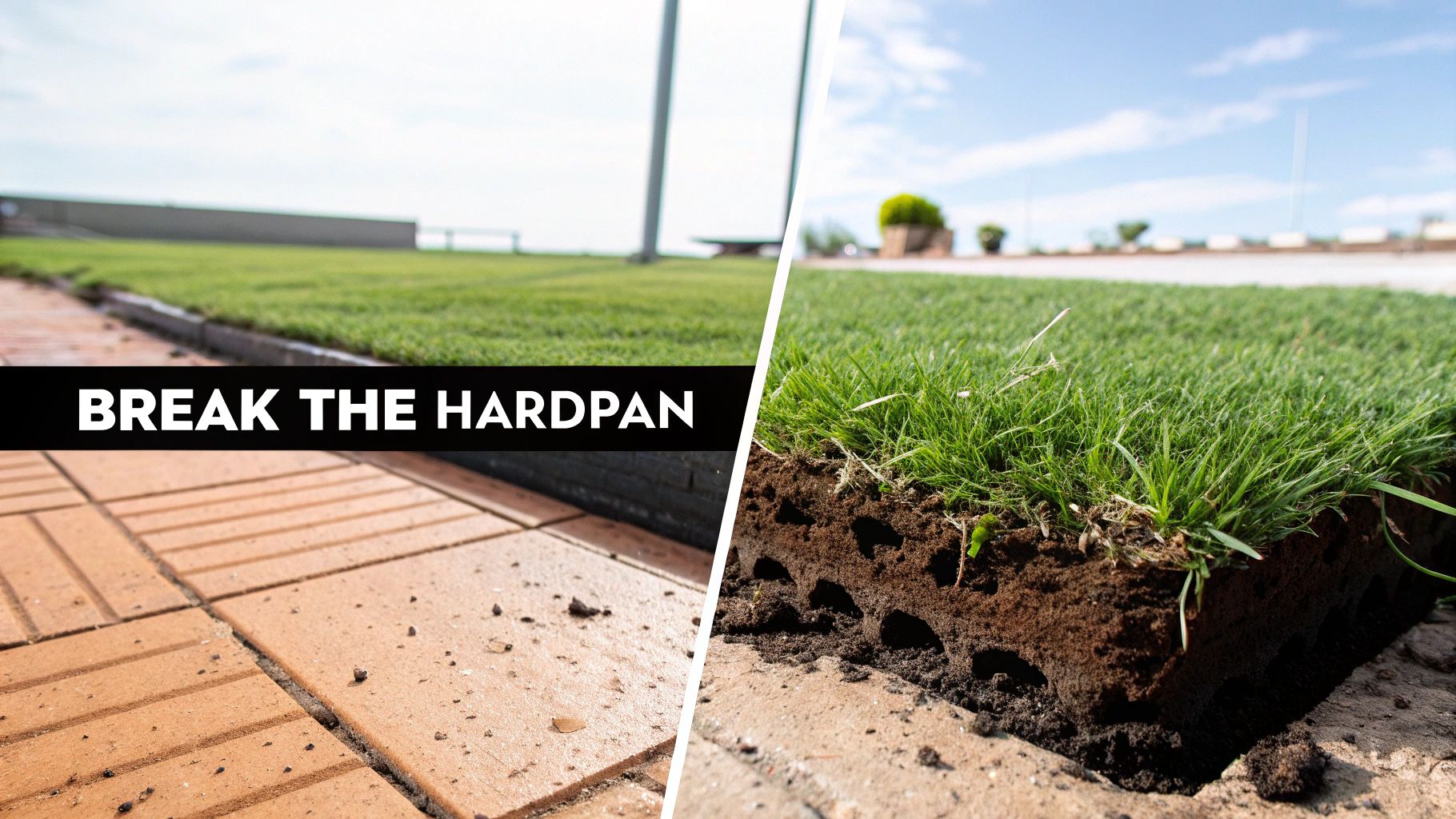
Let's get our hands dirty and talk about why spring aeration is such a game-changer for homeowners all over North Georgia. If you live anywhere from Cumming to Johns Creek, you know exactly what I'm talking about: that infamous red clay. It’s part of our landscape, but it comes with a major catch—it compacts like nobody’s business.
Think about what your lawn goes through. Months of winter rain, plus all the foot traffic from kids, pets, and even just mowing, squeezes those tiny clay particles tightly together. This pressure creates a dense, hardened layer right under your grass, almost like concrete.
This barrier is bad news for your lawn. It essentially suffocates the root system, blocking the vital resources your grass needs to grow and turning your yard into a hostile environment.
The Suffocation Effect on Grass Roots
Imagine a potted plant with no drainage holes. The water just sits there, and the roots drown. That’s a pretty good picture of what happens to your lawn when the soil is compacted.
This dense layer of clay stops the essentials from ever reaching the root zone:
- Oxygen: Roots need to breathe just like we do. Compacted soil has very few air pockets, choking them out.
- Water: Instead of soaking deep into the ground, rainwater and irrigation just pool on the surface or run right off.
- Nutrients: Any fertilizer or organic matter you apply can’t break through that hardpan, leaving your lawn starving from below.
When roots can’t get what they need, they stay shallow and weak. This leaves your turf wide open to the stress of our hot Georgia summers, which is why you see so many brown patches and thinning areas around Cumming and Alpharetta.
Core aeration is the perfect solution. By pulling out small plugs of soil, we create channels that go straight through that compacted layer. These new pathways become lifelines, finally letting air, water, and nutrients get down to the roots and encouraging them to grow deeper and stronger.
The Economic Case for Timely Aeration
It’s no wonder spring is the go-to season for this service. Industry data shows that up to 60% of annual aeration services happen in the spring, right as the growing season kicks off. With the average cost for a professional job hovering around $140, it's a small and incredibly smart investment in your lawn's health for the entire year.
Aerating in the spring gives your lawn the head start it needs to bounce back from winter and build up resilience before the summer heat arrives. To learn more about building a strong foundation for your grass, check out our guide on how to improve soil for a healthier lawn. When you tackle compaction, you’re not just putting a bandage on the problem—you’re fixing the root cause of the most common lawn issues we see in the Cumming area.
When to Aerate Your Lawn in North Georgia
Timing is everything when it comes to spring aeration, especially with North Georgia's unique climate. Get it right, and you're setting your lawn up for a fantastic season. Get it wrong, and you could actually stress the grass or roll out the welcome mat for weeds.
The secret is to aerate when your grass is in its peak growing phase. For most of us here in Cumming, Alpharetta, and the surrounding areas, that means paying attention to our warm-season grasses.
If you have a Bermuda or Zoysia lawn—and most of us do—their most active growth period is your green light. The ideal window for aerating these grasses usually opens up in late spring and stretches into early summer, think late April through early June.
A great rule of thumb I always tell people in the Cumming area is to wait until your lawn has fully greened up and you’ve already had to mow it at least twice. This is the surest sign that the grass is healthy and vigorous enough to recover quickly from the aeration process.
Core vs. Spike Aeration: What Really Works on Clay Soil
When you start digging into aeration, you’ll find two main approaches: core and spike aeration. I can't stress this enough—for our dense, red clay soil around Cumming and Johns Creek, one method is a game-changer, while the other is mostly a waste of your time and effort.
Spike aerators just poke holes in the ground with solid metal spikes. It sounds good in theory, but in clay soil, it often makes compaction worse. Imagine pushing a pencil into a block of clay; you aren't removing anything, just squishing the soil tighter around the hole.
Core aeration, on the other hand, is the only method we stand by for North Georgia lawns. This technique uses a machine with hollow tines to physically pull out small plugs—or "cores"—of soil and thatch. This creates actual, lasting space for the roots to breathe and grow.
Looking at them side-by-side, it's easy to see why one is clearly superior for our local conditions.
Core Aeration vs Spike Aeration for Georgia Lawns
This table breaks down why we always recommend core aeration for the heavy clay soil common throughout Cumming, Alpharetta, Milton, and Dahlonega.
| Feature | Core Aeration (Recommended) | Spike Aeration |
|---|---|---|
| Method | Physically removes 2-3 inch plugs of soil. | Pokes narrow holes into the ground. |
| Soil Impact | Genuinely relieves compaction by creating space. | Can increase compaction around the holes. |
| Effectiveness | Highly effective for dense clay soil. | Ineffective and potentially harmful for clay. |
| Root Benefit | Allows air, water, and nutrients to penetrate deeply. | Provides very limited and temporary access. |
The choice is pretty clear. Spike aeration just doesn't deliver the results you need to truly decompact our stubborn clay.
Know Your Grass, Know Your Timing
Ultimately, hitting that perfect aeration window comes down to knowing what kind of grass you have. Warm-season grasses need warm soil to kick into high gear, which is exactly why late spring is the sweet spot. If you aerate too early while the ground is still cold, the grass isn't ready to grow into the new space you've just created, and you lose most of the benefit.
If you’re not sure what you’ve got, our guide on the best lawn grasses for North Georgia can help you identify your turf and understand its specific needs.
Pairing core aeration with this active growth window is the single most effective thing you can do to improve your soil and get your lawn ready for the brutal summer heat ahead in the Cumming area.
A Hands-On Guide to DIY Lawn Aeration
Thinking about tackling spring aeration yourself? For a lot of homeowners in Cumming and Alpharetta, it can be a satisfying weekend project. If you're willing to put in a little elbow grease and prep work, you can absolutely break up that stubborn clay soil that gives our local lawns so much trouble.
The first, and most critical, part of the job is getting your lawn ready. You simply cannot aerate dry, hard-as-a-rock Georgia clay. The machine won't be able to pull plugs, and you'll spend your afternoon just bouncing a heavy piece of equipment across the yard for nothing.
To get it right, give your lawn a good, deep soak a day or two before you plan to aerate. The goal is soil that’s moist, but not a muddy mess. An easy way to check is with a screwdriver—if it slides into the ground a few inches without a fight, you’re good to go.
Prep Work That Prevents Headaches
Before you even think about starting the machine, you need to spend a few minutes on some crucial prep. This is non-negotiable, especially in established neighborhoods around Johns Creek and Milton where years of landscaping have hidden things just below the surface.
- Flag Your Sprinklers: Grab some small flags and mark every single sprinkler head, valve box, or any shallow utility lines you know about.
- Mark the Invisible Fence: If you have a pet containment system, you have to mark that entire wire perimeter. A core aerator will slice right through it, and that’s an expensive fix you don’t want.
- Clear the Field: Do a quick sweep of the yard and pick up any toys, dog bones, or garden tools. You need a clear path.
This simple graphic shows you exactly where aeration fits into your spring kick-off.
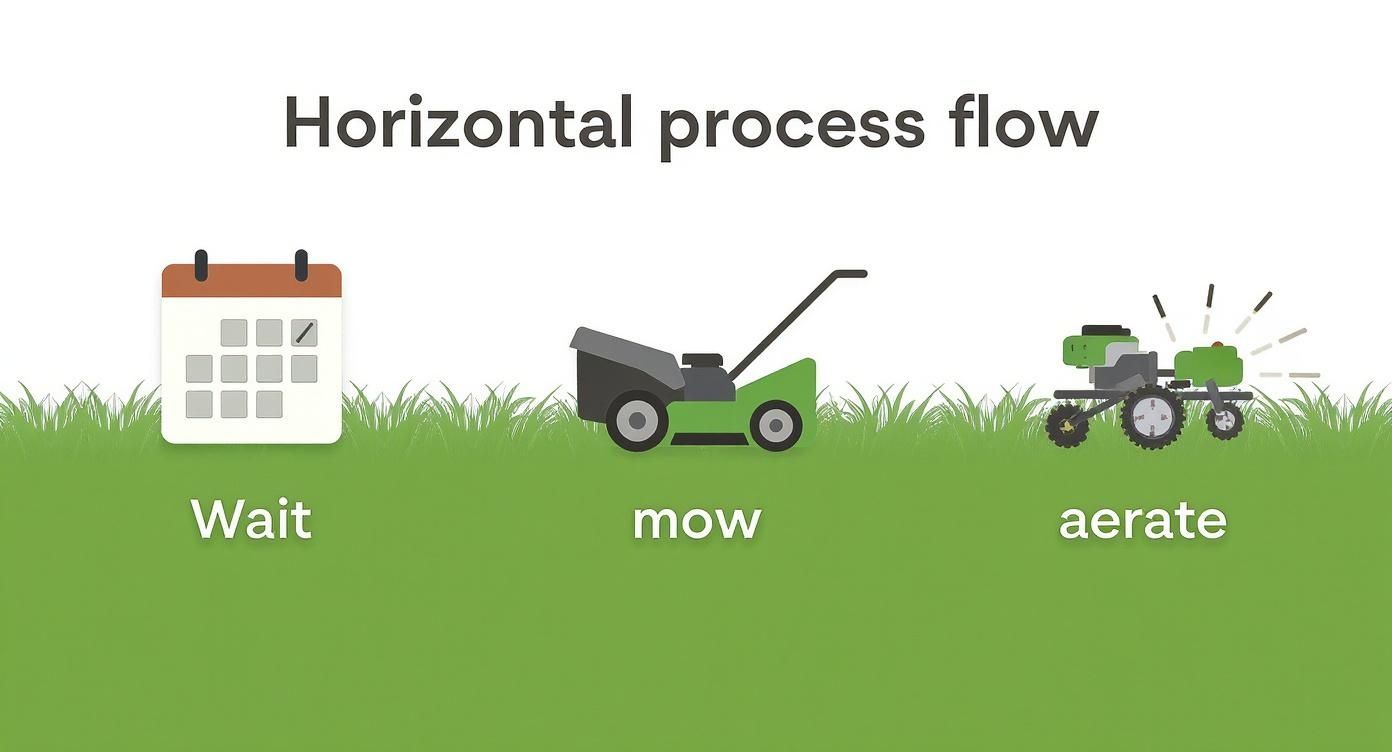
As you can see, aeration isn’t step one. It’s all about working with your lawn's natural rhythm as it wakes up for the season.
Working With a Rented Core Aerator
Renting an aerator is the go-to choice for most DIYers. The global lawn aerator rental market hit $134.4 million in 2023, and it’s no surprise that nearly 60% of those rentals happen right here in the U.S. during the spring.
Here's a critical tip: while spike aerators make up a huge 59.1% market share of rentals, they are basically useless on our heavy clay. You must rent a core aerator—the kind that pulls plugs of soil out—to see real results.
I won't lie, these machines are heavy and can be a beast to handle. Be ready for a workout.
The secret to a good aeration job is being thorough. One quick pass isn't going to cut it. For the best outcome, cover your entire lawn in one direction, then immediately make a second pass perpendicular to the first. Think of it like making a grid or a crisscross pattern. This ensures you’ve opened up the soil everywhere.
Don't be shy about it, either. It’s nearly impossible to over-aerate a lawn suffering from serious compaction. Pay extra attention to the paths everyone walks on—those are always the most packed-down spots.
The Cleanup: What to Do With All Those Plugs
When you’re finished, your lawn will look a little funny, dotted with thousands of little soil plugs. Your first instinct will probably be to grab a rake and clean them up. Don't do it!
Leave those plugs right where they are. They’re packed with beneficial microbes from your soil. Over the next week or two, they will break down and dissolve back into the lawn, recycling valuable nutrients right back where they belong.
With all those new holes providing a direct path to the roots, this is the absolute best time to fertilize and overseed. The holes create perfect seed-to-soil contact, which is exactly what new grass needs to germinate successfully. To really make your hard work pay off, check out how our professional aerate and overseed services are specifically designed to get the most out of North Georgia lawns.
Thinking of Hiring a Professional Aeration Service?
Let's be real for a moment. Does the idea of wrestling a heavy, clunky aerator from a rental shop across your entire lawn sound like your ideal Saturday? If you're like most homeowners in Cumming and Johns Creek, the answer is a hard no.
For many of us, hiring a professional to aerate a lawn in spring isn't just about convenience—it’s a smart move that saves your back and almost always gets you better results.
Honestly, DIY aeration is a serious workout, and that's before you even factor in the equipment. Professional services roll up with commercial-grade machines that are a world apart from what you can rent. These aerators are heavier and far more powerful, designed to pull deep, consistent plugs from our notoriously dense Georgia clay. That deeper pull means better relief for compacted soil and a bigger impact on your lawn's health.
What to Ask Before You Hire Anyone
Choosing the right local lawn care company is the key to getting this done right. Before you sign on the dotted line, you need to vet them properly. A few simple questions can tell you everything you need to know about whether you’re hiring a real expert or just someone with a truck.
Here’s what I always tell my neighbors in Milton and Alpharetta to ask:
- What kind of aerator are you using? For our soil here in North Georgia, the only right answer is a core aerator. If they even mention spike aeration, hang up the phone. It's a huge red flag they don't know what they're doing with clay soil.
- Are you insured? This one is non-negotiable. Any legitimate company will have liability insurance to protect your property. Don't even consider hiring someone who doesn't—it's not worth the risk.
- Can you bundle other services? That period right after aeration is a golden opportunity for overseeding and fertilizing. Ask if they can package these services together. It's not only more effective for your lawn but often saves you some money, too.
When you hire a local pro, you're not just paying for the labor; you're investing in their expertise. A good technician understands the unique challenges of Cumming area soil and can tailor a plan to what your lawn actually needs to look its best.
The Real Value is in the Expertise
At the end of the day, the biggest advantage of hiring a professional is the know-how they bring to your property. A seasoned lawn care expert can spot problems you might miss, like the first signs of fungus or a specific nutrient deficiency.
They know the perfect timing for our tricky Dahlonega climate, ensuring the work is done when your grass will bounce back the fastest and reap the most benefit.
So instead of spending your precious weekend on a back-breaking project, you can relax, knowing the job was done correctly and safely. All that's left for you to do is enjoy the payoff: a visibly healthier, greener lawn that’s truly ready to take on the Georgia summer heat.
Got Questions About Spring Aeration? We’ve Got Answers.
Deciding to aerate your lawn in the spring is a great first step, but it's natural to have a few questions before you get started. Here in North Georgia, we get a lot of the same queries from homeowners in Cumming, Milton, and beyond. Let's clear up some of the most common concerns we hear.
Can I Aerate After Putting Down Pre-Emergent?
This is probably the most frequent—and most critical—question we get. The short answer is a hard no. You should always aerate before you apply any pre-emergent weed control.
Think of it this way: your pre-emergent creates a protective barrier on the soil's surface. When you pull plugs out of the ground with an aerator, you're punching holes right through that barrier. This basically rolls out the welcome mat for crabgrass and other summer weeds. If you've already applied your pre-emergent, it's best to hold off on aerating until the fall.
How Often Should I Really Be Aerating?
For the kind of dense, heavy clay soil we have all over North Georgia, from Milton to Dahlonega, aerating once a year is the gold standard for Bermuda and Zoysia lawns. An annual spring aeration is usually just right.
Now, if your yard doubles as a soccer field for the kids or a racetrack for the dogs, that's a different story. Constant foot traffic compacts the soil much more quickly. In those high-traffic scenarios, your lawn might need a second aeration in the early summer just to keep it breathing. But for most of us here in the Cumming area, once a year in the spring is the perfect rhythm.
Here’s the key takeaway: What you do right after you aerate is just as important as the aeration itself. That moment is a golden opportunity to give your lawn exactly what it needs to thrive all season long.
What Should I Do Right After Aerating My Lawn?
Okay, so the hard part is done. Your lawn is covered in little soil plugs and is full of holes. Now what? Those holes are a direct channel to your lawn's root system, making it the perfect time for two things:
- Overseeding: If you have thin or patchy areas, this is the best time to spread new grass seed. You'll get incredible seed-to-soil contact, which dramatically increases the chances of successful germination.
- Fertilizing and Watering: Following up with a quality organic fertilizer ensures that all those valuable nutrients get delivered straight to the roots where they're needed most. Once you're done, give the lawn a good, deep watering to help it recover and jumpstart all that new growth.
And what about those soil plugs scattered across the yard? Just leave them alone. They’ll break down on their own in a couple of weeks, recycling nutrients and beneficial microbes back into the soil. It's a win-win.
At Barefoot Organics, we handle all the heavy lifting to make spring lawn care easy for our Cumming area neighbors. Our team uses top-of-the-line, commercial-grade aerators to guarantee your lawn gets the deep, effective aeration it needs to handle our local climate. Ready for a healthier, greener lawn? Contact us today for a free quote.